-
-
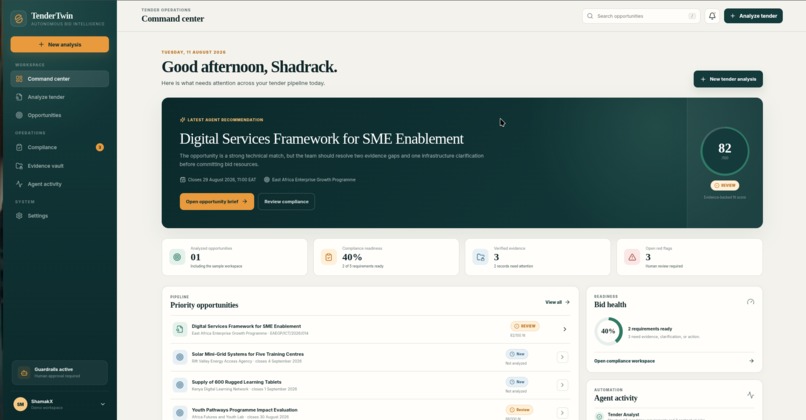
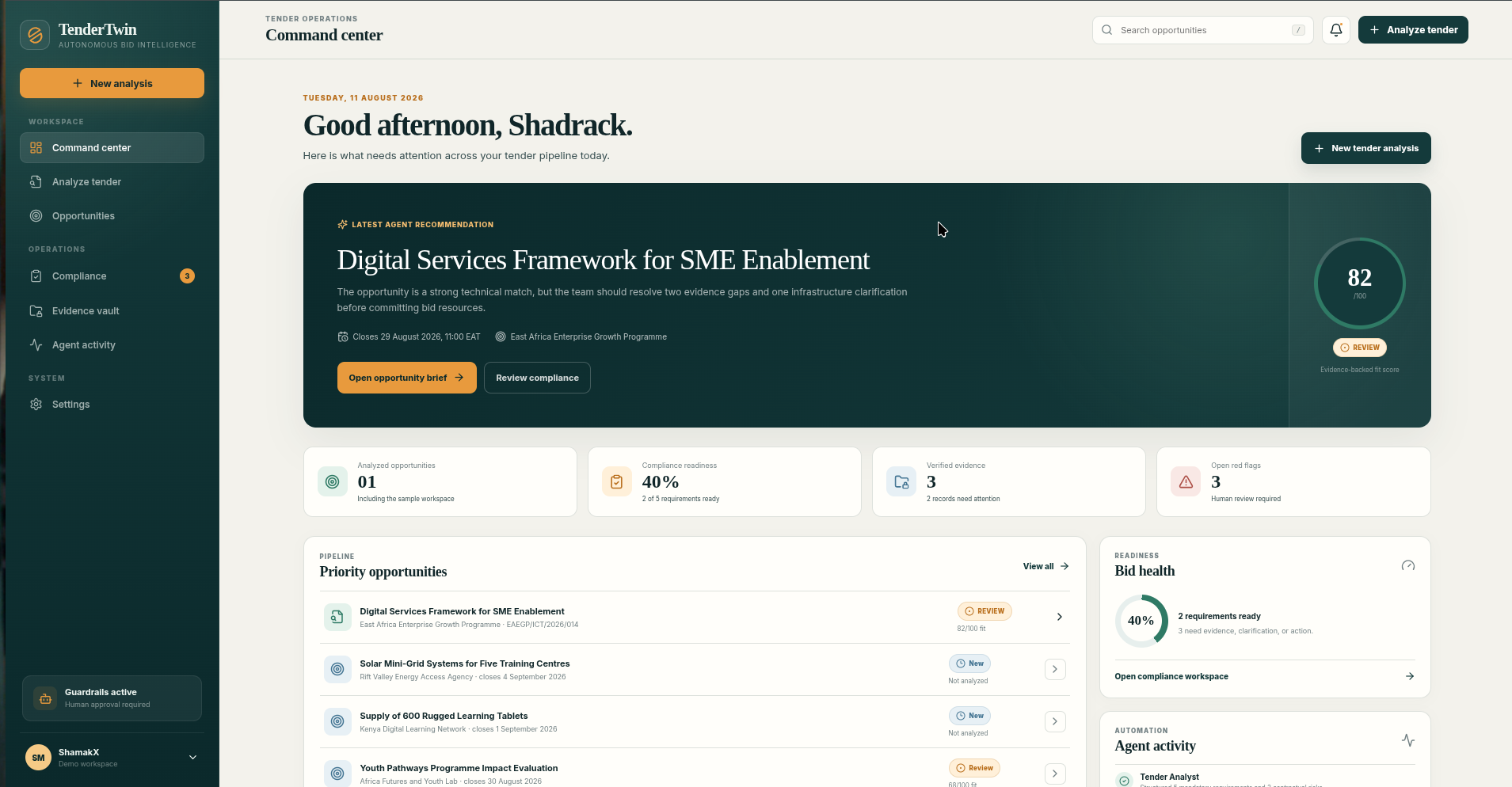
The command centre
-
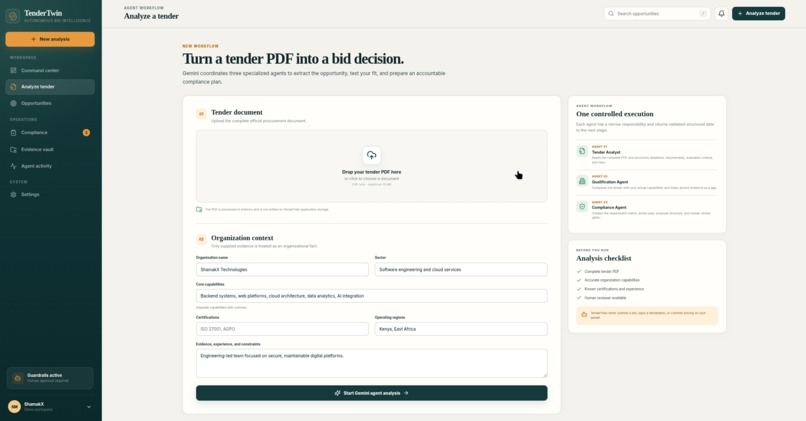
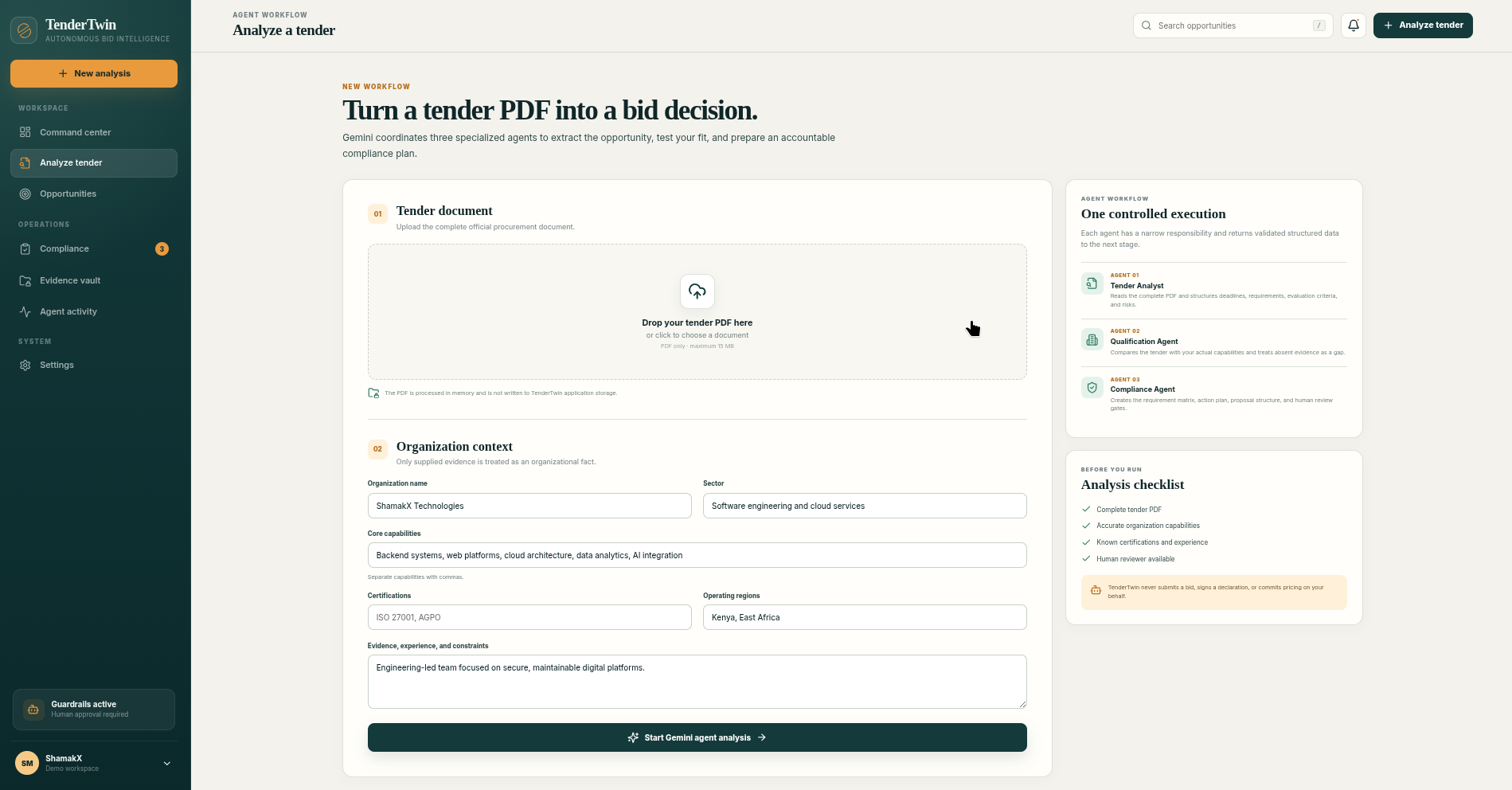
Analyse Tender section
-
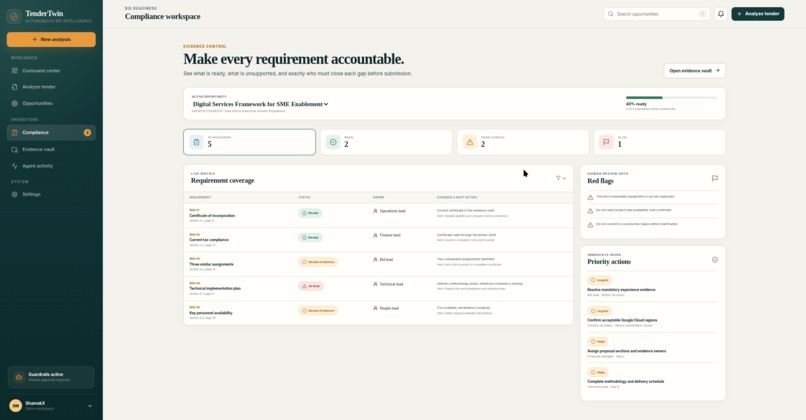
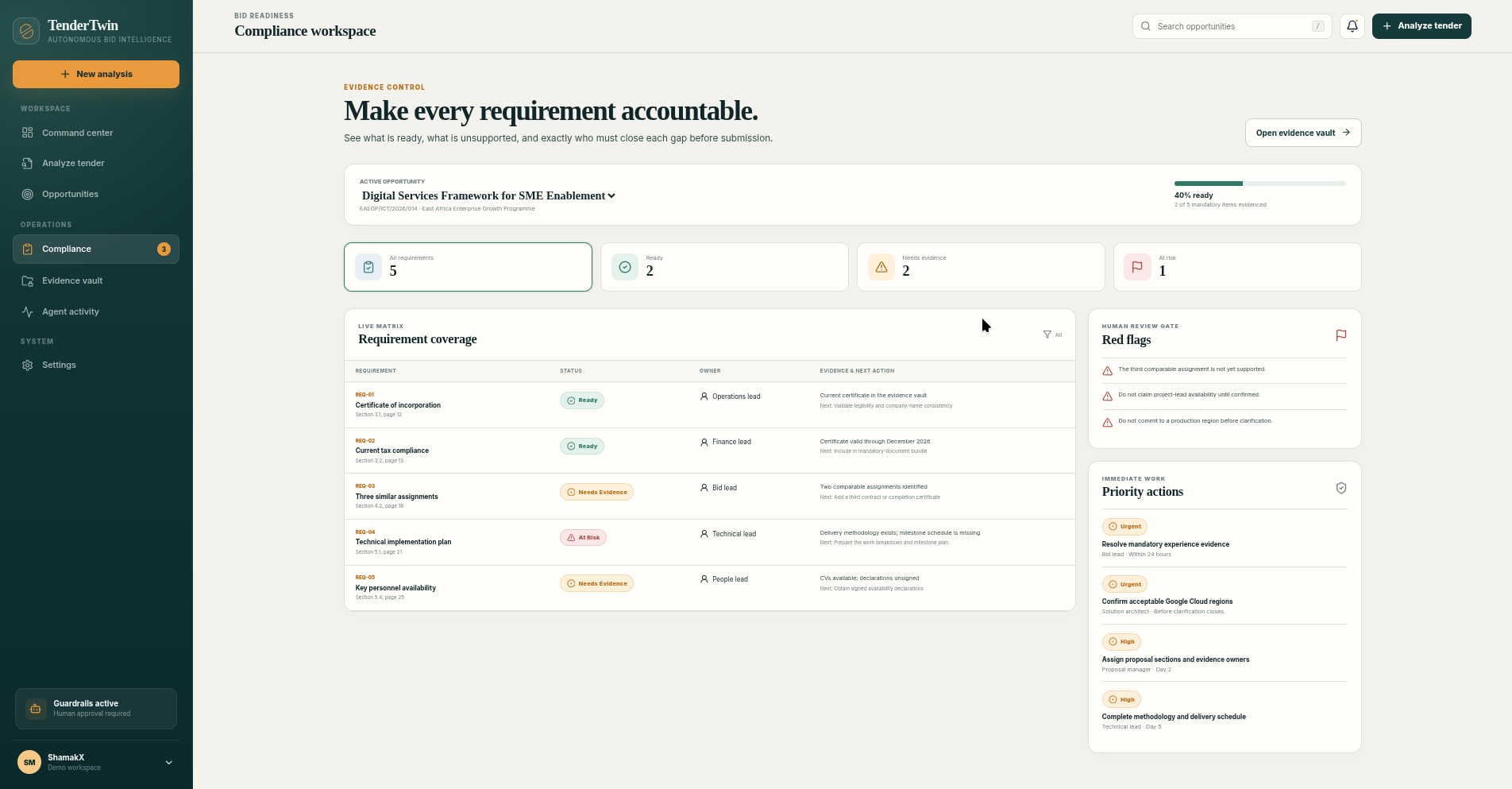
Compliance section
-
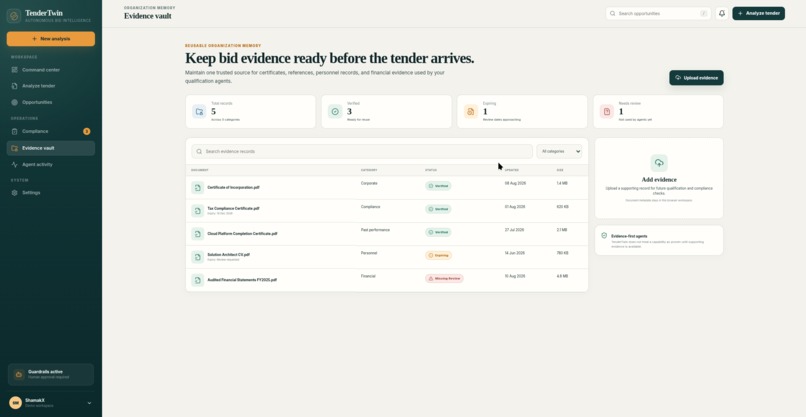
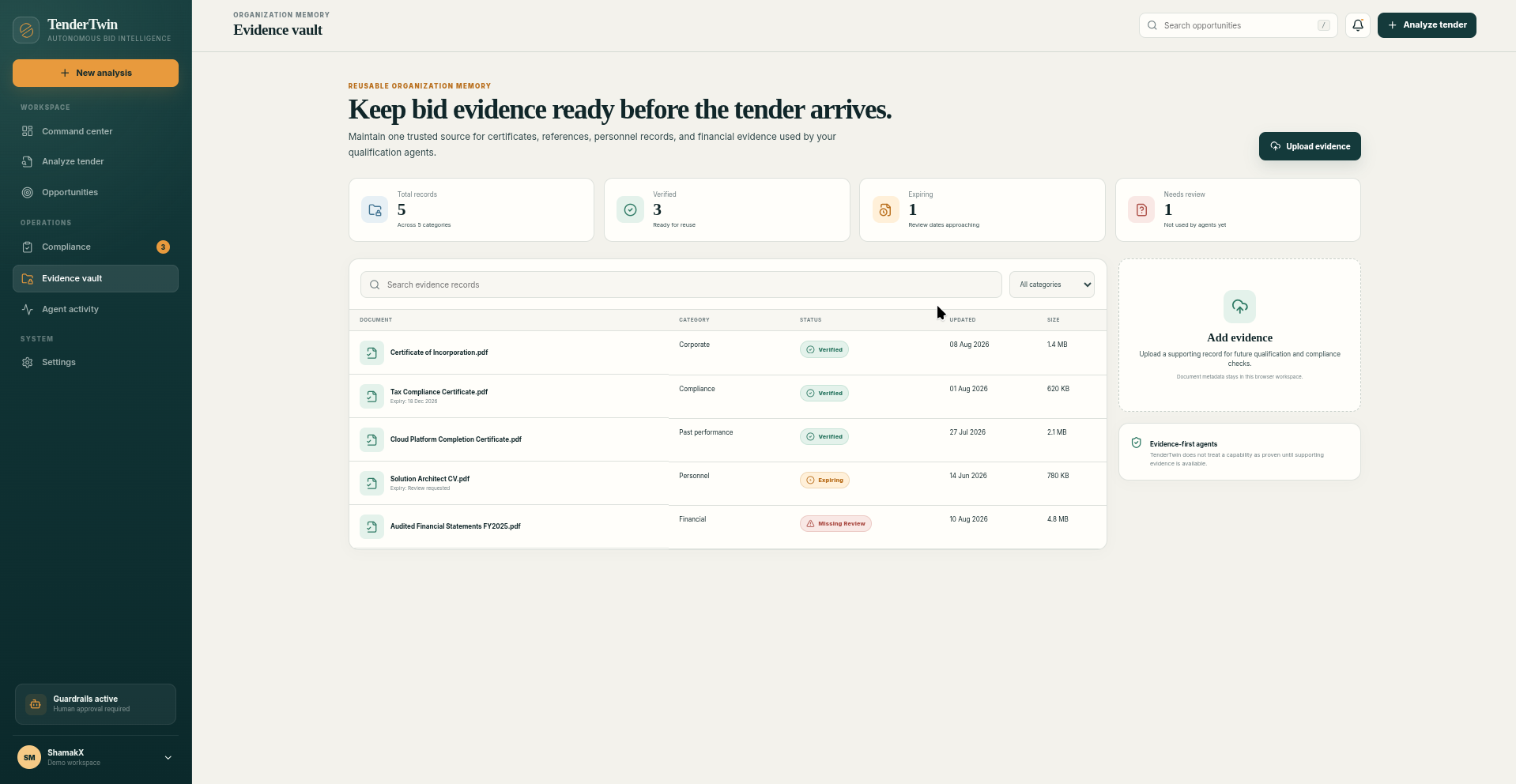
Evidence Vault section
-
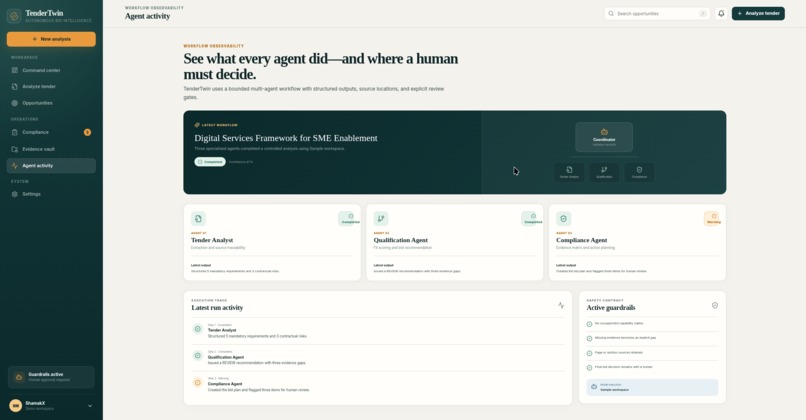
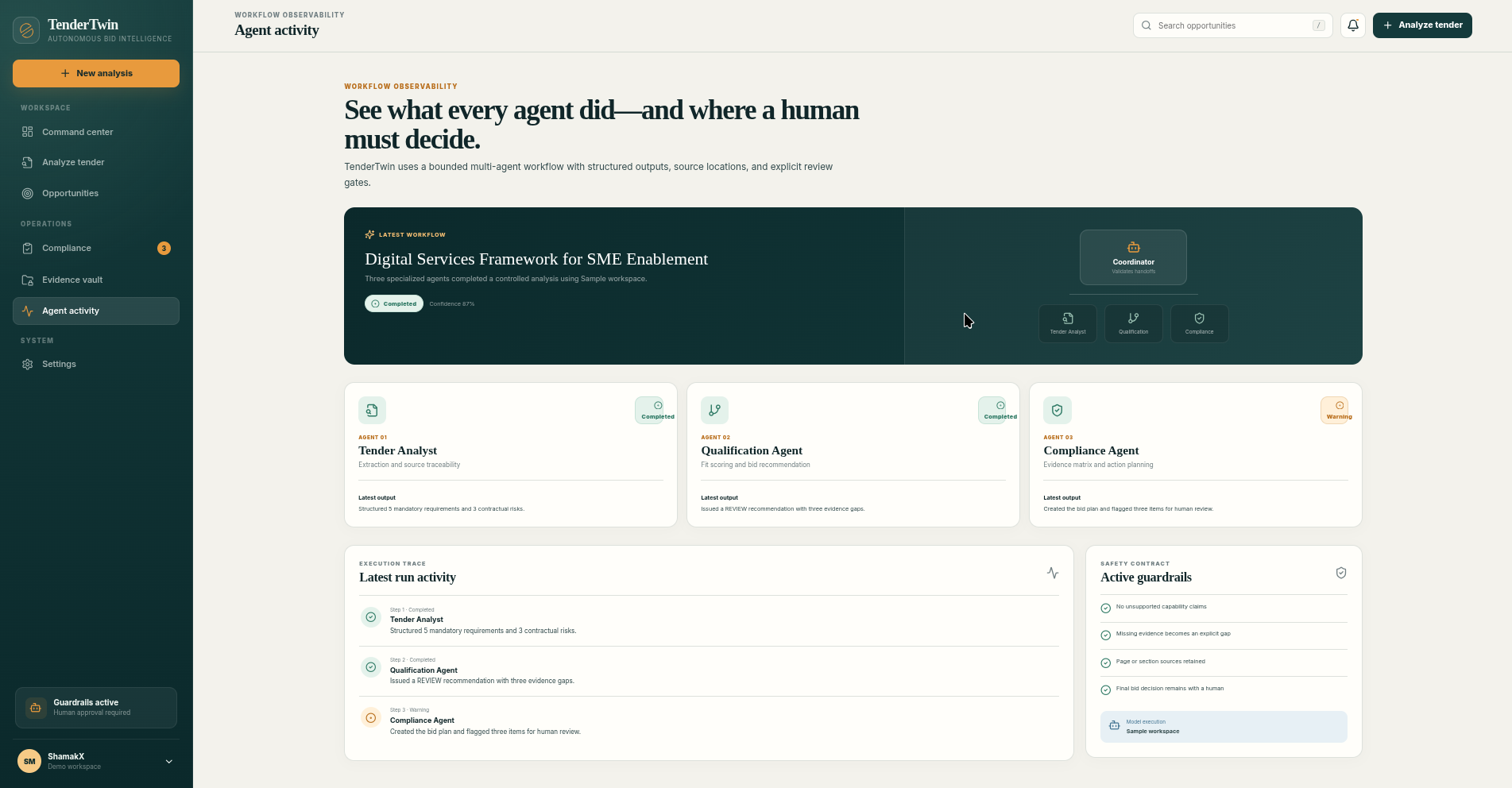
Agent Activity section
-
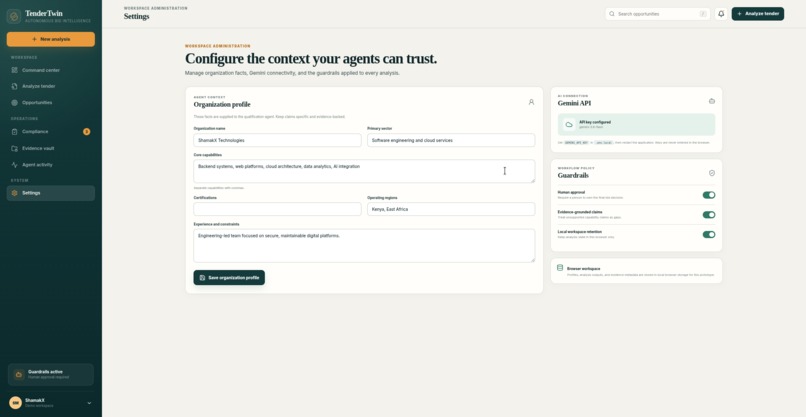
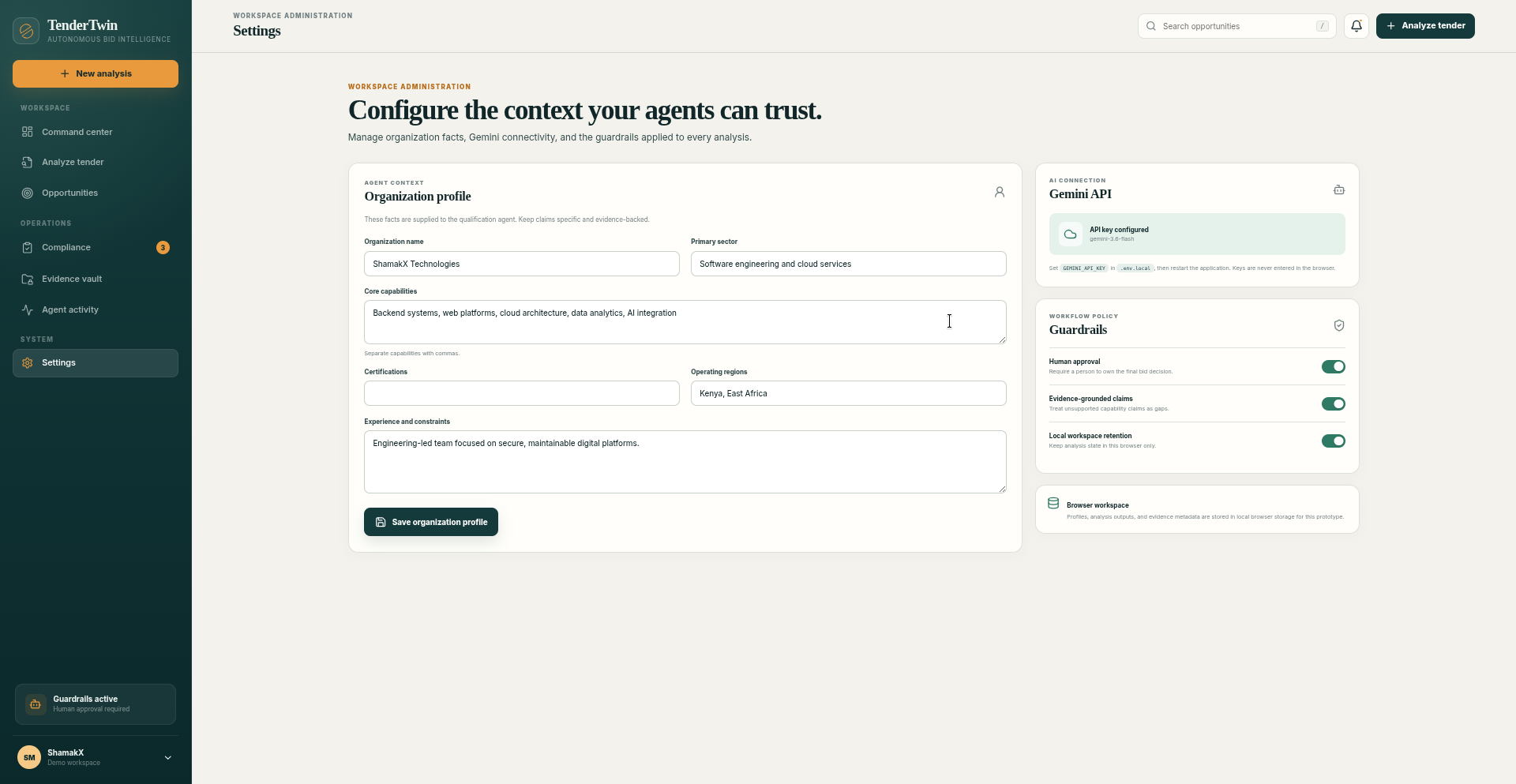
settings page
-
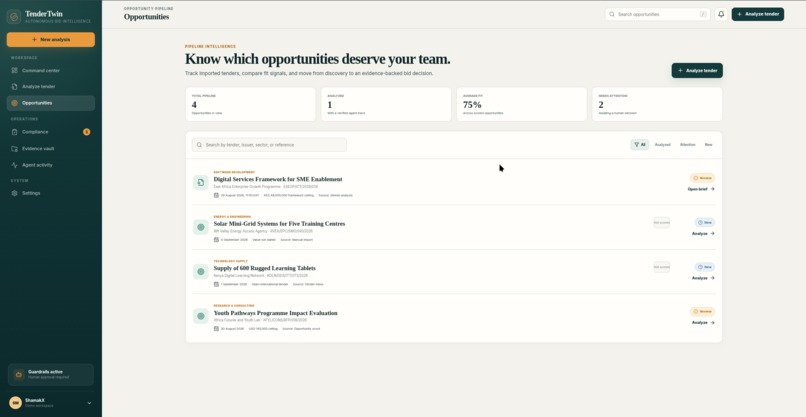
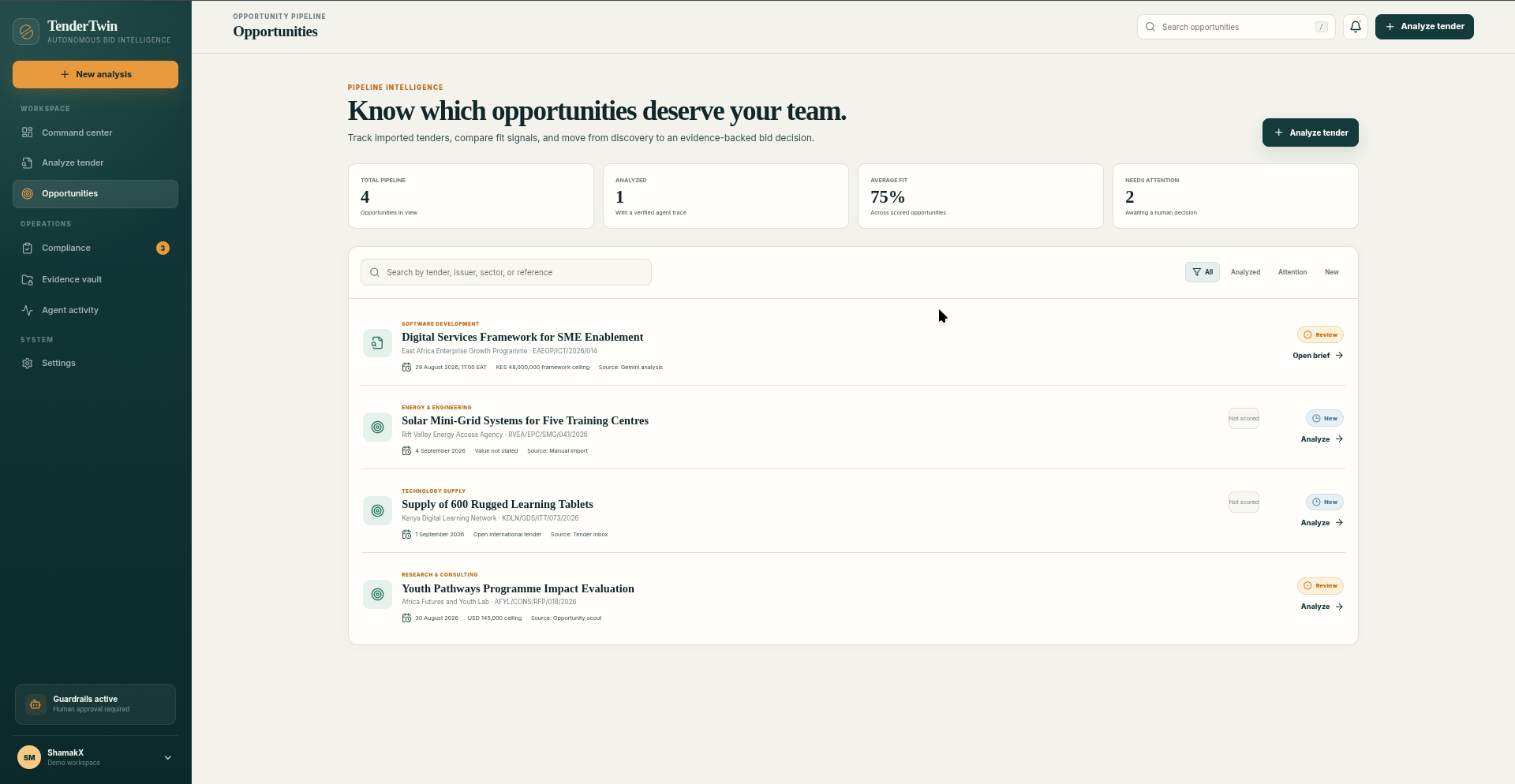
opportunities section
Inspiration
Across Kenya and other emerging markets, thousands of small and medium-sized businesses are technically capable of delivering government, nonprofit, and corporate contracts. However, many never submit a bid or lose bids they could have won because tendering is fragmented, time-consuming, and unforgiving.
A business must search multiple procurement portals, interpret lengthy documents, determine eligibility, track deadlines, collect certificates, coordinate contributors, prepare technical and financial responses, and verify compliance. Missing one mandatory attachment or misinterpreting one clause can invalidate an otherwise competitive proposal.
Large organizations solve this problem with dedicated procurement and bid-management teams. Smaller organizations often rely on one person working through PDFs, spreadsheets, emails, and shared folders.
TenderTwin was inspired by a simple question:
What if every organization could have an intelligent digital twin of an experienced tender-management team?
TenderTwin turns that idea into an autonomous, multi-agent procurement workspace that discovers opportunities, evaluates them, coordinates bid preparation, and keeps a human decision-maker in control of sensitive actions.
What it does
TenderTwin manages the tender lifecycle from opportunity discovery to a submission-ready bid workspace.
A user creates an organization profile containing its services, experience, preferred sectors, operating regions, certifications, financial capacity, and supporting documents. TenderTwin then uses that institutional context to:
Discover relevant opportunities Monitors configured procurement sources and identifies new opportunities matching the organization’s capabilities. Parse tender documents Extracts deadlines, eligibility requirements, deliverables, evaluation criteria, mandatory forms, submission instructions, and contractual risks from PDFs and other uploaded documents. Generate a bid/no-bid recommendation Evaluates whether the organization is eligible, competitive, operationally capable, and able to complete the response before the deadline. Create a compliance matrix Converts every requirement into a structured checklist with its source page, completion status, assigned owner, supporting evidence, and deadline. Build the bid workspace Creates a response plan, proposal outline, task schedule, evidence requests, clarification questions, and document checklist. Draft grounded proposal sections Produces first drafts using only approved organizational information and retrieved evidence. Every important claim is linked to its supporting source. Review the bid before submission Detects missing attachments, unanswered requirements, unsupported claims, conflicting information, formatting problems, and deadline risks.
TenderTwin does not autonomously submit legally binding bids. Final approval and submission remain explicit human actions.
The agentic workflow
TenderTwin operates as a coordinated team of specialized agents:
Opportunity Scout monitors procurement sources and identifies potential opportunities. Tender Analyst extracts and structures requirements from tender documents. Qualification Agent compares requirements against the organization profile. Compliance Agent creates and continuously updates the compliance matrix. Evidence Agent retrieves approved certificates, case studies, team profiles, and past-performance records. Proposal Agent prepares grounded proposal sections and response plans. Risk Reviewer checks for omissions, contradictions, unsupported claims, and contractual risks. Coordinator Agent manages the workflow, state transitions, approvals, retries, and agent hand-offs.
The agents share structured state rather than passing unverified free-form text between one another. Every high-impact action is recorded in an audit trail, and human approval gates are enforced before consequential steps.
Opportunity scoring
TenderTwin uses a transparent scoring model instead of returning an unexplained recommendation:
[ S = 0.30E + 0.25F + 0.20C + 0.15D + 0.10R ]
Where:
(E) represents eligibility compliance; (F) represents technical and sector fit; (C) represents organizational capacity; (D) represents deadline feasibility; and (R) represents the adjusted risk score.
The score is accompanied by supporting evidence, disqualifying conditions, missing information, and an explanation of the recommendation. Users can therefore challenge the result instead of blindly trusting it.
How we built it
TenderTwin uses Google Agent Development Kit to define the specialized agents, their tools, responsibilities, and orchestration rules. Gemini 3.5 Flash performs document understanding, structured extraction, planning, classification, and grounded proposal generation. The backend is implemented with Python and FastAPI. Each tender moves through a persistent state machine so long-running workflows can pause for user input, recover after failures, and resume without repeating completed actions.
Tender documents and organizational evidence are stored in Google Cloud Storage. Document AI extracts text and layout information from uploaded files, while the extraction agents transform the results into validated structured objects. Firestore stores organization profiles, tender metadata, compliance requirements, workflow state, agent outputs, approvals, and audit events. Asynchronous work is distributed through Pub/Sub and Cloud Tasks, allowing document processing and review jobs to continue in the background.
The application is containerized with Docker and deployed on Cloud Run. Credentials are protected using Secret Manager, and access to organization workspaces is enforced through authenticated, role-aware endpoints. The frontend is built using Next.js, React, TypeScript, and Tailwind CSS. It provides:
an opportunity dashboard; document upload and analysis; qualification reports; a traceable compliance matrix; task and deadline tracking; evidence management; proposal drafting; agent activity and audit views; and approval checkpoints.
The system is designed so individual agents can fail, retry, or request clarification without corrupting the complete tender workflow.
Challenges we ran into
Extracting reliable requirements
Tender documents vary significantly in structure and quality. Some contain tables, scanned pages, appendices, inconsistent numbering, or requirements distributed across multiple sections. We addressed this with multimodal document processing, schema-constrained extraction, page-level citations, and validation passes that check whether every extracted requirement can be traced to the source document.
Preventing unsupported proposal claims
A fluent proposal is dangerous if it invents qualifications or past experience. TenderTwin separates general drafting context from approved organizational evidence. Claims involving experience, personnel, certifications, finances, or completed work must be supported by an approved source.
Coordinating long-running agents
Tender preparation cannot be completed in one chat session. Some workflows last days or weeks and depend on documents or approvals that are not immediately available. We therefore modelled tender preparation as a persistent workflow with resumable tasks, idempotent operations, explicit state transitions, retry controls, and human approval gates.
Balancing autonomy with accountability
Full autonomy is inappropriate for financial quotations, declarations, legal commitments, and final submissions. Our challenge was deciding which tasks the system could execute independently and which required approval. TenderTwin automates research, extraction, organization, drafting, reminders, and validation while keeping legally or financially consequential decisions under human control.
Handling sensitive business information
Tender responses may contain financial statements, identification records, staff information, certificates, and proprietary business data. We designed workspace isolation, restricted tool permissions, encrypted cloud storage, secret management, and audit logging into the architecture from the beginning.
What we learned
We learned that a useful agent is defined by the workflow it completes—not by the length or sophistication of its conversation. Reliable agentic systems require more than good prompts. They require structured state, deterministic validation, narrowly scoped tools, failure recovery, observability, provenance, and carefully placed human checkpoints.
We also learned that retrieval and memory serve different purposes. Retrieval locates evidence relevant to the current tender, while persistent memory preserves organizational preferences, previous decisions, reusable answers, and corrections across future opportunities. Most importantly, procurement automation requires explainability. A bid/no-bid recommendation only becomes useful when users can inspect the requirements, evidence, assumptions, risks, and calculations behind it.
TenderTwin is not simply a tender search engine, PDF summarizer, or proposal-writing chatbot. It is an autonomous operational system that:
watches for opportunities; determines what needs to happen next; coordinates specialized agents; maintains state across long-running workflows; retrieves verifiable organizational evidence; tracks every compliance requirement; requests human input only when necessary; and produces an auditable, submission-ready bid workspace.
TenderTwin gives smaller organizations the operational capacity of a dedicated bid-management team without removing human accountability.
What's next for TenderTwin
The next phase will expand TenderTwin with:
integrations with procurement portals and organization email accounts; collaborative task assignment and notifications; reusable tender-response knowledge; multilingual document analysis; pricing and financial-schedule validation; organization-specific learning from approved corrections; calendar and deadline integrations; enterprise identity and permission controls; and analytics showing win rates, disqualification causes, and opportunity trends.
Our long-term vision is to make procurement participation more accessible, transparent, and competitive especially for capable organizations that are currently excluded by administrative complexity.
