-
-
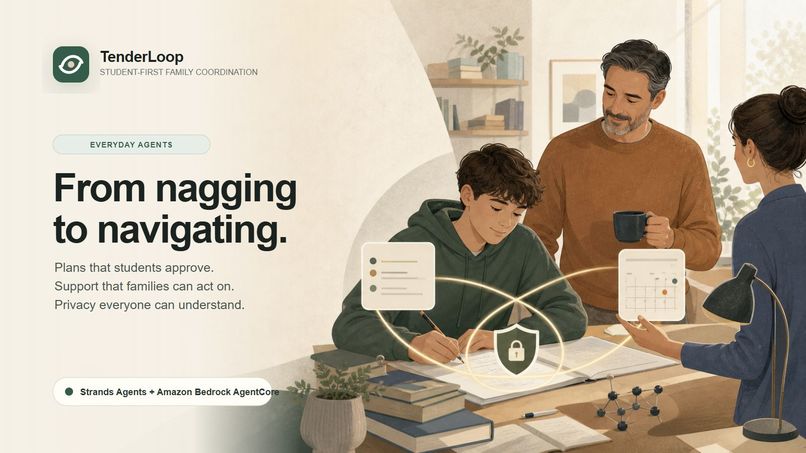
TenderLoop turns homework friction into private, consent-mediated family coordination.
-
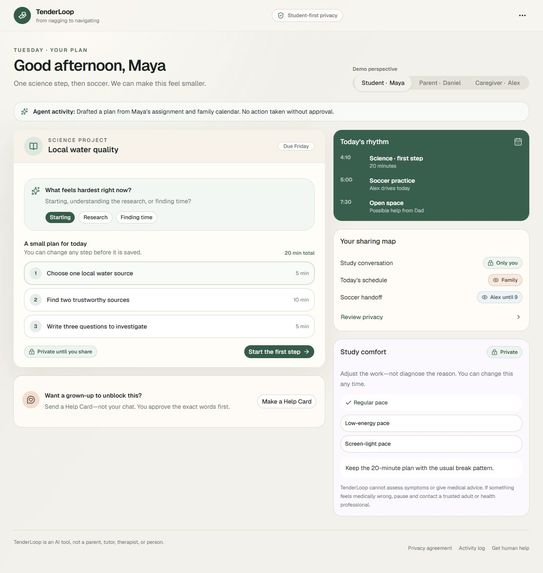
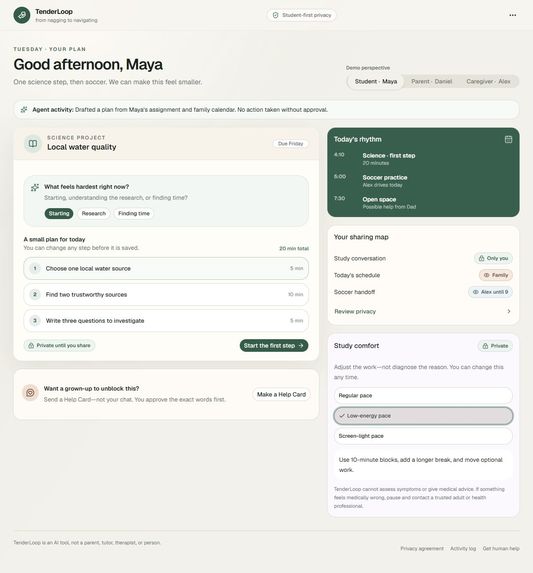
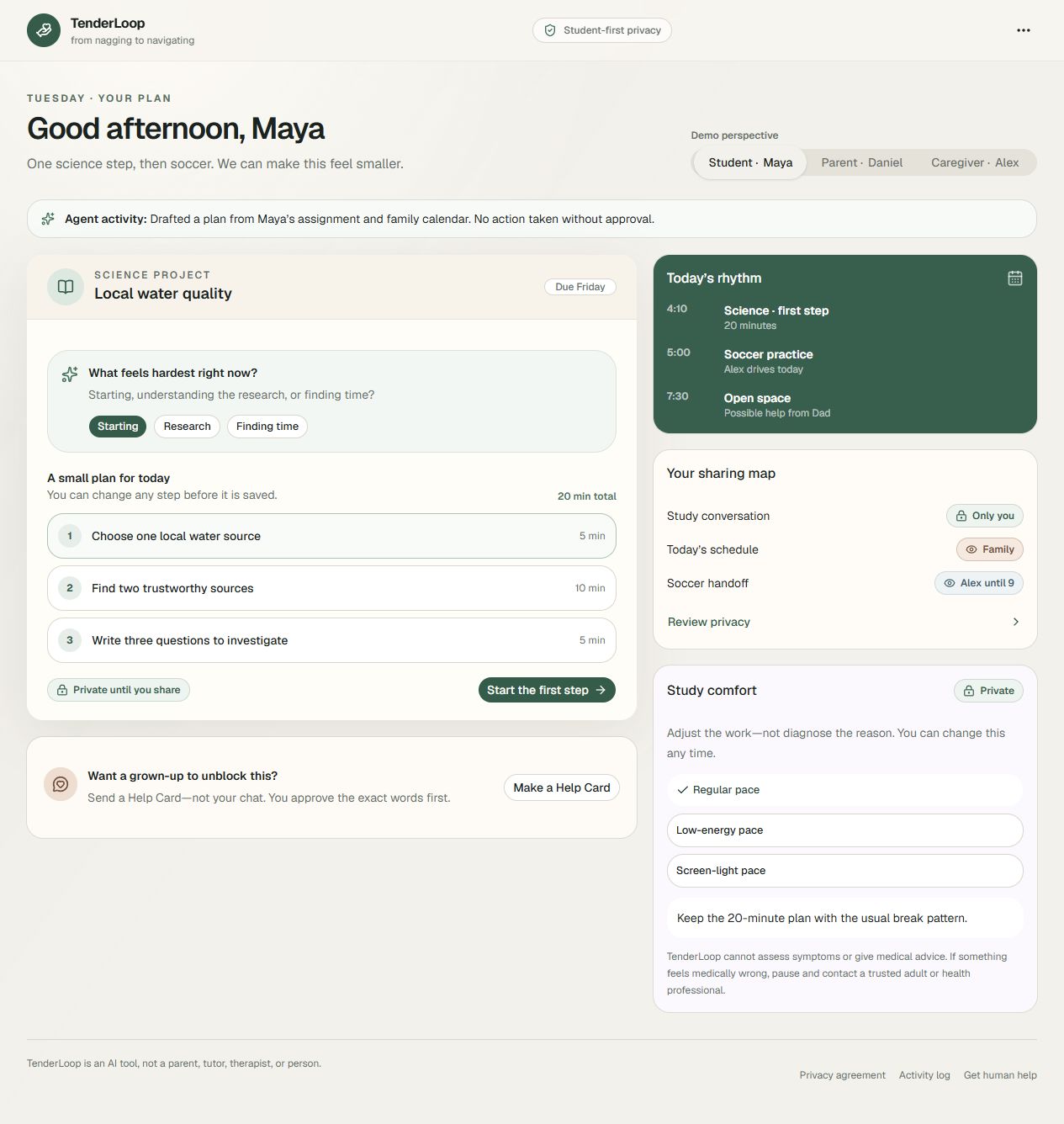
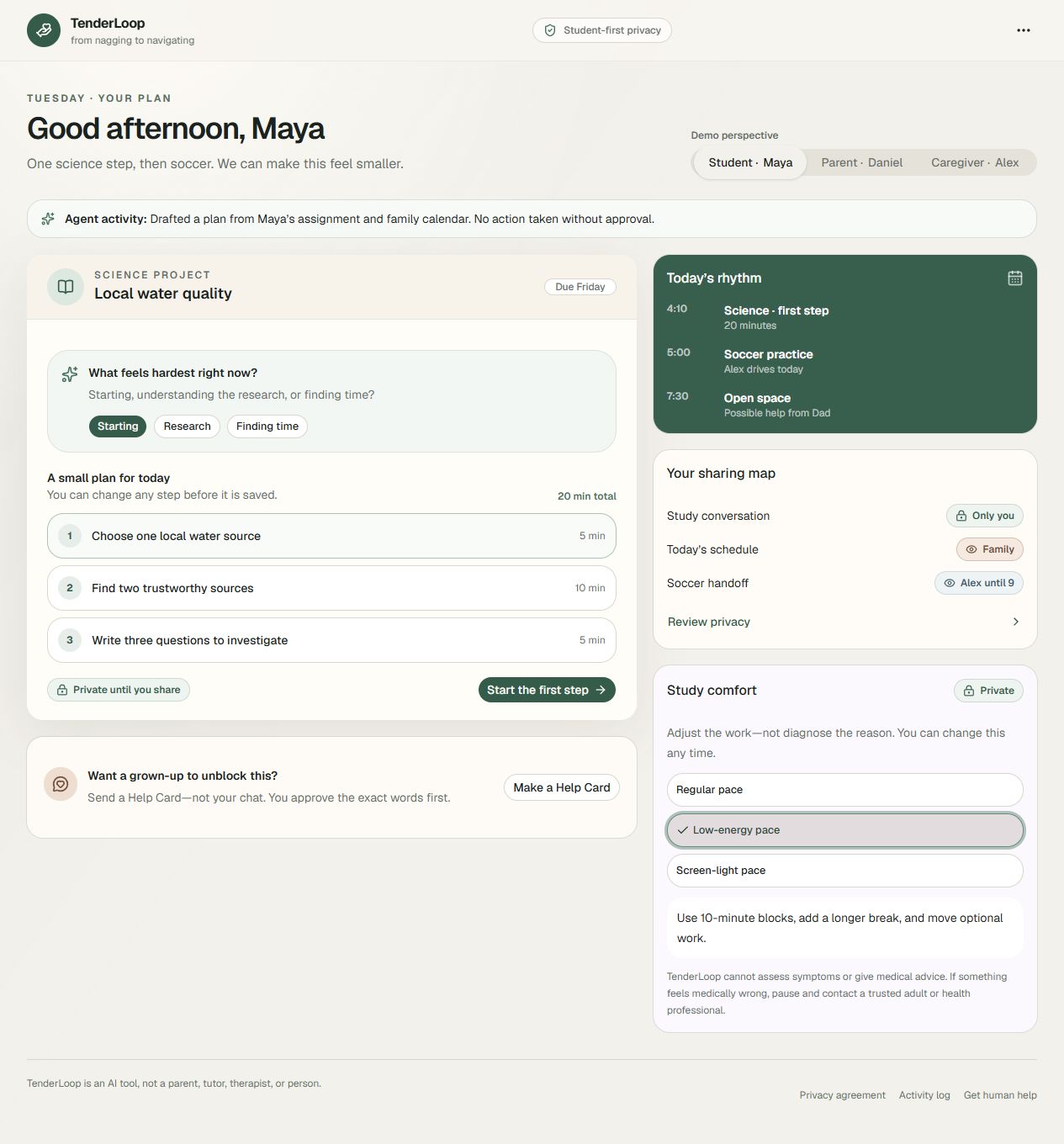
Maya breaks a science assignment into a small plan while her study conversation stays private.
-
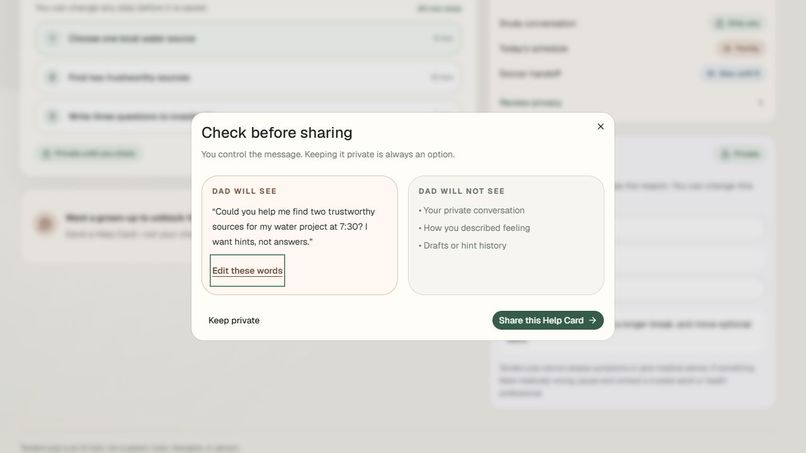
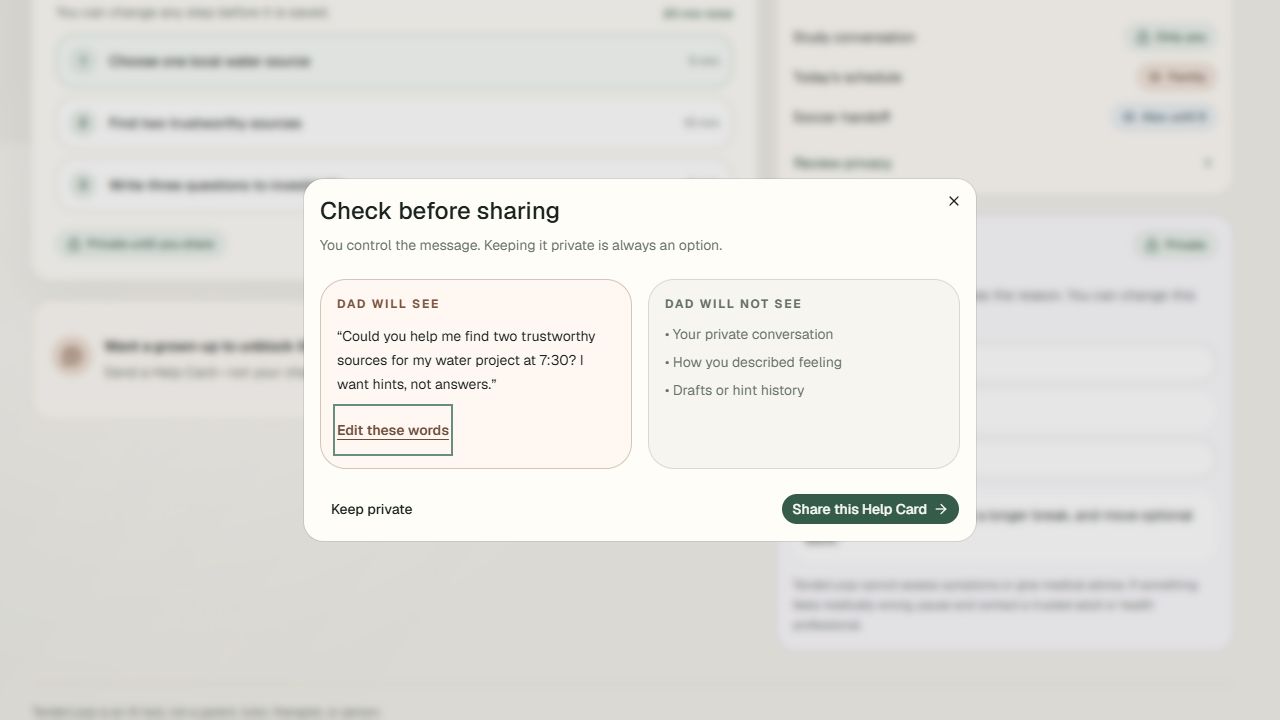
A child-readable preview shows exactly what Dad will—and will not—see before sharing.
-
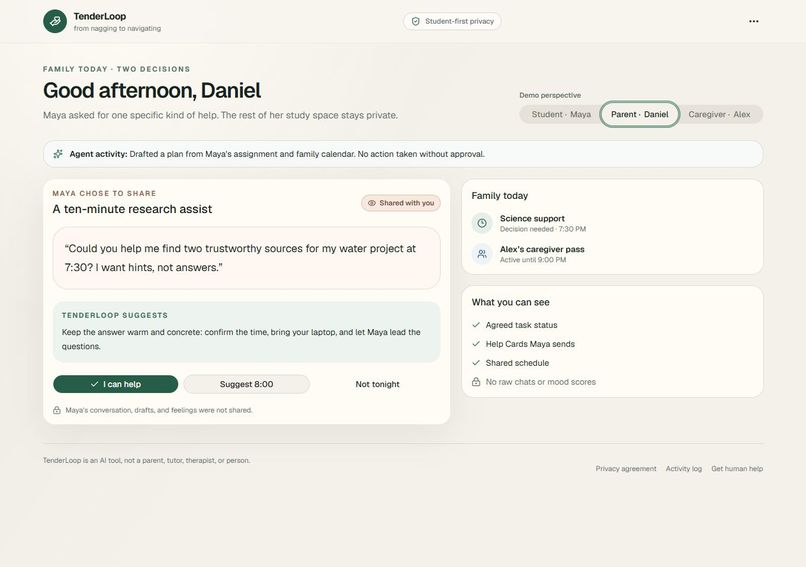
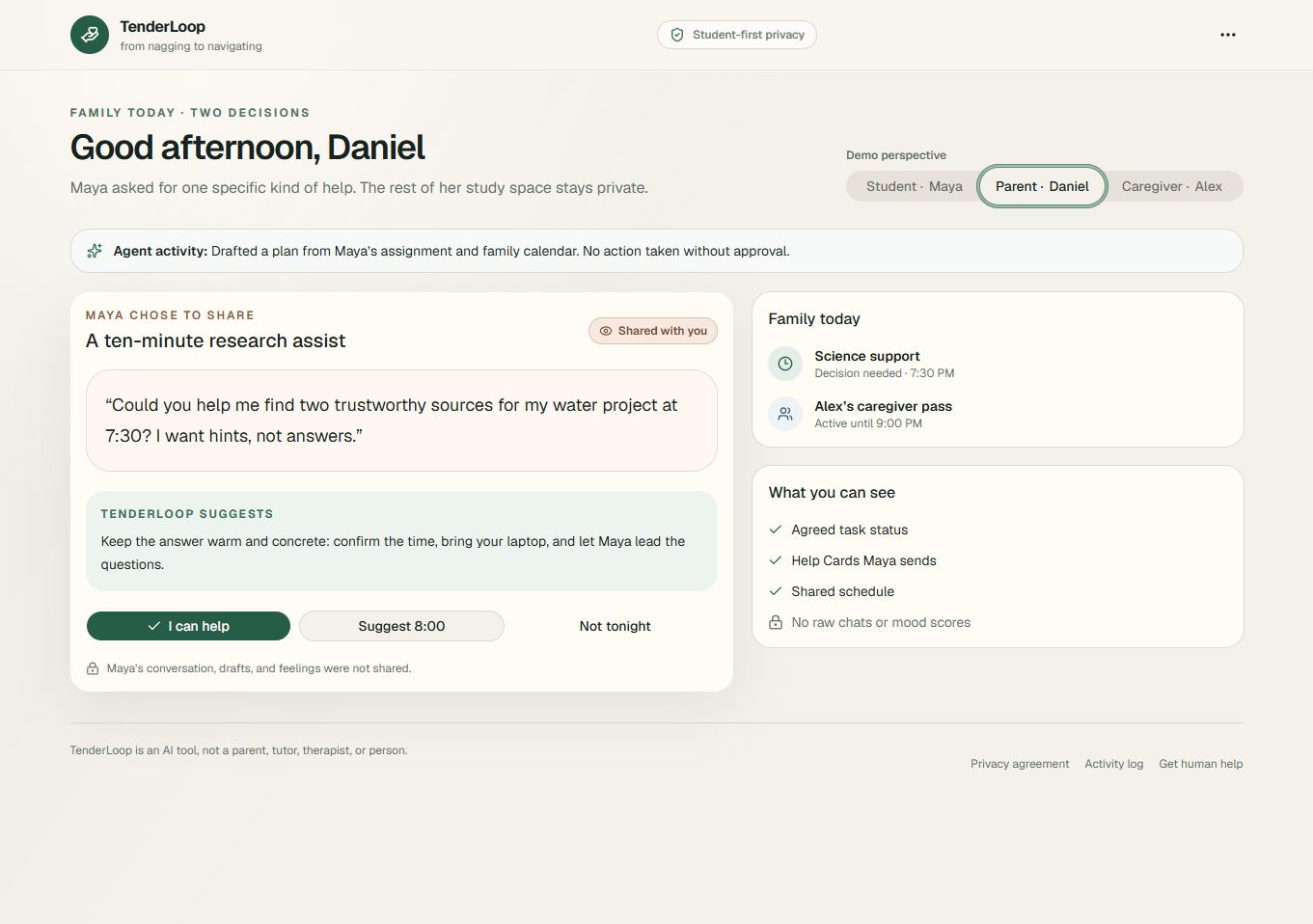
Daniel receives one concrete Help Card, without Maya’s transcript, mood score, or private preferences.
-
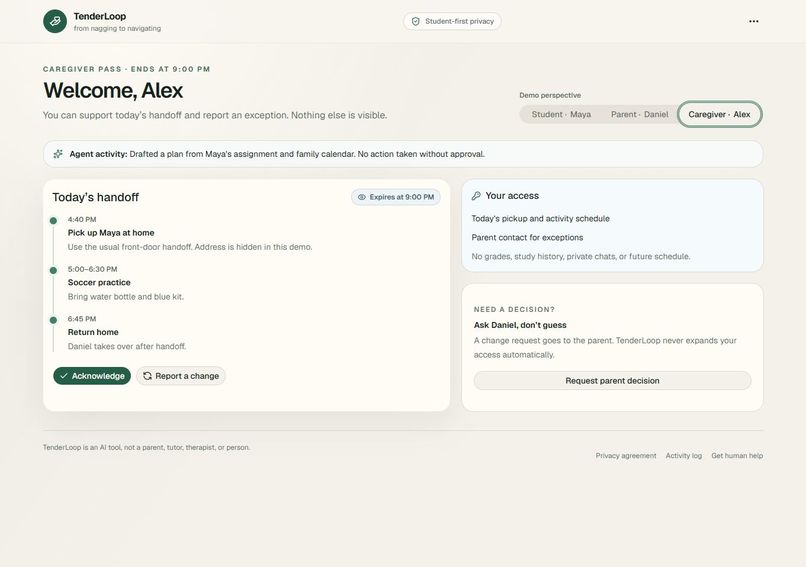
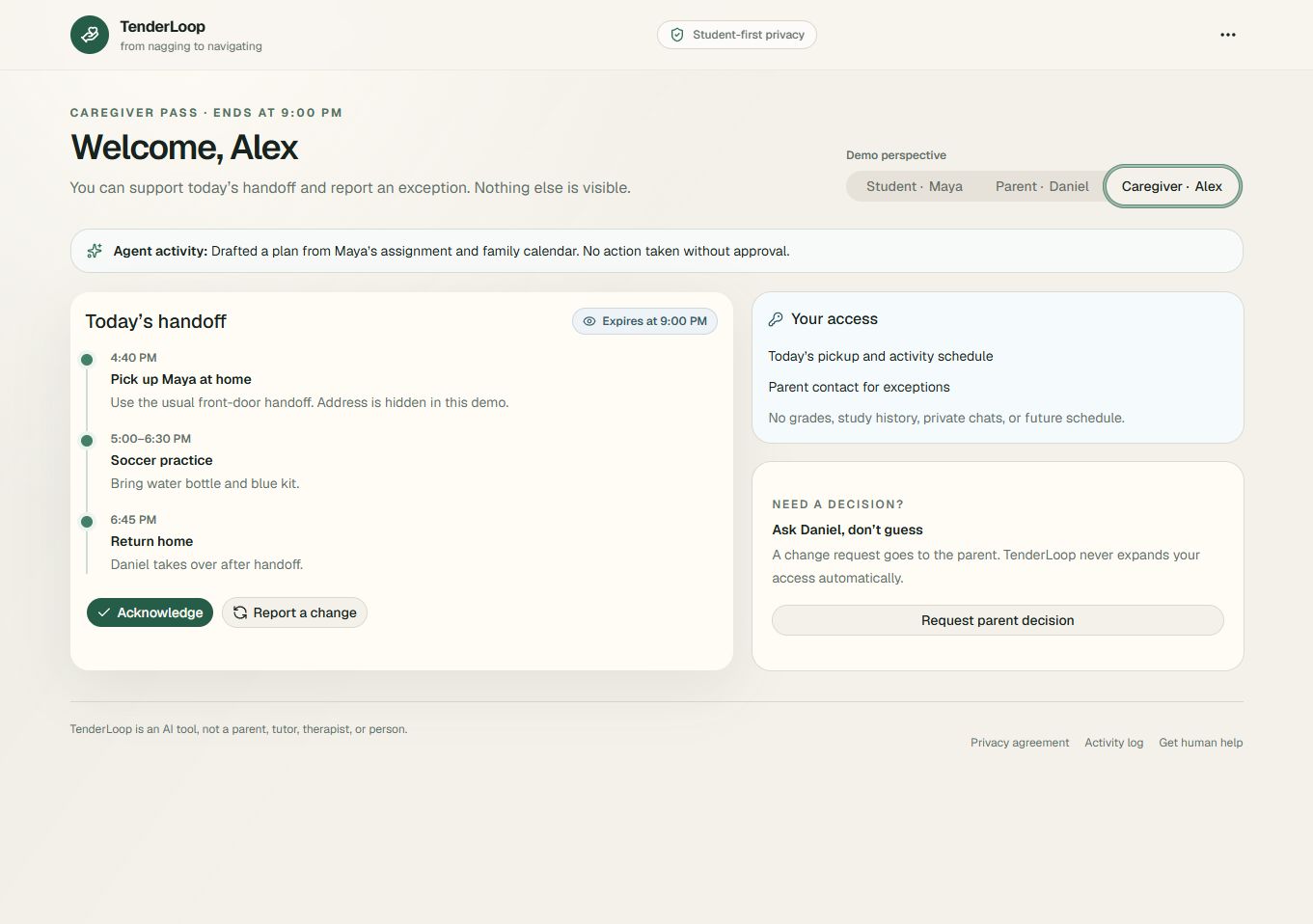
Alex gets logistics-only access for today’s handoff, with automatic expiry at 9 PM.
-
Private comfort settings adapt pacing and screen load without diagnosis or wellbeing surveillance.
-
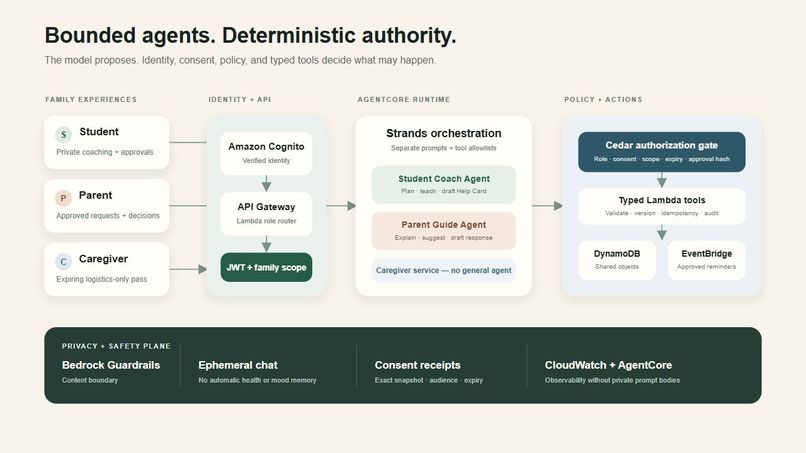
Strands and Nova Lite call one bounded planning tool; validation and explicit approval keep output review-only.
Inspiration
Homework conflict is often treated as a tutoring problem, but the harder problem is coordination. A student may not know how to begin. A parent may see a deadline but not know what kind of help would actually be useful. A babysitter or trusted relative may need tonight’s logistics without needing access to grades, health details, or private conversations.
Most family-learning products choose between a generic homework chatbot and a parent surveillance dashboard. TenderLoop explores a third path: private student support connected to explicit, consent-mediated family coordination.
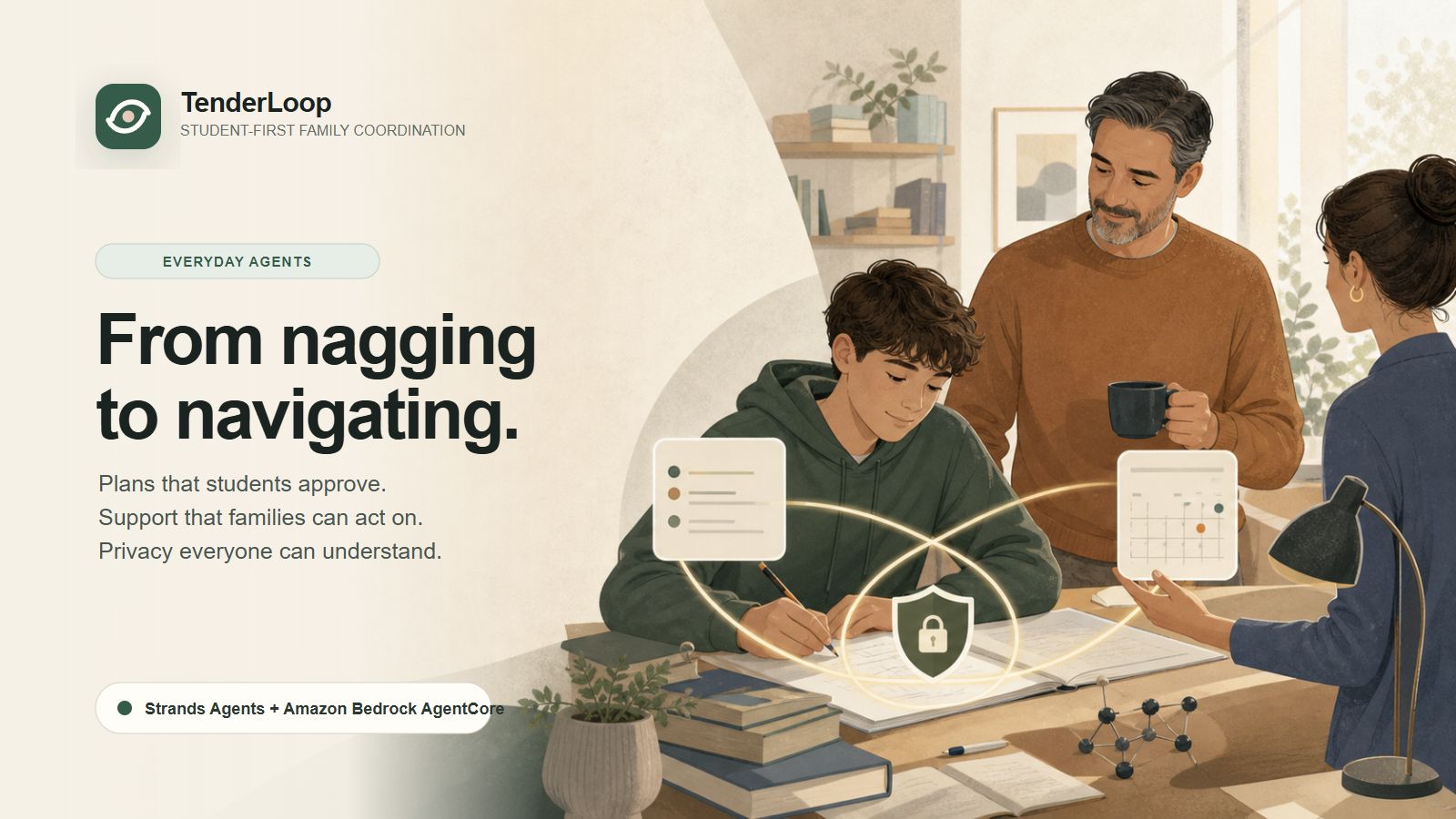
TenderLoop does not replace a parent or watch a child. It helps a student make a plan, ask for help, and lets a caring adult show up in the way the student actually needs.
What it does
TenderLoop is a student-first family coordination agent for learners aged 13–16.
In the demonstration, Maya has a Friday science project and soccer practice. TenderLoop:
- asks whether starting, understanding, or finding time feels hardest;
- turns the assignment into a small, editable study plan;
- keeps the study conversation private by default;
- uses Socratic hints rather than producing submit-ready graded work;
- adapts the plan when Maya selects a private low-energy or screen-light study preference;
- lets Maya preview and approve an exact Help Card for her father;
- gives her father a concrete decision without showing raw chat or mood scores; and
- gives a temporary caregiver a narrow, expiring Caregiver Pass for today’s logistics only.
Every shared object answers six questions: who can see it, what they see, why it is needed, how long access lasts, who approved it, and how it can be withdrawn.
How we built it
The repository contains a working Next.js 16 and React 19 interactive vertical slice, a shadcn/Radix component system, synthetic family and school data, a documented consent model, and a production-oriented AWS architecture contract.
The Student Coach is implemented behind a server-only API route with the official TypeScript Strands Agents SDK. It uses a validated build_study_plan tool, structured output, a three-turn execution limit, and a student-safety system prompt. When AgentCore is unavailable or a response fails validation, the UI identifies its deterministic fallback as Safe preview rather than pretending that an LLM ran.
The bounded Strands Student Coach is now deployed on Amazon Bedrock AgentCore Runtime in Mumbai and uses Amazon Nova Lite through the APAC Bedrock inference profile. Vercel invokes the runtime with short-lived credentials from a production-only OIDC role; no long-lived AWS access key is stored in the hosting environment. A verified end-to-end production request reported engine: agentcore, called build_study_plan, returned three schema-valid steps, and displayed Strands · AgentCore in the live interface. The safety contract passed all five tests.
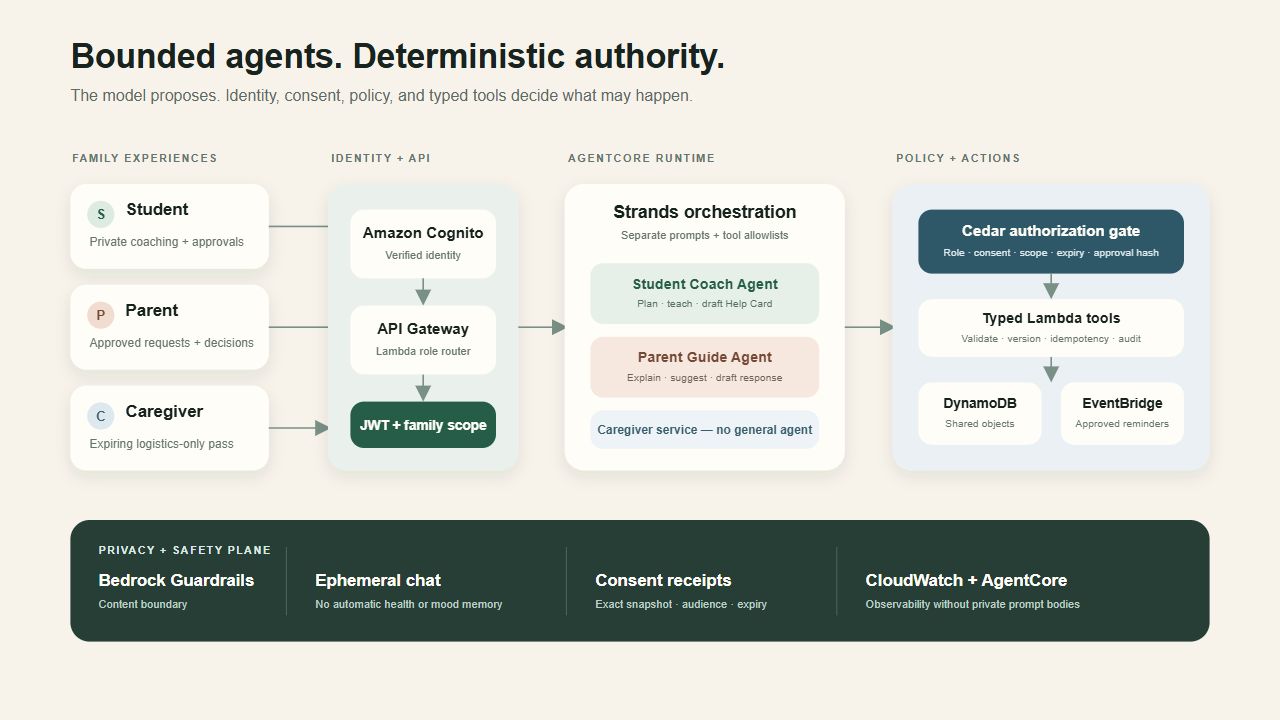
The language model is never the authority: it may draft a plan or Help Card, while deterministic policy and a human approval artifact decide whether a consequential action can execute. The interactive frontend, live AgentCore path, bounded Strands agent, and local consent-mediated Help Card handoff are shipped. Cognito identity, Cedar authorization, DynamoDB persistence, EventBridge scheduling, and Bedrock Guardrails remain documented production milestones and are not claimed as shipped features.
Read the deployment write-up: Shipping TenderLoop on AgentCore with Keyless Vercel OIDC.
Challenges we ran into
The central challenge was not prompt engineering; it was defining the boundary between helpful context and surveillance. We separated legal authority from day-to-day caregiving, operational permissions from data visibility, private conversations from shared coordination objects, functional study accommodations from diagnoses, and an agent proposal from an authorized action.
We also avoided assuming one nuclear-family model. TenderLoop represents a configurable circle of care, multiple households, user-defined relationships, and expiring grants. It never mediates custody or assumes the registered parent is always the safest adult for an escalation.
Accomplishments that we're proud of
- A child-readable share preview states both what Dad will see and what Dad will not see.
- The parent experience contains no transcript, inferred mood, risk score, streak, or behavior ranking.
- The Caregiver Pass demonstrates useful temporary authority without general account access.
- Wellbeing is implemented as private functional accommodation—not diagnosis or medical advice.
- The interface makes agent activity, execution provenance, and approval boundaries visible instead of hiding them behind a chatbot.
- The production agent runs on AgentCore through keyless Vercel OIDC and falls back honestly when unavailable.
What we learned
Family software cannot reduce culture and relationships to a single template. A safer engine needs configurable roles, households, schedules, languages, communication preferences, accessibility needs, jurisdiction packs, and explicit provenance for each piece of context.
We also learned that multi-agent architecture is not automatically better. TenderLoop deliberately uses bounded language-model roles and a deterministic caregiver service. Cross-role communication occurs through stored, student-approved objects—not invisible agent-to-agent conversation.
What's next for TenderLoop
- Add durable DynamoDB consent artifacts and connect the verified Help Card flow to persistence.
- Enforce consent, role, scope, expiry, and approval through Cedar and Amazon Verified Permissions.
- Add Cognito-backed family identity and audited, idempotent coordination tools.
- Expand privacy, role-escalation, prompt-injection, academic-integrity, and safety red-team coverage.
- Complete specialist review before enabling any health or crisis-related production flow.
The goal is not more engagement. Success means less repeated prompting, faster time to start, more student-initiated requests for specific help, fewer unnecessary parent alerts, and zero unauthorized disclosure in testing.
Built With
- agentcore
- agents
- amazon
- bedrock
- next.js
- nova
- radix
- react
- shadcn
- strands
- tailwind
- typescript
- vercel


Log in or sign up for Devpost to join the conversation.