-
-
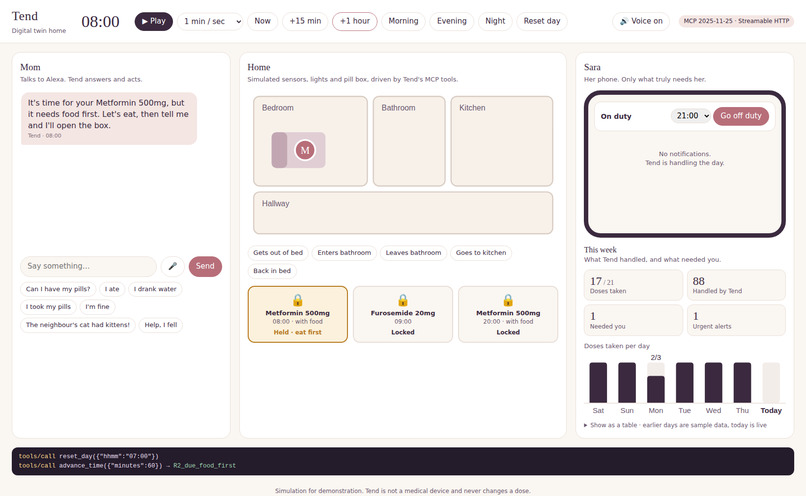
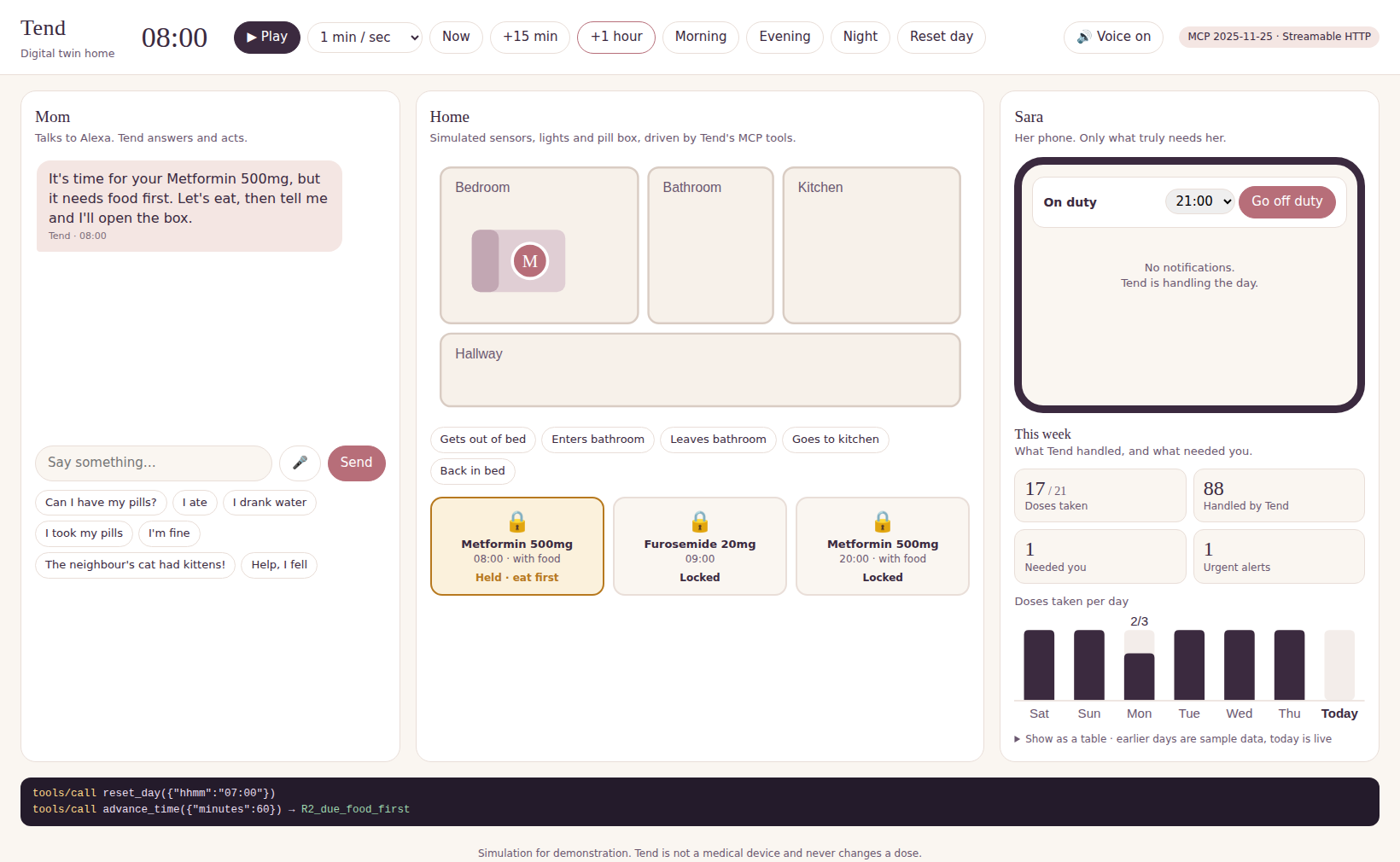
8:00. Mom's pills are due, but this dose needs food first, so Tend keeps the compartment locked.
-
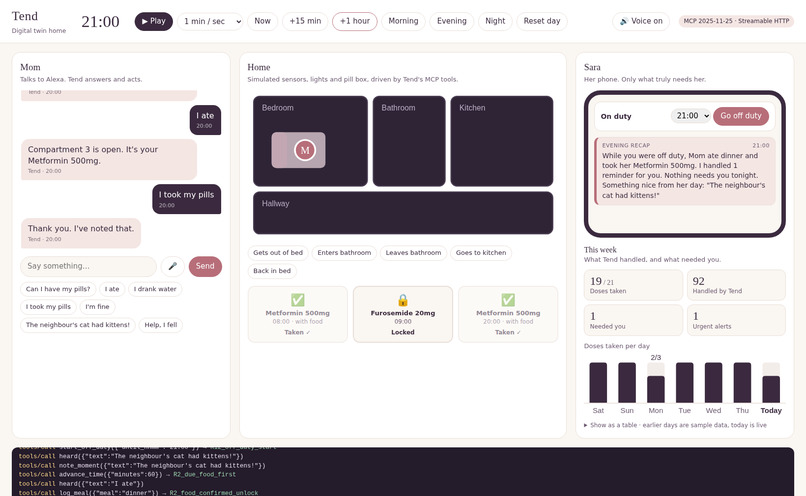
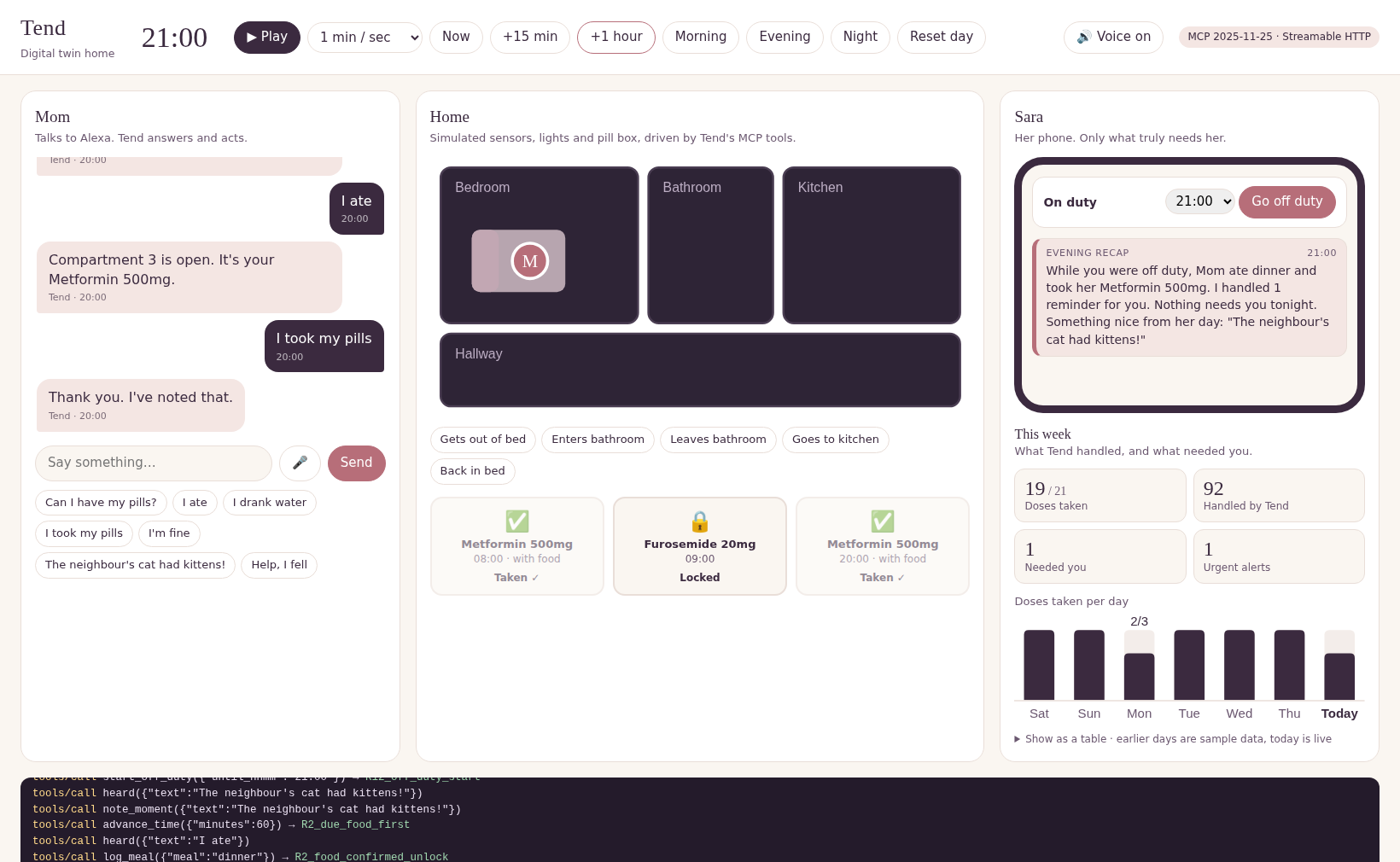
Sara was off duty all evening. Instead of a dozen alerts, she gets one recap, including a nice moment from Mom's day.
-
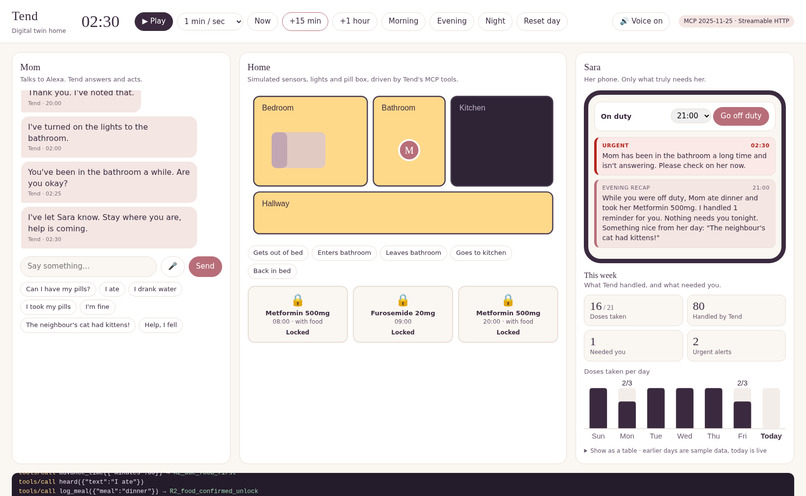
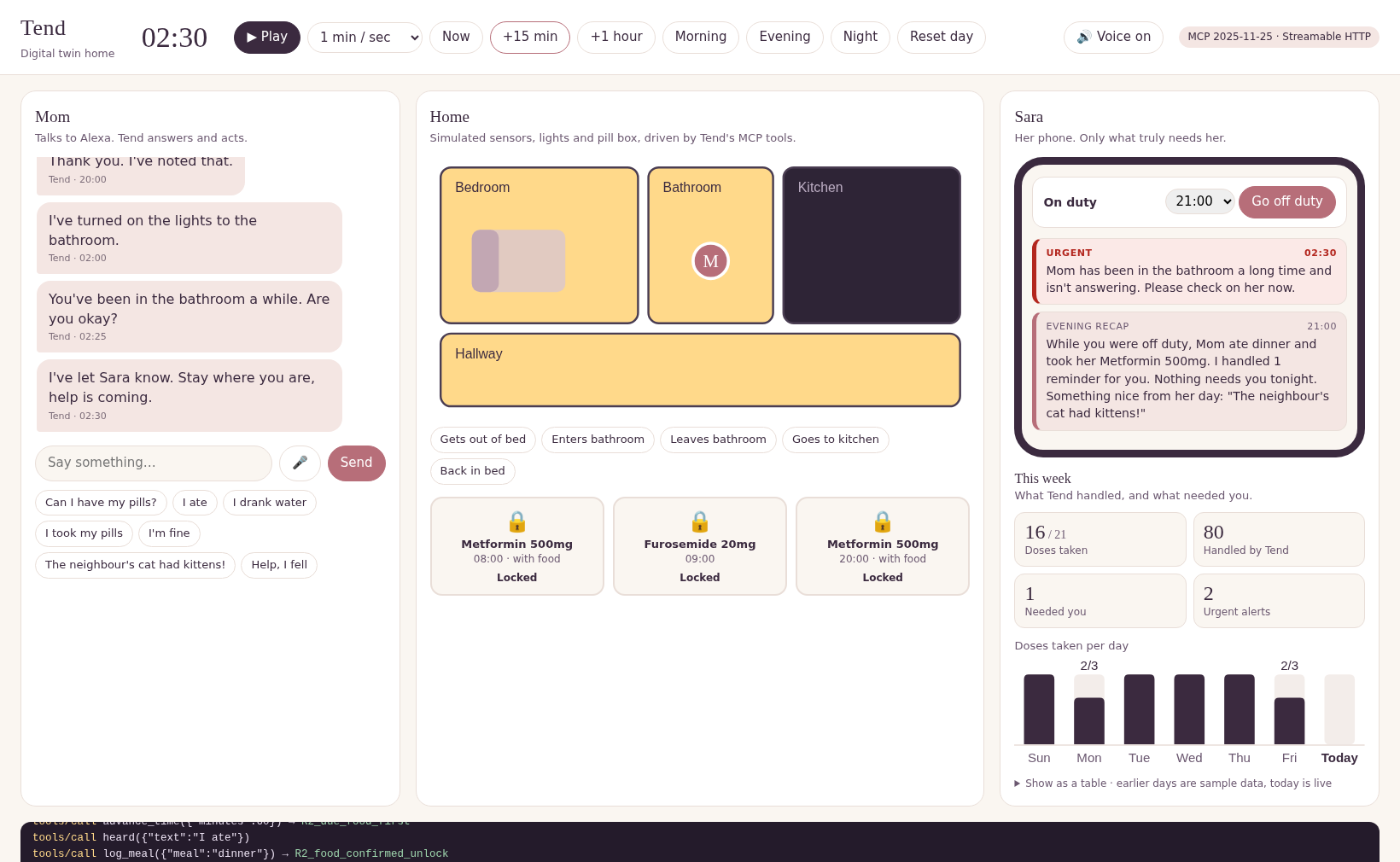
2:00. Mom gets up and Tend lights the way. A long bathroom visit with no reply sends an urgent alert, even off duty.
-
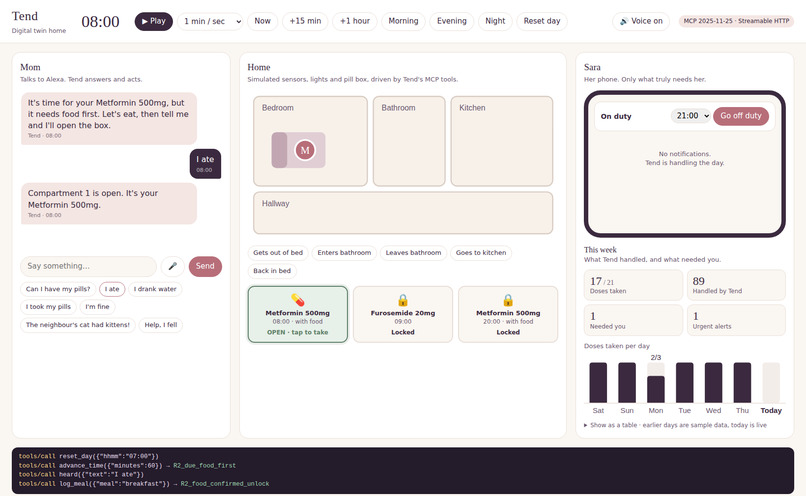
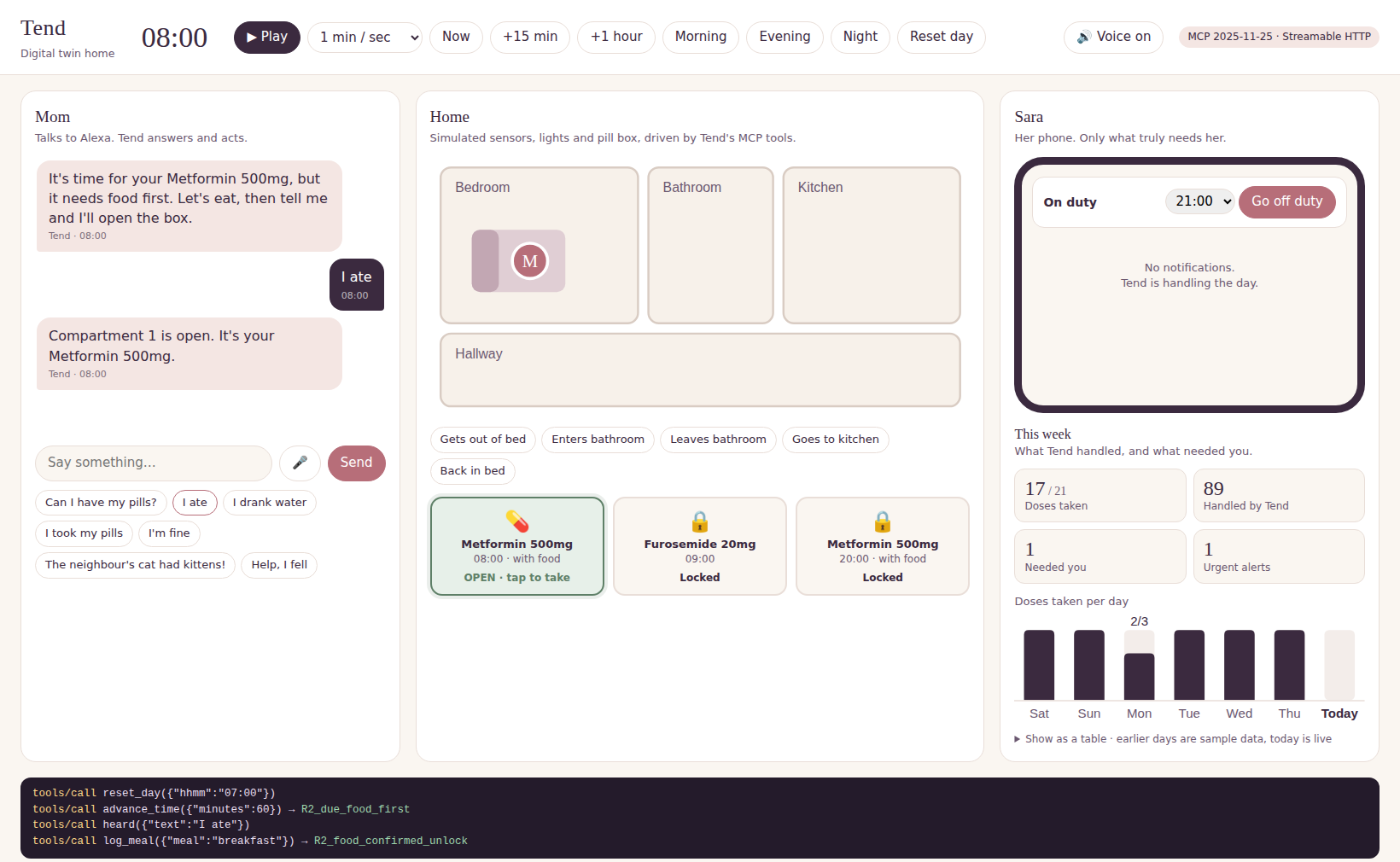
Mom says "I ate", and only the due compartment unlocks. Every action is a real MCP tool call, shown in the log below.
Inspiration
People who care for an aging parent while working come home to a second shift: pills, meals, water, the bathroom, checking in. Smart pill boxes, reminder apps and fall alarms exist, but each works alone, and every one of them is designed to watch the parent. None is designed to give the caregiver her evening back. I wanted a home that handles the routine itself, so the parent never has to wait and the caregiver can rest.
What it does
Tend is an Alexa+ agent that connects the signals in a home and acts on them together.
- Pills at the right time, not before. Each compartment unlocks only in its time window. A dose marked "with food" stays locked until she has eaten, then opens on its own.
- Cross-signal care. A water pill triggers a bathroom reminder 40 minutes later. Water reminders taper off in the evening. Getting up at night lights a path to the bathroom.
- Check in before alarming. Unopened pills, a long bathroom visit or a silent morning lead to a voice check-in first. No answer, and the caregiver is told.
- Off duty mode. The caregiver taps one button. Routine events are handled silently, non-urgent problems are held, and urgent ones always get through.
- One honest recap. When off duty ends she gets a single message: what her mother ate and took, what still needs attention, and one nice moment from the day.
- A week at a glance. Doses taken, what Tend handled itself, and what needed her.
- Urgent words never wait. "Help", "I fell" or "chest pain" alert the caregiver at once.
Tend is not a medical device. It never changes a dose; it only sequences around rules the caregiver sets.
How I built it
- A self-hosted MCP server (Python, official MCP SDK) exposing 15 tools over Streamable HTTP on spec 2025-11-25.
- A deterministic rules engine with 14 rules and 44 automated tests. There is no LLM in the safety path, so every decision is repeatable and testable.
- A simulated Alexa+ experience: a digital twin home in the browser. Its backend is an MCP client, so every sentence and button press becomes a real MCP tool call, shown live in an on-screen log.
- Voice through the browser's Web Speech API.
- All thresholds live in one care-plan file, not in code.
- I used an AI coding assistant to help write and test the code; the idea, design decisions and product are mine.
Everything runs on one laptop with no paid services. The home is simulated, and the earlier days in the week view are sample data. All code was written during the submission period.
Challenges I ran into
- A recap that sounded fine when it wasn't. An early version said "a quiet evening" while dinner and a dose were still outstanding. The recap now lists anything still open before it reassures.
- Silent missed doses. At first the box only opened when asked, so an unrequested dose vanished. Tend now offers each dose at its time and reports any that are missed.
- Overlapping dose windows. Two windows can be open at once. Tend offers one dose at a time, in order.
- SDK versions. The newest MCP Python SDK renamed its server class and negotiates a newer protocol. I pinned the 1.x line to get exactly spec 2025-11-25.
- "Ate" versus "eight". Speech recognition heard "8". The twin now reads several recognition candidates and picks the one that makes sense.
Accomplishments that I'm proud of
- A working end-to-end demo with a real MCP server, built solo with no budget.
- A safety design I can defend: check in first, never delay an urgent alert, never change a dose, never say things are fine when they aren't.
- The caregiver's wellbeing as a design goal, not an afterthought.
What I learned
- MCP makes an agent's actions concrete: each capability is a named, testable tool.
- For anything safety-related, deterministic rules with tests beat clever language understanding.
- The hard part of care technology is deciding what not to tell someone.
What's next for Tend
- Real devices in place of the simulation: an Alexa-compatible locking pill dispenser, smart lights, and motion and door sensors. No cameras.
- Caregiver alerts on a real phone: Alexa app notifications first, then text messages for urgent alerts.
- An LLM for understanding free speech, with the rules engine staying the only decision-maker.
- A week view built from stored history instead of sample data.
Built With
- alexa
- css3
- html5
- javascript
- mcp
- model-context-protocol
- pytest
- python
- starlette
- svg
- uvicorn
- web-speech-api

Log in or sign up for Devpost to join the conversation.