-
-
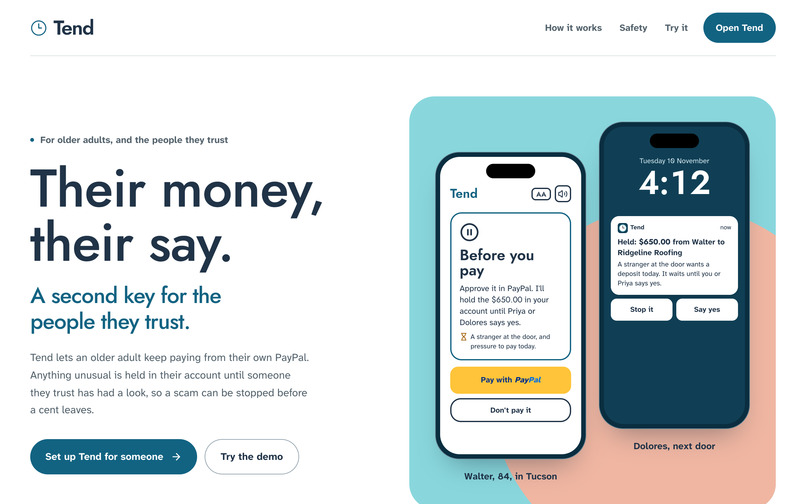
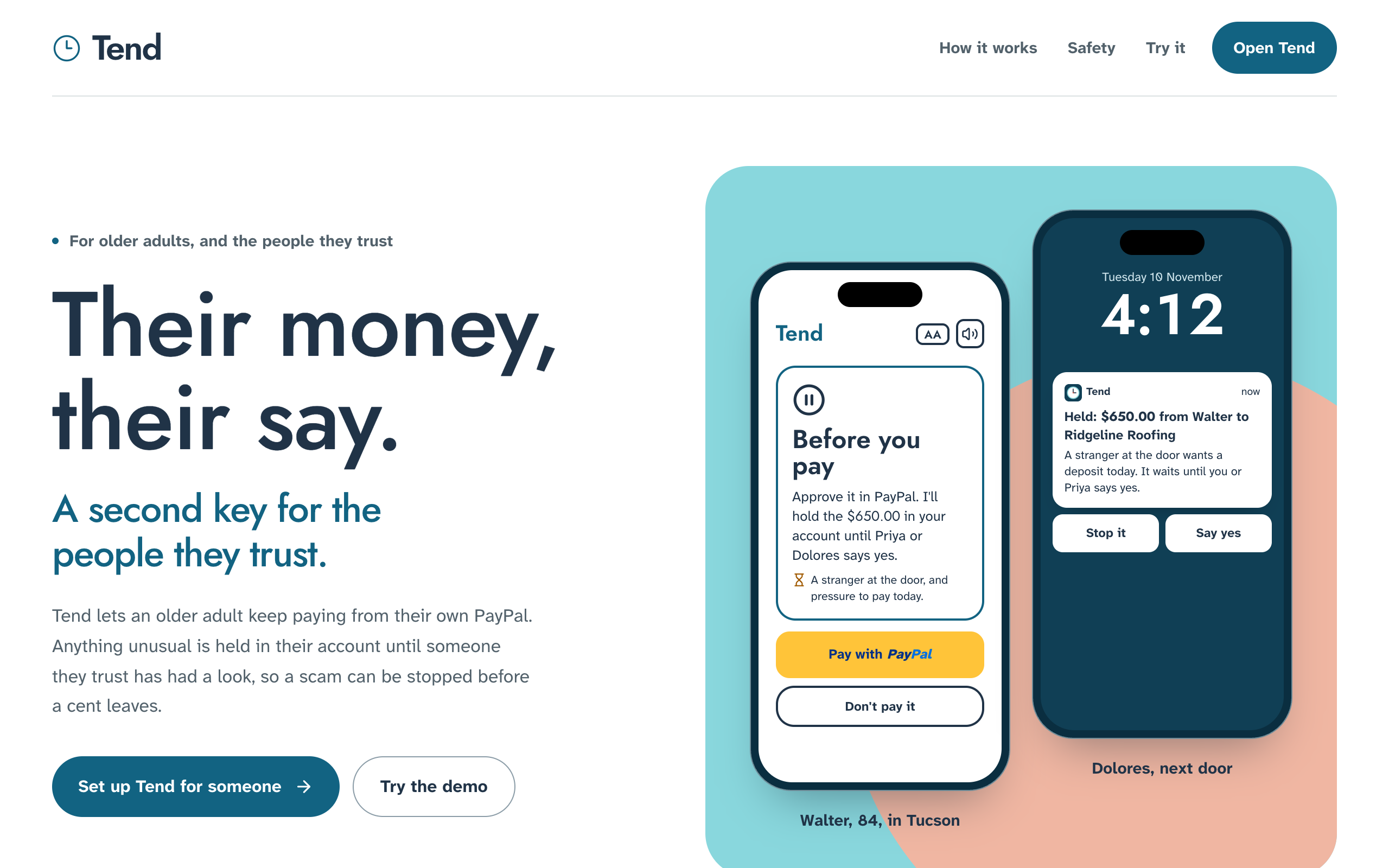
Tend lets an older adult keep paying from their own PayPal, and gives the people they trust a second key.
-
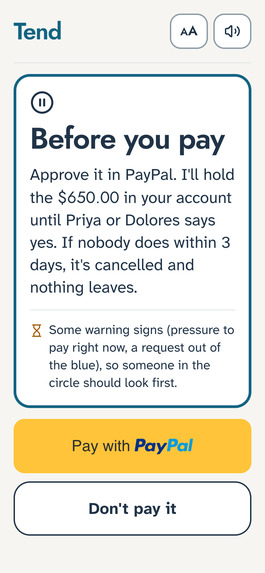
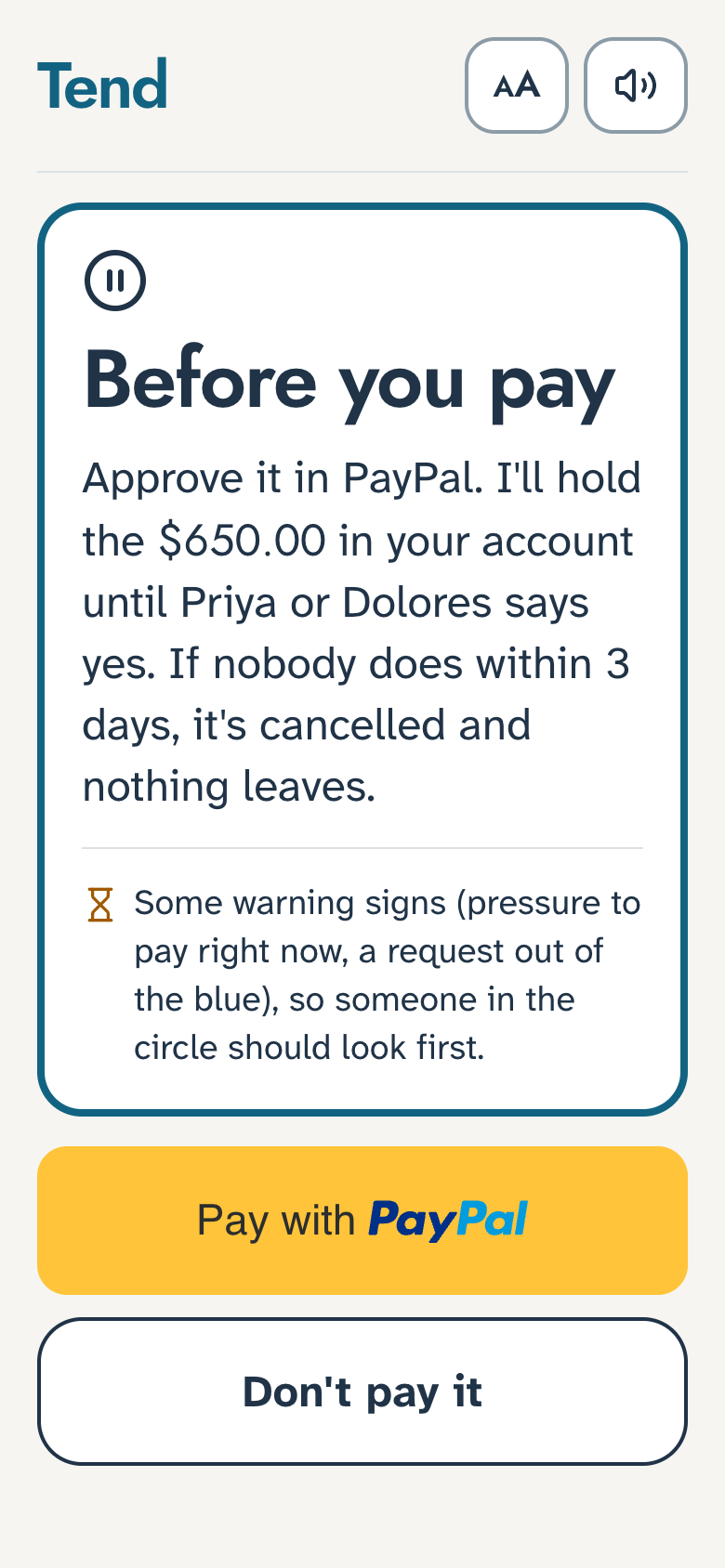
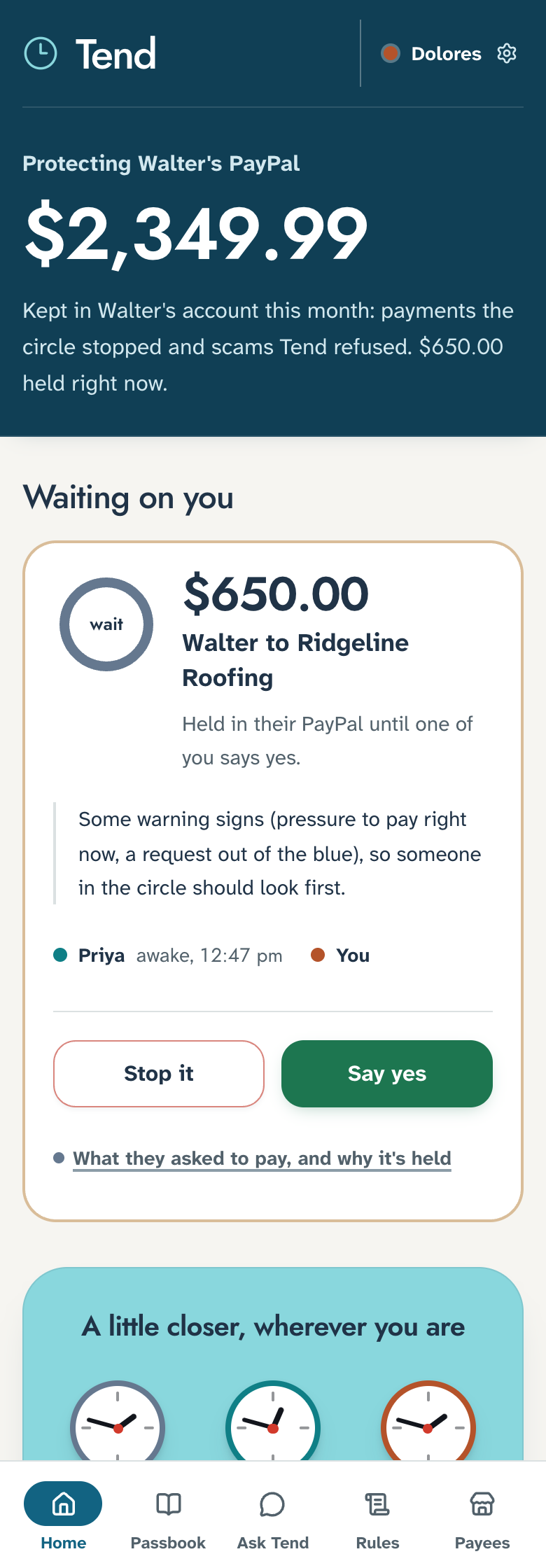
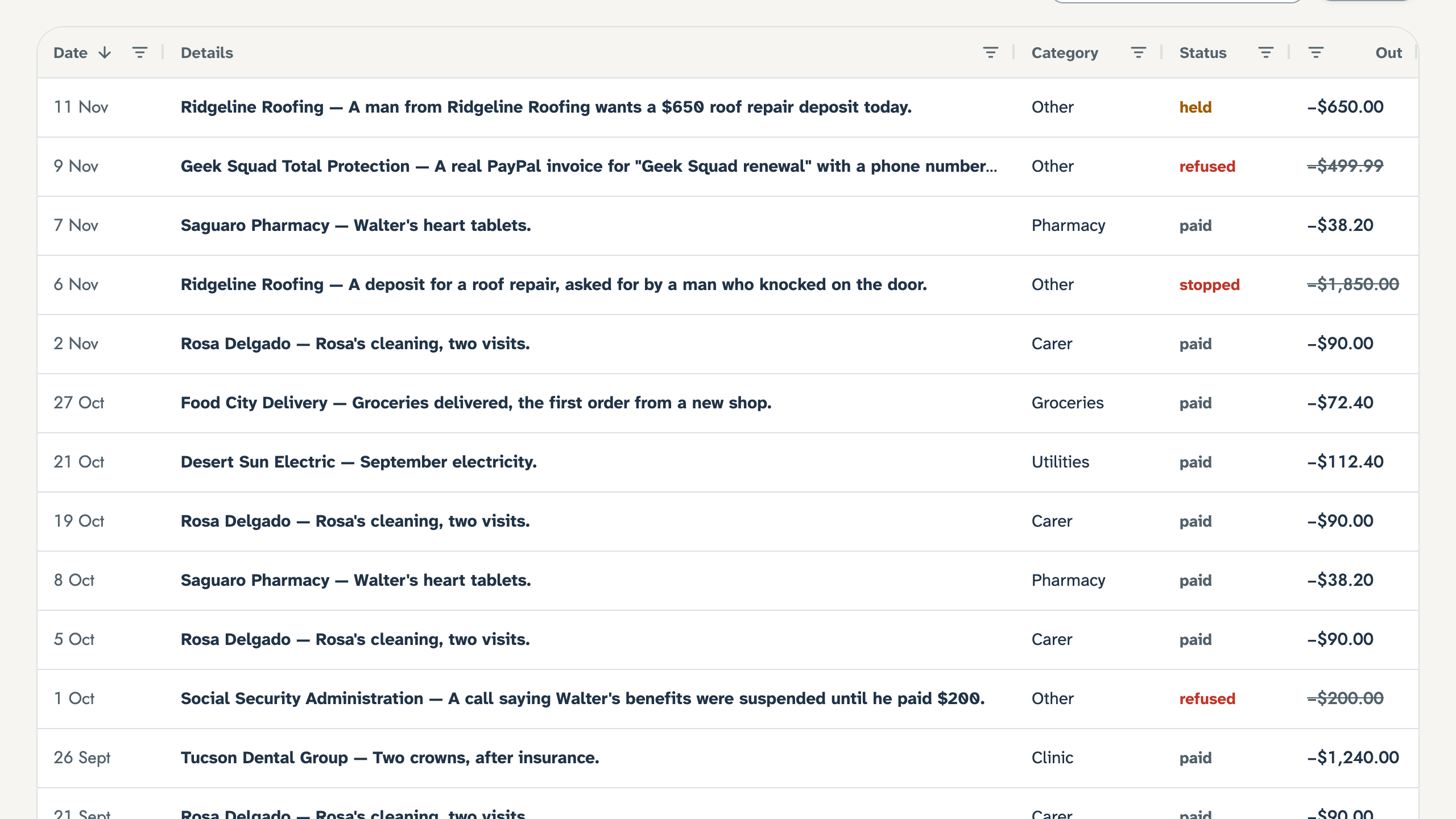
A stranger wants $650 today. Before Walter pays, Tend explains it will be held in his own PayPal until Priya or Dolores says yes.
-
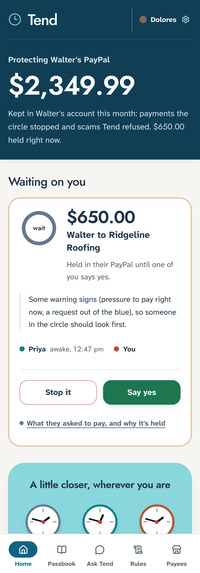
On Dolores’s phone, the $650 is held in Walter’s PayPal, and it shows who’s awake. One tap on Stop it and PayPal voids the hold.
-
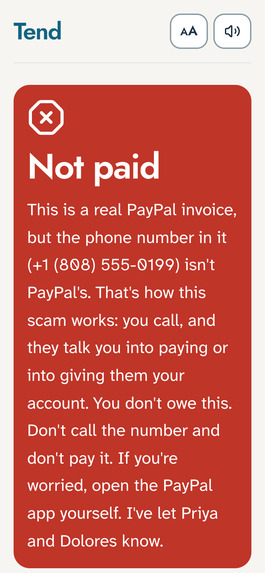
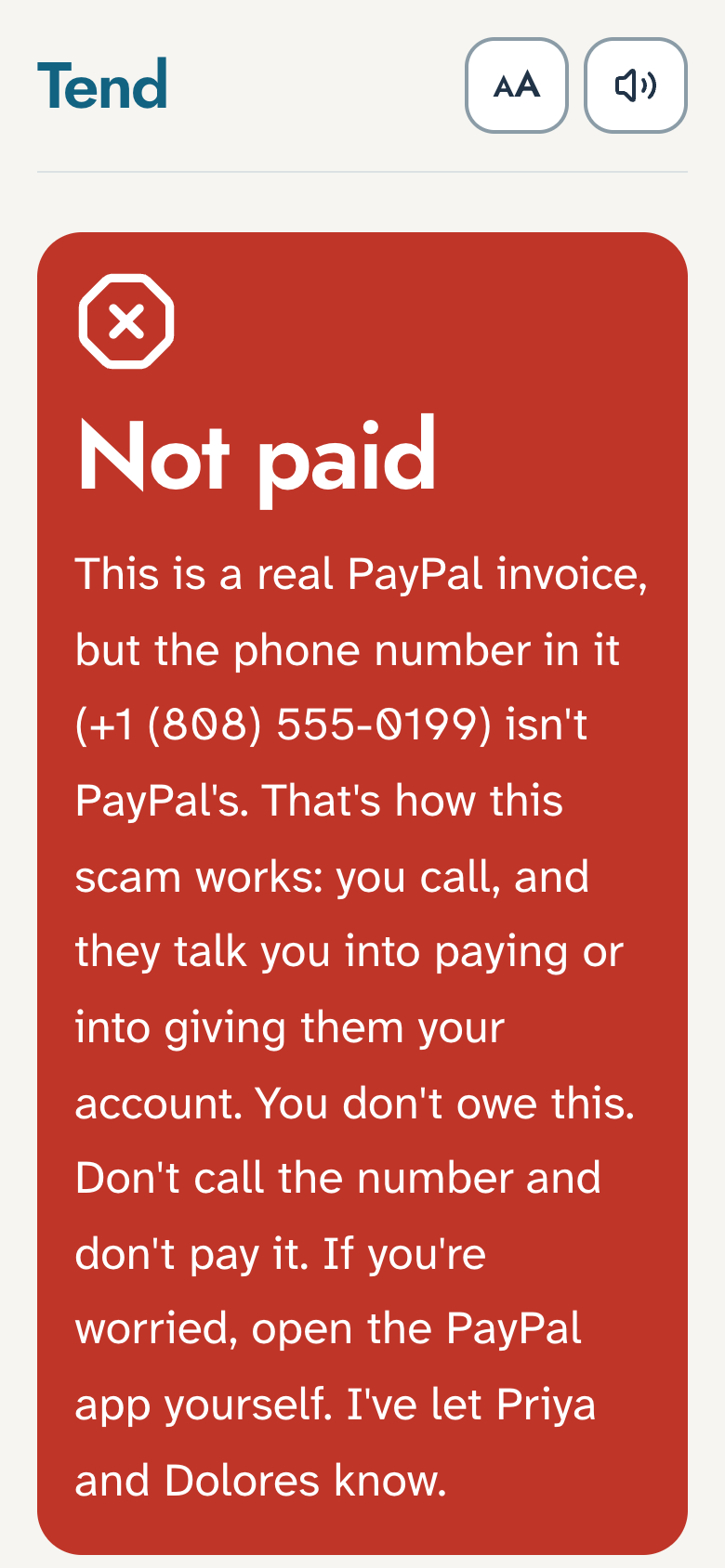
A real PayPal invoice with a fake support number. Tend refuses it and tells Walter to not call the number
-
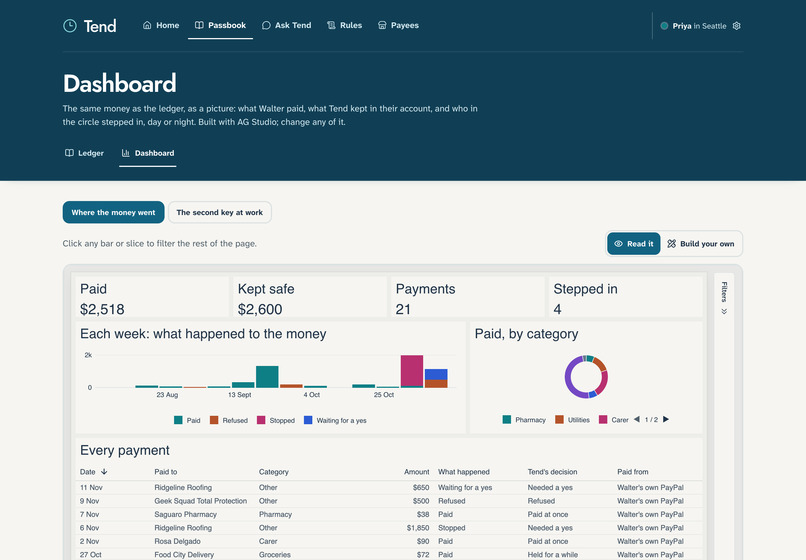
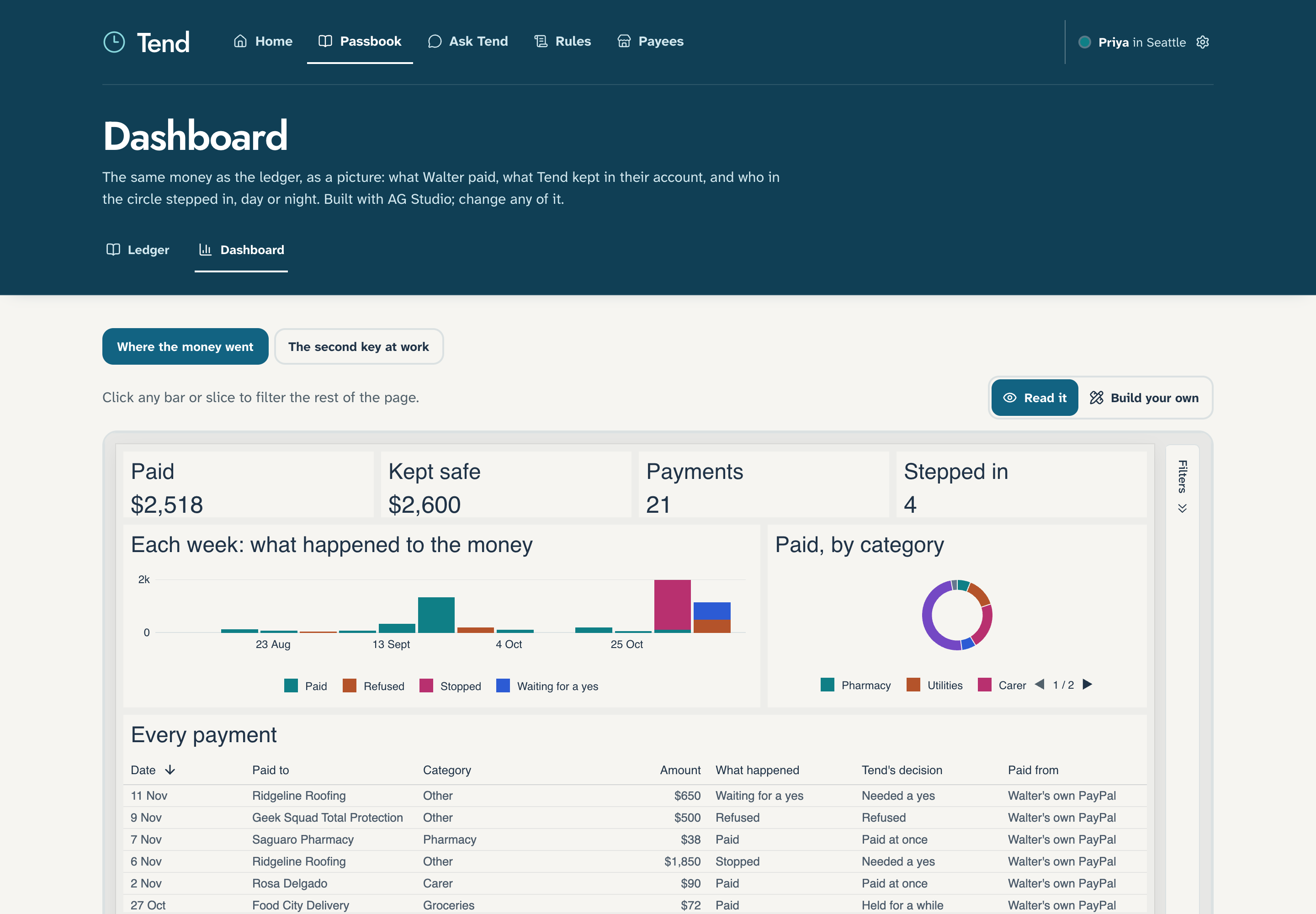
The circle’s dashboard, built with AG Studio: what Walter paid, what Tend kept in his account, and every payment.
-
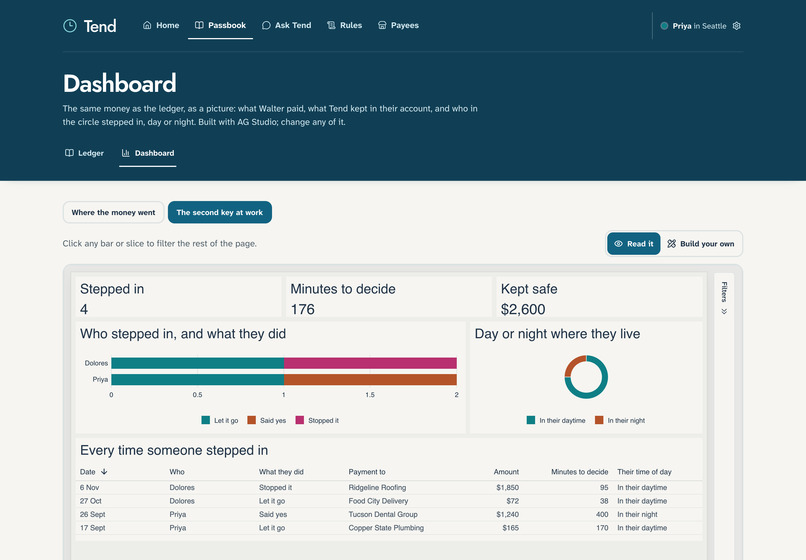
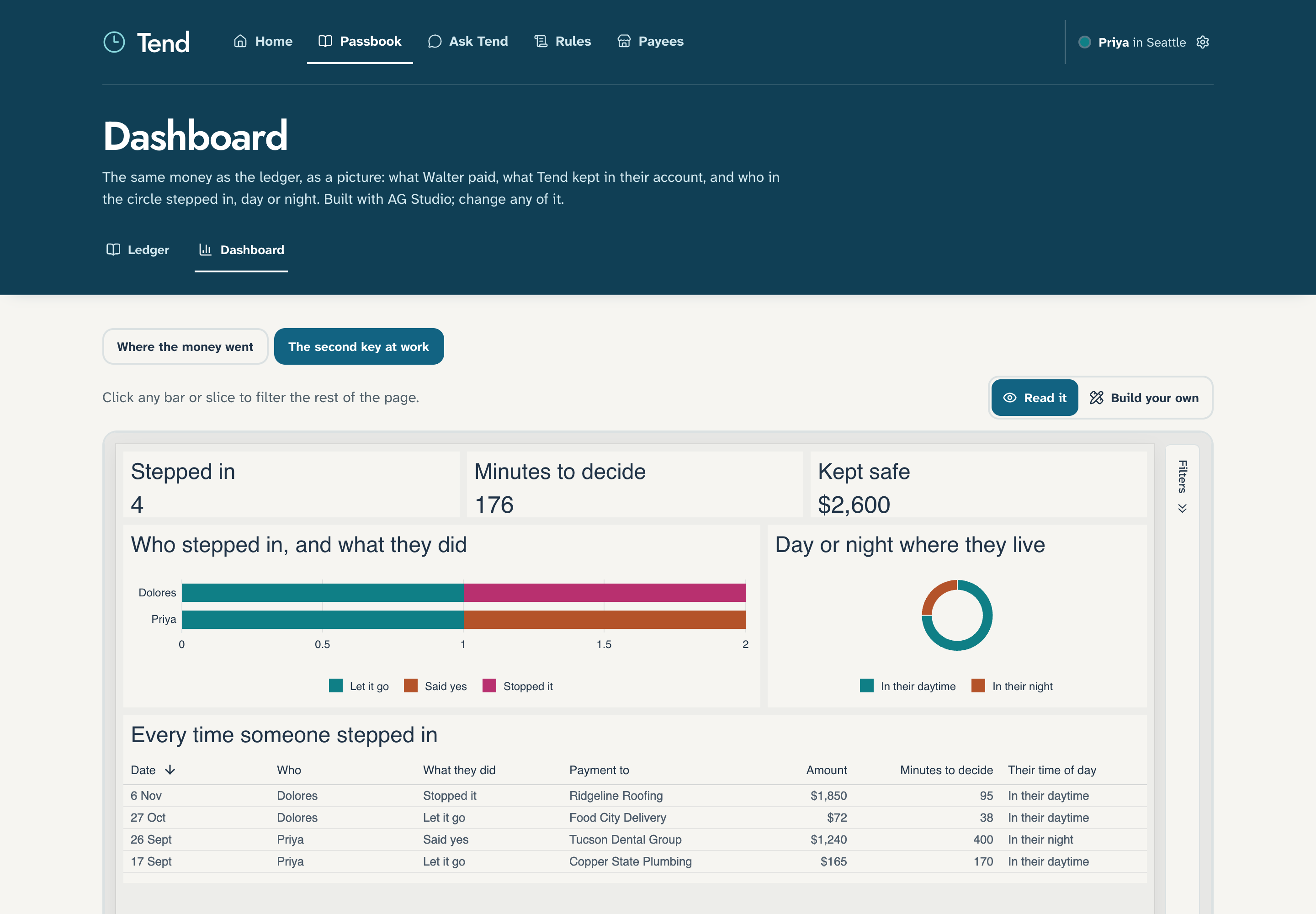
The second key at work: who stepped in, what they did, how fast they decided, and whether it was day or night where they live.
-
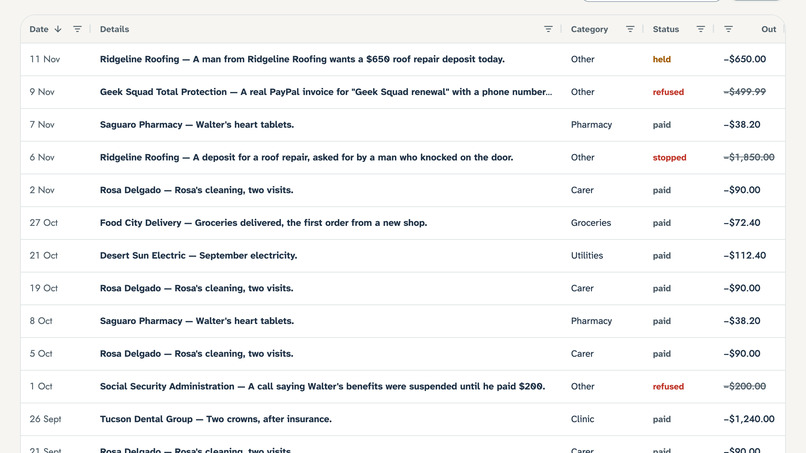
The passbook, built on AG Grid: everything paid, held, stopped or refused. Ask it questions in plain words.
-
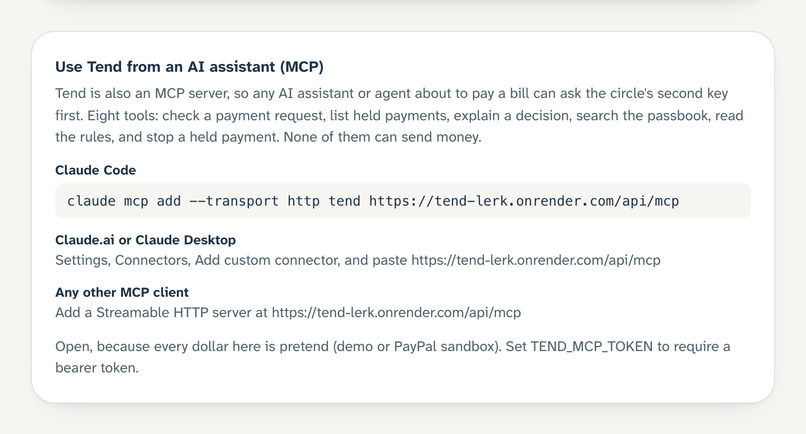
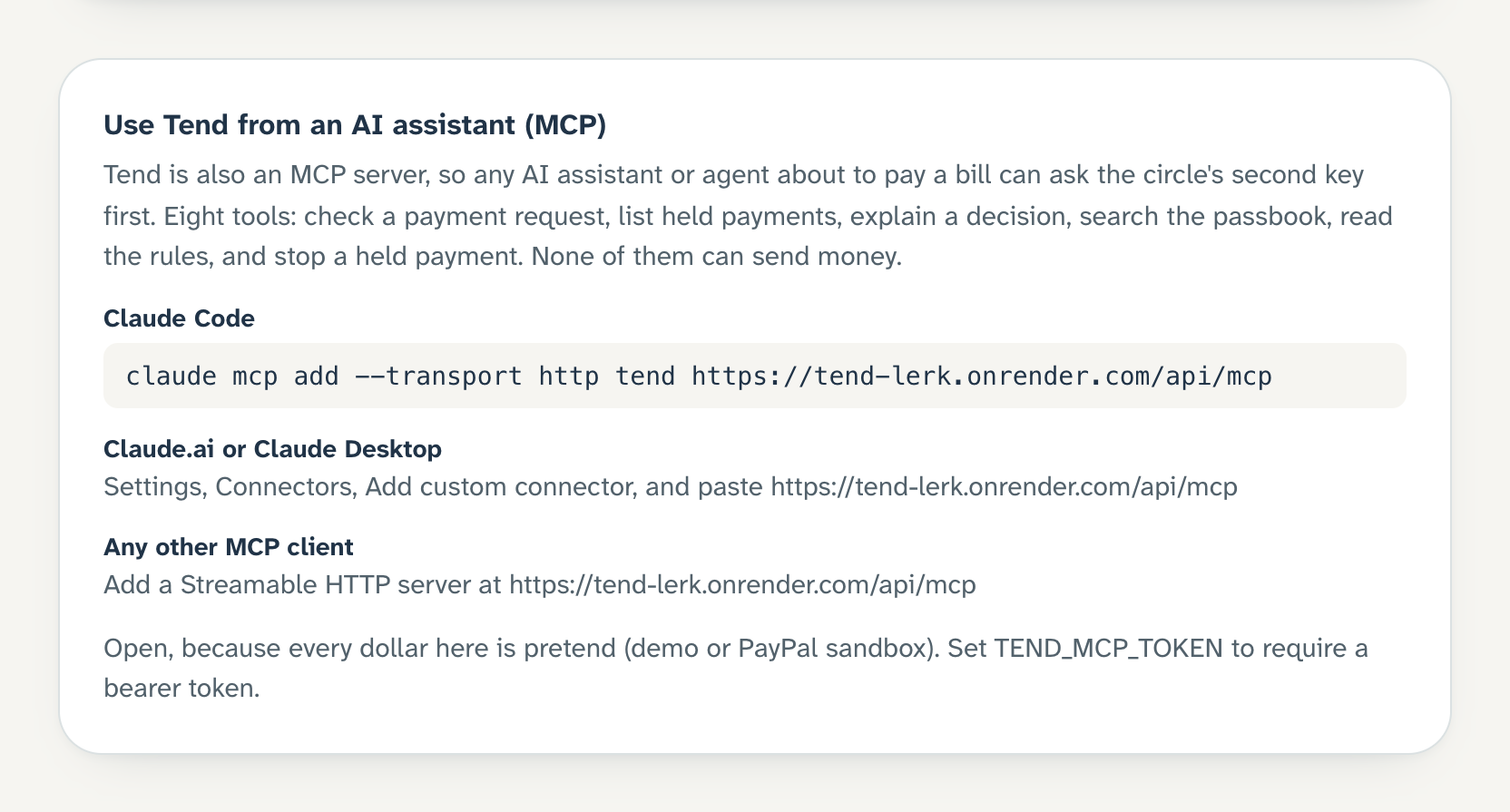
Tend is also an MCP server, so any AI assistant can ask Tend before it pays a bill. It can stop a payment, but it can never send one.
-
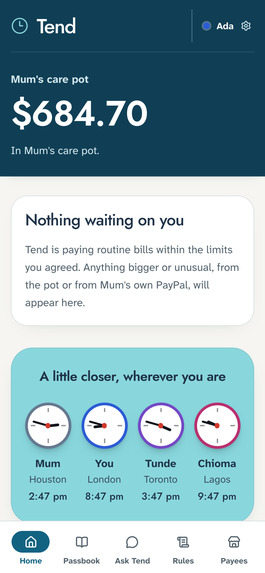
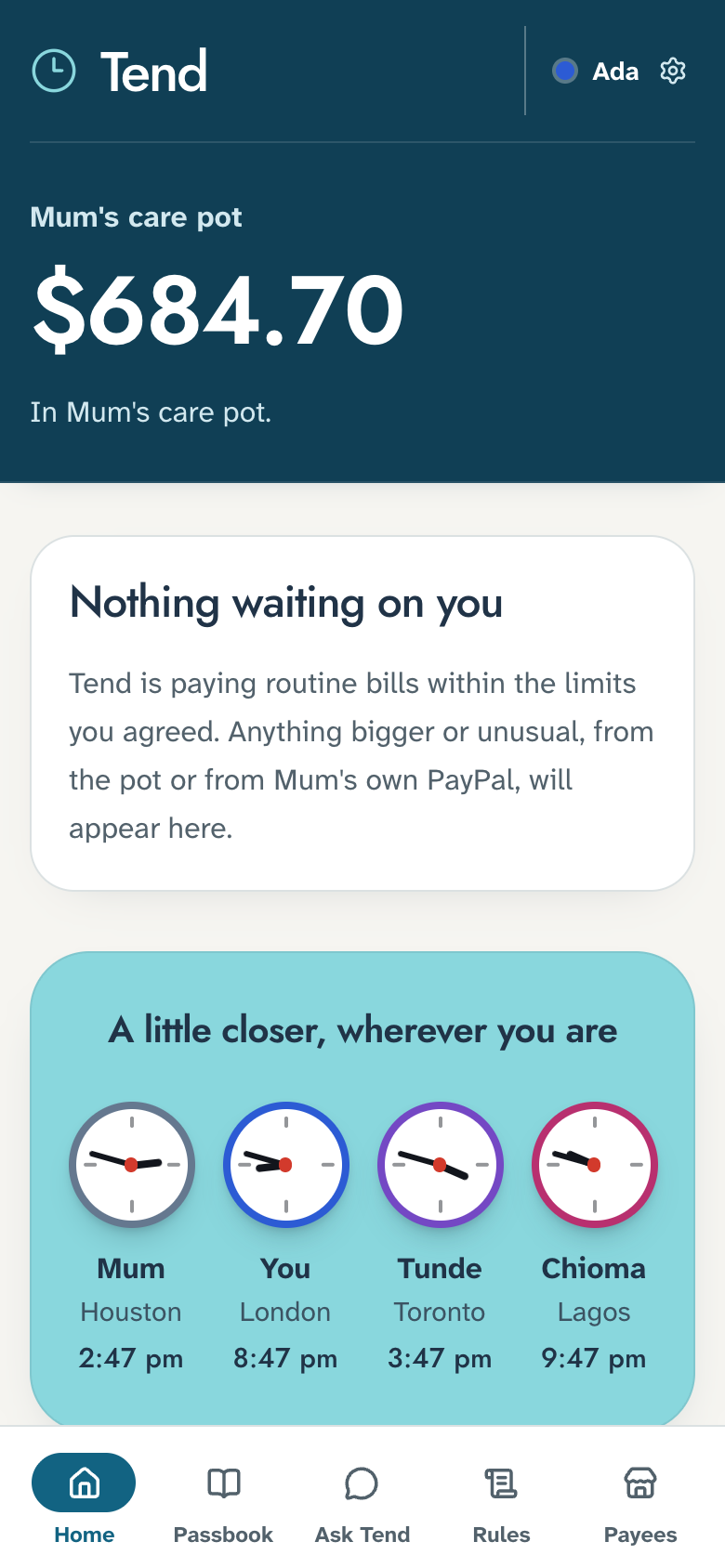
The Okafor family share a care pot for Mum in Houston, from London, Toronto and Lagos, each with their own clock.
-
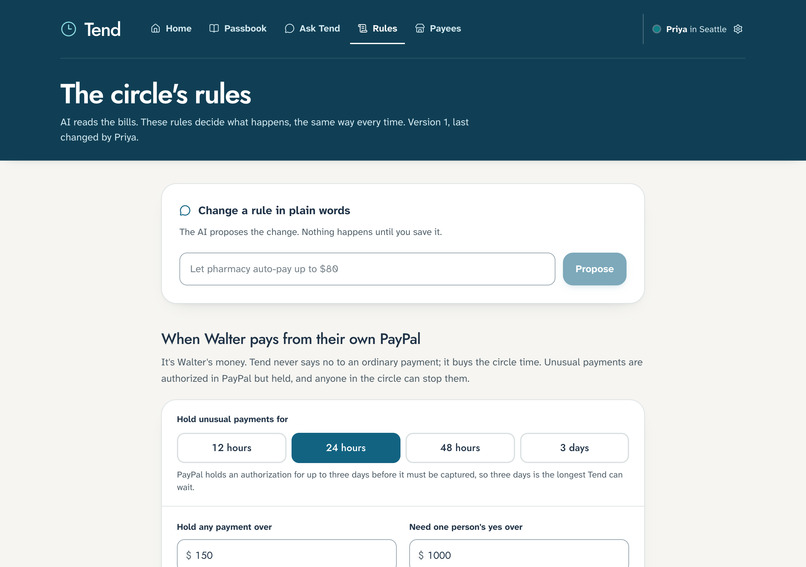
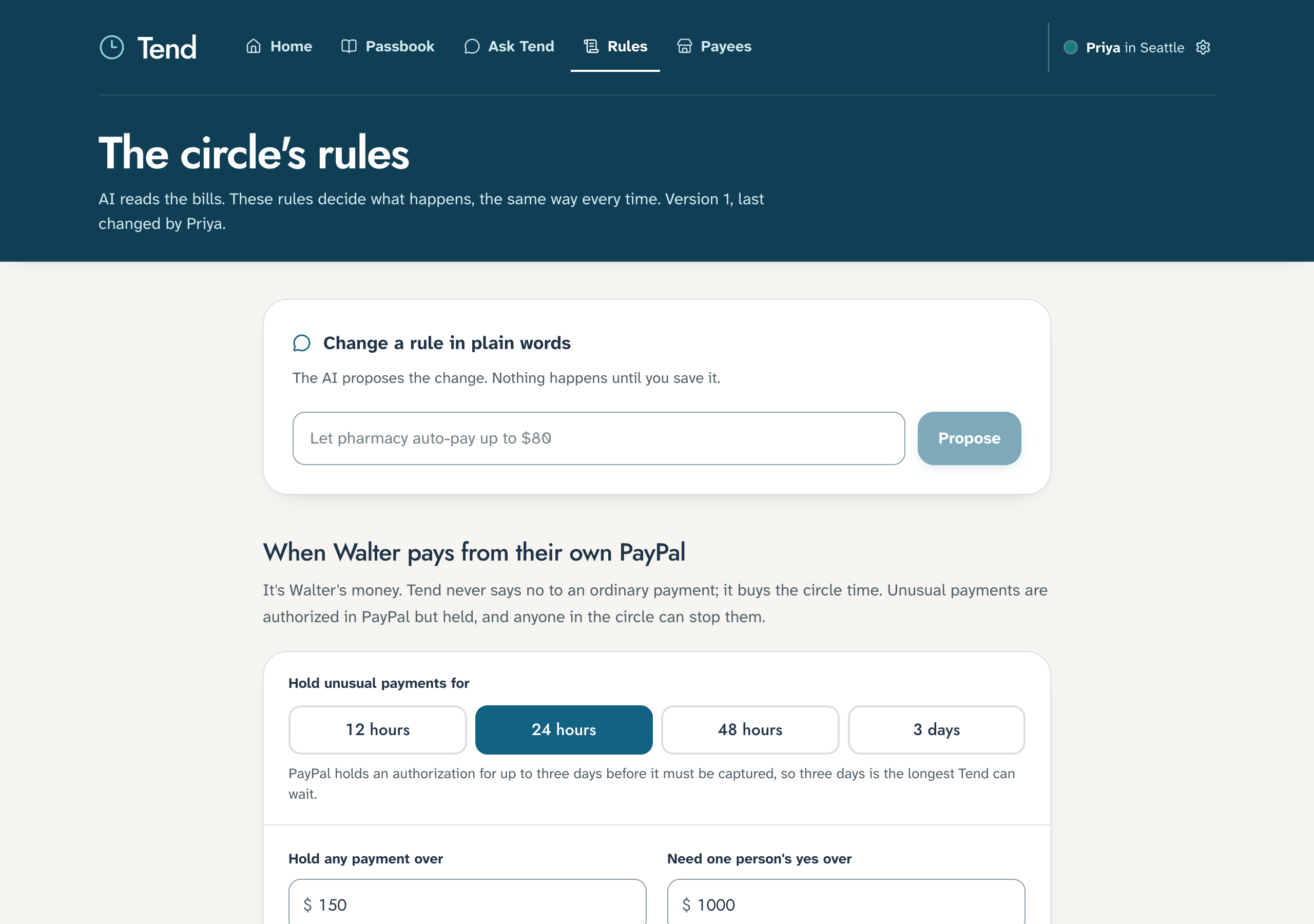
The circle’s rules in plain words: how long to hold, what needs a yes, and new rules proposed by typing a sentence.
Name: Tend
Tagline: Their money, their say. A second key for the people they trust, built on PayPal's own authorize-and-capture.
Inspiration
People over 60 reported $7.75 billion in fraud losses to the FBI in 2025, up 59% in a year, at an average of $38,500 each. The scams have moved onto the rails people trust: a real PayPal invoice arrives from PayPal's own address, and the trap is a "support" number in the note.
The usual answers take control away from the person: a joint account, a power of attorney, a card someone else manages. The UK found a better one. Since October 2024, banks may hold a suspicious payment for up to four business days, because time breaks scams. The people an older adult trusts have no such power.
We also noticed who gets left out. Most "protect your parent" ideas assume the person has children nearby. A quarter of Americans over 65 live alone, and many have no children at all. So Tend's main example is Walter, 84, in Tucson: no children, a niece in Seattle and a neighbour next door.
What it does
Tend gives an older adult's circle (a son abroad, a niece, a neighbour, a friend) one power: time for a second look, while the person keeps paying from their own PayPal.
- The person sends what they want to pay. A photo of a bill, a voice note, or a message they were sent. An AI model reads it. They get one plain sentence back, read aloud in a natural voice.
- Routine payments go straight through. A refill from a pharmacy they've paid before is approved in PayPal and paid at once.
- Unusual payments are authorized but held. A first payment to someone new, or anything over the circle's limit, is authorized in their PayPal, not captured. The money hasn't left. Their circle sees a countdown ring, says who's awake, and anyone can Stop it (PayPal voids the authorization) or Let it go now (PayPal captures it). If nobody objects, Tend captures it when the hold ends.
- The circle gets an alert, and can act on it there. When something is held, Priya's and Dolores's phones get a notification with Stop it and Say yes on it. On Android, one tap voids the PayPal authorization without opening the app; on an iPhone, the alert opens the payment.
- Warning signs wait for a yes. A stranger at the door wants a $650 deposit for the roof, today. It might be a real roofer, so Tend holds it until someone in the circle says yes. If nobody does in three days, it's voided. Silence never pays.
- Scams are refused before any money moves. Gift cards, crypto, wire transfers, "grandchild in trouble" texts, "Medicare Card Services" wanting a fee for a new card. And scams that run on PayPal itself: forward a PayPal invoice with a phone number in the note, and Tend says "This is a real PayPal invoice, but the phone number in it isn't PayPal's. You don't owe this. Don't call the number."
- Regular bills without a PayPal screen each time. The person saves their PayPal once (Vault). Tend can then pay the payees they ticked, up to the amount they set, still inside the circle's rules. They can revoke it any time.
- A care pot when there's a family to fund one. The Okafor family (Mum in Houston, children in London, Toronto and Lagos) share a pot: bills under the rules are paid by PayPal Payouts, bigger ones need two siblings' yes, shares are collected by PayPal invoices, and a pharmacy bill paid twice is recovered with a PayPal invoice.
- Ask Tend. An AI agent for the circle: "Is anything of Walter's held right now?" then "stop it". It reads the ledger and PayPal's read-only tools; it can stop a hold but never send money.
- Tend as an MCP server. Any assistant about to help someone pay can call
check_payment_requestfirst and get Tend's verdict and reasons. The only action exposed is stopping a held payment. - The passbook. An AG Grid ledger the circle can question in plain words ("what was stopped or refused?"), with colour-coded statuses, struck-through amounts for money that never left, live totals and CSV.
- The circle's dashboard. Built with AG Studio, AG Grid's embedded analytics: where the person's money went each week, what Tend kept in their account, and who in the circle stepped in, how fast, and whether it was day or night where they live. Anyone in the circle can build their own by dragging fields, or ask AG Studio's AI assistant ("add a bar chart of how much was stopped each week") and watch it build it. A view one person saves is the one everyone opens.
- Set up in a minute. "Set up Tend for someone": who it's for, who their second key is, how careful to be. It creates the circle and an invite link for everyone, which signs them in on their own phone. Added to the Home Screen, Tend opens like an app, already signed in.
- The rules in plain words. "Hold anything over $200 for 2 days" becomes a reviewed change. Every version is kept; changes that loosen the rules are flagged.
How we built it
PayPal's own primitive is the safety mechanism. A held payment is an Orders v2 AUTHORIZE intent. Stop is POST /v2/payments/authorizations/{id}/void. Release is /capture followed by a Payout to the payee. Holds are capped at 71 hours, inside PayPal's three-day honor period, and a cron job (plus every page load) releases cooling-off holds that have ended and voids needs-a-yes holds nobody answered.
PayPal, end to end: Orders v2 (authorize, capture, void, and capture for top-ups) · JS SDK v6 with a server-made client token (createInstance, findEligibleMethods, one-time payment sessions) · Vault / Payment Method Tokens v3 (setup token → payment token → vault_id orders) · Payouts (releases, pot payments, one-cent payee verification) · Invoicing through the Agent Toolkit (shares, refund invoices) · the Agent Toolkit's read-only tools for the agent (list_transactions, list_invoices, get_order, list_disputes…) · Webhooks with signature verification (PAYMENT.AUTHORIZATION.VOIDED, PAYMENT.CAPTURE.COMPLETED, payouts, invoices), each shown in that payment's history.
AI: One AI model, chosen in configuration, through the Vercel AI SDK. We run Claude Sonnet 5.5 on the Claude API (OpenRouter also works), and any model with image input, tool calls and structured output can replace it with one setting. It reads photos, voice and messages into a typed extraction with scam signals and a PayPal-native flag (invoice or money request, and the phone number in it); runs Ask Tend as a tool-using agent; turns sentences into rule changes and passbook filters; and answers AG Studio's dashboard assistant, whose agents run in the browser while every model turn runs on Tend's server, so no key reaches the page. The model proposes; a pure, deterministic rules engine decides (refuse > needs a yes > hold > pay), with reasons in plain words. A high scam score alone never refuses: Tend refuses outright only on a sign with no innocent version (impersonation, secrecy, gift cards, crypto or wire, a phone number in a PayPal invoice), so a real roofer can still be paid once the circle has looked. The model never holds a tool that moves money.
MCP: the same engine is exposed as an MCP server over Streamable HTTP (/api/mcp, built with the official TypeScript SDK): eight tools, seven read-only, one protective.
Sponsor tools: AG Studio (AG Grid's embedded analytics, on AG Grid Enterprise) for the circle's dashboard: three data sources built from the ledger, a finished three-page report on first load (figures, a stacked weekly chart, donuts, grids, page filters, cross-filtering), Tend's theme and palette, a phone layout, drag-and-drop editing, AG Studio's AI assistant on Tend's own model through a custom AgLlmAdapter, and dashboards saved per circle in Postgres. AG Grid Community for the passbook (Theming API, an external filter driven by the model's structured output, pinned totals that leave out money that never moved, status cell renderers, CSV, responsive columns). Render for hosting (a Blueprint with Postgres, the web service with a health check, and a cron job that settles payouts and holds, on an always-on instance; if the database ever stops answering, Tend falls back to an embedded database and reseeds instead of going dark). Channel3 for product search in the shopping agent.
Design: the clock wall. Diaspora homes and bank halls have a row of clocks labelled with cities; Tend's home screen is a row of live dials that go to night when someone's asleep, so a held payment always says who can look now. The person's own screen has three big actions, Atkinson Hyperlegible Next, three text sizes and answers read aloud in a natural voice. The circle gets phone alerts it can act on, a banner the moment something is held on any screen that's open, every open screen updating itself within seconds of a change, and a new circle is set up in four short steps. Everyone signs in from their own invite link; the example circles live behind their own door, so the product itself has no demo controls.
Runs with no keys: clone, npm install, npm run db:seed, npm run dev. PayPal is simulated (every id is labelled SIM-) and messages are read by a keyword reader. Add sandbox keys and it's real.
Challenges we ran into
- Making a hold safe both ways. A cooling-off hold must release on time (a cron job, webhooks and page loads all race to do it) and must never pay a risky payment by default. Each transition is a conditional database update (
held → paying,held → voided), so exactly one actor wins, and needs-a-yes payments lapse to a void. - Staying inside PayPal's authorization rules: a three-day honor period and a 29-day validity. Tend caps every hold at 71 hours and tells the circle when each one goes, in their own time zone.
- PayPal-native scams. The email is genuine, so sender checks don't help. The signal is a real PayPal invoice or money request plus a phone number plus a call to action. Both the AI model and the offline reader look for exactly that.
- Person-neutral by design. "Protect Mum" assumes a family. Walter's circle has a niece and a neighbour, no pot, and the same protections.
- Bridging the PayPal Agent Toolkit (AI SDK v4 tools) into AI SDK v7 without losing PayPal's own
execute().
Accomplishments we're proud of
- A protection that uses PayPal exactly as designed, with nothing to claw back: a stopped payment never left the person's account.
- 101 automated tests, including the full hold → stop → void and hold → release → capture → payout paths, Vault consent limits, and an MCP client driving the server.
- An intake eval of 21 real-looking inputs, including PayPal invoice and money-request scams, a Medicare card fee and a roofer at the door (
npm run eval:intake). It checks amount, category, scam risk, and whether the rules refuse it or let the circle check: 21/21 with Claude Sonnet 5.5; 19/19 for the offline reader (the two photos need Claude). - An interface for the people who use it: an 84-year-old with low vision, and a niece glancing at her phone between meetings two time zones away.
What we learned
The interesting question in agentic payments isn't "can the agent pay?" It's "who can stop it, and how long do they have?" Giving people time did more for safety than making the model stricter, and it let the person keep their independence.
What's next
- Make the payee the merchant of record through PayPal's partner and platform APIs, so a released payment moves once instead of capture-then-payout.
- Text messages alongside push alerts, timed to each person's waking hours, and an "I'm on it" claim so two people don't both call the roofer.
- Let the person name a professional daily money manager as their second key when they have no one else.
- Cross-border payees (a carer in the home country) with PayPal's international payouts.
Built With
- ag-grid
- ag-studio
- capture
- channel3
- claude-sonnet-5.5-(claude-api)
- drizzle-orm
- model-context-protocol
- next.js
- openrouter-speech-(microsoft-mai-voice)
- paypal
- paypal-agent-toolkit
- paypal-js-sdk-v6
- paypal-orders-v2-(authorize/capture/void)
- paypal-payouts
- paypal-vault-(payment-method-tokens-v3)
- paypal-webhooks
- pglite
- postgresql
- react
- render
- tailwind-css
- vercel-ai-sdk
- vitest
- web-push

