-
-
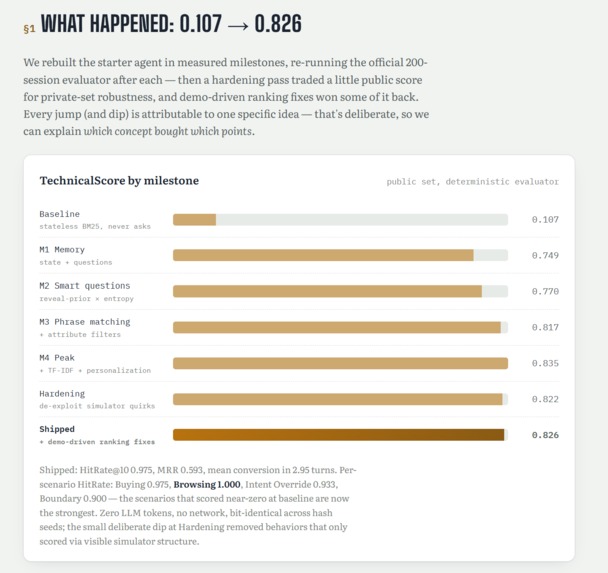
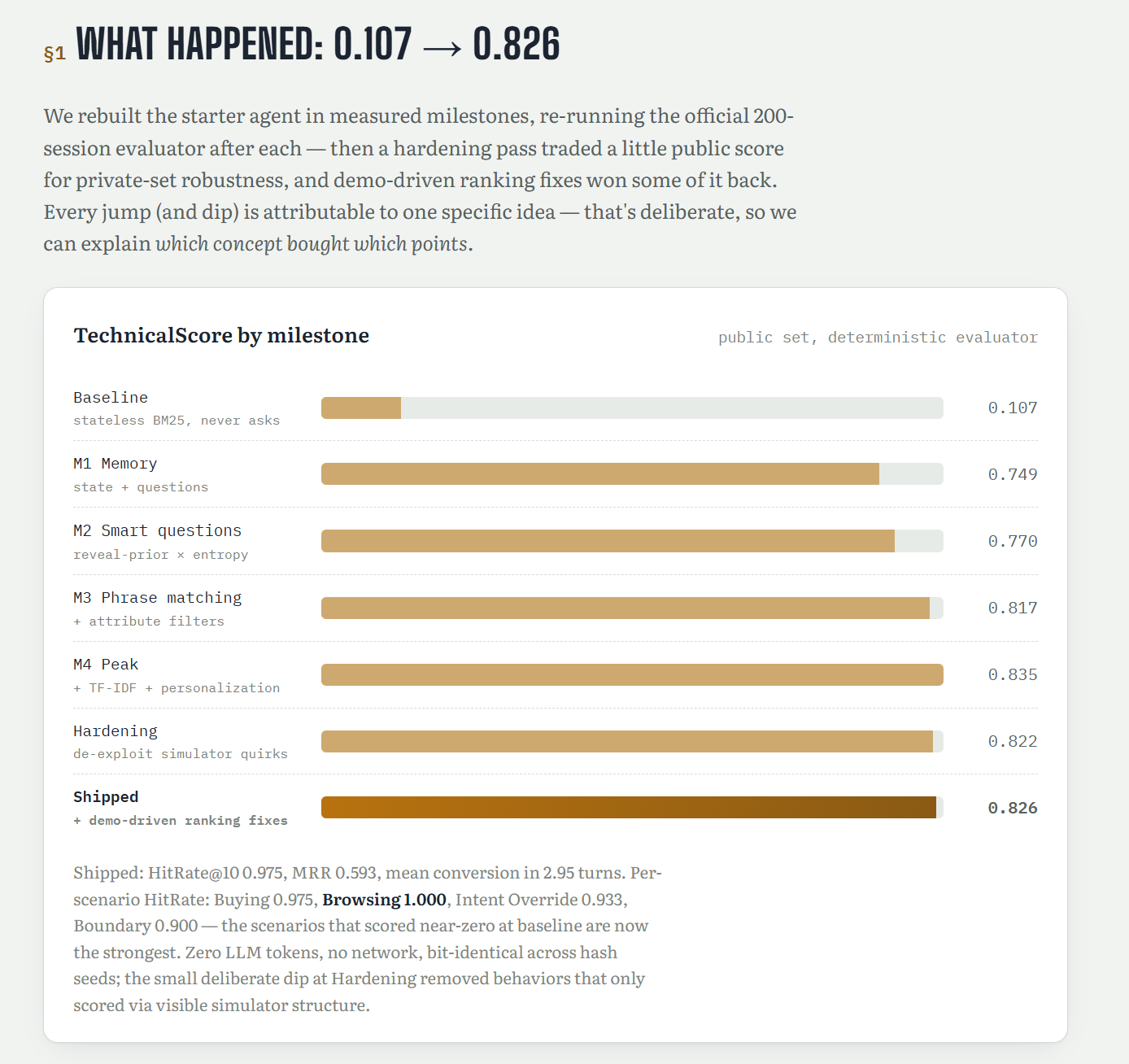
Score climb: 0.107 baseline → 0.826 shipped, every step measured
-
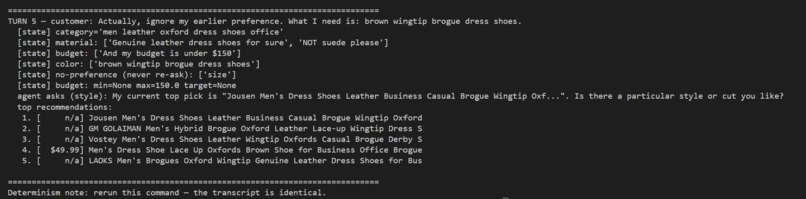
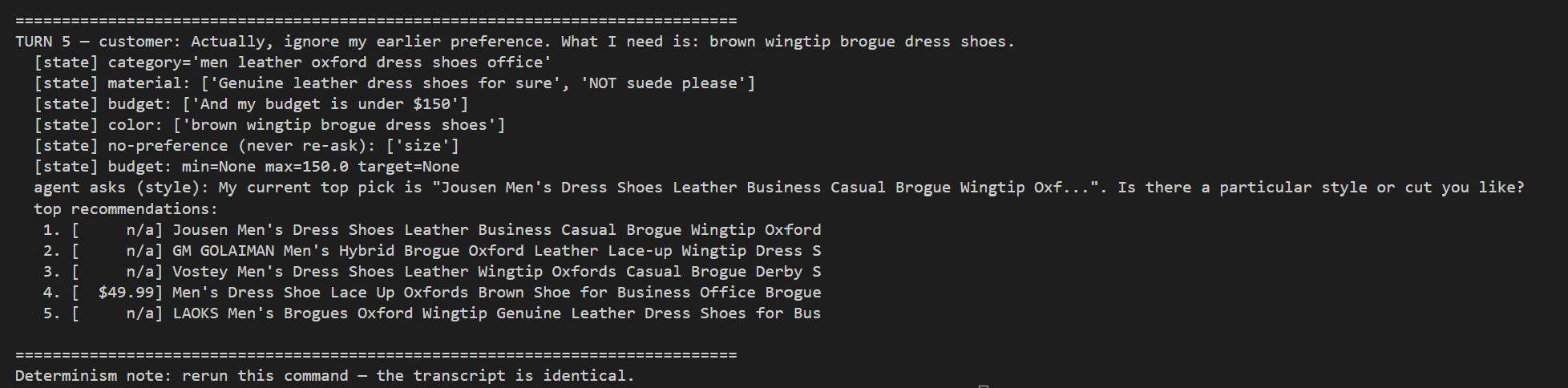
Turn-5 pivot: one slot rewritten, top 5 all match the new request
-
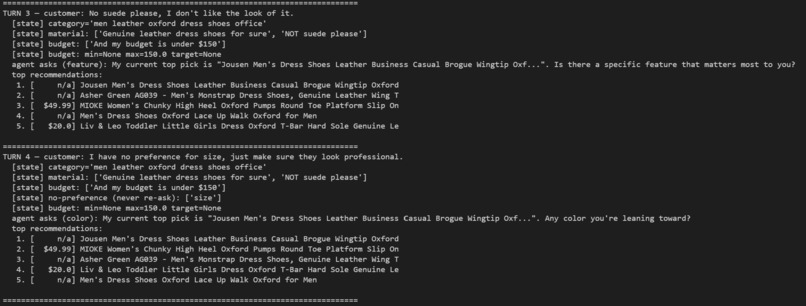
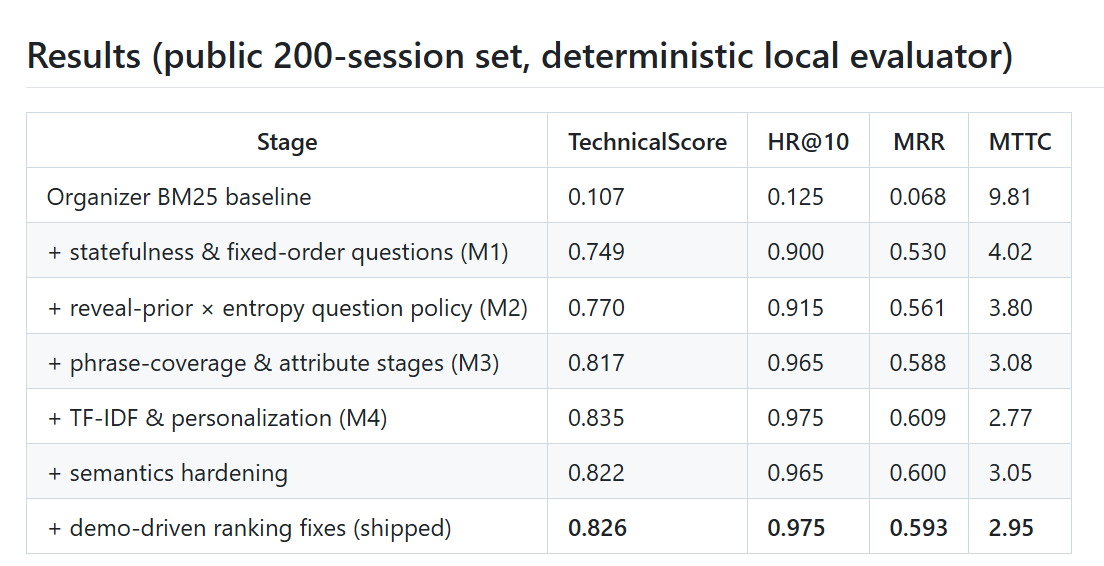
Milestone-by-milestone results on the official evaluator
-
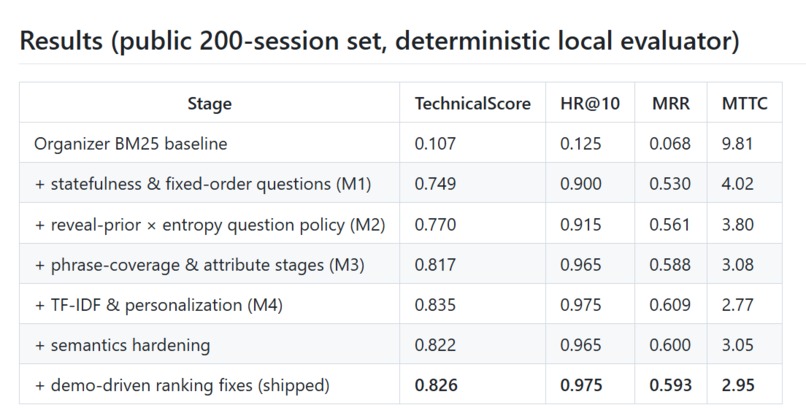
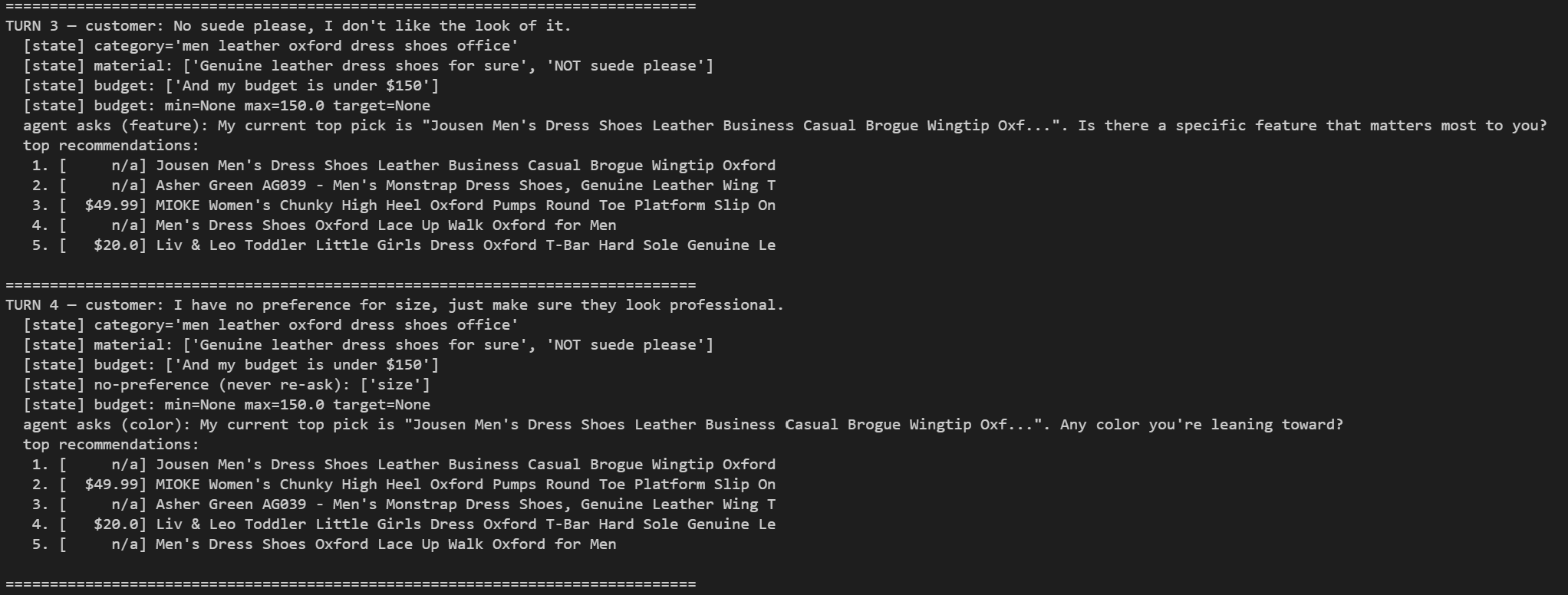
Live dialog state: exclusions, typed budget, never re-ask
-

61 tests green; identical transcript on every rerun

Devpost Project Description
Source text for Team KE$HA's Devpost submission (Track 4). Sections match Devpost's "About the project" template exactly — paste from Inspiration through What's next.
Inspiration
Traditional e-commerce search does keyword matching and hopes for the best; real shoppers arrive vague ("something for winter, still exploring"), change their minds mid-conversation, and expect an assistant that remembers. Track 4 makes this concrete: find the customer's hidden target product in a 50,000-item catalog within 10 conversational turns, scored on HitRate@10, MRR, and mean turns to conversion. The organizer's baseline agent — stateless, never asking a single question — scores 0.107. We wanted to see how far disciplined engineering could go without a single LLM token in the scored loop.
What it does
A stateful conversational search pipeline that runs five steps every turn, mapping directly onto the problem statement's pillars:
- Dialog state tracking. Every customer message is split into clauses and classified independently: constraints file into typed slots (material, color, budget, size, style, use-case) with polarity — "I don't want leather; cotton is fine" excludes leather and keeps cotton. "No preference" replies retire an attribute permanently. Intent overrides are scoped: "actually, I need a hiking backpack" rewrites the shopping category and retires the old intent's constraints, while "actually, what I need is: X" replaces exactly one slot and leaves everything else the customer said intact.
- Hybrid retrieval. Cumulative BM25 recall (SQLite FTS5, in-memory) feeds re-ranking
signals: polarity-aware attribute matching with typed budget operators
(under/over/between/around), a category-coverage anchor, an idf-weighted
phrase-coverage boost — our key insight: disclosed constraints are near-literal
fragments of the target's own listing, so coverage of a distinctive phrase is the
strongest possible signal — TF-IDF tie-breaking, and profile personalization from the
anonymized
preference_tags. - Adaptive clarification. The next question maximizes reveal-likelihood × pool-splitting entropy over the live candidate pool, stops asking once the pool is small or a clear leader emerges, and never re-asks what the customer already answered. A signature-based stall detector notices when the same candidates keep recurring with no new evidence and relaxes filters — runtime strategy re-orchestration, not a static pipeline.
- Recommendations every turn. Asking and recommending are never either/or — misses cost nothing and a hit ends the session, so the agent always attaches its best top-10.
- A safety choke point. Every response exits through one schema validator with transactional per-turn state and two fallback tiers, so the agent never crashes a session.
How we built it
Measured milestones, each gated against the official deterministic evaluator and logged in
REGRESSION_LOG.md: statefulness first (0.107 → 0.749 — the single biggest jump came from
simply remembering the conversation), then adaptive questioning (0.770), phrase-coverage
and attribute ranking (0.817), TF-IDF + personalization (0.835), then a hardening pass
against an independent teammate audit (negation, mixed clauses, scoped overrides, typed
budgets, determinism, transactional state) and demo-exposed ranking fixes — finishing at
0.8264 with every change's score impact recorded, including the experiments that
measured worse and were reverted.
- Development tools: VS Code with the Claude Code extension (Anthropic Claude Opus 5) for AI-pair-programmed development, code review against the organizer's evaluator source, and test authoring; Python 3.10–3.12; Git/GitHub; PowerShell & Bash; the organizer's deterministic local evaluator as the measurement harness.
- APIs: none required at runtime — the scored agent is fully offline (0 prompt /
0 completion tokens reported). Optional, explicit opt-in only (
TECHJAM_ENABLE_LLM=1- key): Anthropic Claude Haiku (
claude-haiku-4-5-20251001) for varying clarifying-question phrasing — presentation polish with a circuit-breaker fallback to templates; it never affects retrieval or ranking correctness, and an ambient API key alone can never trigger a call.
- key): Anthropic Claude Haiku (
- Libraries & frameworks: Python standard library only for the scored path —
sqlite3(FTS5 full-text index, BM25),difflib(fuzzy cue matching),dataclasses,re,math,unittest(61 tests). Optional accelerators, off by default:rapidfuzz,anthropic. Deliberately no PyTorch / Transformers / vector database — the rules require in-memory light execution, and our measured results show classic IR + careful dialog-state semantics gets there without them. - Datasets & assets: the organizer's frozen competition kit, derived from Amazon
Reviews 2023 (McAuley Lab, UCSD),
Clothing_Shoes_and_Jewelrycategory — 50,000-product catalog (SHA256-verified) + 200 labeled public development sessions. No external training data, no scraped data, no manual labeling.
Challenges we ran into
The public simulator is deterministic and visible — the discipline was refusing to overfit it. We removed behaviors that scored points only through simulator structure (re-asking answered attributes, leaning on the catch-all "other" question), costing a measured −0.013 public score, and validated the trade with a grouped holdout split plus a battery of hand-written adversarial semantics tests (negation, mixed clauses, category switches, typed budgets) that the public set never exercises. Then demo rehearsal exposed further free-form ranking bugs the evaluator never triggers — a flat budget bonus let a $5.99 ear cuff outrank the correct shoes whose price field was missing — and fixing them (category anchoring, unknown-price credit) recovered the score to 0.8264 without re-introducing the overfitting behaviors.
Accomplishments that we're proud of
- 7.7× the official baseline: TechnicalScore 0.8264 vs 0.107 — HitRate@10 0.975, MRR 0.593, mean conversion in 2.95 turns; Browsing scenario HitRate 1.000.
- Zero LLM tokens, no network access for the full score — immune to the network-disabled final-scoring policy, with honest 0/0 token disclosure.
- Bit-identical results across Python hash seeds — determinism engineered and verified, not assumed; anyone who clones the repo reproduces our exact numbers and our demo video's exact transcript.
- No overfitting gap: a grouped holdout split (sessions never used for tuning) scores higher than the tuning split (0.8458 vs 0.8158).
- A regression log with the failures left in — every change's measured impact, including reverted experiments, is public in the repo.
What we learned
- Textbook information gain is wrong for this task: entropy-maximizing questions made the agent worse (0.749 → 0.714) until blended with a reveal prior — question value is reveal-likelihood × splitting power, not splitting power alone.
- Negation scope is subtler than it looks: customer negation ("no suede") must become an exclusion, but negation inside quoted catalog fragments ("do not bleach") describes the product — treating it as customer intent penalized the correct target itself (measured: Intent Override 0.933 → 0.900 until scoped).
- Your demo is a test harness: rehearsing free-form conversation exposed real ranking bugs the official evaluator structurally cannot trigger. Fix the product, not the video.
- Determinism is earned, not free: Python's hash-randomized set ordering made question selection vary between runs until we rebuilt tie-breaking on a fixed order.
What's next for Hitmaker
Multi-route recall with reciprocal-rank fusion (our single BM25 gate is the known recall ceiling), a conversation-replay visualization built on the agent's per-turn decision trace, and a learned reranker gated on holdout — not public — gains.
Team
Team KE$HA — Wang Zilu, Lim Wei Feng Leo, Guan Chen Di, Dylan Yap, Damien Tan. All members contributed across design, implementation, review, and submission preparation, with Claude Code (Anthropic) used as an AI pair-programming tool throughout.
Links
- Public repository: https://github.com/IcySnowy16/TiktokTechjam
- Demo video: https://youtu.be/2UY8_PIC6Yw
Built With
- bm25
- claude
- conversational-ai
- dialog-systems
- e-commerce
- fts5
- information-retrieval
- natural-language-processing
- python
- recommender-systems
- regex
- sqlite
- tf-idf


Log in or sign up for Devpost to join the conversation.