Inspiration
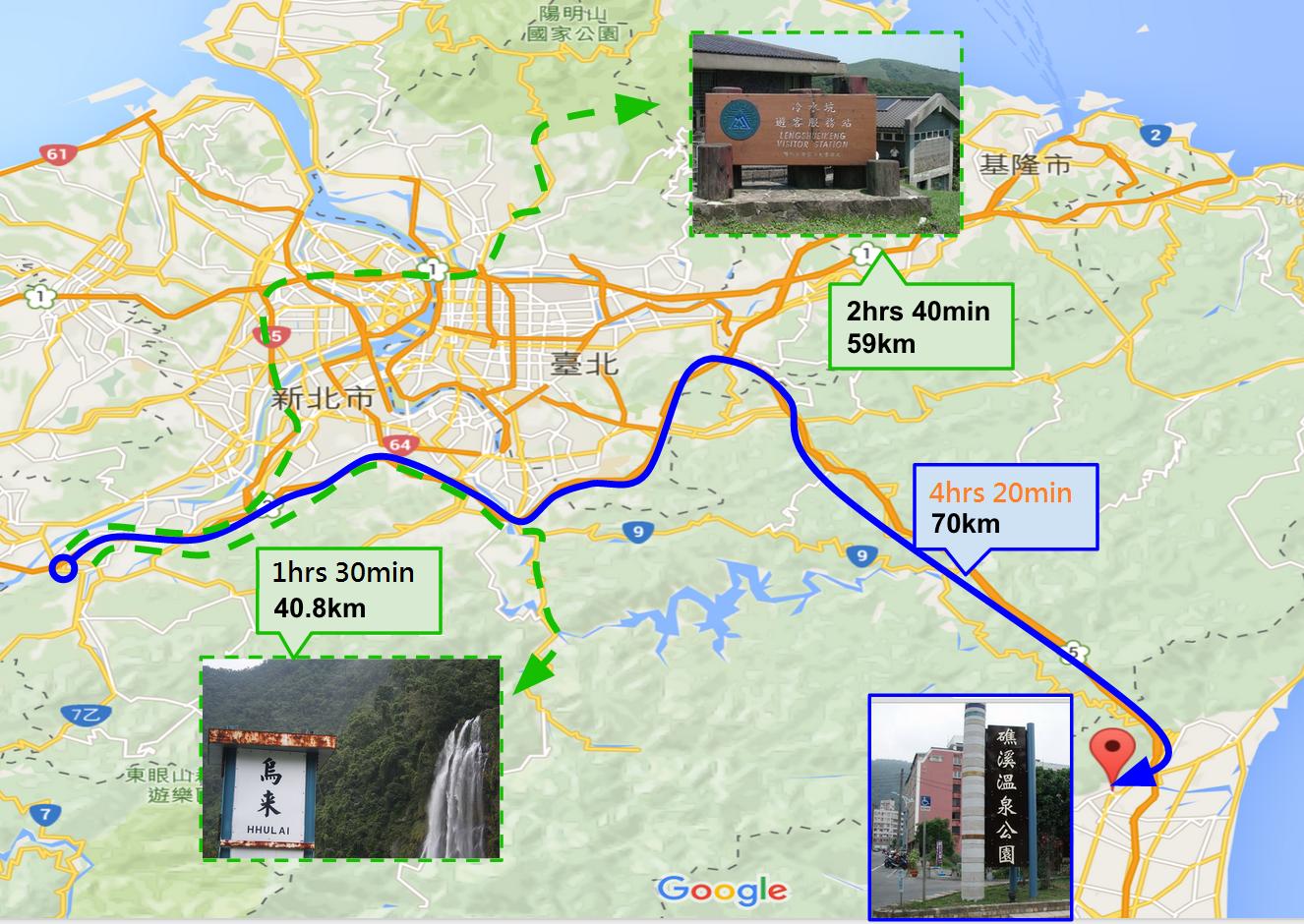
The best way to travel from the Taipei area (Taipei, New Taipei City, Keelung City) is driving through the Hsuehshan Tunnel via Freeway 5. This 12,942 meter long tunnel is not only a much safer and quicker way to go to many popular north Taiwan vacation destinations, but also a magnificent structure, the second longest road tunnel in East Asia, for drivers to see.
However, the severe traffic jams on the Freeway 5 make the journey much more painful than we would like to bear. The southbound traffic is usually not that bad in the morning when people start to drive toward Yilan; however, the terrifying northbound traffic from 3:00pm to 10:00pm is usually what caught people off guard. According to the data, it could take 1~2 hours before you even get on the Freeway on the regular weekend.
Work hour is long here in Taiwan, and we don’t want to waste any time sitting in the car. We hope for relief traffic jam on Freeway 5, but people can still enjoy their holiday. Our solution is to forecast the serious traffic jam and sent people to an alternative tourist point when traffic most likely to happen.

What does it do
The goal of “bypass” is to decrease the amount of tourist travel to Yilan when we forecast an incoming traffic jam by offering them an alternative place to go.
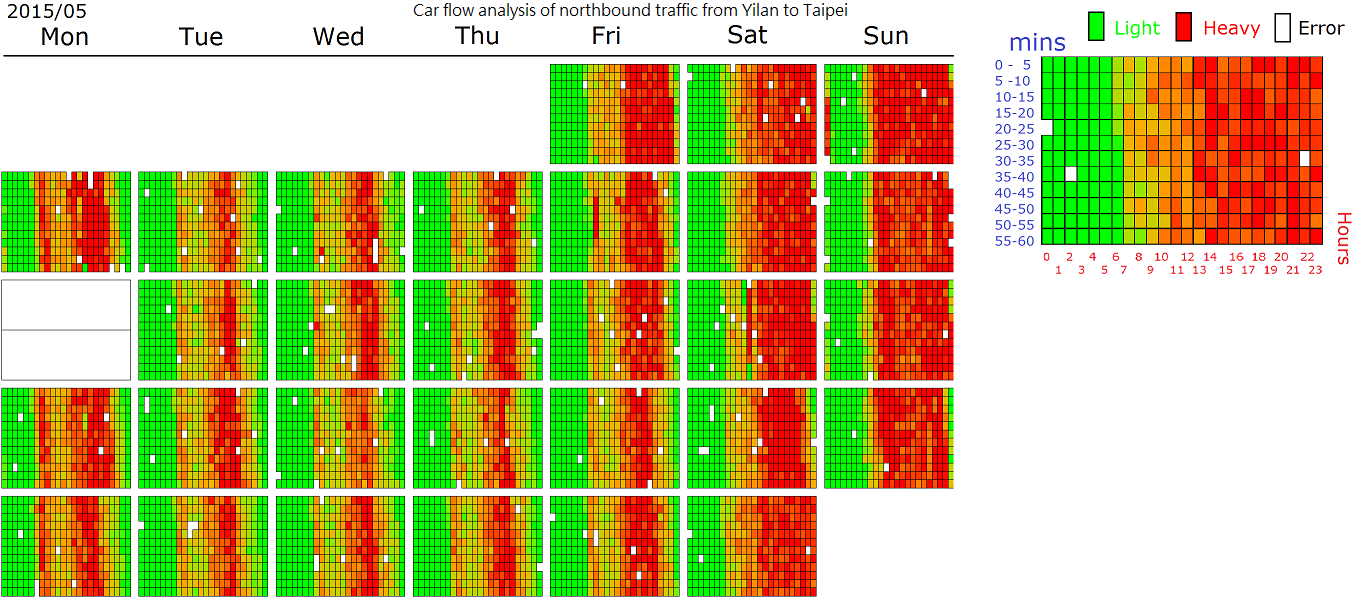
At the beginning of the project, we analyze the data from Taiwan Area National Freeway Bureau. And we find that the traffic is worse during Sunday afternoon or the last day of any holiday (see Figure 2). The traffic time starts from around 10am and would extend to as late as 11pm.

The only quick solution for this is to remove these people from Freeway 5 on Sunday afternoon. We would estimate the time the user could make it back to home, according to the destination point they choose, and we would show the user how long they can actually spend at destination view point and relax, and how long they would have to sit in the car and wait for the traffic (it is usually not a pretty number on the last day of the weekend). By this, we hope to reduce the amount of people go to Yilan on Sunday.
However, we aren’t trying to make people stay at home during the holiday; by analysis the destination which user chooses, we would suggest a similar point of interest to go around the Taipei area using our rating formula. The “bypass” would tell them how much time they can spend on actually playing, not on the traffic, if they go to this place instead of going to Yilan.

We hope for relief traffic jam on Freeway 5, but not the tourism economy of northern Taiwan.
How we built it
We analyze the traffic data from Taiwan Area National Freeway Bureau, and find traffic patterns, and we decide that if we can give drivers some incentive to drive to an alternative point. Not everyone has to stick with the traffic.
By analysis that traffic data from Taiwan Area National Freeway Bureau. We conclude four traffic patterns:
- There is a very little southbound traffic from Taipei to Yilan. Most of the traffic peaks occur around 3pm to 10pm on northbound direction, especially on the afternoon of Sunday or last day of a long weekend. The driving time could be tripled during this time.
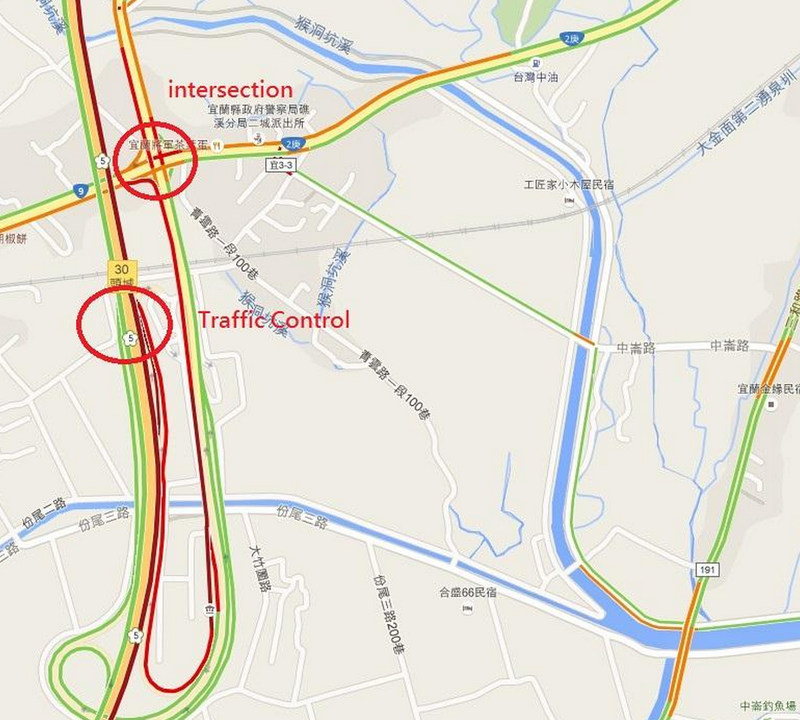
The critical traffic point is actually not on the freeway 5, but the Toucheng junction, which is the last entrance before entering the Hsuehshan Tunnel. The reason for this is the traffic controls on the junction which only allow as few as 12 cars go on the freeway every minute. This 3 km section can take up to 2 hours during rush hours.

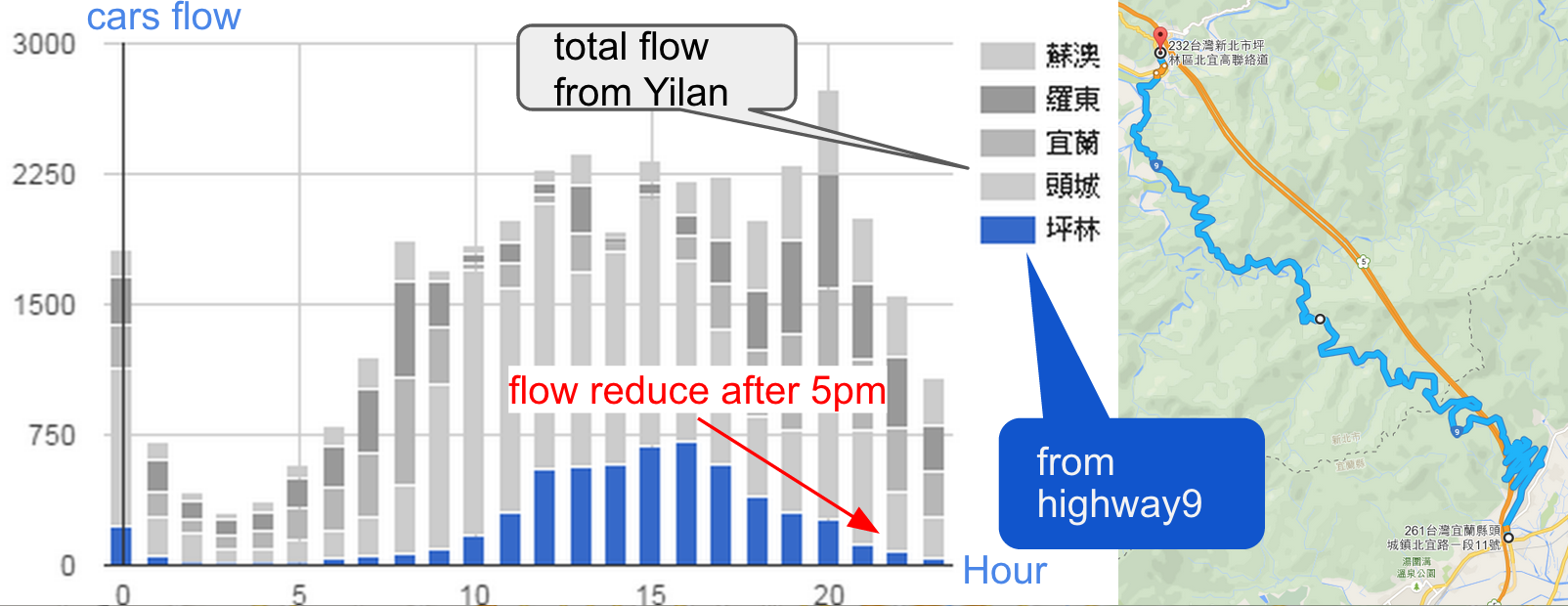
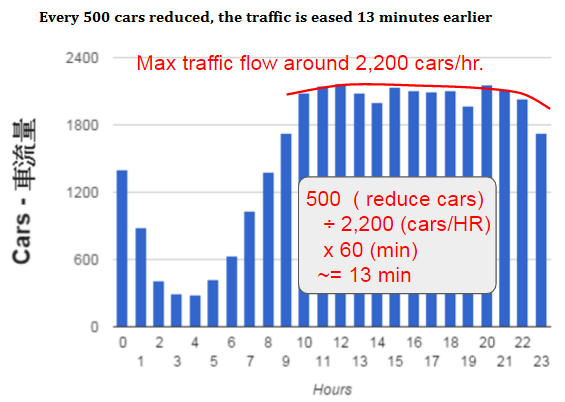
The maximum traffic flow without significant flow rate drops is around 2,200 cars/HR

Drivers are less likely to take the alternative routes after sunset.

The next step is to find what kind of travelers has highest tendency not to go on the Freeway 5 during the traffic hour. There are three types of drivers who are coming back from Yilan to Taipei on the last day of the weekend.
- One day tourist.
- Multiple day tourist
- Non-tourist (visit Yilan for other reasons.)
We decide to try to reduce the amount of traffic goes into Yilan from One day tourist drivers (Type 1) on the last day of the weekend for that they have other options. Type 2 and Type 3 travelers usually drive following a schedule; it would be harder to make them drive by another time.
In our application, we will give one day tourist some information in order to reduce their will to go on their trip.
Warn drivers about the amount of driving required for the round trip for the day. We would obtain real time data from National Freeway Bureau and calculate the time required to go to view point selected at Yilan. We would also estimate the return time of the trip and estimate the traffic time according to accumulated historical data. The time required to pass Toucheng junction is calculated separated, since it could take up to 60% of the time of the return trip. We want to estimate this time as accurate as possible.

Calculate the opportunity cost of the time spend on the traffic. The increased driving time is presented in different ways. (For example: it you use 1 extra hour of freeway, it would be equal to 200 dollars)
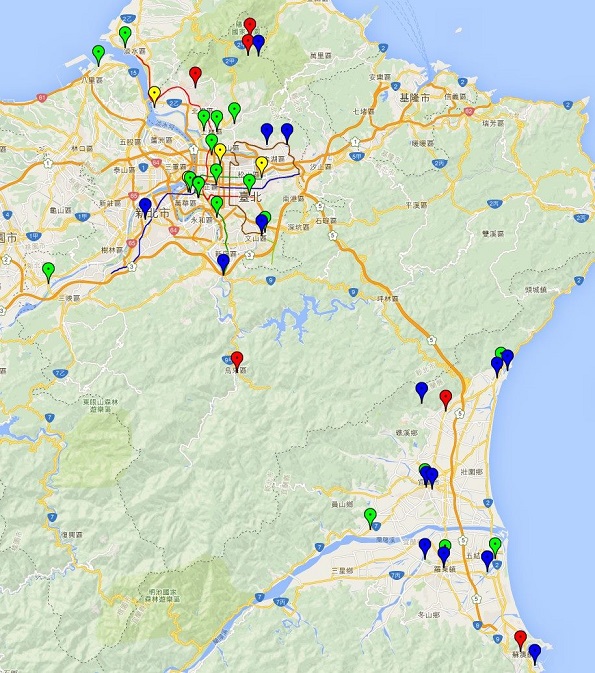
Offer an alternative location to go somewhere else. This location is going to be similar to the location the driver wants to go at Yilan.We collect major tourist point around Taipei area, and compare them with the tourist point at Yilan. We also gather ranking from Google Place/Maps API; therefore we can analysis the tourist point driver want to go and offer an alternative location with similar characteristic. We would also offer a driving time required for the round trip and show how much time the driver saved by going to this location. And we would skip the location which also takes a long time to get to.
The goal of the “bypass” is to help driver hit the road to the destination but not the endless traffic.
What do we expect from bypass?
Without changing current government policy, or build another freeway, the best way to reduce driving time would be reducing overall car flow when there are too many.
The main benefit of our system is to reduce amount of traffic only when there are going to be a traffic. The system would only recommend an alternative location if a traffic around the return time is expected. Therefore, reduce the amount of traffic when there are too many cars.
According to historical data, the overall driving time starts to increase when car flow exceeds 2,200 cars per hour. During the Sunday, this flow would keep going until 10pm. However, for every 500 cars reduced, the traffic is eased 13 minutes earlier. There are other ways to reduce overall car flow. However, bypass is a doable solution which we can deliver with the given data and circumstance.
What's next for bypass?
People want to go to a place and have a good time, but this place doesn’t have to be Yilan. And by not going to Yilan, they are helping people who have to go there having a better time.
- More accurate driving time estimation. The best way to earn trust of our users is giving them accurate time estimation.
- More accurate tourist point suggestion. Our goal isn’t keeping people from going out at the weekend, but gives them a better solution to escape from the urban environment.
Supplement
1. Why alternative routes wouldn’t work?
There are two alternative routes
- Provincial Highway 2
- Provincial Highway 9
Provincial Highway 2 is a long way around the north shore; it could take 2 hours to drive back to Taipei even when there is no traffic. Provincial Highway 9 leads driver into the mountains. It is extremely challenging to drive there, especially after dark or while the driver is exhausted from the day trip. There are also quite some accident occurred due to the driving conditions. Unless some extreme condition takes place on Freeway 5, it is still much safer and faster to travel on Freeway 5.
2. Why is bypass aim to one day trip drivers?
We separate drivers on Freeway 5 on the last of the weekend into 3 different groups
- One day tourist.
- Multiple day tourist
- Non-tourist (visit Yilan for other reasons.)
The reason we aim at one day tourist (type 1) is because that it is not likely to change driving pattern of the other two groups of people. They are already there, and they are usually on a schedule. They have to get back to the Taipei area before Monday. On the other hand, one day tourist is looking for a place to spend their holiday. They don’t have to go to Yilan.
For the one day trip, even if they have to go to Yilan, it would be much easier to go on Saturday. Just don’t go there on Sunday.


Log in or sign up for Devpost to join the conversation.