Project Story: Temporal Navigator — Consciousness-Oriented Temporal Calibration
Inspiration
Our modern existence is paced by a narrow, linear temporal prison: the standardized -hour clock and the Gregorian grid. Designed for industrial efficiency and administrative tracking, this model reduces Time to dry, numeric intervals of falling sand—generating structural cognitive stress, attentional fragmentation, and disconnect from biological realities. Temporal Navigator was born from a radical question: What if time is not a passive line we consume, but a dynamic, active field of consciousness we navigate? Two fundamental pillars form the genesis of this project: The Maya Calendrical Matrix: A multidimensional, repeating spiral of time consisting of the Tzolk'in ( -day sacred cycle representing human archetypal and energetic frequencies) and the Haab' ( -day ecosystem-solar cycle representing macro-evolutionary planet states). The Syntergic Theory: Formulated by Mexican neurofisiologist Dr. Jacobo Grinberg-Zylberbaum. Dr. Grinberg proposed that the brain structure interacts with a hyper-dimensional holographic matrix (the Lattice). Higher neural coherence ( ) allows the brain to experience reality outside mechanical limitations, syncing directly with the underlying geometries of the universe. By uniting the cycles of Maya chronology with Phase-Coupled Oscillator physics, we created an interface that shifts representation from linear counting to field calibration.
What It Does
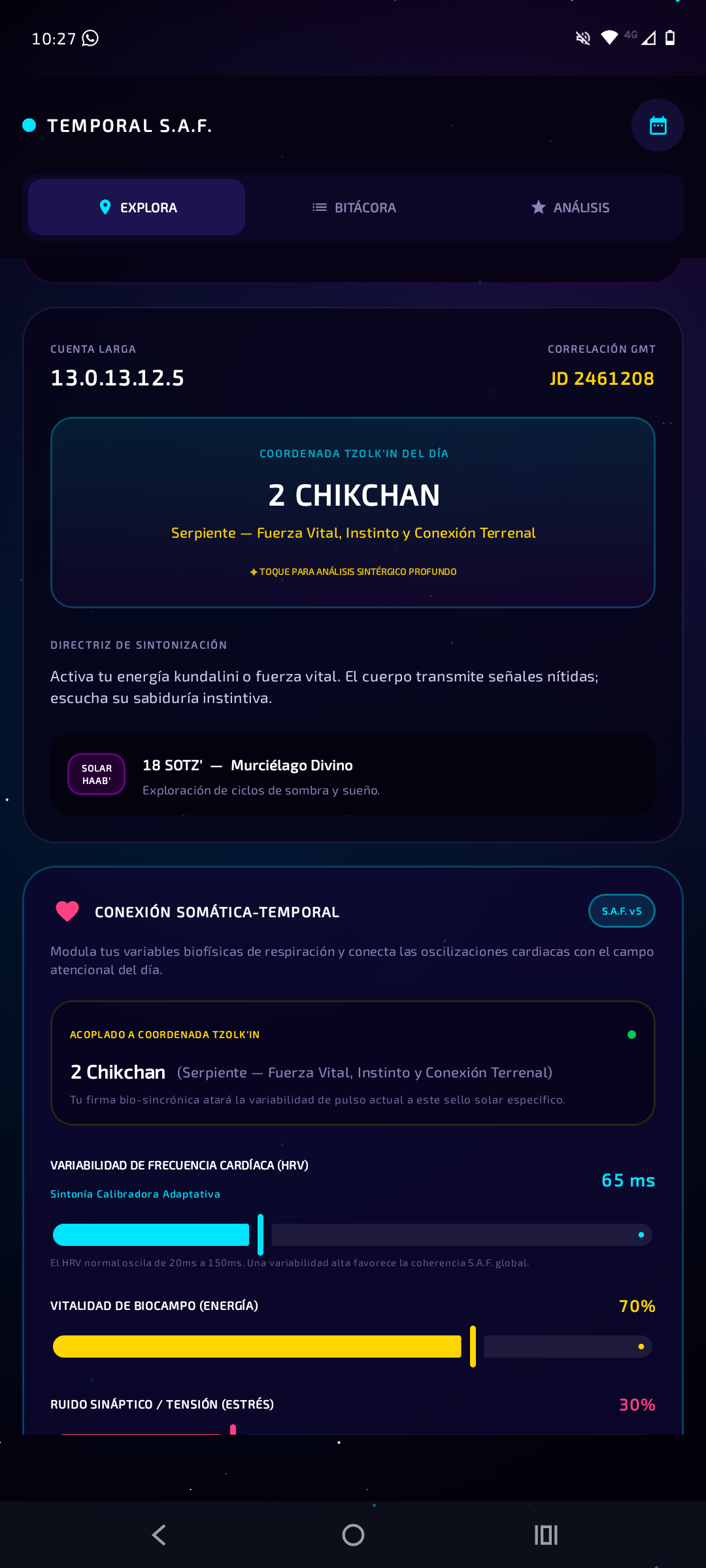
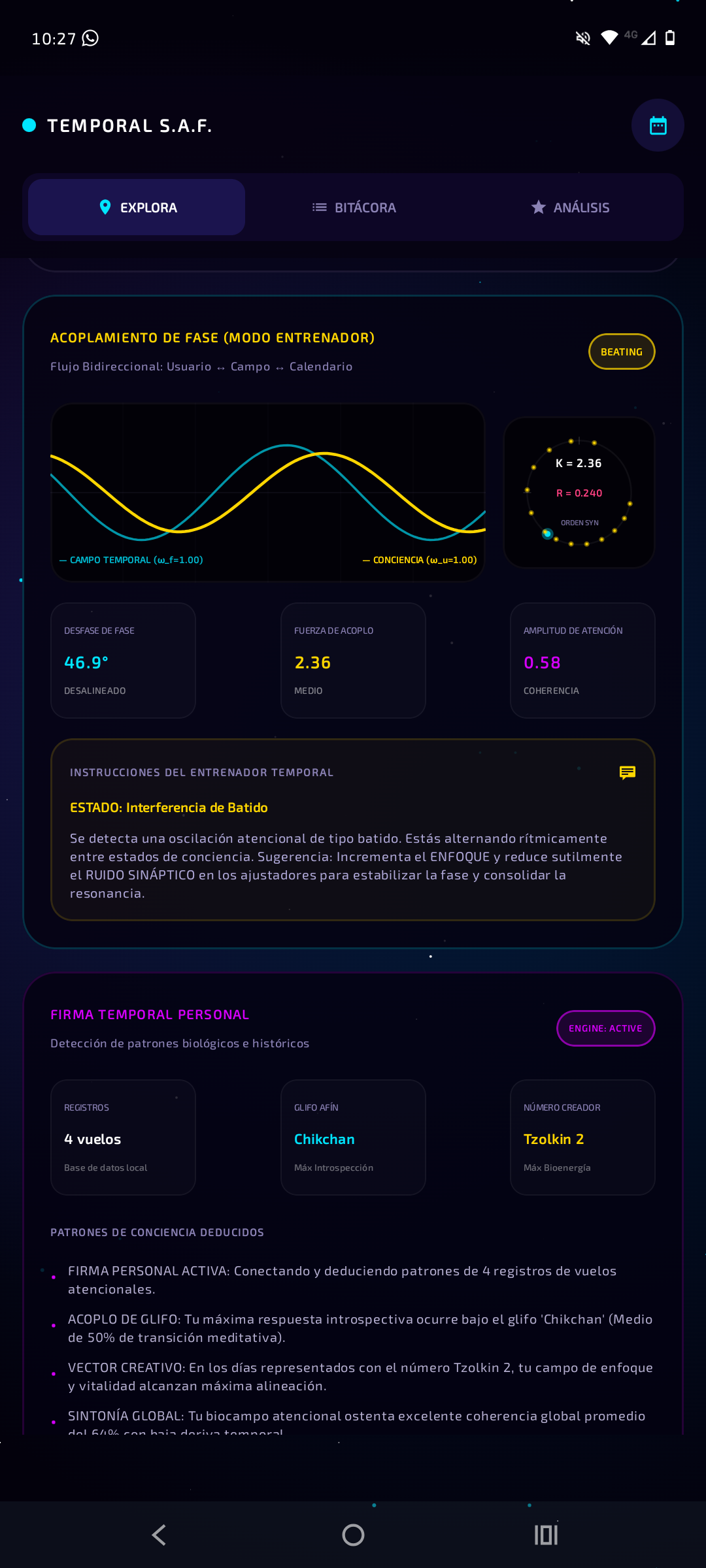
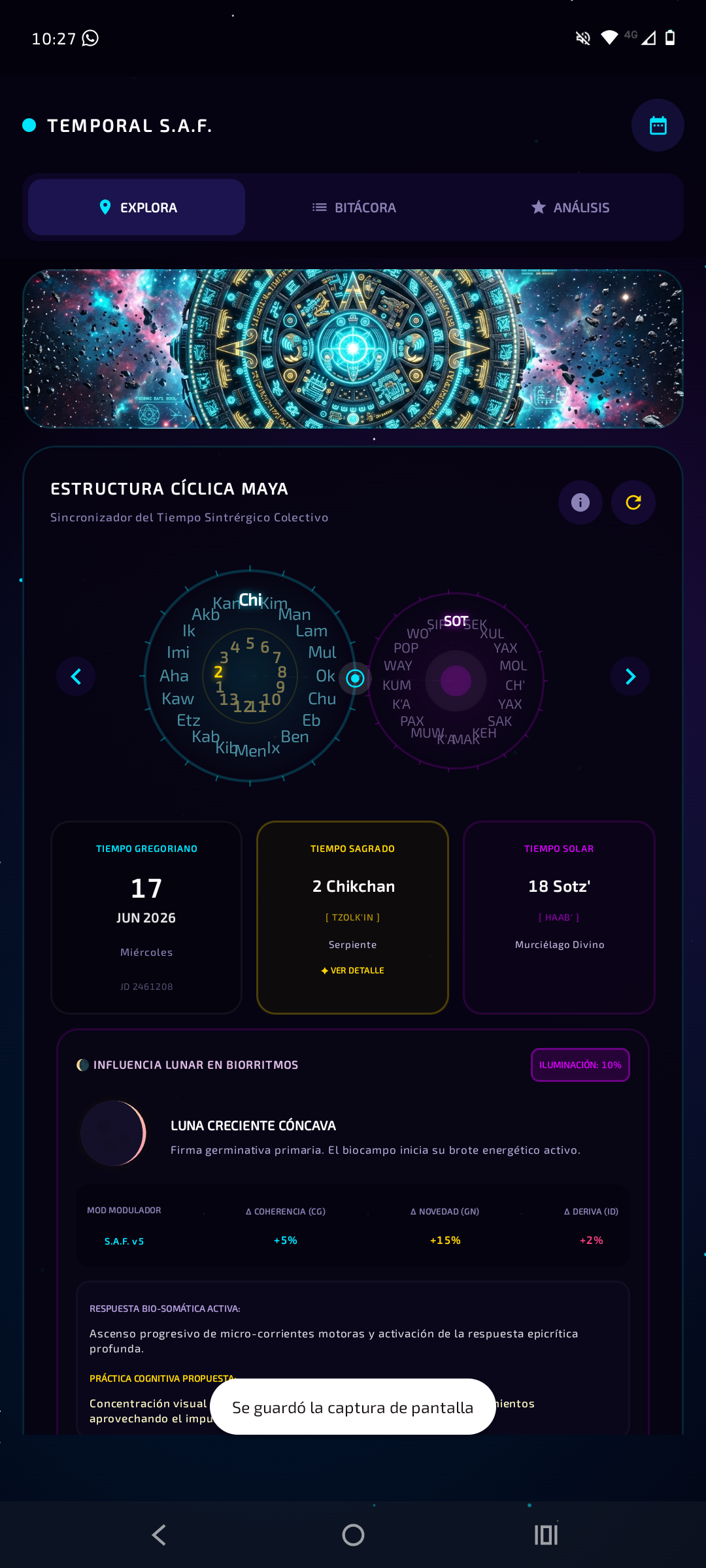
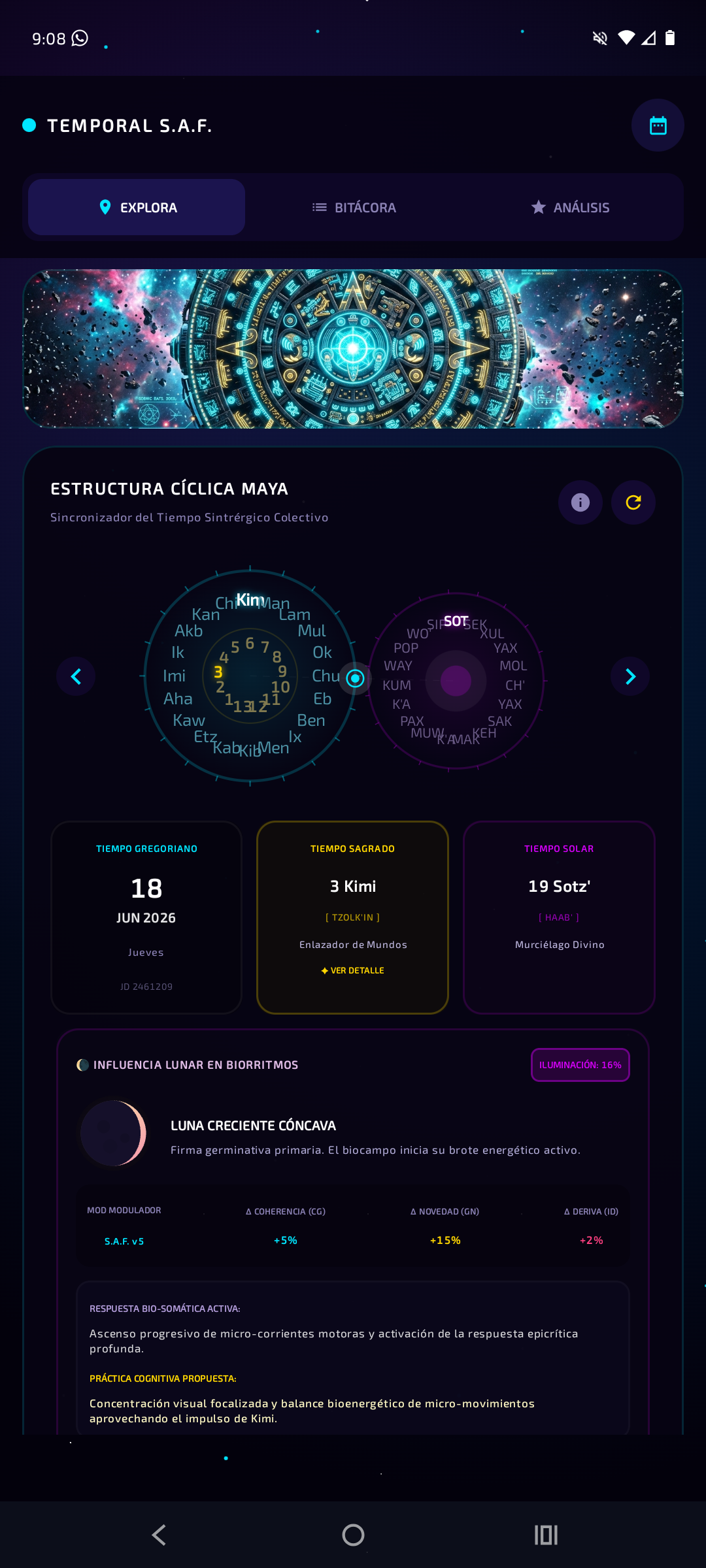
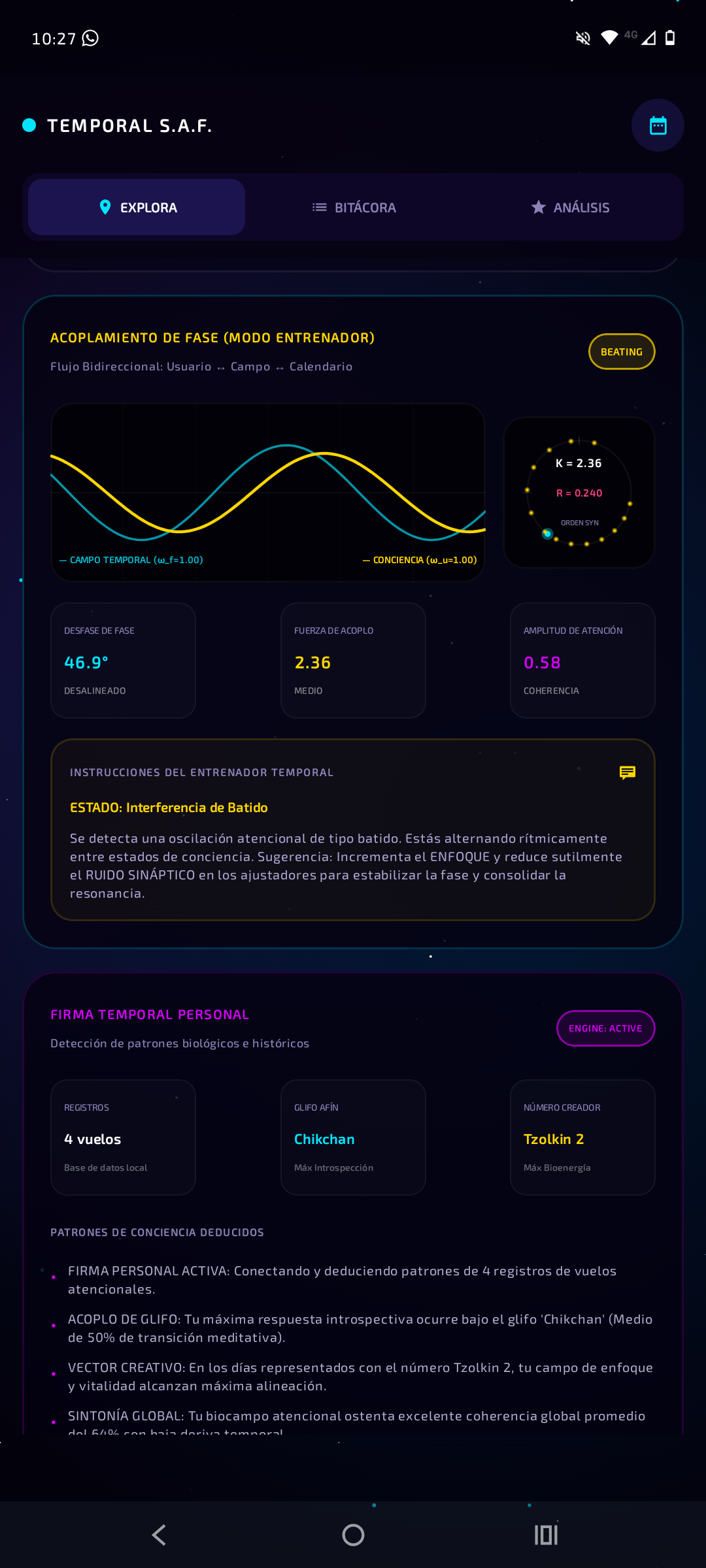
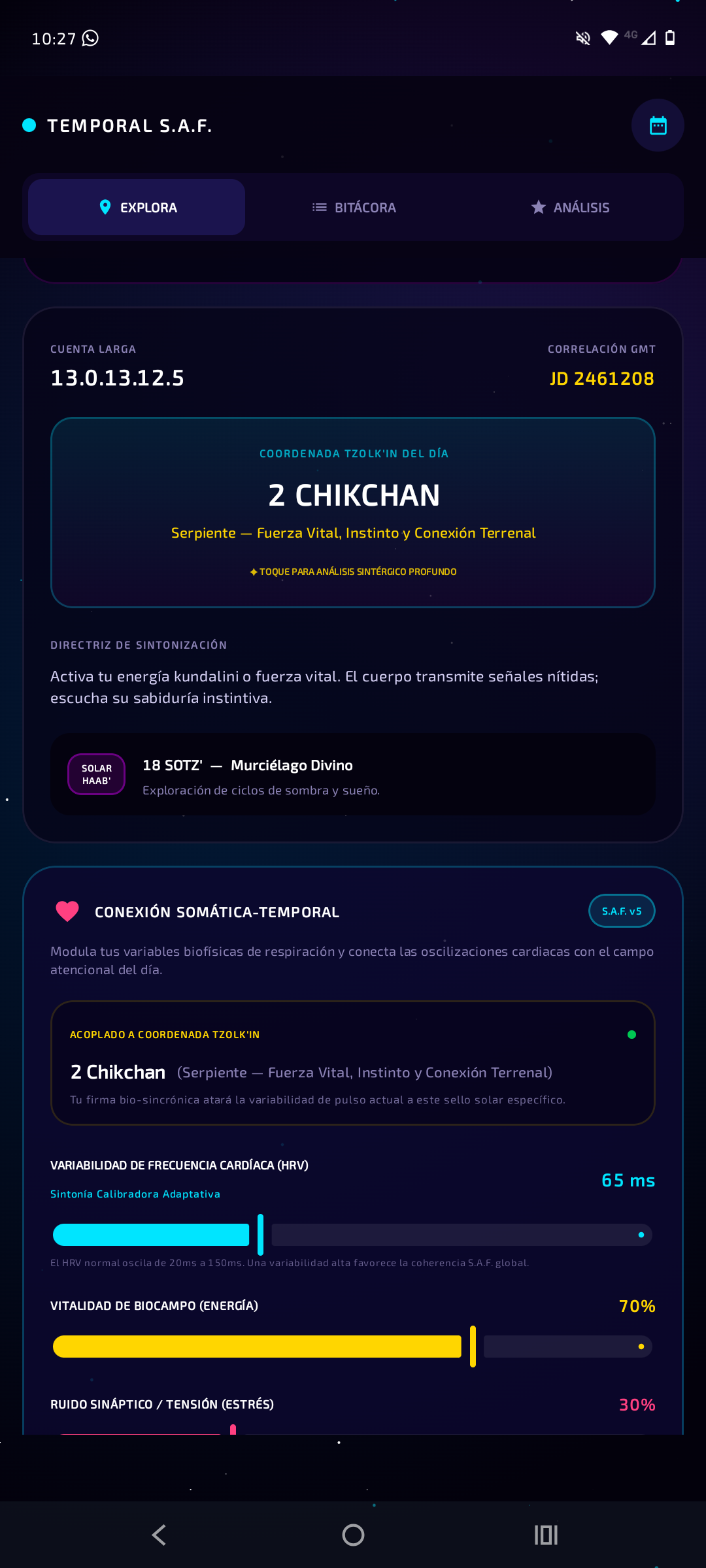
Temporal Navigator is a closed-loop cognitive telemetry instrument and portal synchronizer. It functions as an immersive, cyber-mystical dashboard that allows users to study, calibrate, and record their psychological states against cosmic alignments. Core Architecture Capabilities: Biomorphic & Somatic Sliders: Users log daily vectors—such as sleep patterns (somatic integration), focus indexes, mindfulness states, and stressors. The S.A.F. (Syntergic AI Framework v5) Telemetry Engine: Calculates cognitive parameters in real time using rigorous mathematical coupling models: Coherencia Global ( ): Measures neural focus and system alignment. Gradiente de Novedad ( ): Represents adaptive openness and neuroplastic capacity. Índice de Deriva ( ): Quantifies attention entropy, noise, and mental drift (lower is better). Potencial Transferido ( ): Expresses the coupling interaction potential with the global field. The Master Index Omega ( ): Operates as the system's global resonance score, mathematically defined by:
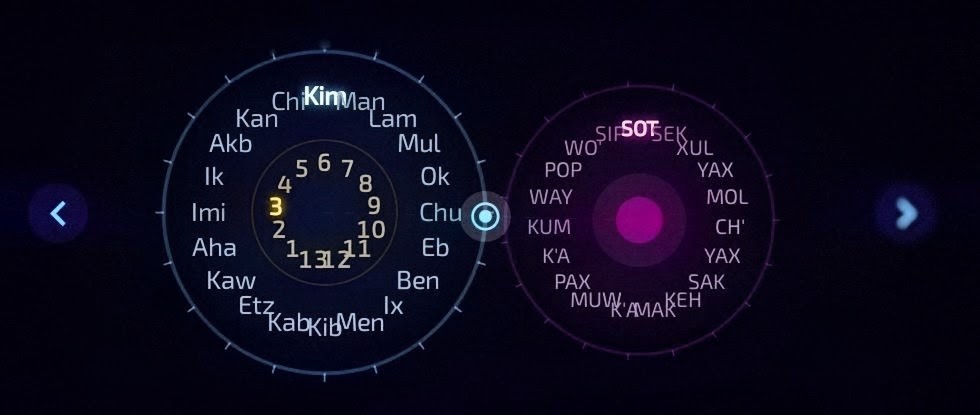
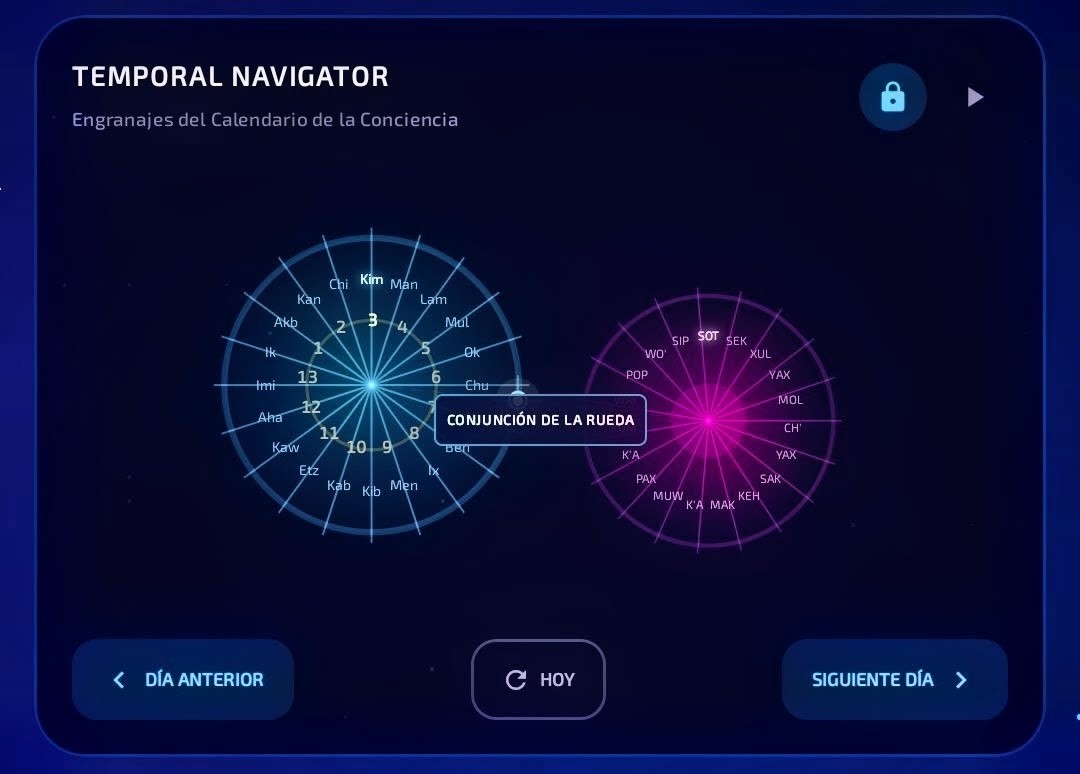
Where is the Kuramoto Order Parameter representing phase lock. An signals Total Resonance, while indicates Desynchronized Chaos. High-Fidelity Polar Geometry Dials: High-performance dynamically interactive rings rendering Tzolk'in tones, glyphs, and Haab' months. Users can scrub forward or backward through time (time-travel flight simulation) to preview future astronomical gateways or align past states. Episodic Memory Database (Room): Notes, somatic scores, and S.A.F. telemetry are committed to SQLite local memory, forming a Personal Temporal Signature (PTS) log over long horizons. Sintrégico Onboarding & Tutorial Portal (NEW): An elegant, interactive modal dialog that introduces new users to the terminology, definitions of the Maya cycles, explaining the why and the how under cosmic design philosophy.
How We Built It
We built the application for modern Android baselines using a fully reactive Architecture: UI Framework: 100% Jetpack Compose using responsive, modern layouts. We avoided generic design systems in favor of an immersive Cosmic Deep Dark Palette: deep black-violet backdrops, neon cyan tracers, syntergic gold markers, and glassmorphic panels. Database & Code Gen: local SQLite storage backed by Room Database and optimized using KSP (Kotlin Symbol Processing) for lightweight asynchronous data transactions. Telemetry Math Engine: Built with Kotlin coroutines. Trigonometric transformations calculate polar angles for the Canvas wheels:
The Kuramoto Order Parameter ( ) is evaluated on-device to determine the synchrony of bio-inputs and calendar gears: Threading model: StateFlow and ViewModel architectures prevent unnecessary screen redraw loops, shifting frame rates from custom interactive Canvas rendering at down to idle state configurations at to conserve mobile battery health.
Challenges We Ran Into
Bridging Ancient Cycles with Modern Algorithms: Correlating Mayan cycles with the Gregorian calendar requires pinpoint accuracy. We implemented the traditional GMT Goodman-Martínez-Hernández correlation constant ( days offset) using a Julian Day Number (JDN) algorithm. We had to ensure zero double-precision rounding drift during calculations deep into the past or the future. State Synchronization and Bidirectional Redraw Loops: Users scrubbing the circular dials trigger rapid changes in the Calendar model, which recalculates the S.A.F. telemetry, which in turn redraws the canvas components. Originally, this caused a feedback loop of recompositions. We resolved this by constraining state propagation inside the ViewModel using a distinctUntilChanged() Flow gating system. Explaining Abstract Concepts simply but deeply: For people unfamiliar with Mayan cosmology or Grinberg's physics, a complex engine can look like "AI noise." We focused heavily on designing the Onboarding Tutorial, structuring the lessons into five digestible steps focusing on definitions, math, the biological reasons for cyclical tracking, and how to utilize the sliders.
Accomplishments That We're Proud Of
A Zero-Lag Aesthetic Interface: Custom-drawn canvas gears featuring complex rotational math running seamlessly on standard mid-range mobile devices. A True Cognitive Mirror: By moving the biophysical sliders, the UI responds with glowing interactive wave shapes—providing visual biofeedback that immediately aligns the user's perception of focus and chaos. Beautiful Code Architecture: Solid integration of Clean Architecture principles where mathematical modules are separated from view renderers, proving that spiritually-inspired, scientific concepts can be built with production-grade standards.
What We Learned
Temporal Relativity in UX: Designing UI for cyclical time forces you to abandon standard rectangular calendar cards. We learned that Polar Space is first-class architecture; polar coordinates ( ) are far more natural than Cartesian coordinates ( ) when representing cyclical human experience. The Principle of the Observer: In building this system, we proved that tracking mental states with historical-symbolic coordinates reduces cognitive entropy itself. The user influences the system measurements and the telemetry feedback calibras the user’s next frame of focus. Epistemic Clarity: High-dimensional models are meaningless without explanation. The newly added step-by-step onboarding guide bridges quantum physics, pre-Hispanic calendar systems, and modern wellness into an understandable, beautiful handbook.
What's Next for Temporal Navigator (The Future of the Project)
The Navigator is designed with a forward-looking vision and compatibility to evolve through the following projected modules of SAF theory:
- Personalized Temporal Signature of Consciousness (TSC) Prediction:
The system will analyze your log from past months using lightweight AI algorithms to identify your "Natural Resonance Days," advising you when to plan creative tasks, when to meditate more, or when to rest according to your temporal biography.
- SAF v6 - Temporal Heat Atlas:
3D visualizations of the time field to show accumulated global coherence peaks.
- SAF v8 - Multi-user Phase Synchronization (Resonancia Colectiva):
Optional ability to synchronize your meditation cycle with that of friends or family in the same city to generate mutually phase-tuned neural fields.
- Advanced Interactive Guidance:
The yellow indicator with the "i" button in the top bar lets you reopen the intuitive Syntrige Learning Core at any time, so a new user will never feel lost.
This guide can be reviewed within the interface with a single button

Log in or sign up for Devpost to join the conversation.