-
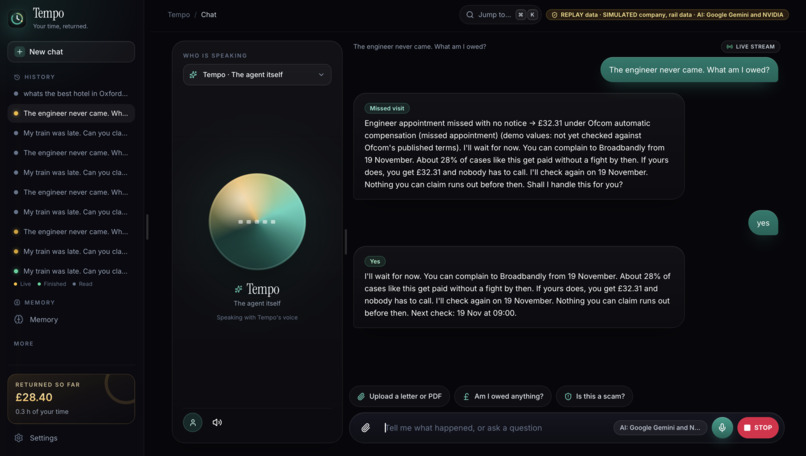
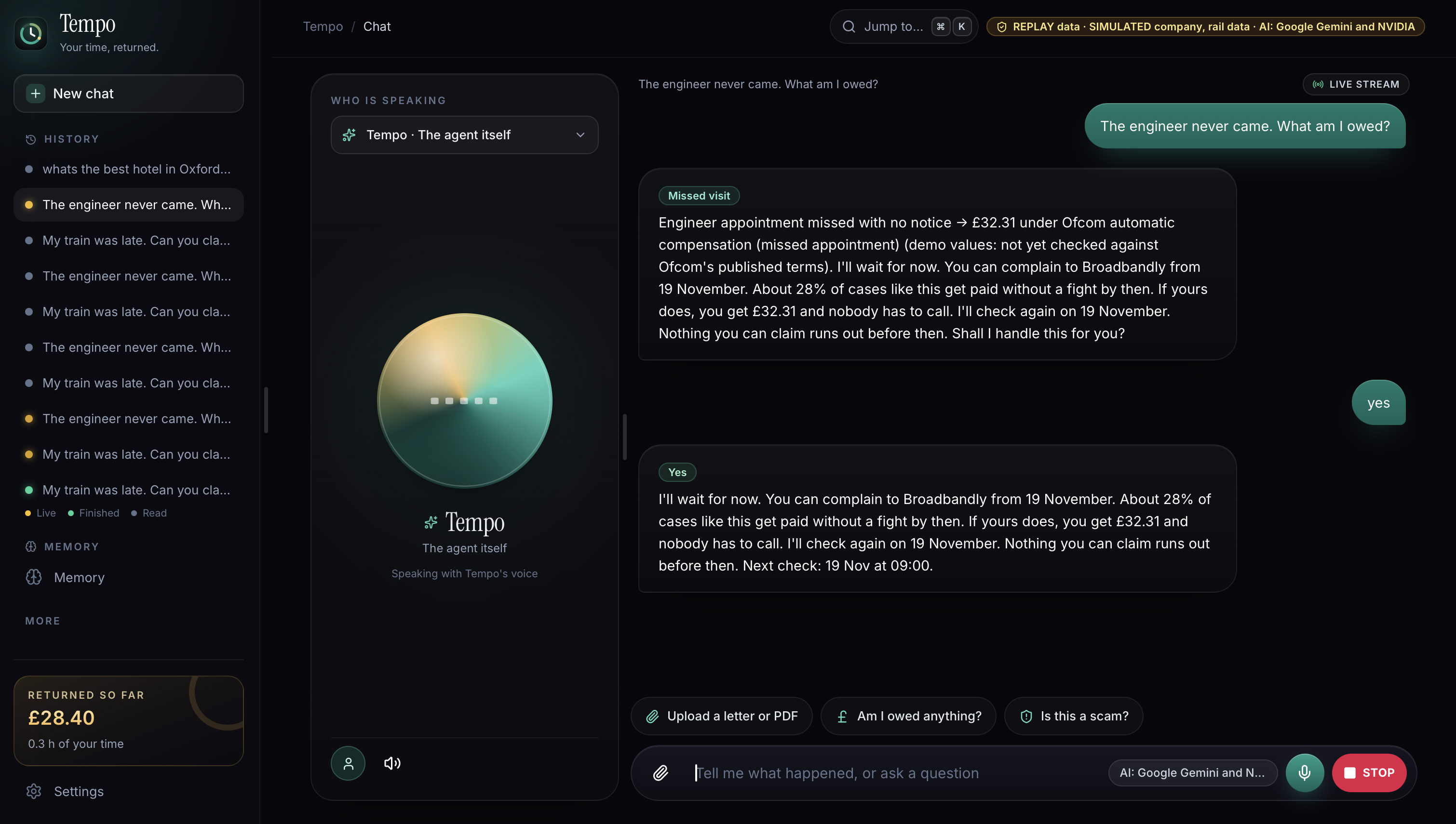
UI
Only 45% of eligible UK rail passengers claim delay compensation, and an estimated £24.1bn a year in benefits goes unclaimed, mostly because claiming means forms, phone queues and deadlines. Two in three people want an AI to deal with companies for them, yet only 5% would trust one to act even with their approval. So we built Tempo, an open-source agent you can reach by landline, text or the web. It works out what you're owed from rule packs written as code. Three models from three providers check the case. It weighs the claim against what your time is worth: roughly $pA - \frac{m}{60}v$, the chance-weighted payout minus the minutes it costs you at your hourly value. And it acts only on a passkey-signed yes.
We built it with a Vite, React 19 and Tailwind web app and a Python 3.12 FastAPI backend. NVIDIA Nemotron runs the chat, Microsoft Agent Framework runs the workflows, Gemini and MiniMax sit on the Consensus Court, ElevenLabs and Twilio handle voice and SMS, MCP connects the tools, and PostgreSQL with pgvector and Mem0 holds memory. The hardest part was keeping models away from money: amounts come only from code, and guardrails check consent before any tool runs. Our scam model first scored a genuine council-tax reminder 0.98, almost certainly a scam, which taught us that a model's confidence isn't evidence. It now only triggers a warning when the rules agree. The biggest lesson: trustworthy agents come from a simple split, where models read and plan, code decides, and guardrails enforce.
Built With
- claude
- elevenlabs
- gemini
- nvidea-nim
- openrouter
- react.js
- typescript


Log in or sign up for Devpost to join the conversation.