-
-
Tempo Logo and Branding
-
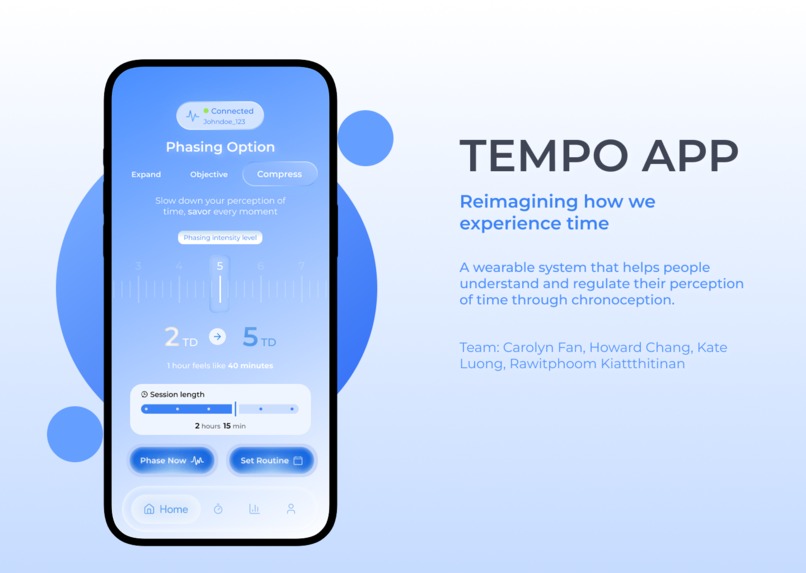
Tempo Mobile App Interface
Inspiration
Sometimes time feels like it flies by when we’re stressed or busy, and other times it slows down when we’re deeply focused or present. We want to delve into this human sensory experience and found that this is related to chronoception, which is our brain’s perception of time.
We started wondering what it would look like if we could actually see and understand how our mind experiences time in real life. Most apps track productivity or time spent on tasks, but they don’t show how our mental state affects how time feels. That idea inspired Tempo, a tool that helps make our internal sense of time more visible and understandable.
What it does
Tempo is a wearable patch that users place on their temple. Once the patch is applied, the app begins a calibration process to learn the user’s natural rhythm by measuring signals such as heart rate variability, breathing pace, focus stability, and neural patterns. This helps Tempo understand how the user’s body and mind normally respond to stress, focus, and relaxation.
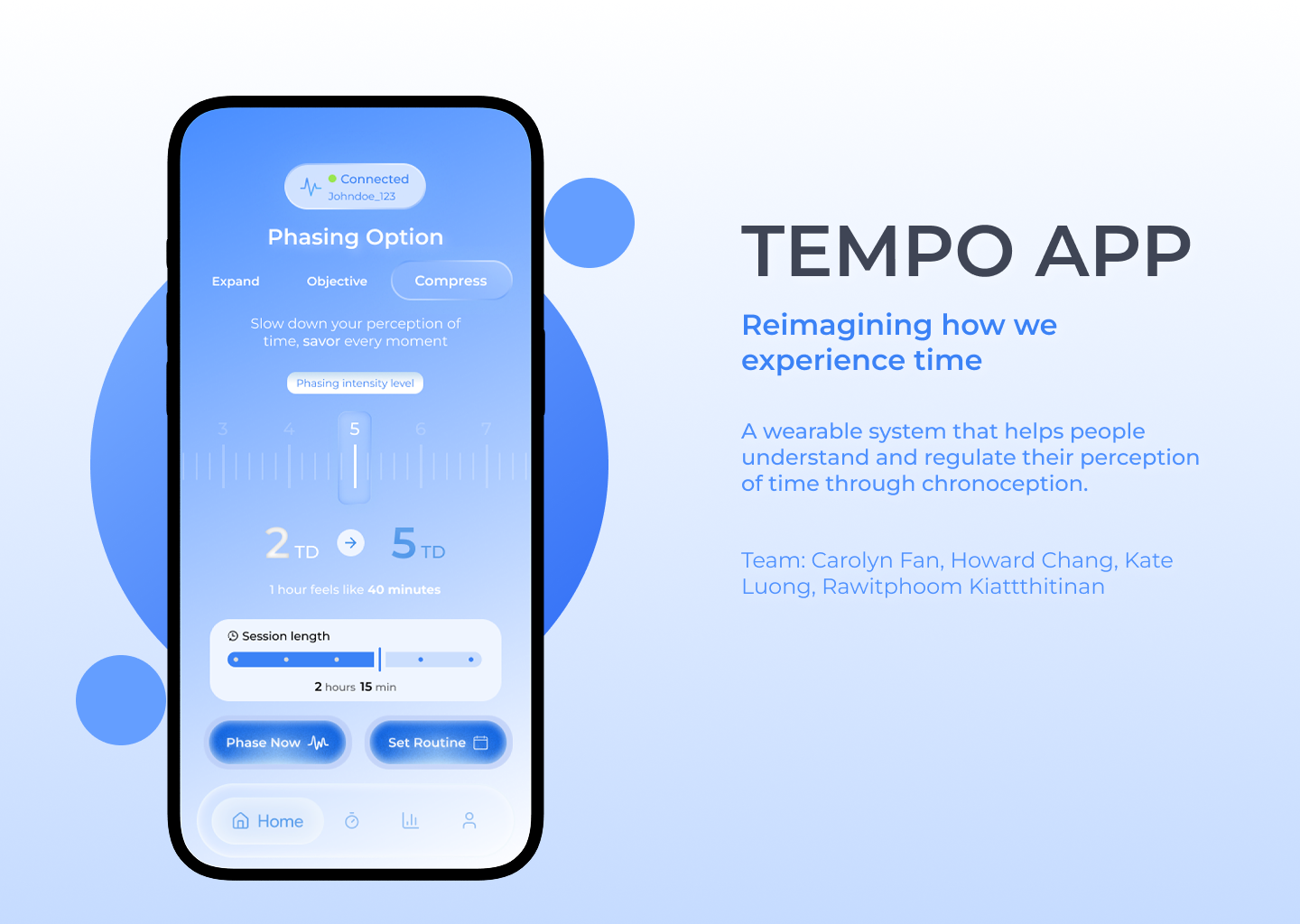
After calibration, Tempo can guide users into different sensory experiences that influence how they perceive time. For example, users can choose experiences designed to slow down time for deep focus, reflection, or mindfulness, or speed up time to help routine or repetitive tasks feel shorter and more manageable. These experiences use visual, auditory, and rhythmic cues that interact with the user’s physiological signals to shift their mental pacing.
While users go about their day or complete a session, Tempo passively tracks patterns such as mental pace, attention stability, breathing rhythm, and energy levels. At the end of a session, the app provides a simple summary showing how the user’s focus changed and how their perception of time may have shifted during the experience. Over time, Tempo helps users better understand their personal rhythm of time and attention, and learn how to intentionally create states of deeper focus or faster mental pacing when they need it.
How we built it
We built Tempo as a fully interactive prototype in Figma, designing both the wearable patch and the mobile application experience. The patch itself was designed as a small adhesive sensor placed on the temple, which conceptually collects physiological signals like heart rate variability, breathing pace, and neural activity patterns.
On the software side, we created a fully functional mobile prototype that simulates how the Tempo system would work in real life. This includes the onboarding process, calibration phase, real-time data tracking, and sensory experiences that allow users to choose whether they want to slow down or speed up their perception of time.
Challenges we ran into
One of the main challenges we faced was deciding what type of device would work best in a real-life context. Since Tempo is meant to be worn throughout the day and interact with users naturally, we explored different possibilities such as AR interfaces or other wearable formats. In the end, we decided to focus on a mobile app experience, since it is more accessible and something people are already comfortable using in their daily lives.
Another challenge was figuring out how to present the data to users in a way that is transparent but still easy to understand. Tempo deals with concepts like chronoception and perception of time, which are abstract and not something people are used to seeing as data. We had to carefully decide which signals to show such as heart rhythm, breathing pace, and focus stability, and how to translate them into simple insights rather than overwhelming users with technical information.
Accomplishments that we're proud of
One accomplishment we’re proud of is being able to turn a fairly abstract concept like chronoception into something tangible that users can interact with. Instead of just tracking time like most productivity apps, Tempo focuses on how people actually experience time, which made the idea feel more unique and meaningful.
We’re also proud of building a fully interactive prototype in Figma that shows the entire user journey, from onboarding and calibration to sensory experiences and data summaries. Even though it’s a prototype, users can clearly see how the patch, the app, and the feedback system would work together as a real product.
Finally, we’re proud of the way we tried to make complex biometric signals understandable. By translating data like heart rate variability, breathing pace, and neural activity into simpler insights like mental pace and focus stability, we made the concept easier for users to interpret.
What we learned
Through this project, we learned how challenging it can be to design around something as intangible as time perception. Since chronoception can’t be measured directly, we had to think carefully about which signals could represent it and how those signals should be visualized for users.
Another takeaway was understanding how important context and accessibility are when designing wearable technology. Choosing to use a mobile app interface helped make the concept more realistic and easier for people to imagine using in their everyday lives.
What's next for Tempo
Moving forward, we would like to further develop the sensory experiences that influence time perception, exploring how visual, auditory, and rhythmic cues can help users intentionally slow down or speed up their perception of time.
We would also want to improve the data insights and personalization features as Tempo collects more data over time. This way it could learn each user’s unique rhythm and provide more accurate recommendations for when to enter focus states, take breaks, or manage mental pacing.
Built With
- figma


Log in or sign up for Devpost to join the conversation.