Inspiration
Time management tools have existed for decades — but they all track clock time. What nobody had addressed is the gap between clock time and felt time. Our research with 50 participants revealed something consistent: people aren't losing their days because they don't know what time it is. They're losing them because they can't feel time distorting until it's already gone. That insight led us to chronoception — the scientifically recognized but largely invisible human sense of time perception. We wanted to make that sense legible for the first time.
What it does
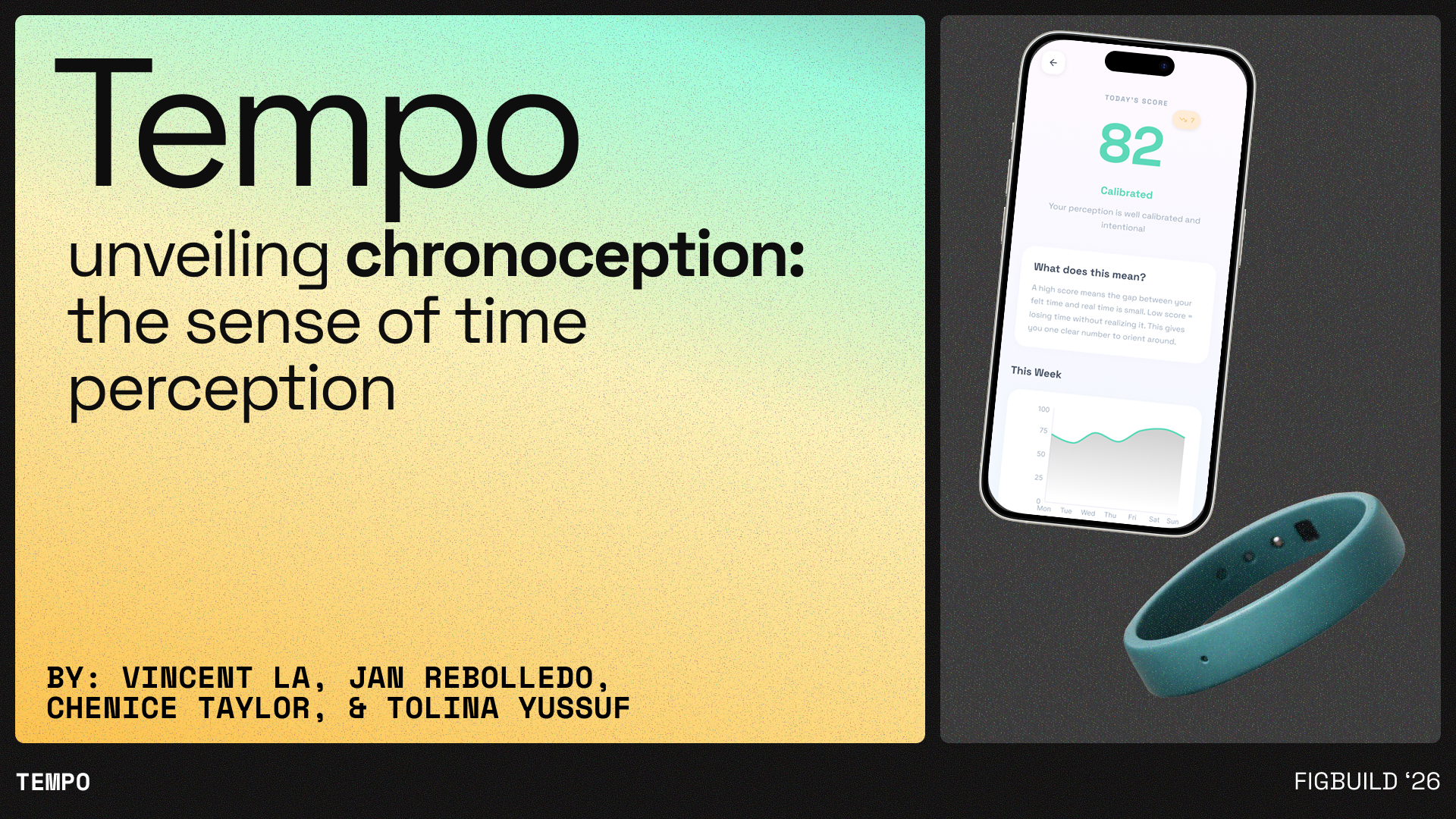
Tempo is a speculative wearable and mobile experience that tracks, measures, and influences chronoception. A wristband passively reads biometric signals — heart rate variability, skin conductance, body temperature, and movement — and cross-references them with calendar data, deadline proximity, and personal history to detect which of three time states you're in: Drag (time crawling), Flow (locked in), or Slip (deadline closing fast).The mobile app translates all of that into three layers: a single daily Tempo Score reflecting the gap between felt and real time, a State Dashboard showing your current state and weekly patterns, and Drift Alerts that speak felt-time language rather than clock-time warnings. The system also forecasts your likely state before your day starts — so you can prepare instead of react.
How we built it
We started in FigJam, using it to synthesize our primary research — running affinity mapping sessions to cluster survey responses into the insights that shaped our three-state model, design principles, and user archetypes. From there we moved into Figma Design to build out the full mobile experience, onboarding flow, and hardware concept. Finally, we used Figma Make to bring the core functionality to life as an interactive prototype — demoing the Temporal Calibration Test onboarding, the State Dashboard, and a Drift Alert in action.
Challenges we ran into
Designing for a sense that is invisible and unconscious meant we couldn't rely on familiar interface patterns. How do you visualize something people have never seen represented before? Finding the right language was one of our biggest challenges — Drift Alerts in particular went through many iterations before we landed on felt-time framing that felt honest rather than manipulative. We also had to hold a constant tension between giving users meaningful new information and not overwhelming them — our research made clear that cognitive overload was a dealbreaker, so every design decision had to earn its place.
Accomplishments that we're proud of
We're proud that every major design decision in Tempo is traceable back to something a real person told us. The three-state model, the single-number Tempo Score, the no-guilt mechanics, the felt-time language in alerts, even the physical band concept — all of it was validated by our research before it became a design choice. We're also proud of the Temporal Calibration Test as an onboarding concept — it's novel, memorable, and does something no other wellness tool does: it builds your personal baseline from the very first interaction.
What we learned
We learned that the most important design constraint wasn't aesthetic — it was emotional. Users don't want to be lied to, guilted, or made dependent on a tool to function. Those three fears shaped Tempo more than any interface decision. We also learned that speculative design is most powerful when it's rooted in real human need — the further out the concept, the more important the research underneath it becomes. Chronoception felt fantastical at first. The data made it feel necessary.
What's next for Tempo
The immediate next step is usability testing the prototype with users from our original research cohort — particularly to validate whether the Temporal Calibration Test successfully builds trust during onboarding. From there, we'd want to explore the hardware side more deeply: sensor feasibility, haptic vocabulary, and what a real band form factor could look like. Longer term, Tempo has natural expansion paths into academic institutional partnerships, integration with Canvas and calendar platforms, and potentially a group or team mode — helping people understand not just their own time states, but how they sync with the people they work alongside.
Built With
- claude
- figjam
- figma
- figma-make


Log in or sign up for Devpost to join the conversation.