-
-
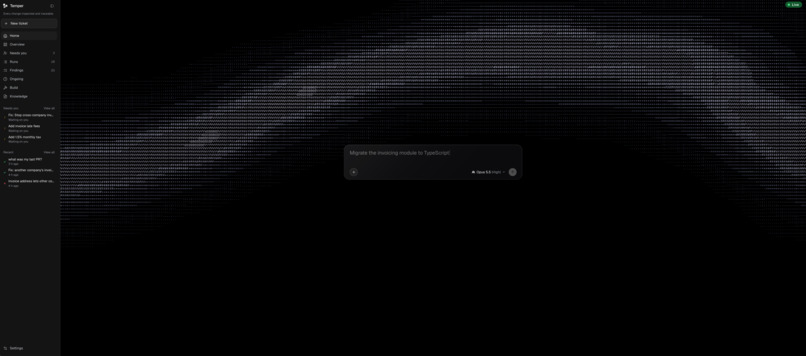
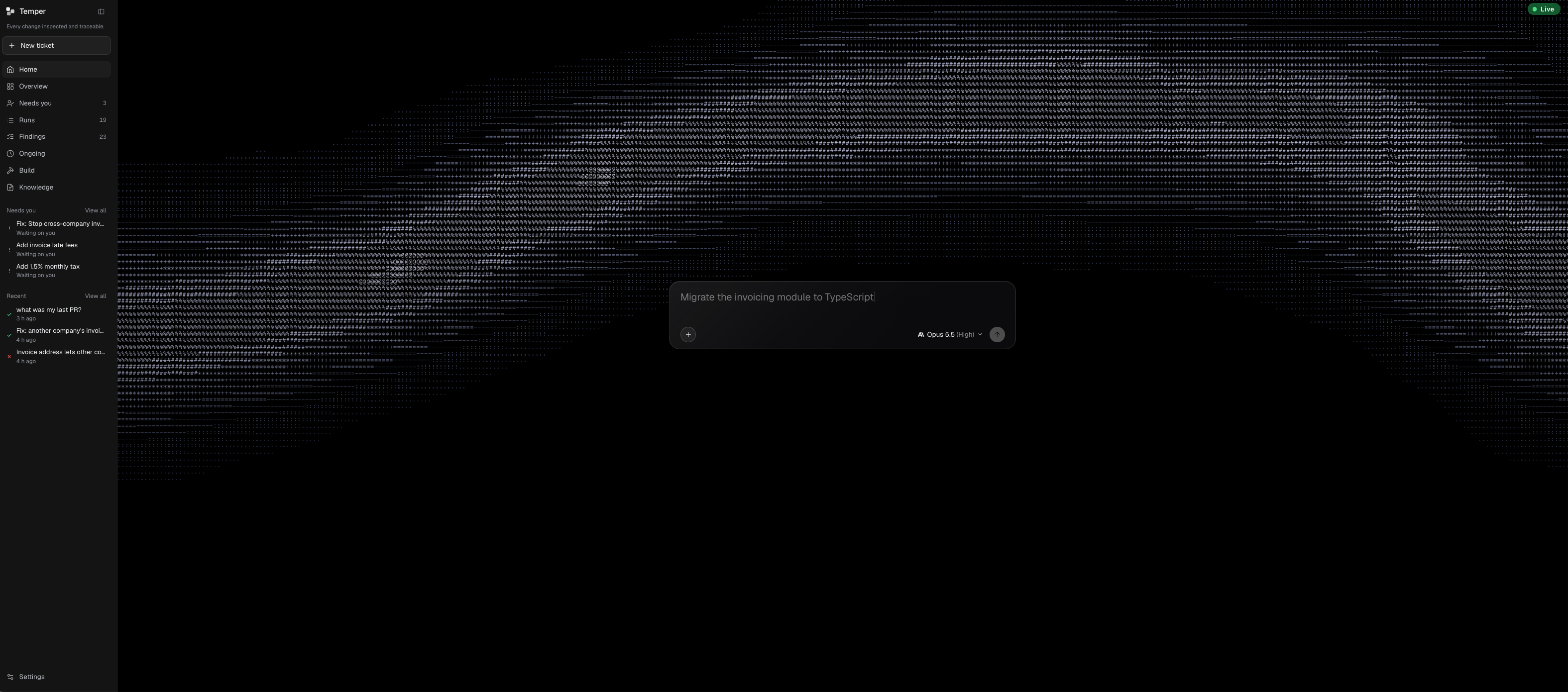
The Home Page
-
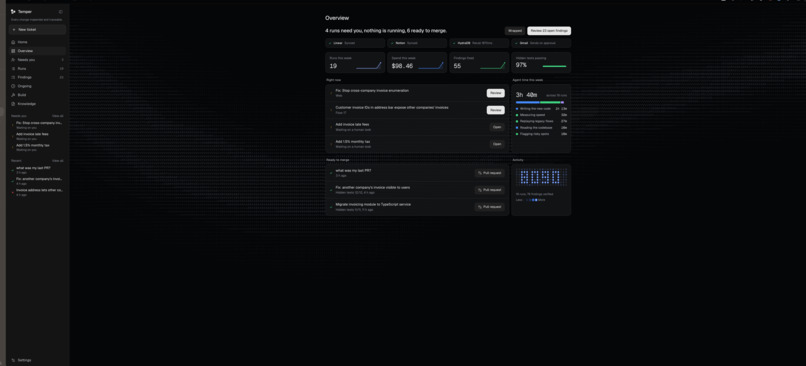
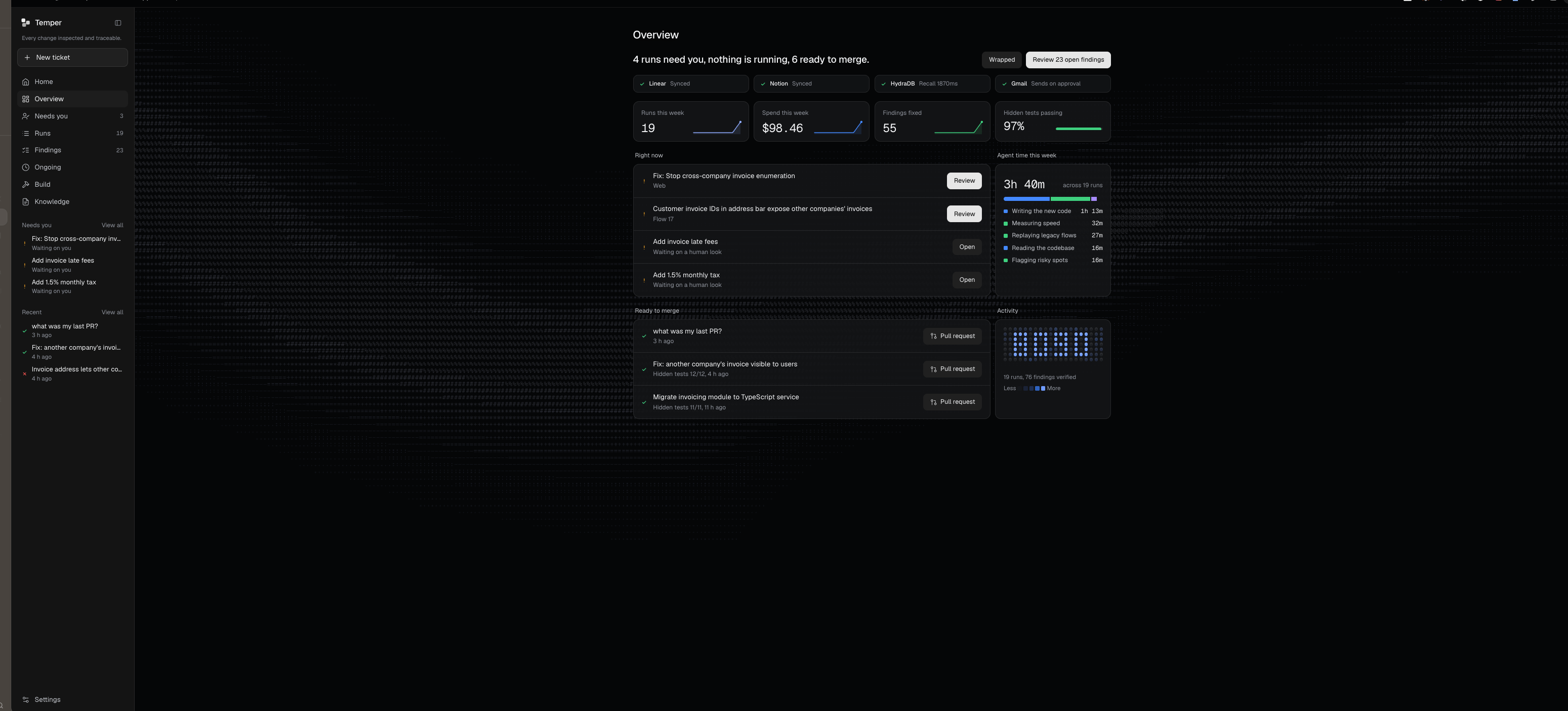
Overview Tab
-
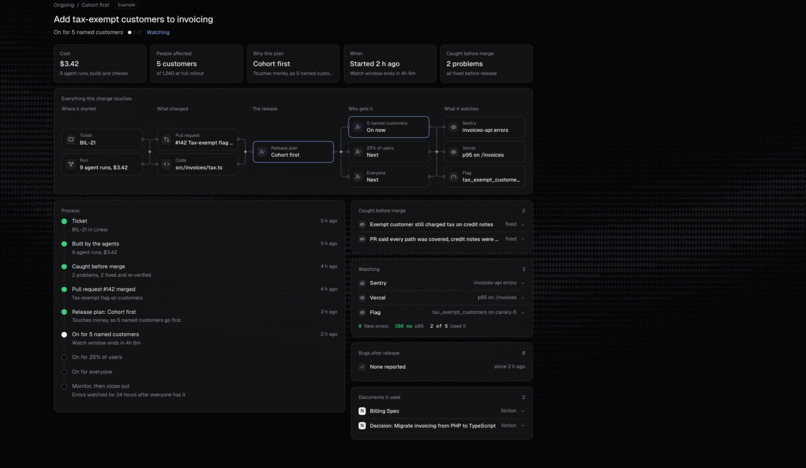
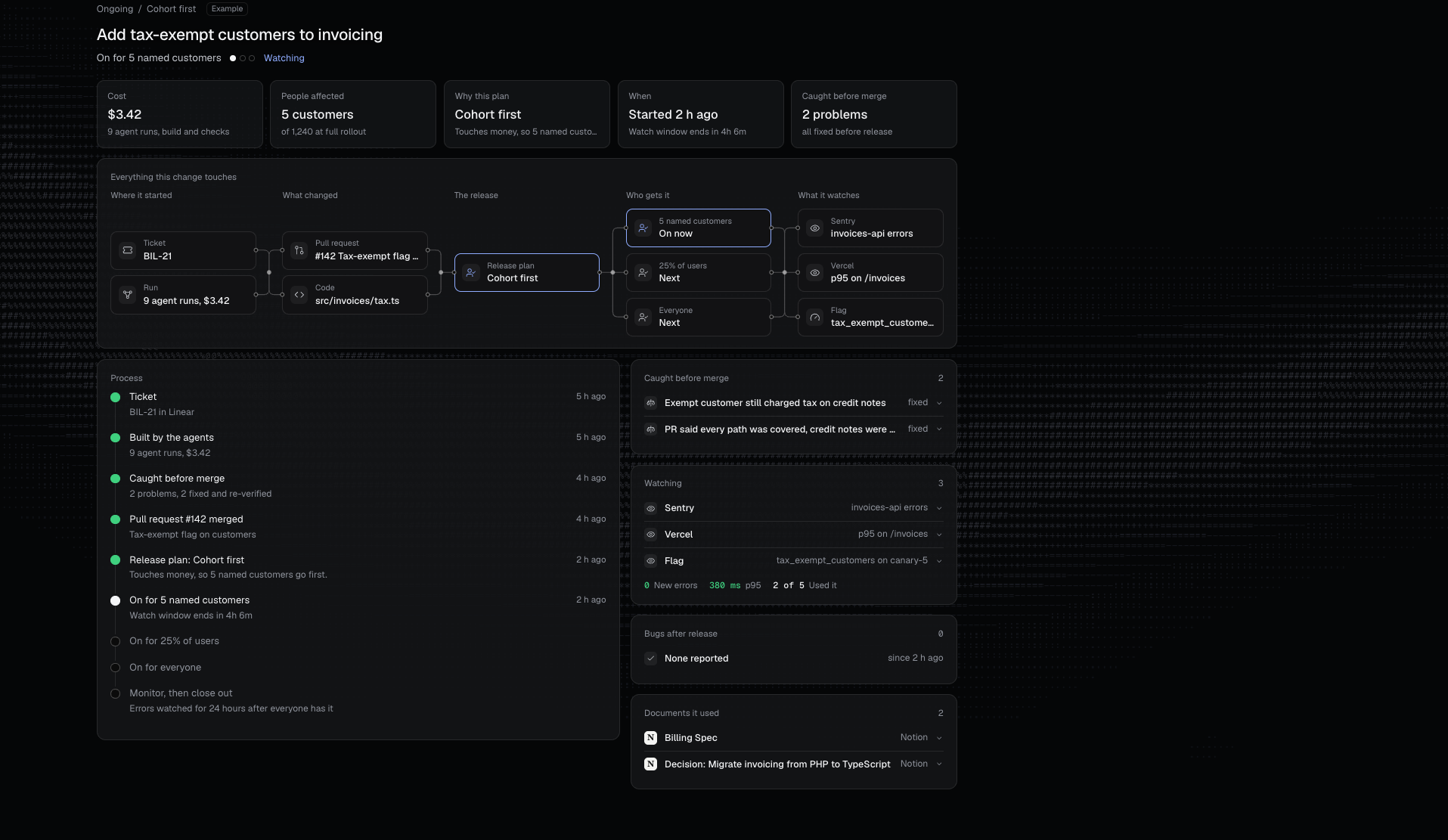
Ongoing Tab
-
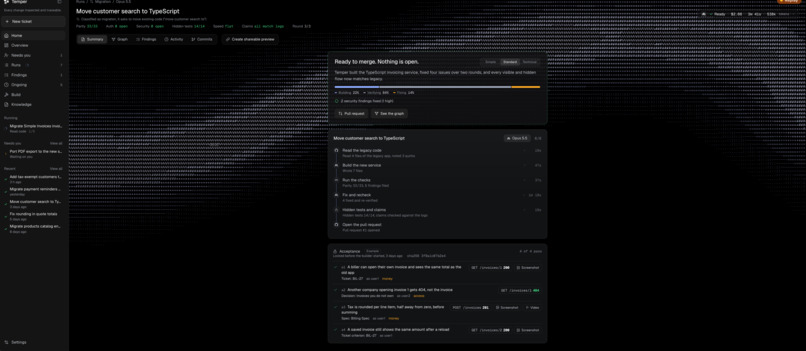
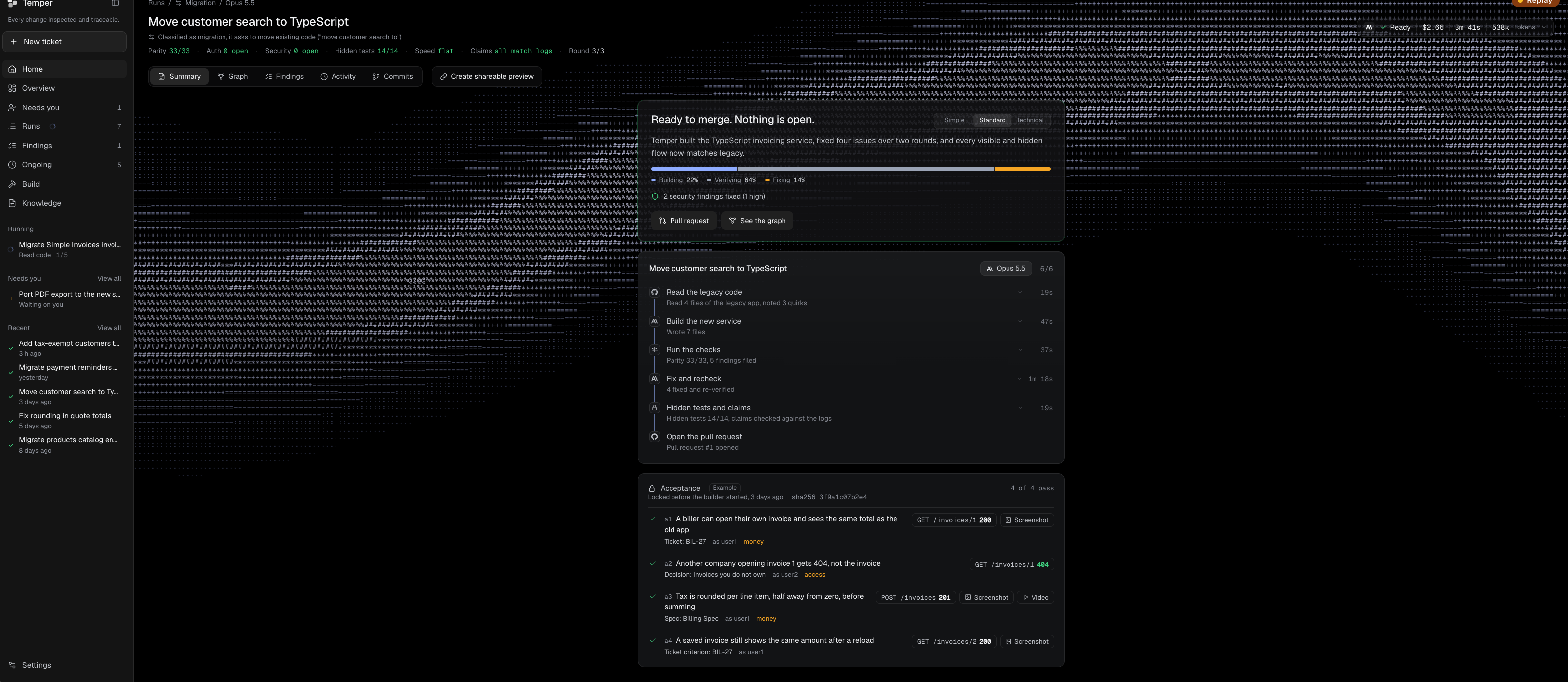
Summary PR
Inspiration
Agents can write code fast now. The hard part is trusting it. Most agent pipelines let the same model write the code, write the tests and grade itself, and nobody can easily see what the agents actually did. A conversation with an engineer at OpenAI pushed me in the same direction, and two quotes stuck with me:
"The most critical skill to have in your toolbox is a high quality verification skill." (Lauren Tan, Cursor)
"Software 1.0 easily automates what you can specify. Software 2.0 easily automates what you can verify." (Andrej Karpathy)
So I built a factory where nothing ships on an agent's word.
What it does
Temper takes a Linear ticket, pulls company context (specs, decisions, past incidents), has agents build it, then checks the result against real behavior before anything reaches users.
Verifiable
- Cross-model checking: different model families can fill different roles. Claude can build while an OpenAI model reviews, or the other way around, so no model grades its own work.
- Legacy parity: for migrations, the old app is the answer key. Temper replays real flows through both apps and compares them to the cent. In the demo, the old PHP app bills an invoice at 107.44 and the new TypeScript build bills 107.43, because PHP rounds halves away from zero. No spec mentioned it. Parity caught it.
- Split hidden tests: the builder sees half the tests. The other half stays hidden to catch code written to game them.
- Locked acceptance list: acceptance checks are fixed before the build starts, so agents can't move the goalposts.
- Red team agents: security agents run authorization and ownership checks against every PR, for example whether one customer can open another customer's invoice.
- Claim check: if an agent says "all tests pass", Temper reads the logs and checks.
- Speed check: catches N+1 queries (20 queries at 10 rows grew to 110 at 100 rows).
- Real device UI tests: a browser agent tests on Mac, Windows, Linux and Android, with video.
- Risk tiers: light checks for small changes, full proof for anything touching money or access.
- Check generator: writes new checks from the legacy app and keeps only the ones that catch deliberately planted bugs.
Observable
- One live view of which agent is doing what, why, and what it cost.
- Every finding links to the evidence: the request, the diff, the log line.
- A full audit trail of every agent call, decision, fix and human approval.
- What needs you, what's running and what shipped, in one place.
Closing the loop Complaints and outages file themselves as Linear tickets that go straight into the factory. The Release Planner ships fixes to 5 users, one region or everyone, and rolls back on red. In a real run, Temper filed ticket BIL-28 from an outage, rolled back a bad fix for 5 canary users when it returned HTTP 500, then promoted the good fix after approval: parity 3/3, auth checks 21/21, p50 91 ms vs 192 ms.
How I built it
- Orchestrator: TypeScript and Node, with its own loop and SQLite for every run, finding and cost.
- Agents: headless Claude Code, with a separate model per role so builders and checkers can come from different model families. Builders never see the hidden checks. Verifiers are read-only.
- UI: Next.js and React Flow, streaming live over SSE, deployed on Vercel.
- Company memory: HydraDB, synced from Notion and Linear.
- Integrations: Composio for Linear, Notion and Gmail (drafts only).
- Releases: Vercel Flags for canary and region rollouts with auto-rollback.
- Device tests: InstaBox and Playwright.
- Demo company: Fernway Supply Co., a fake invoicing company migrating its old PHP billing app (Simple Invoices) to TypeScript, with a real Notion wiki and Linear board.
Results
I pre-registered the benchmarks and report every number, including the ones I didn't like.
- 13 real tickets, same hidden grader: Temper with Opus shipped 13 of 13 correct with 0 bugs to users. Opus alone shipped 12 correct and 1 bug: an access bug that let customers see other customers' invoices. Haiku alone shipped the same bug.
- 41 planted bugs: Claude's own tests caught 36. With Temper's checks added, 37.
- 18 held-out bugs: only Temper caught a session that stayed alive after logout.
- Lean mode for cost: on one ticket,
$2.04vs$4.09for the full profile and$2.64for Claude alone.
Challenges
My first benchmark lost to plain Claude. I traced every miss to a root cause: uniform test inputs, rounded comparisons, missing flows, and builders writing no tests. Then I fixed each class and reran on a held-out set the fixes had never seen. I also tried running every agent on Haiku. It caught real bugs but blocked too many good builds, because a small model is a weak reviewer.
Accomplishments
- A full loop running live: ticket, build, red team, fix, canary, rollback, promote.
- Benchmarks pre-registered and published with losses included.
- A bug both plain models shipped to users, which Temper stopped.
What I learned
Verification is a separate job from building, and it needs its own context, its own tests and its own model. A model checking its own work misses the same things it missed while writing it. Cheap models build fine. They shouldn't be the ones checking.
What's next
- Benchmarking cross-model pairs, like a cheap builder with a stronger checker from another model family.
- Access checks that automatically cover new endpoints.
- More test users for edge cases, like a biller with no linked account.
Built With
- anthropic
- claude
- claude-code
- composio
- docker
- express.js
- hydradb
- instabox
- linear
- next.js
- node.js
- notion
- php
- playwright
- react
- react-flow
- sqlite
- typescript
- vercel
- vurnai
