-
-
ClinicSync logo
-
ClinicSync app
-
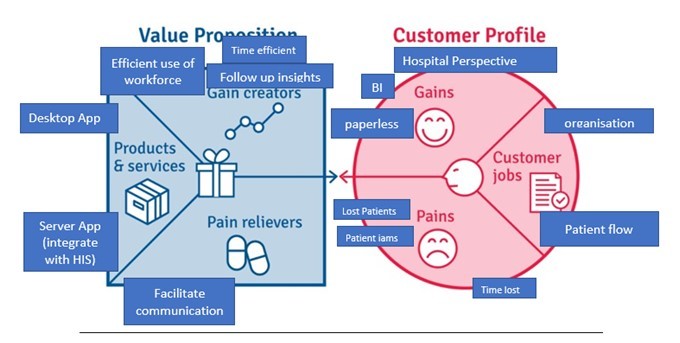
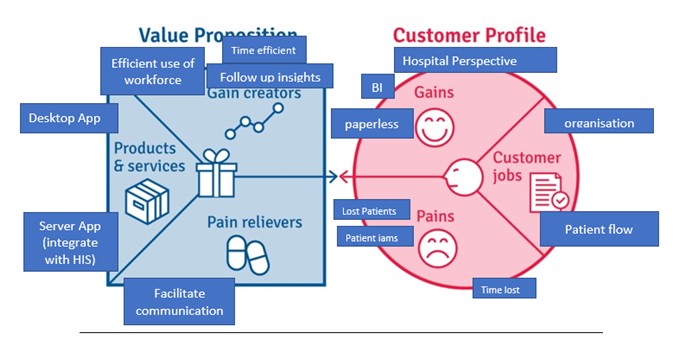
ClinicSync Value Proposition
-
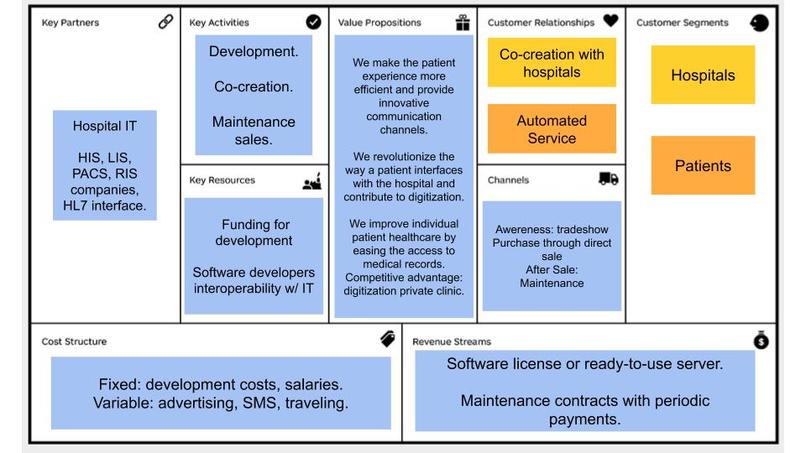
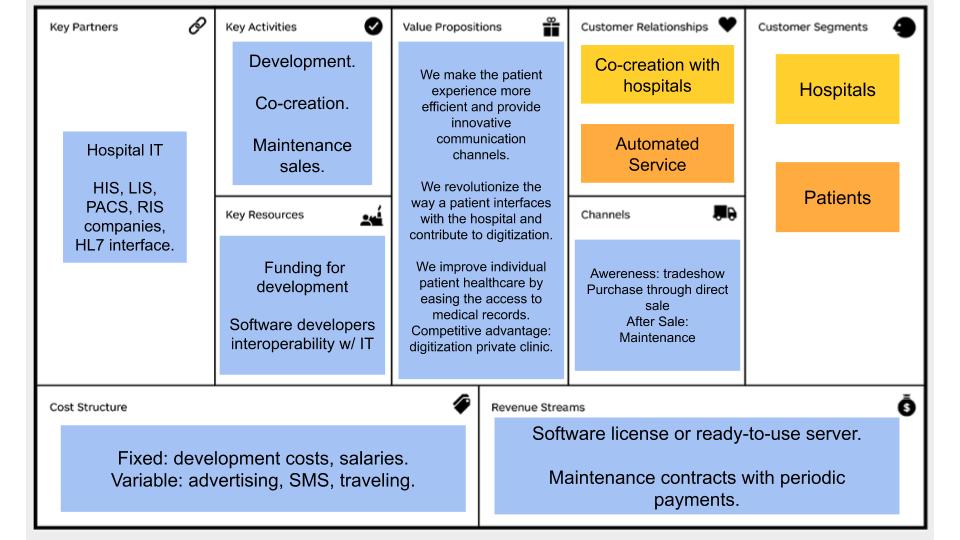
ClinicSync Business Plan Canvas
Inspiration
We would like to show the problem we address through a potential user story:
THE PROBLEM -Information for patients is not centralized. -The need to call patients to check appointments, and inform of changes is antiquated, and time-wasting for hospital staff. -Information that gets to patients is usually displayed in a confusing manner. -Hospitals tend to ask for patient information over and over again.
MARIA AND HER CHEST PAIN -Maria Yorkkson, 23 yrs, is feeling chest pains -She makes an appointment with her general practitioner, and this appointment is in the ClinicSync. She visits her general practitioner. He decides to send her to the hospital to get an MRI on her chest. -He refers her to the cardiac department of the local hospital via a standardized electronically transmitted document of referral.
The referral document contains: -Short symptom description -Name, Age, etc. -Email and Phone number as means of contact
-The hospital receives the document, verifies their capability to perform the exam, and sends a suggested appointment time to the ClinicSync -She can see a window that allows her to confirm the date, time, and location of the appointment. There is a list of possible dates to select from if the suggested appointment is not suitable.
-On the day of the appointment, she receives an SMS reminding her of her visit. -When she opens the App, she sees a map of where to go and a checklist of what to bring and what to prepare (insurance card, don’t eat prior to surgery, etc.) -She drives to the hospital, and the location is displayed in the app (which is the MRI department) (a huge benefit for the hospital) (directions routing in App)
-After having done the MRI she goes home again -After one week she receives a push notification that there is a new document in the app for her -She can preview a report from a radiologist which says she is perfectly fine or further appointments are needed
ADVANTAGES For the clinic: -Make the work of existing staff more efficient -Less time lost due to delayed patients -Share documents/easier access to the patient story among different hospitals -Reduce infection/crowding (patient routing + timing with the maps feature)
For the patient/relatives: -Stays informed in real-time -Can prepare for their appointment/stay in advance -Has access to more information -Never feels lost -Arrive more punctual
What it does
ClinicSync is an application that unites patient portals from hospitals and clinics in order to empower patients with information about their journey through the healthcare system in order to reduce the stress and uncertainty of hospital visits. The app supplements a patient’s visit at the clinic. It is installed before the visit and allows a patient to see their appointments at multiple healthcare facilities, access instructions from a clinic about how to prepare for an appointment, reschedule an appointment. It provides the information regarding the time of visits and locations and also necessary directions through push notifications. The app stores and allows access to documents that emerge from and during the visit. It gets automatically updated when an Admission Discharge Transferal gets detected in the Hospital Information System. It provides an integrated Electronic Health Records. It also gives directions through the hospital so that the patient can easily navigate corridors._ Augmented Reality Based Indoor Navigation facility_ is also added that allows better navigation within the Hospital. They do provide support during the visit. It allows the clinic to steer the patients in order to reduce crowding at entrances and to account for construction or obstructions. It also helps with the Steer patient flow at peak times. The ClinicSync app opens a communication channel to the patients using real-time notifications so that patients can better manage their time and feel more secure about the hospital environment.
How we built it
For the prototype, we used an interface design tool called Figma. This tool allows us to create the UI/UX side of the app.
Challenges we ran into
We were not able to add all the functionality we wanted to, such as real-time camera usage or notifications. Moreover, this was our first time trying to design an app, which is a challenge in itself. Lastly, creating a smooth user-experience was new, therefore making a challenge.
Accomplishments that we're proud of
We have developed a nice prototype for our app. We have deeply developed our idea, which includes a business plan canvas and value propositions. We have learned new skills such as video editing, adding 3D effects to videos, prototyping from scratch, learning about UI/UX.
What we learned
Our learning experience was focused on developing a prototype. Everything from how each page should interact, to how it should be formatted, to what information should be included was new. And it was incredibly enriching.
What's next for ClinicSync
The next step for ClinicSync is to finish development with the help of potential stakeholders and to talk with stakeholders in order to develop a realistic budget and timeline for marketing and implementation in a test market. Through user feedback in a test-market, including feedback from end-users (patients) as well as clinics and hospitals, we will develop and change the app in order to make continuous improvements. We will actively send surveys, receive feedback from users, and engage in continuous, open communication in order to improve the app.
Stakeholders:
- App developers
- Marketing
- Patients
- Hospitals/Clinics
- Health Insurance
Built With
- adobe-after-effects
- figma


Log in or sign up for Devpost to join the conversation.