-
-
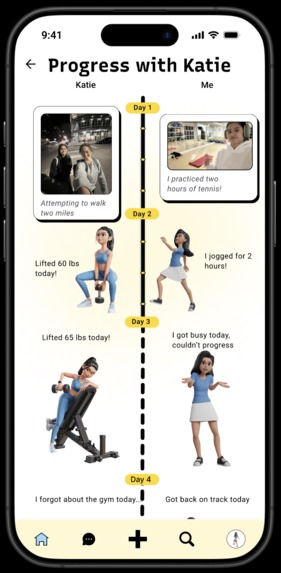
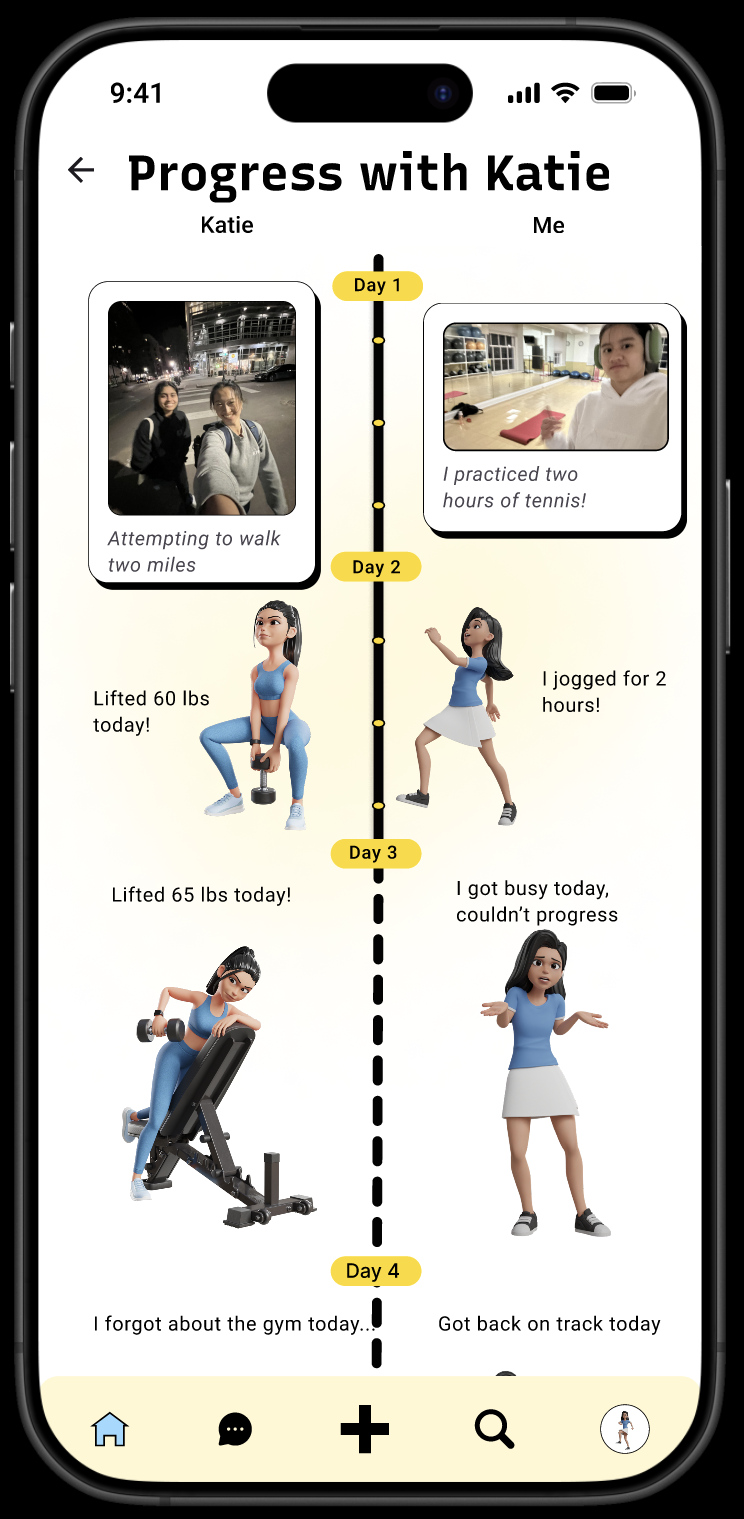
Your progress timeline with a friend
-
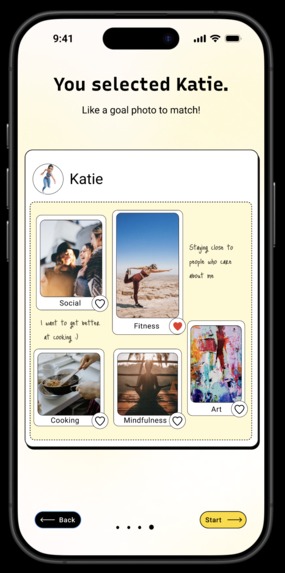
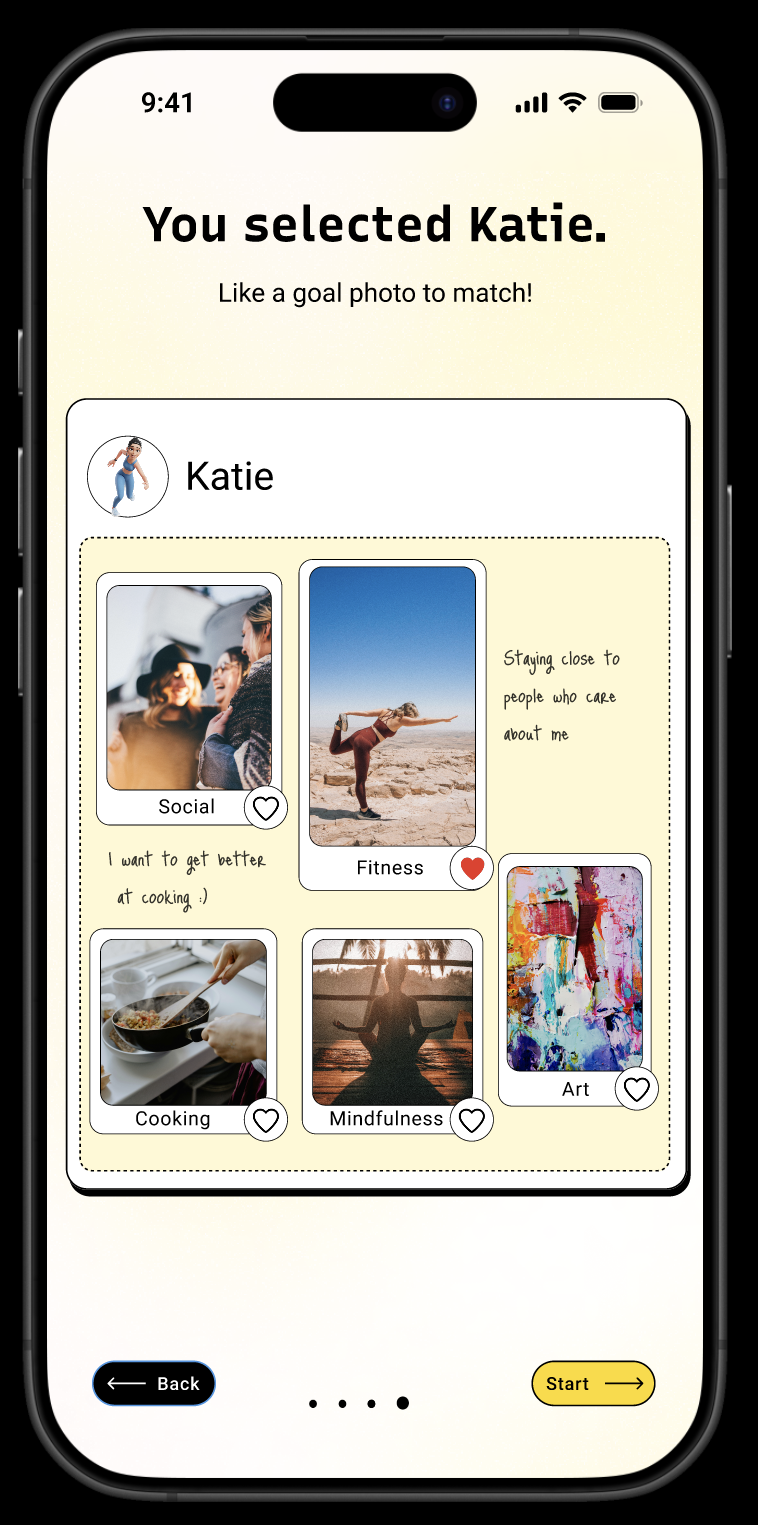
Finding partners to achieve goals with
-
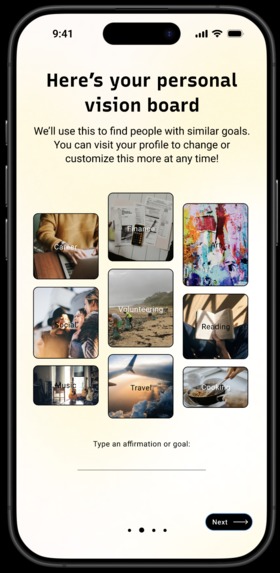
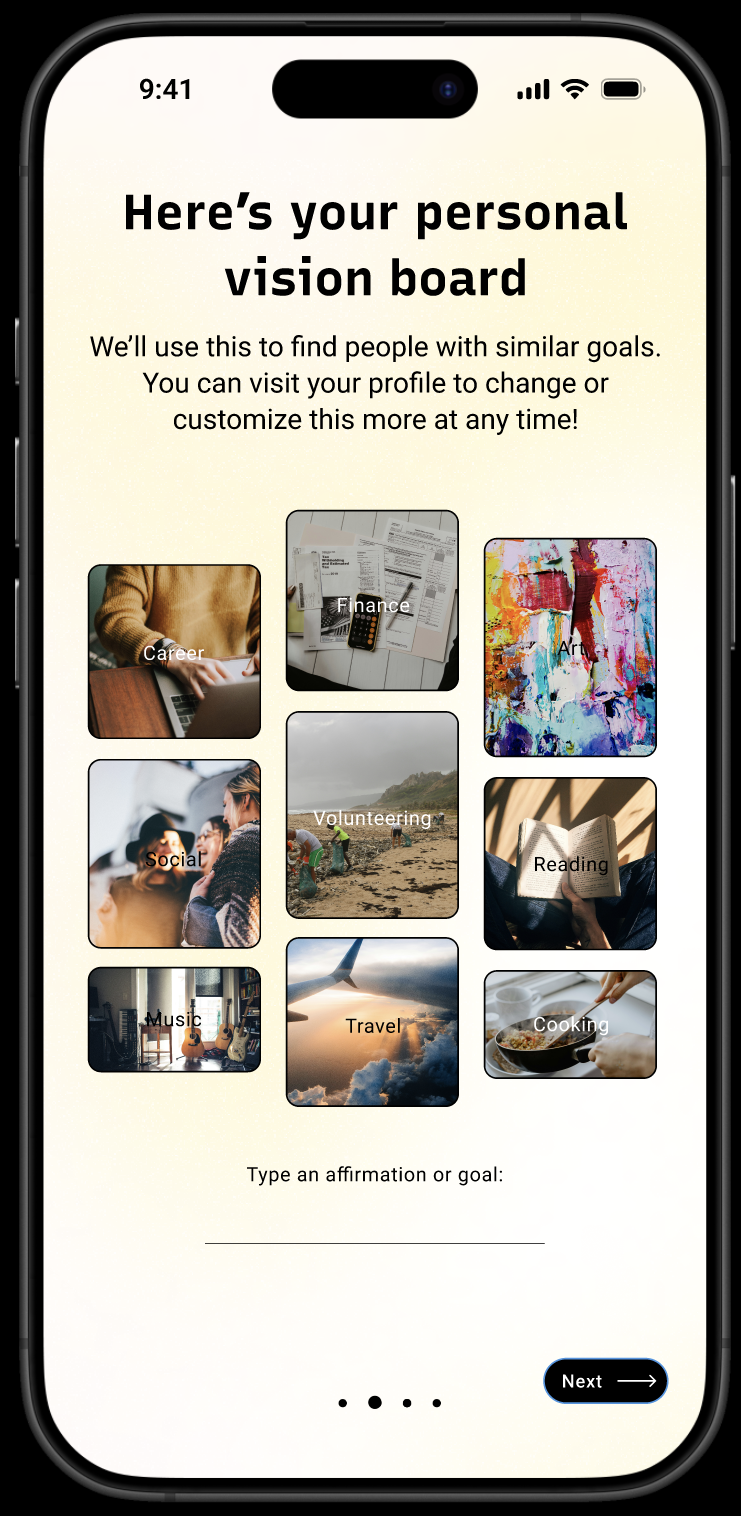
Your own vision board
-
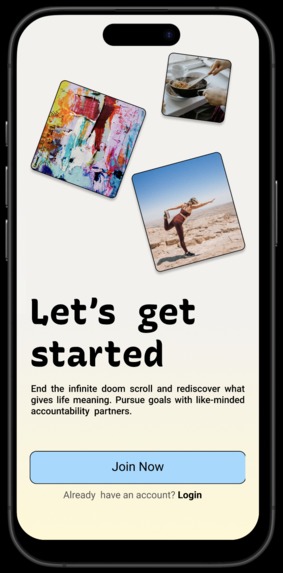
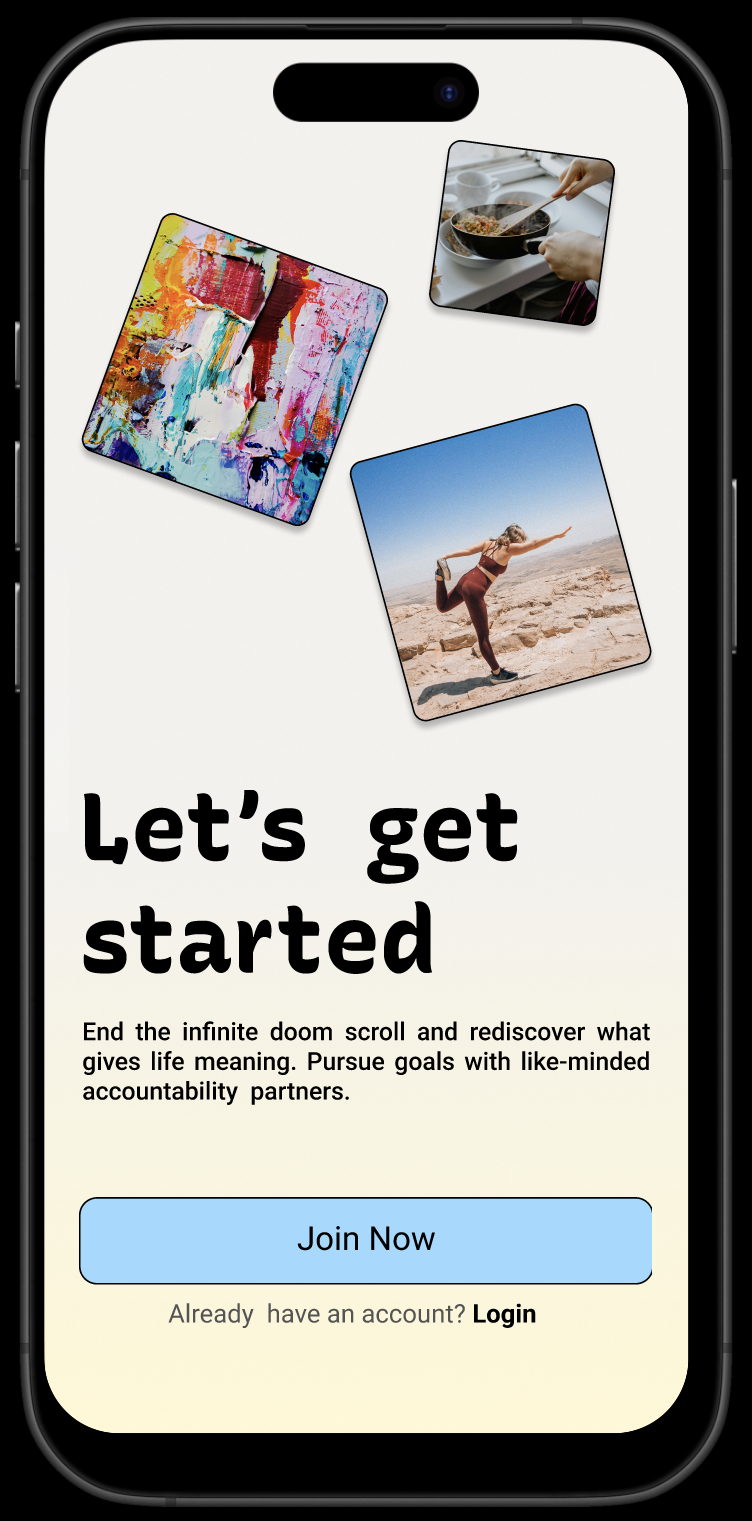
Onboarding
Prototype link (Please submit a link to a playable prototype, not a link to your design file) Link
https://www.figma.com/proto/Hji7GKYwZ9RaBveEYn6Fcd/Ikigai?node-id=0-1&t=xWai2KHvth2oshay-1
Describe your project (max 150 words) Write your answer here.
Our project is inspired by ikigai, the Japanese philosophy that defines purpose as the intersection of passion, mission, vocation, and profession. In a world where social media algorithms fuel endless scrolling, we ask: how can we inspire people to stay motivated and embrace life’s many experiences?
Today’s social media is flooded with AI-generated media and content designed to ‘hack’ trending algorithms enhanced by AI, often distorting reality and disconnecting users from authentic experiences. It also exposes them to unsolicited negative or NSFW content. Our app counters this by fostering intentionality– helping users embrace growth, celebrate milestones, and reflect alongside like-minded partners.
As AI transforms digital interactions, it’s important to reconnect with what truly matters. Through shared challenges and real-world experiences, we empower people to end the infinite doom scroll together and rediscover what gives life meaning– and what it means to be human.
Describe your research process and findings. If you conducted any surveys or interviews, please include the survey form and/or interview questions here. If you conducted secondary research by pulling from online sources, please include a link to your sources. (Max 500 words) Write your answer here.
To ensure our design approach aligned with real-world user needs, we gathered comprehensive insights into student motivations, goal habits, and screen time by completing 12 one-on-one interviews, sending a survey form to different students across campus, and conducting secondary online research.
We began our research process by empathizing with our peers, interviewing them about their AI interactions and daily challenges, keeping detailed notes to capture their authentic thoughts. Through these interviews, we identified key themes that were continuously repeated such as the following “Difficulty removing oneself from the social media landscape even with the conscious understanding and feeling of time wasted” and “AI as a valuable tool for increasing efficiency, but often used in ways that dictate what one should think and do, ultimately limiting the ability to think critically and feel independently.” This led us to the realization that while many students viewed AI as a tool to complete tasks more efficiently, they also recognized doom scrolling and overreliance on AI as prevalent issues that negatively impact their productivity and overall well-being.
These insights helped us define our guiding problems and core question: _ How can we help individuals stay motivated and embrace life in a world dominated by hyper-personalized digital content? _ This question became the foundation for our design thinking process, guiding our efforts to create a solution that addresses both user needs and broader challenges in the digital age.
To design a truly user-centered product, we also researched AI functionality, social media algorithms, and their impact on user behavior and well-being. Platforms by Meta personalize content delivery through various analyzation methods such as the likelihood of its users’ audio usage from reels and reel watch time. The more reels users interact with, the more data these platforms gather to understand user digital content consumption, making them more effective at curating content aligned with the algorithm’s notions of you, thus diminishing your sense of control and self. We also found that the AAR of different social media platforms jumped to 37.03% compared to rates of less than 2% in 2022, with long-form content platforms seeing the most dramatic increases in AIGT. With this significant increase in AI-generated content, concerns about user autonomy, the potential for over-reliance on AI-driven recommendations, and lack of genuineness are raised.
Equipped with these insights and our interview findings, we entered the ideation phase, brainstorming as many ideas– no matter how outlandish they sounded– that directly addressed our core question. After careful consideration, we ultimately selected the concept of a partner goal-tracking app as the most effective solution. As we developed and refined the prototype of this idea, we continued to gather insights via user interviews and a survey, asking questions such as the following:
- How much does personalization in an app matter to you?
- Tell me about your phone habits.
- What was your experience like working with someone to achieve a goal without seeing them face-to-face?
After multiple iterations of testing and implementing feedback, we finalized Ikigai’s MVP.
Links to sources
https://www.japan.go.jp/kizuna/2022/03/ikigai_japanese_secret_to_a_joyful_life.html https://pmc.ncbi.nlm.nih.gov/articles/PMC9580444/ https://hai.stanford.edu/news/data-behind-your-doom-scroll-how-negative-news-takes-over-your-feed#:~:text=This%20can%20drive%20further%20polarization,and%20useful%20set%20of%20tools.%E2%80%9D https://bernardmarr.com/the-amazing-ways-instagram-uses-big-data-and-artificial-intelligence/ https://help.instagram.com/423837189385631 https://transparency.meta.com/features/explaining-ranking/ig-reels-chaining/ https://transparency.meta.com/features/explaining-ranking/
Describe your most important design decisions. What research findings and/or user testing results led you to make these decisions? (Max 500 words) Write your answer here.
Actively deciding not to use AI in our design – Our research revealed that while AI offers hyper-personalization, it diminishes users' ability to choose what they genuinely like, and often leads to endless scrolling and a loss of personal agency. In a survey, most students valued personalization but wanted a more streamlined experience. To address this, we implemented a feature that automatically matches users with potential partners based on the alignment of their vision boards, eliminating the need to manually sift through profiles. This keeps the process efficient, while still allowing for meaningful personalization without reinforcing the scrolling cycle.
Timeline – Out of 38 responses, 89.5% of survey respondents said that in their ideal motivational goal-tracking app, a roadmap or timeline would be a desired feature as a way of recognizing and celebrating progress. Wanting to prioritize user feedback, we prioritized it as a feature in our MVP.
Streaks – In the same survey, 52.6% of survey respondents said that streaks would be another desired feature. We implemented this feature with the previous intentions.
Making Goal Mode its own screen in the navigation bar – At first, we prototyped Goal Mode to be a similar feature to the “Disappearing Mode” for messages in Instagram. However, we noticed that most users could not figure out how to turn it on, despite it being a core functionality of the app. Implementing user feedback, we made the decision to make Goal Mode its own screen, accessible by the ‘+’ sign icon in the navigation bar so that users could easily record their progress.
Built With
- figma

Log in or sign up for Devpost to join the conversation.