
Inspiration
Financial literacy is usually taught through articles, videos, calculators, and lessons, but knowing what you should do with money is very different from seeing what happens when you actually make those decisions.
We wanted to turn personal finance into something you could experience instead of memorize.
Larp City was inspired by city-building games where you grow a city while reacting to fires, crimes, and other disasters. We asked ourselves: what if those disasters were financial?
Instead of protecting buildings from fires, you are protecting your life from debt, market crashes, medical bills, car problems, recessions, and unexpected expenses. Instead of simply trying to become rich, your goal is to build a financially stable life and successfully make it to retirement.
Our goal was to make financial education feel less like homework and more like living through a simulated version of your future.
What it does
Larp City is an interactive financial-life simulator where players begin at age 22 and live through decades of financial decisions until retirement.
Players start with a simulated financial profile that includes income, debt, credit score, expenses, and a vehicle. Sammy, our owl guide, walks the player through important early decisions including:
- Choosing health insurance
- Building an emergency fund
- Selecting a beginner credit card
- Contributing to a Roth IRA and 401(k)
- Managing monthly expenses
- Handling a car loan and insurance
- Setting long-term goals such as buying a house, becoming debt-free, getting married, and retiring
From there, time moves forward day by day.
Players receive paychecks, pay bills, manage debt, invest money, build credit, and react to events that can dramatically change their financial future.
Those events include situations such as:
- Stock market crashes and booms
- Recessions
- Penny-stock opportunities
- The AI market bubble
- Car breakdowns
- Injuries and hospital bills
- Marriage and divorce
- Credit and debt problems
When a major decision occurs, the simulation slows down and asks the player what they want to do.
For example, during a market crash, the player may have to decide whether to panic sell or continue holding their investments. Later, when the market recovers, the game can show exactly how much that decision helped or hurt them.
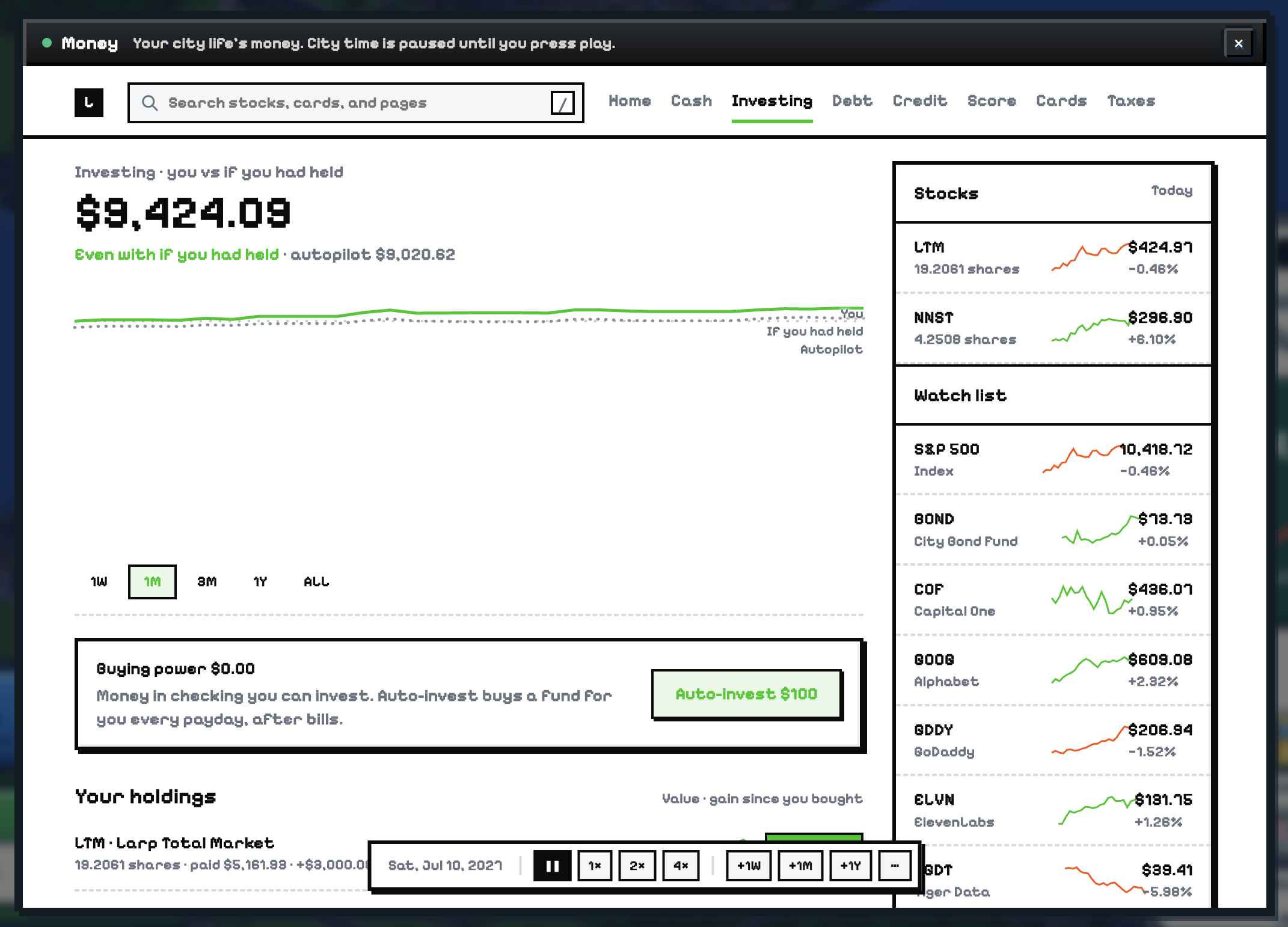
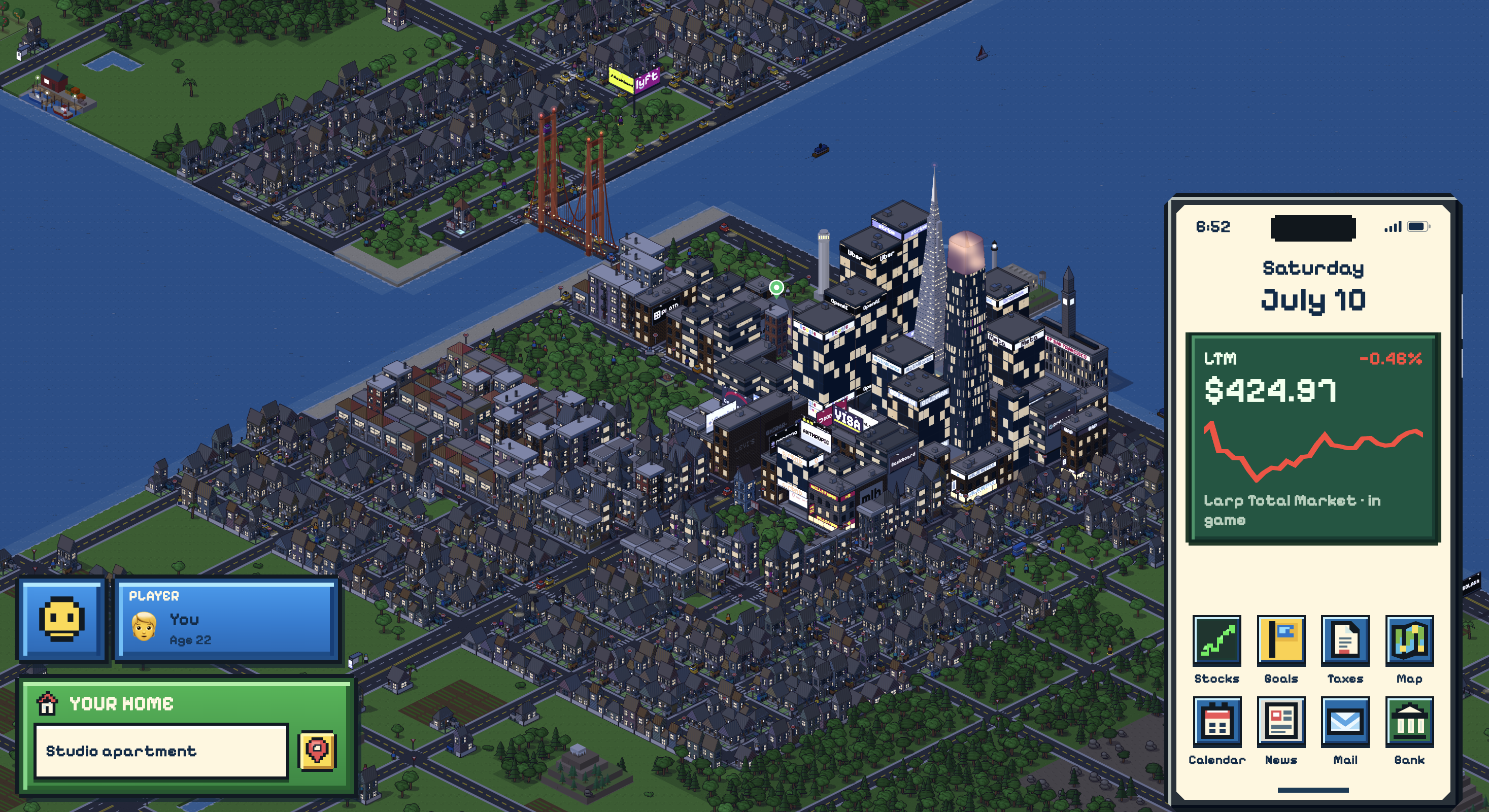
The game also includes a phone containing apps for goals, banking, stocks, news, bills, taxes, the calendar, and the map.
The player's decisions ultimately affect their net worth, debt, credit score, retirement readiness, and happiness.
The final goal is retirement. Players who build enough financial stability can retire, receive a final score, and review the decisions that shaped their life.
How we built it
We built Larp City as a browser-based game using TypeScript, Vite, and PixiJS.
PixiJS powers the interactive city environment and lets us create the pixel-art/isometric style we wanted without requiring a full 3D engine.
Behind the city is a financial simulation engine that advances the player's life one day at a time.
One of the most important parts of the system is that the simulation is seeded and deterministic. This means market conditions and random life events can be recreated exactly.
That allows us to do something especially useful for learning: after finishing a run, players can revisit an earlier financial decision, make a different choice, and compare how their life would have changed under the exact same circumstances.
We also built separate systems for:
- Credit cards
- Loans
- Bank accounts
- Credit scores
- Debt and delinquency
- Investing
- Paychecks and expenses
- Market events
- Life events
- Taxes
- Savings and retirement contributions
Rather than inventing every financial product, we incorporated real-world financial data where possible. Our card system uses real credit-card information and financial terms, while our market system uses historical financial data and external market sources.
For investing, we created comparison portfolios so the player can see their performance against strategies such as simply holding their original investments or following an automated portfolio.
We also use AI to turn the player's simulation history into personalized explanations. Instead of giving generic advice, the financial coach can explain what happened using decisions from that specific run.
The architecture separates the visual city from the simulation engine, allowing the same financial logic to continue running while players skip ahead weeks, months, or even years.
Challenges we ran into
One of our biggest challenges was figuring out how realistic the financial simulation should be.
Real financial systems are extremely complicated. Taxes, credit cards, debt, investing, insurance, employment, and retirement could each become an entire project by themselves.
We constantly had to balance realism, educational value, and gameplay.
Another challenge was time.
A financial life can last more than 40 years, but nobody wants to wait 40 years to finish a hackathon game. We needed a simulation that could move extremely quickly while still slowing down when something meaningful happened.
Creating deterministic events was another challenge. If players wanted to compare two decisions, the market and random events needed to stay identical. Building the simulation around seeded randomness allowed us to replay the same financial timeline instead of creating a completely different future every time.
We also had to rethink features several times during development. Some ideas sounded impressive but made the experience unnecessarily complicated. We simplified the project around one question:
Does this feature help someone understand how their financial decisions affect their future?
If the answer was no, we cut it.
Accomplishments that we're proud of
We are especially proud that Larp City became much more than a financial calculator.
It is a complete simulated financial life.
The player has income, expenses, debt, accounts, investments, credit, goals, unexpected events, and eventually retirement, with all of those systems influencing one another.
We're also proud of our investment comparison system. Instead of simply telling players that selling during a crash was a bad decision, we can show what their portfolio actually became compared with what would have happened if they had held.
Another accomplishment was incorporating real financial information into the experience. Our credit-card system can evaluate actual card terms and offers rather than relying entirely on fictional products.
We also built the game so that financial events connect directly to the city and interface. Your finances are not hidden inside a spreadsheet—they become part of the world you are living in.
Most importantly, we built the simulation around learning rather than punishment. Players can eventually revisit their decisions and experiment with different choices without being penalized for trying again.
What we learned
The biggest thing we learned is that financial literacy is not really about memorizing individual rules.
It is about understanding how decisions interact over time.
Choosing a credit card might affect your credit score. Your credit score affects borrowing. Debt affects how much you can invest. Investments affect retirement. Insurance decisions may seem unnecessary until an unexpected medical event occurs.
Once we started connecting those systems, financial education became much easier to visualize.
We also learned how important simulation design is.
Simply making a mathematically accurate financial model does not automatically make a good educational experience. Players need feedback at the moment a decision becomes meaningful.
A market crash, hospital bill, or car breakdown creates a much stronger learning moment than simply showing someone another paragraph explaining emergency funds.
Technically, we learned a lot about designing deterministic simulations, coordinating multiple financial systems, working with real-world financial datasets, building an interactive game with PixiJS, and connecting game events with AI-generated feedback.
What's next for Larp City
Our next goal is to expand Larp City into a deeper financial learning platform.
We want to add more careers, salary progression, housing decisions, insurance options, investment strategies, and life events so that every financial life feels different.
We also want players to be able to experiment with different starting situations, including different salaries, debt levels, locations, and financial goals.
Another major direction is improving our AI financial coach so it can explain not only whether a decision was good or bad, but why, using the player's complete financial history.
Long term, we see Larp City becoming more than a game.
Imagine banks, schools, universities, or financial-literacy programs allowing someone to complete a simulated financial life before opening their first credit card, taking out a loan, or beginning their career.
Instead of asking:
"Do you understand personal finance?"
we could actually let someone prove it by successfully living through decades of financial decisions.
That is what we want Larp City to become.
Built With
- blender
- datatiger
- elevenlabs
- gemini
- nessi
- pixi.js
- python
- typescript


Log in or sign up for Devpost to join the conversation.