-
demo page
GridSync – Smarter Buildings, Stronger Grid
Inspiration
We noticed that cities like Bengaluru face frequent power cuts even though the state is officially “power surplus.” The real issue is peak hour stress — when everyone uses power at the same time, the grid buckles.
Instead of just building more power plants (often coal or diesel), what if buildings themselves became active grid citizens, reducing stress when it matters most?
That’s the idea behind GridSync: turning buildings into smarter, more flexible energy consumers that also earn money while helping the grid.
What it does
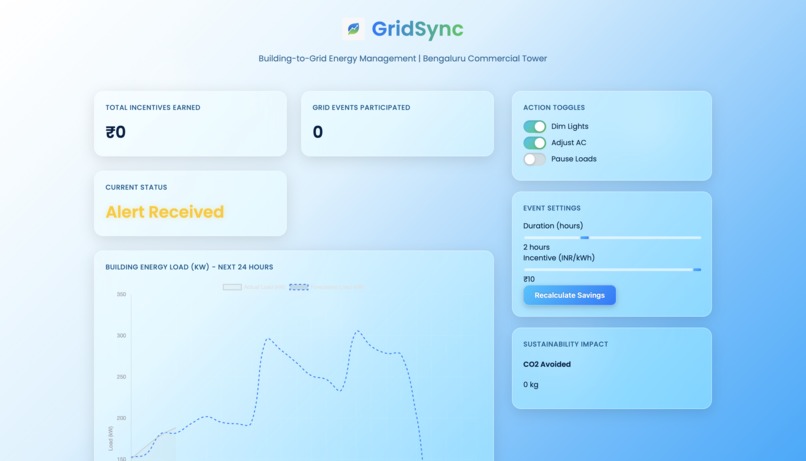
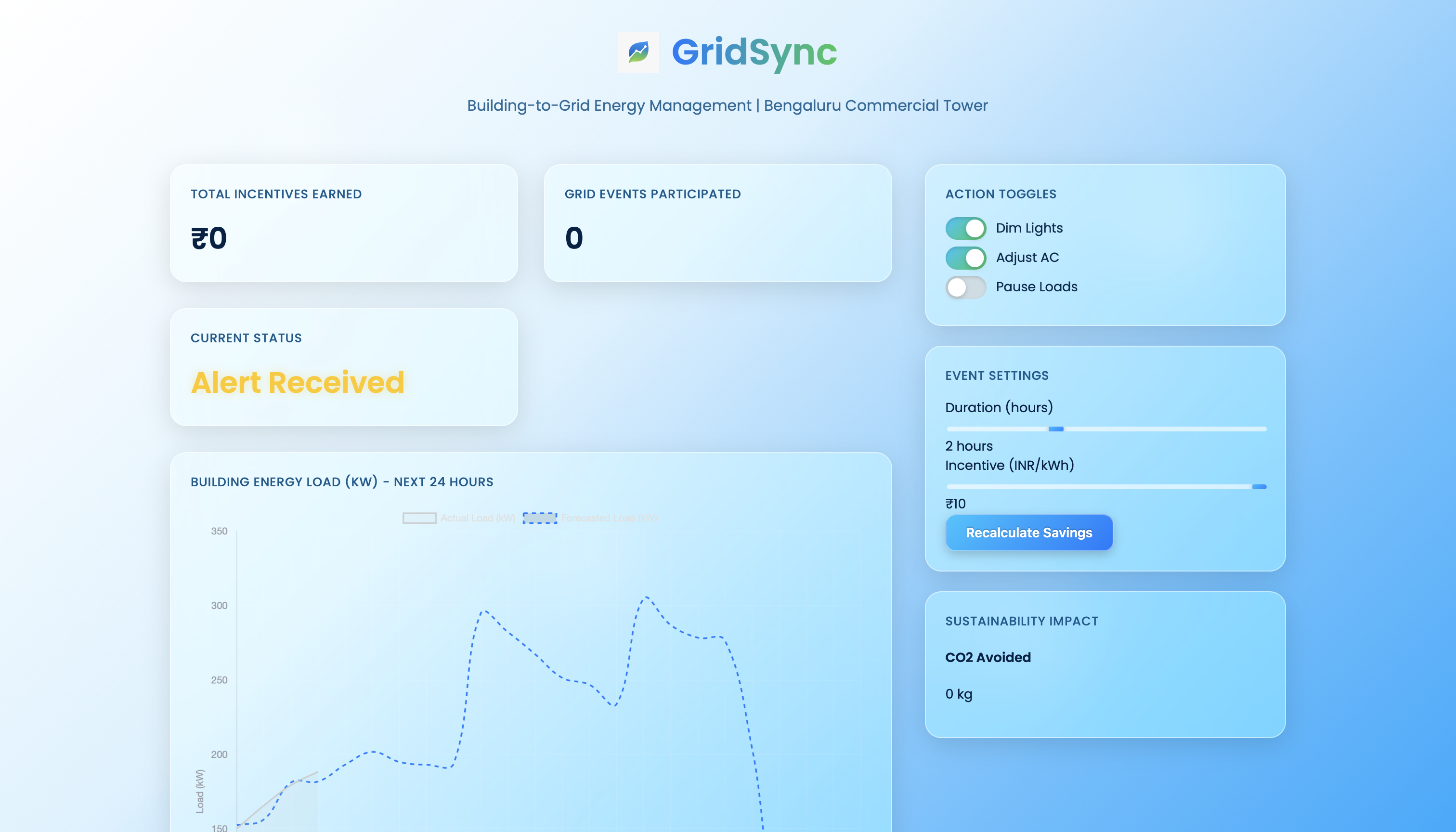
- Forecasting: Predicts a building’s next 24 hours of energy usage using the TSFM (Time Series Foundation Model).
- Flexibility Calculation: When a grid stress alert is received, GridSync calculates how much energy the building can safely cut or shift (its flexibility).
- Recommendation Example:
> “Reduce 120 kWh between 6–9 PM and earn ₹3,600.” - One-click Action: Facility managers can trigger an automated Peak Shave mode (e.g., dimming non-essential lights, pre-cooling rooms).
- Post-Event Review: Shows how much was actually saved and the incentive earned → creating clear ROI for managers.
How we built it
- Frontend: Clean Vercel-hosted dashboard with charts and alerts for facility managers.
- Backend: FastAPI server connecting dashboard, TSFM model, and flexibility logic.
- AI Model (TSFM): Uses historical building energy data → forecasts next 24 hours → detects anomalies.
- Business Logic: Integrated BESCOM’s tariff and incentive schemes (ToD, SIS, etc.) for realistic financial outcomes.
- Data Flow:
Manager → Dashboard → API → TSFM forecast → Flexibility calculation → Recommendation → Action → Review.
Challenges we ran into
- Understanding and implementing BESCOM’s complex incentive schemes.
- Formatting time-series data properly for TSFM predictions.
- Balancing realism vs hackathon speed — accurate calculations vs fast demo-ready features.
- Designing a UI/UX that makes grid flexibility simple and actionable for busy facility managers.
Accomplishments we’re proud of
- Linking demand prediction directly to financial outcomes.
- Designing a dashboard that makes energy management simple and actionable.
- Creating a scalable framework → from one building to entire cities as virtual power plants.
- Making energy management feel less like engineering, more like everyday decision-making.
What we learned
- Energy flexibility is as much about communication and trust as technology.
- Utility incentives (like BESCOM’s schemes) are powerful if presented clearly and transparently.
- Hackathon speed forces simplicity — focus on minimum set of actions that prove impact.
- Even small load shifts can create huge impact at scale (thousands of buildings).
What’s next for GridSync
- Real integrations with building management systems (BMS) instead of simulations.
- Expansion to industrial users (larger incentives: ₹2–4/kWh).
- Adding renewable integration (e.g., sync with solar surplus during the day).
- Evolving into a city-wide virtual power plant platform, aggregating flexibility across hundreds of users.

Log in or sign up for Devpost to join the conversation.