-
-
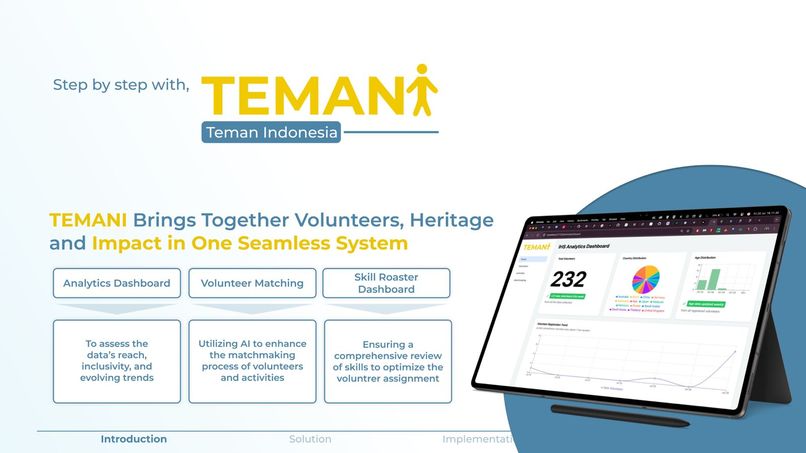
Product Overview
-
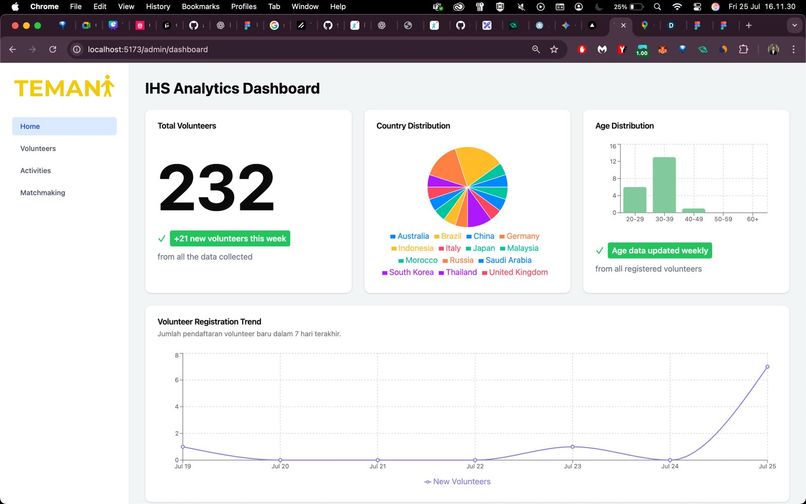
Homepage Dashboard
-
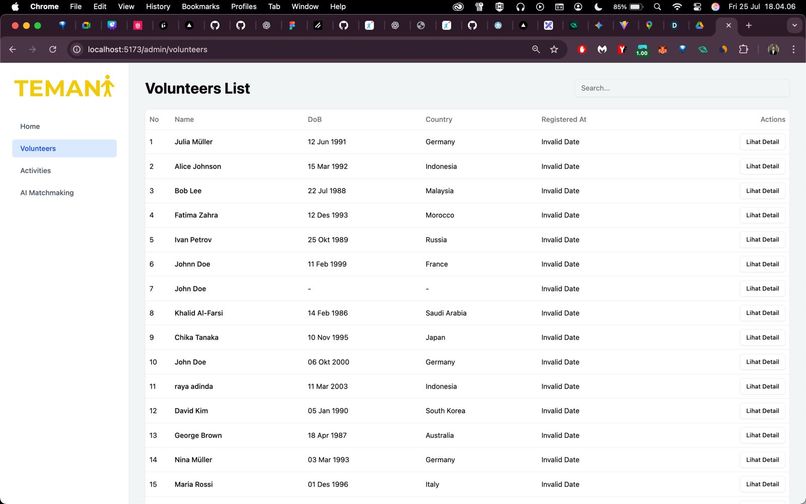
Volunteer Page
-
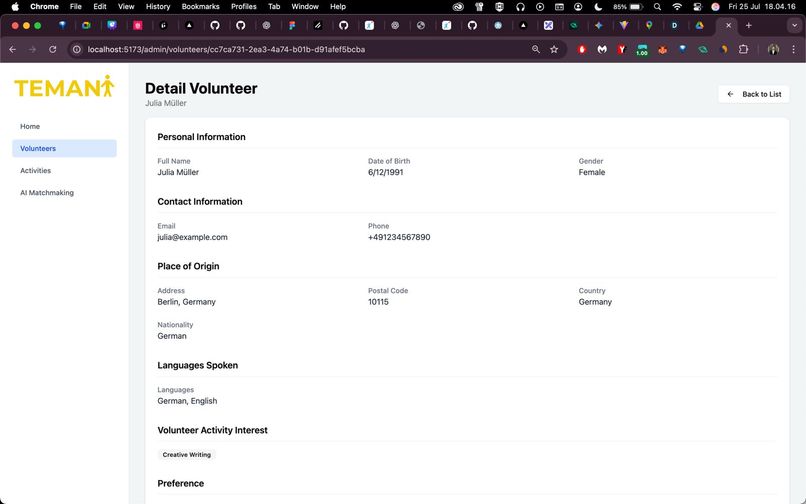
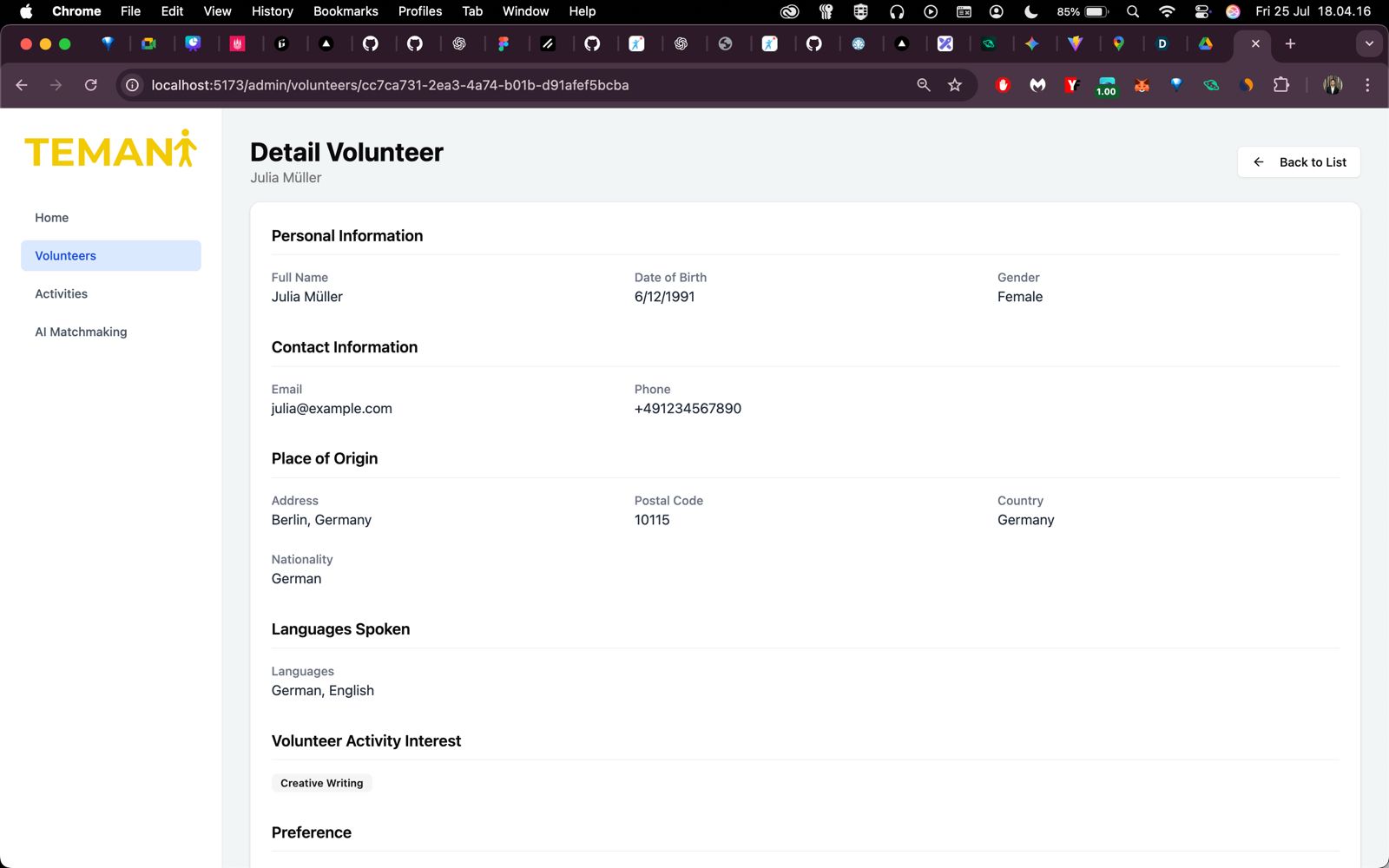
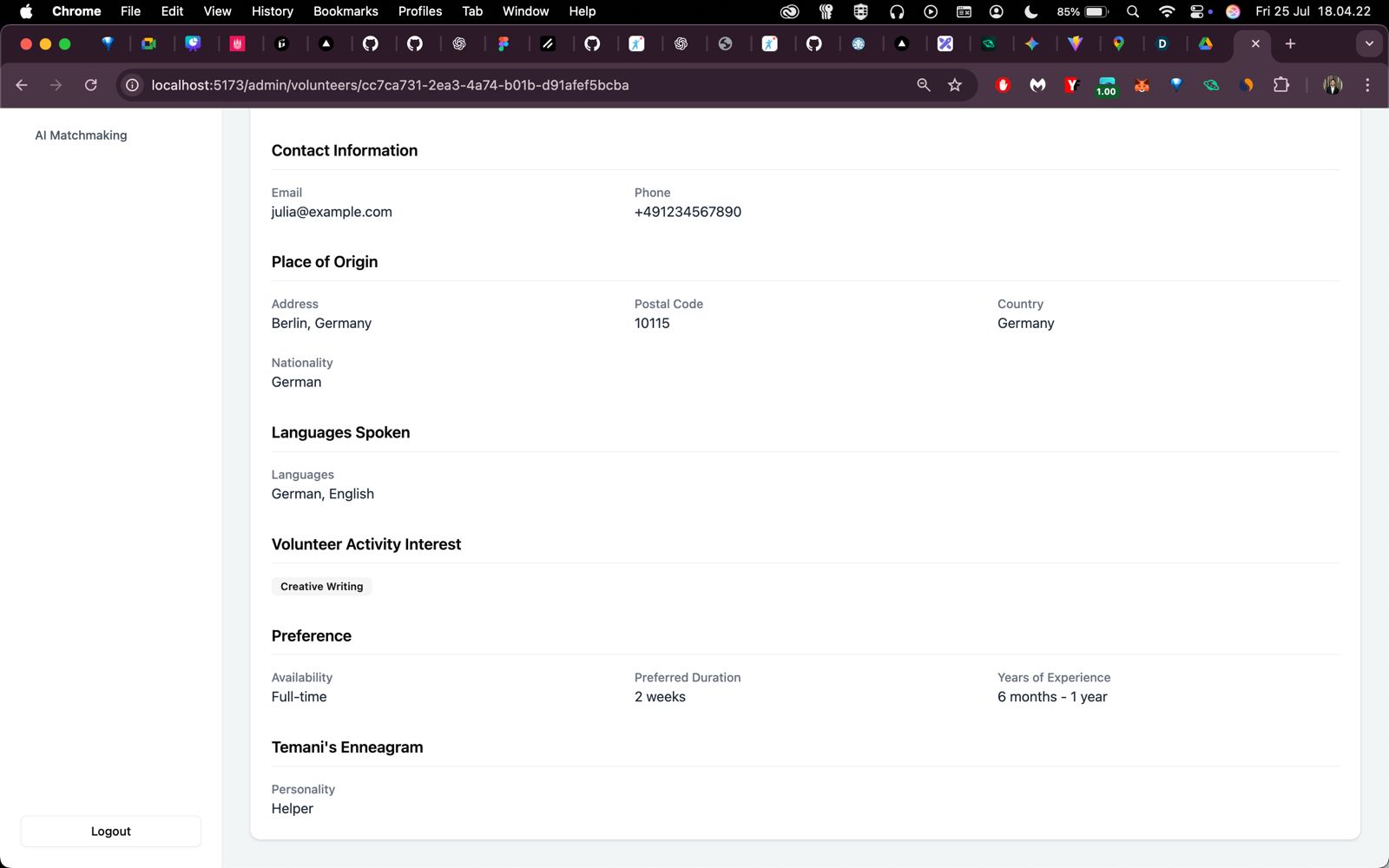
Detail Volunteer Page Dashboard
-
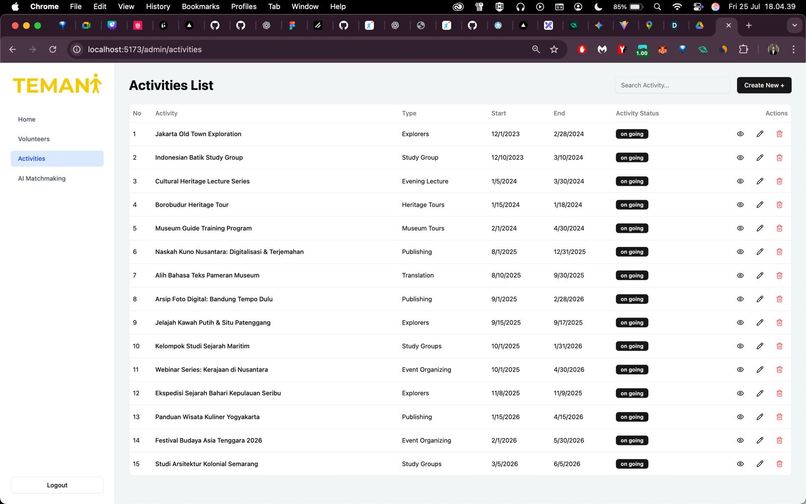
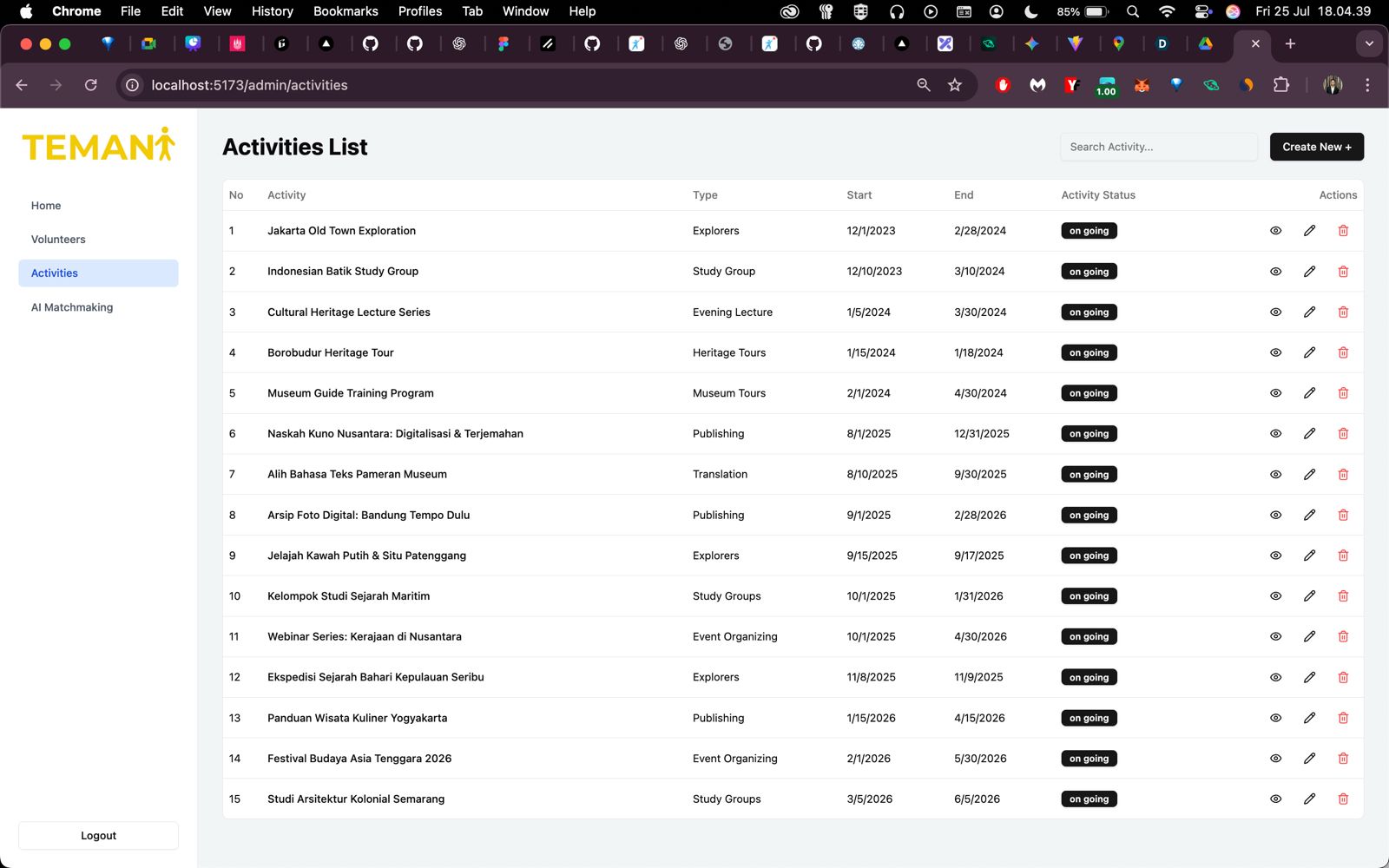
Activity Page Dashboard
-
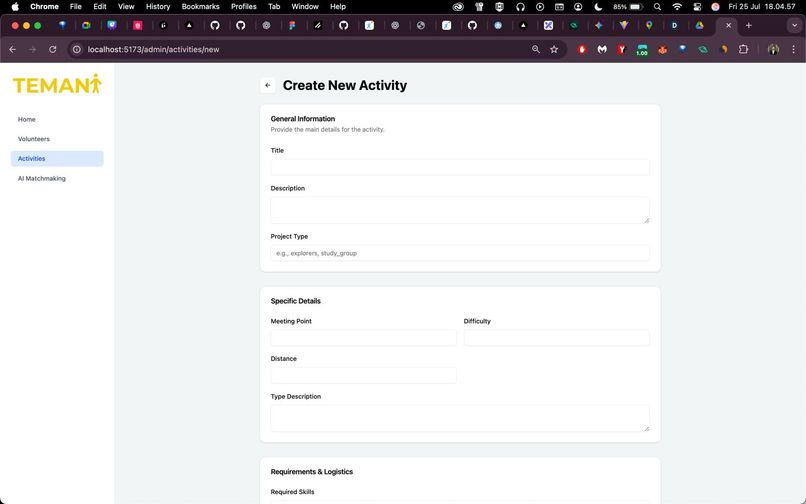
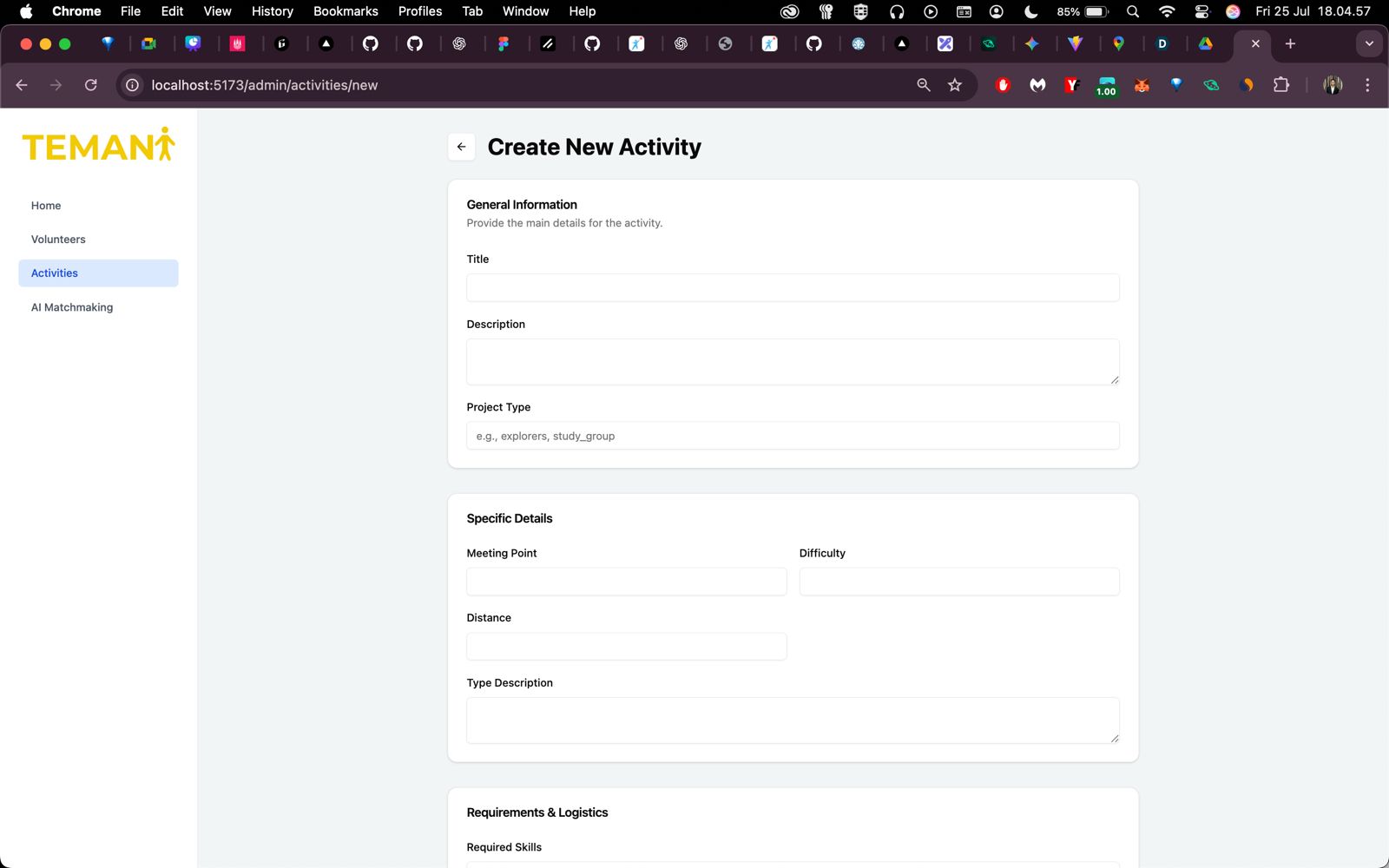
Create New Activity Page
-
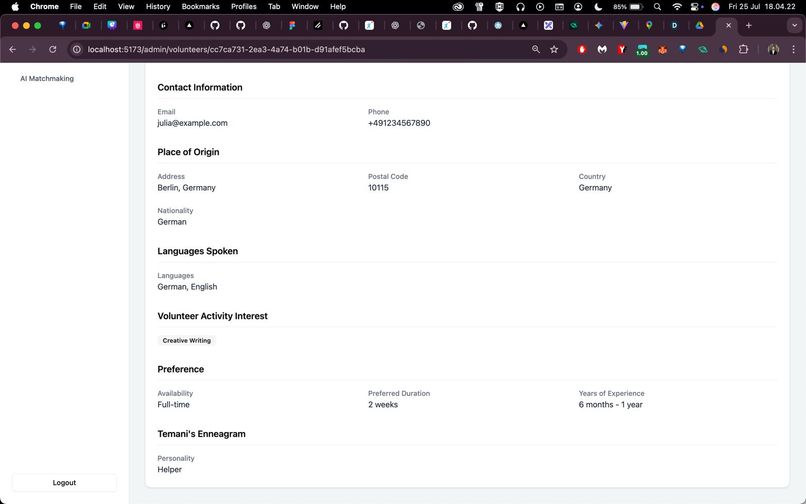
Create New Activity Page part 2
-
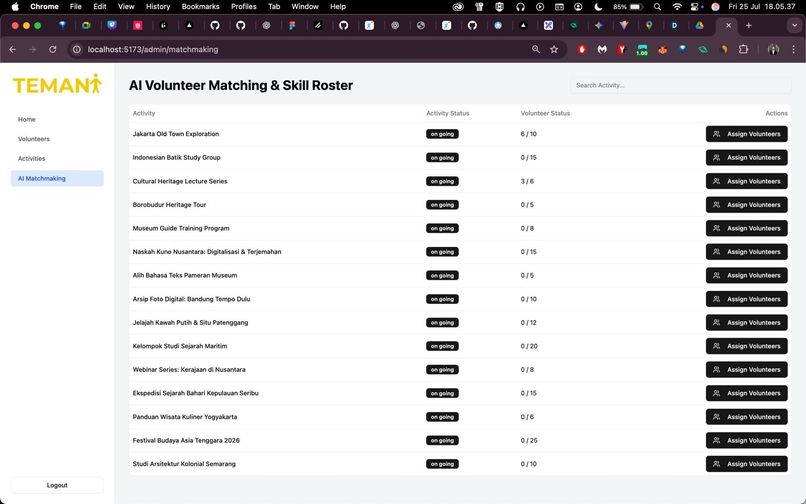
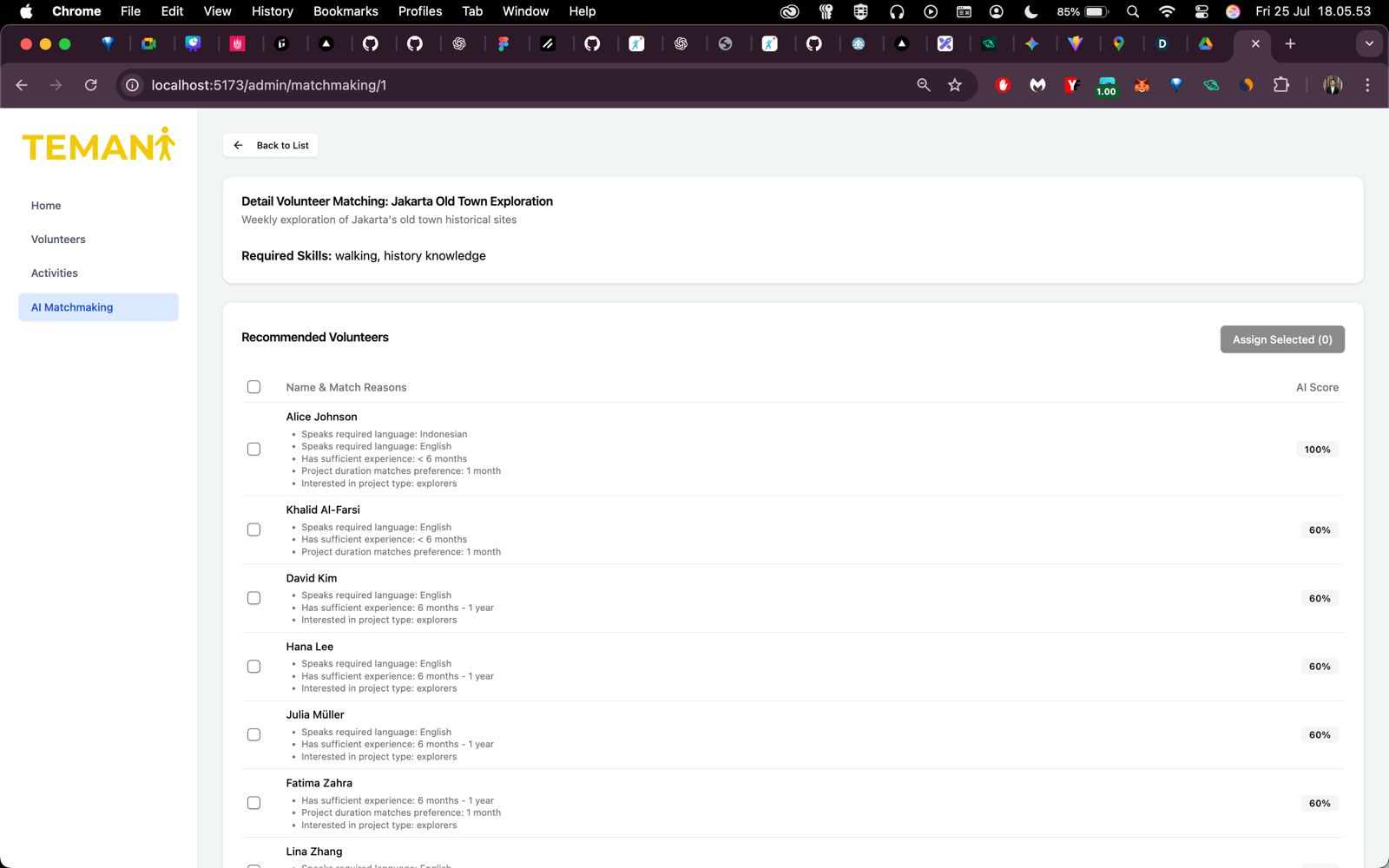
AI Matchmaking Page 2
-
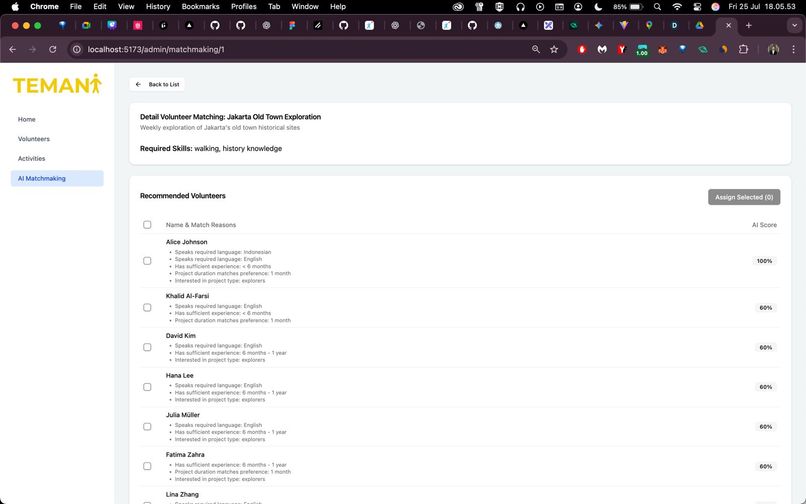
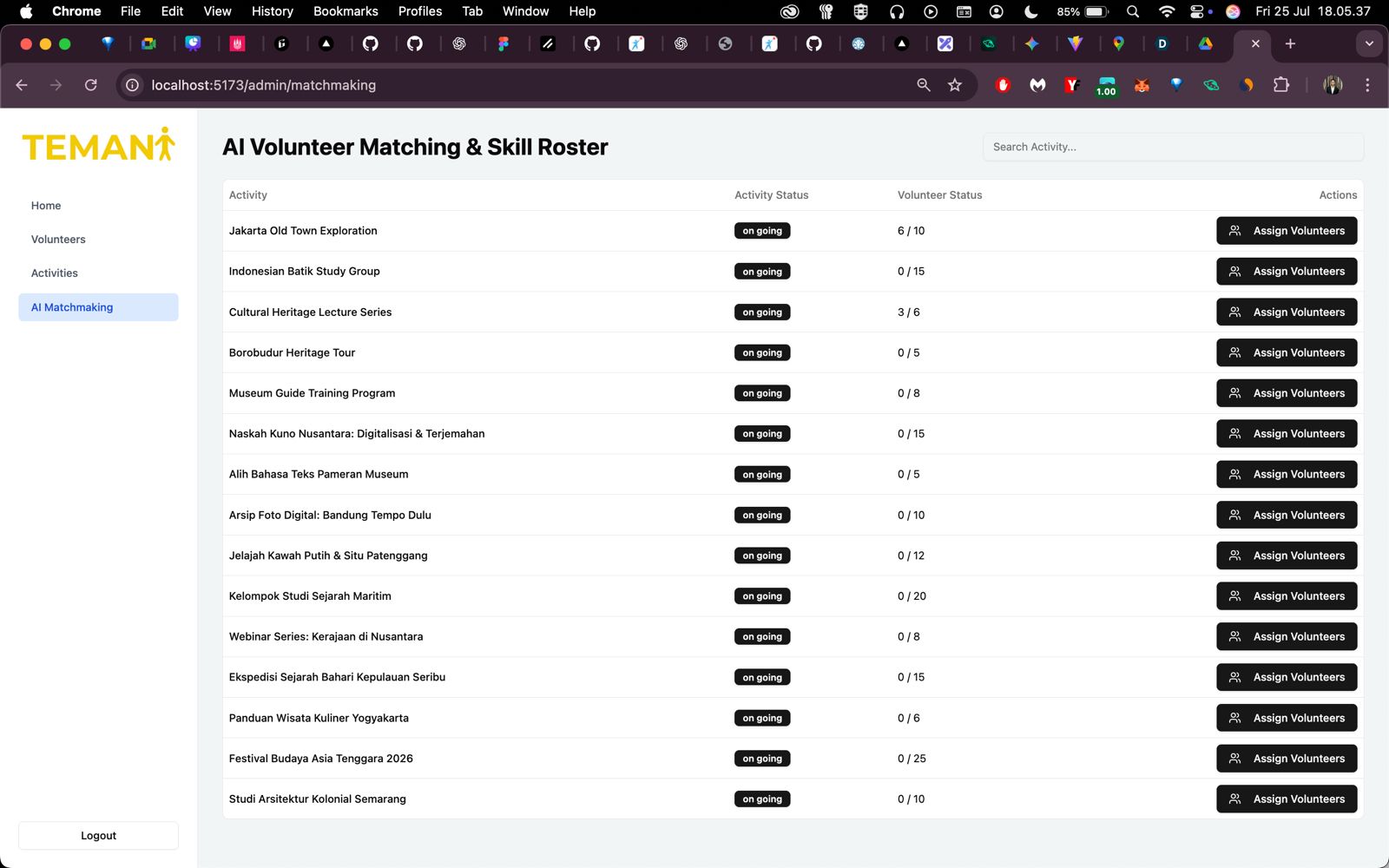
AI Matchmaking Page
💡Inspiration
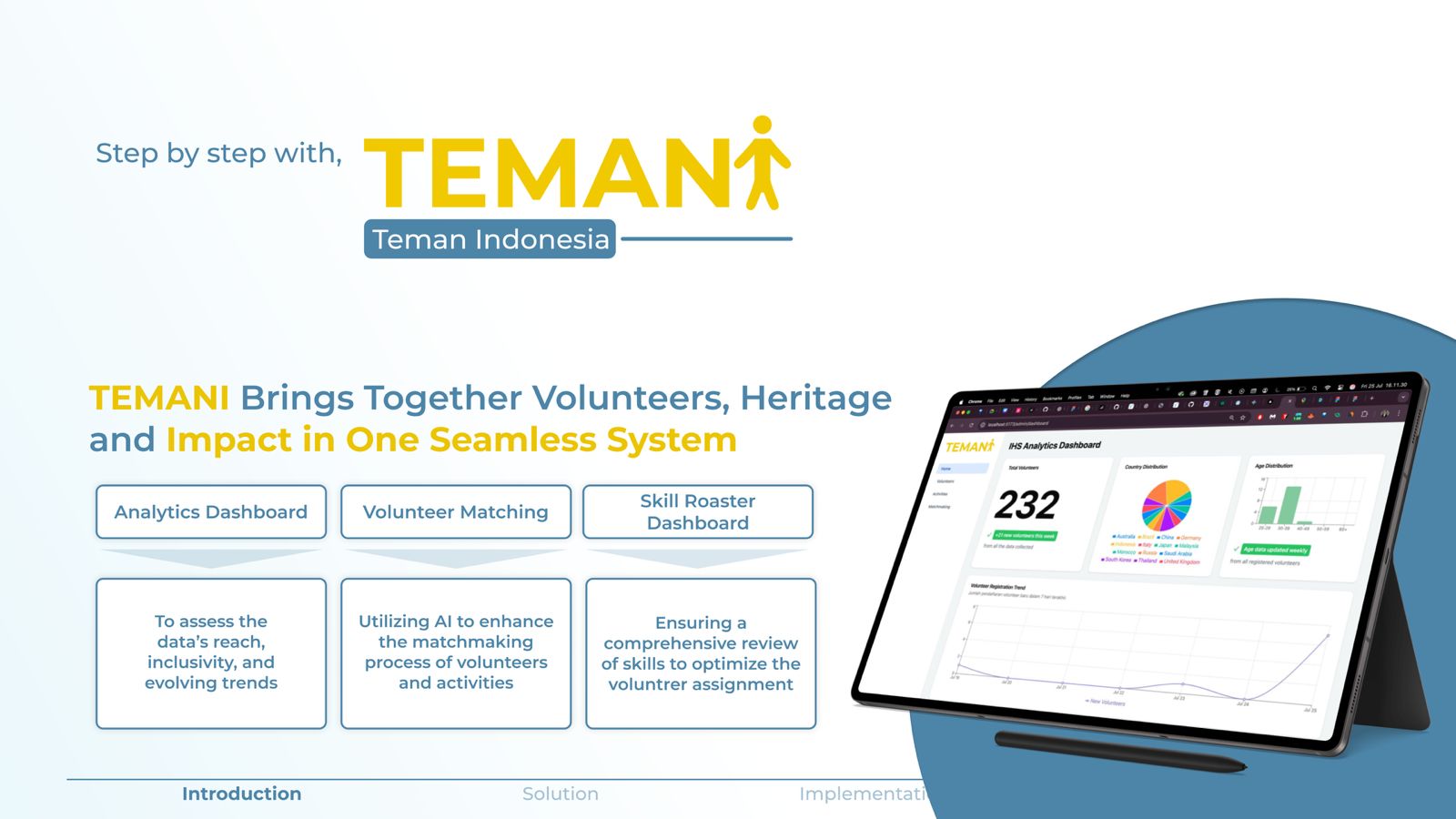
Our team was inspired to take on this idea after learning about the Indonesian Heritage Society’s continued reliance on manual rostering using Excel sheets and fragmented volunteer data. We saw an opportunity to make a meaningful impact by addressing these operational inefficiencies through digital transformation. Recognizing the organization’s critical role in preserving Indonesia’s cultural heritage, we set out to design a centralized volunteer management system equipped with data visualization, smart activity matching, and impact analytics. By integrating AI based volunteer to activity matching, our goal is to strengthen the people, processes, and policies that support long term sustainability and more meaningful volunteer engagement. This initiative is not just about efficiency, it’s about preserving heritage through better coordination, empowerment, and informed decision making.
🛠️What it does
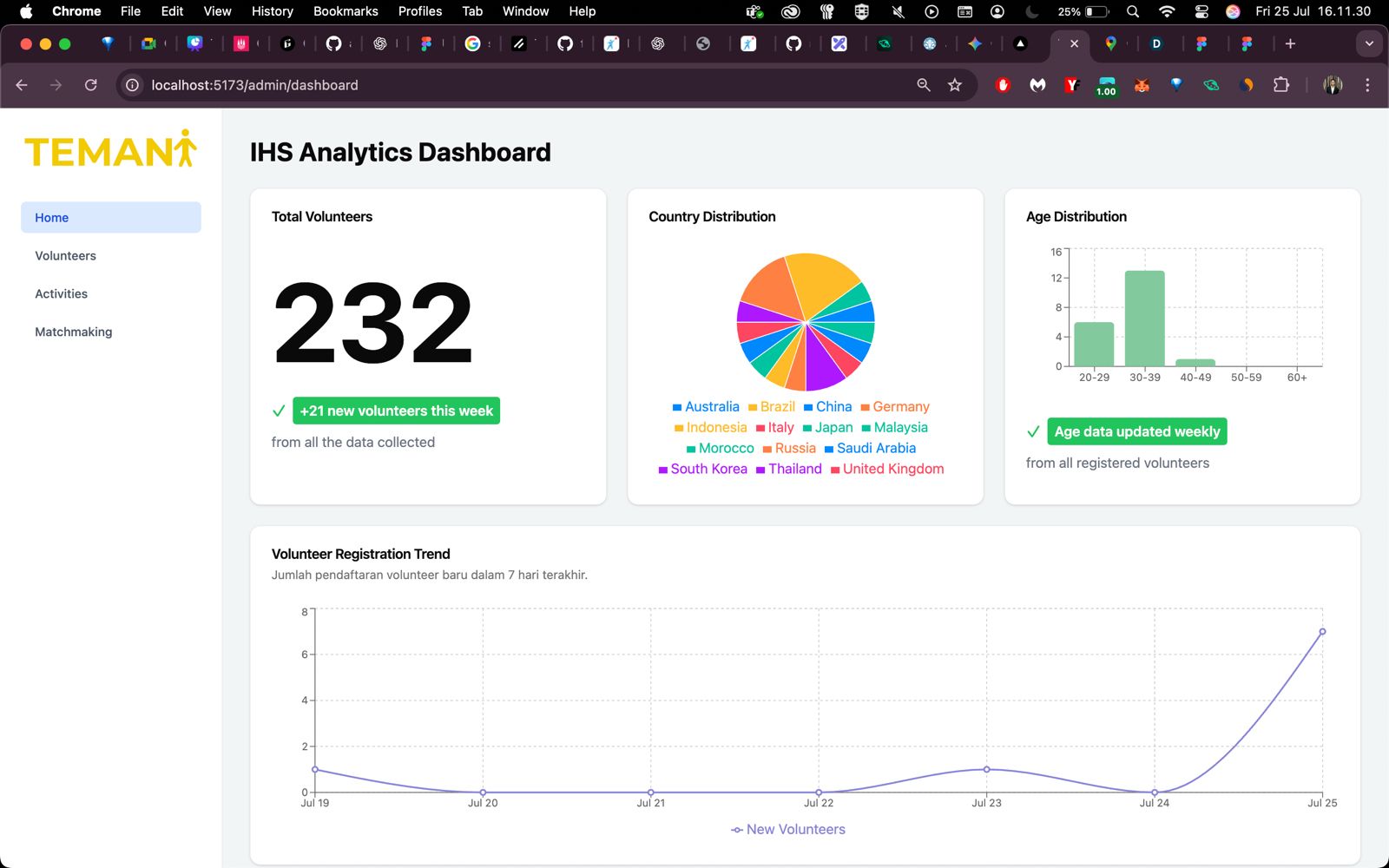
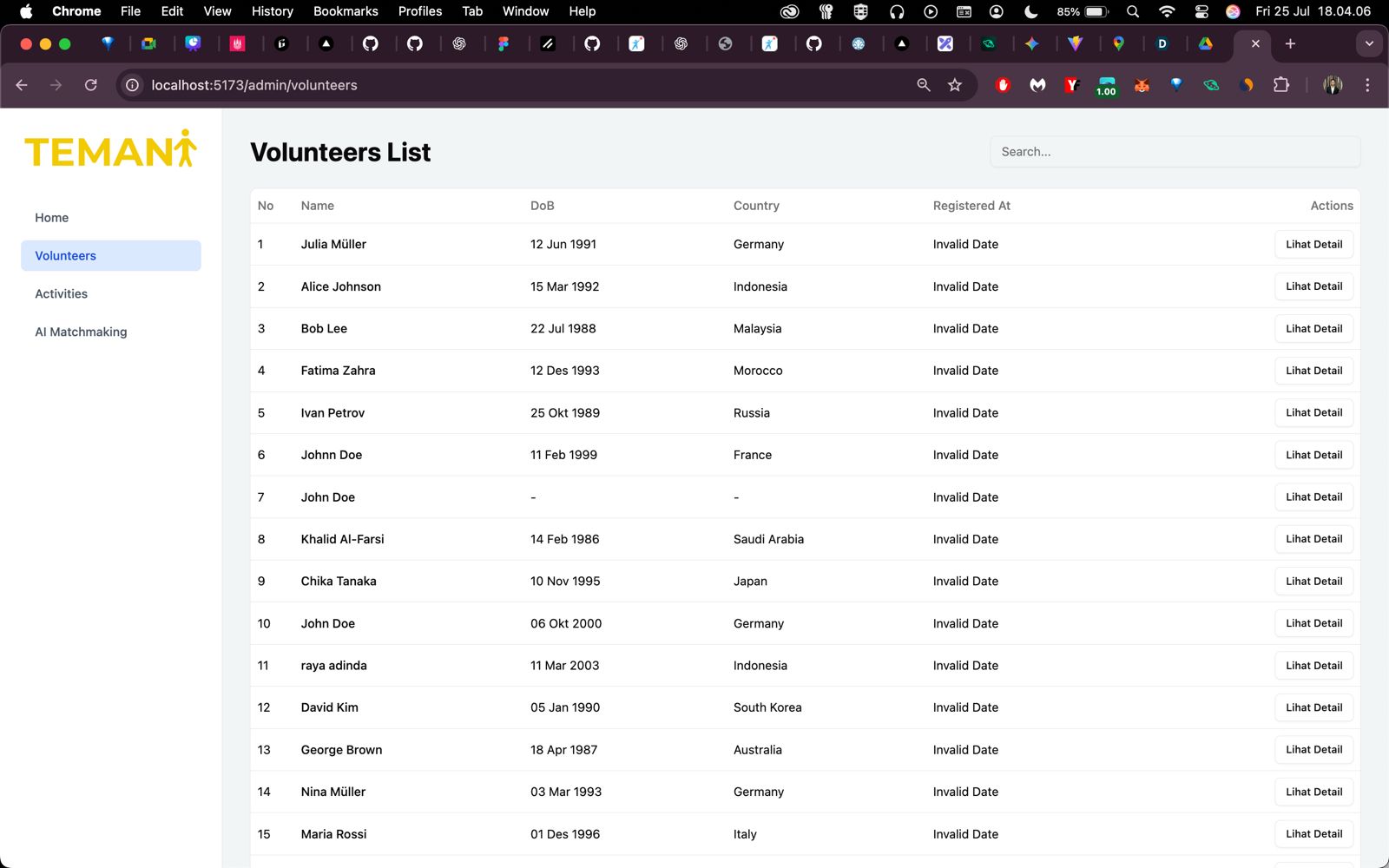
The volunteer management system we built serves as an all in one platform to streamline and enhance the Indonesian Heritage Society’s volunteer operations. It features an intuitive dashboard for visualizing volunteer data, a centralized volunteer directory, and a project/activity page for managing ongoing and upcoming initiatives. At its core, the system includes an AI powered matching engine that recommends suitable volunteers for each activity by analyzing their \textit{personality traits, skills, availability, and language preferences}. Each volunteer profile and project requirement is transformed into a high dimensional feature vector.
Admins can view the resulting match scores, select top candidates, and send activity invitations directly through the platform—replacing manual rostering processes. In addition, the system incorporates feedback collection and \textbf{sentiment analysis} to assess project impact and volunteer satisfaction. These insights empower the organization to make informed, data-driven decisions and ensure the long-term sustainability of Indonesia’s heritage preservation efforts.
🧱 How We Built It
We developed the system using a modular, data-driven architecture focused on scalability, maintainability, and ease of use.
🔧 Tech Stack
- Frontend:
Built using React for a responsive, component-based UI. We prioritized simplicity and accessibility for non-technical users. - Backend:
Developed with Express.js, providing RESTful APIs for handling volunteer registration, activity management, AI matching, and feedback submission. - Database:
Powered by PostgreSQL via Supabase.
We used:- Normalized tables for structured core data (volunteer info, activities)
- JSONB fields for flexible attributes like personality, language, and volunteer opportunities
To enable smart matching, we implemented an AI engine that transforms both volunteer profiles and project requirements into numerical vectors and calculates match scores using cosine similarity. The matching score between a volunteer and a project is calculated using the cosine similarity formula: $$ \text{Similarity}(A, B) = \cos(\theta) = \frac{A \cdot B}{|A| |B|} = \frac{\sum_{i=1}^{n} A_i B_i}{\sqrt{\sum_{i=1}^{n} A_i^2} \sqrt{\sum_{i=1}^{n} B_i^2}} $$ Where:
- ( A ) is the feature vector representing the volunteer profile
- ( B ) is the feature vector representing the project requirement
- ( A \cdot B ) is the dot product of the vectors
- ( |A| ) and ( |B| ) represent the magnitudes (Euclidean norms) of the vectors
This ensures high-quality, personalized recommendations. The entire system replaces fragmented Excel workflows with a centralized platform designed for long-term sustainability, improved engagement, and operational transparency.
🚧 Challenges We Ran Into
We encountered several technical and design challenges while building TEMANI:
- 📦 Structuring Unorganized Data
The initial dataset came from unstructured and inconsistent information on the Indonesian Heritage Society’s website and manual Excel files. Designing a clean, normalized schema from this was time-consuming and required careful data mapping. - 🧠 Designing a Flexible AI Matching Engine
We had to account for multiple volunteer factors (skills, personality, languages, duration) while ensuring the matching system remained interpretable and configurable by non-technical admin users. - 🌐 Balancing Semantic Complexity and Performance
We explored embedding project descriptions to better understand context, but had to carefully manage trade-offs between deep NLP models and system performance. - 👥 User Experience for Non-Technical Admins
Since the system is intended for cultural volunteers and heritage staff, we needed to continuously test and iterate on a UI that was simple, clean, and easy to adopt. --- Despite these hurdles, overcoming them helped us build a more scalable, inclusive, and impactful platform for heritage preservation.
🏆Accomplishments that we're proud of
We’re proud to have transformed a manual, error-prone volunteer management process into a streamlined digital system tailored to the real needs of the Indonesian Heritage Society. One of our key accomplishments was successfully implementing an AI powered matching engine that connects volunteers to activities based on nuanced criteria like skills, personality traits, and availability. Something previously almost impossible with spreadsheets. We also built a clean, intuitive dashboard that empowers admins to visualize volunteer data and project impact in real time. Most importantly, we created a scalable foundation that not only supports smarter volunteer engagement today, but also opens doors for future expansion into museum and partner management, ensuring the long term sustainability of heritage preservation efforts.
📚What we learned
Through this project, we learned how impactful technology can be in empowering non-profit and heritage organizations to operate more efficiently and sustainably. We deepened our understanding of vector-based matching algorithms and how to apply cosine similarity to real world human data like personality and skill sets. We also gained hands on experience in designing flexible data structures using JSONB fields to accommodate complex volunteer profiles. Building the AI matching engine taught us the importance of balancing algorithmic precision with interpretability for end-users. Most importantly, we learned how crucial user-centric design is when creating tools for non-technical stakeholders ensuring the platform is not only smart, but also usable and meaningful for the organization’s long term mission.
🔮What's next for TEMANI
Looking ahead, we plan to enhance TEMANI’s AI matching capabilities by integrating BERT and other transformer-based models to embed project descriptions and volunteer profiles with deeper semantic understanding. This will allow the system to capture contextual meanings behind phrases like “biodiversity,” “volcanoes,” or “national parks,” enabling even more accurate and meaningful matches between volunteers and projects. We also aim to improve the platform’s impact analysis by applying sentiment analysis tools such as Vader, TextBlob, or BERT-based models to automatically interpret volunteer feedback, identifying trends like “amazing” (positive) or “not fun” (negative) to better evaluate project success. Beyond volunteer management, TEMANI will expand into Museum Inventory & Program Management, helping the Indonesian Heritage Society digitize and organize exhibitions, events, and training programs further supporting their mission to preserve cultural heritage through smarter, integrated systems.
🔐Notes: If you want to login in https://temani-sigma.vercel.app you can use this:
Admin [email protected] Testing123
Volunteer [email protected] Johndoe123
Built With
- express.js
- node.js
- postgresql
- python
- railway
- react
- shadcn-ui
- sklearn.metrics.pairwise
- sklearn.preprocessing
- supabase
- taildwindcss
- typescript
- vercel


Log in or sign up for Devpost to join the conversation.