-
-
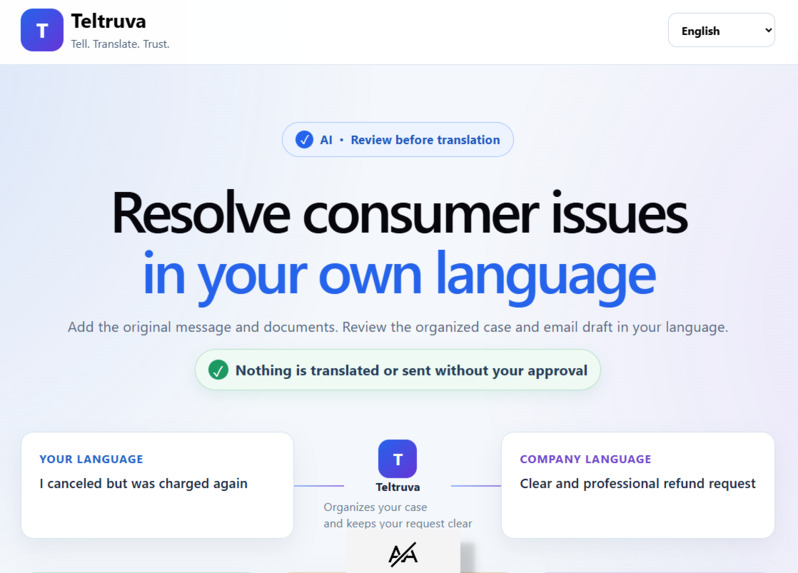
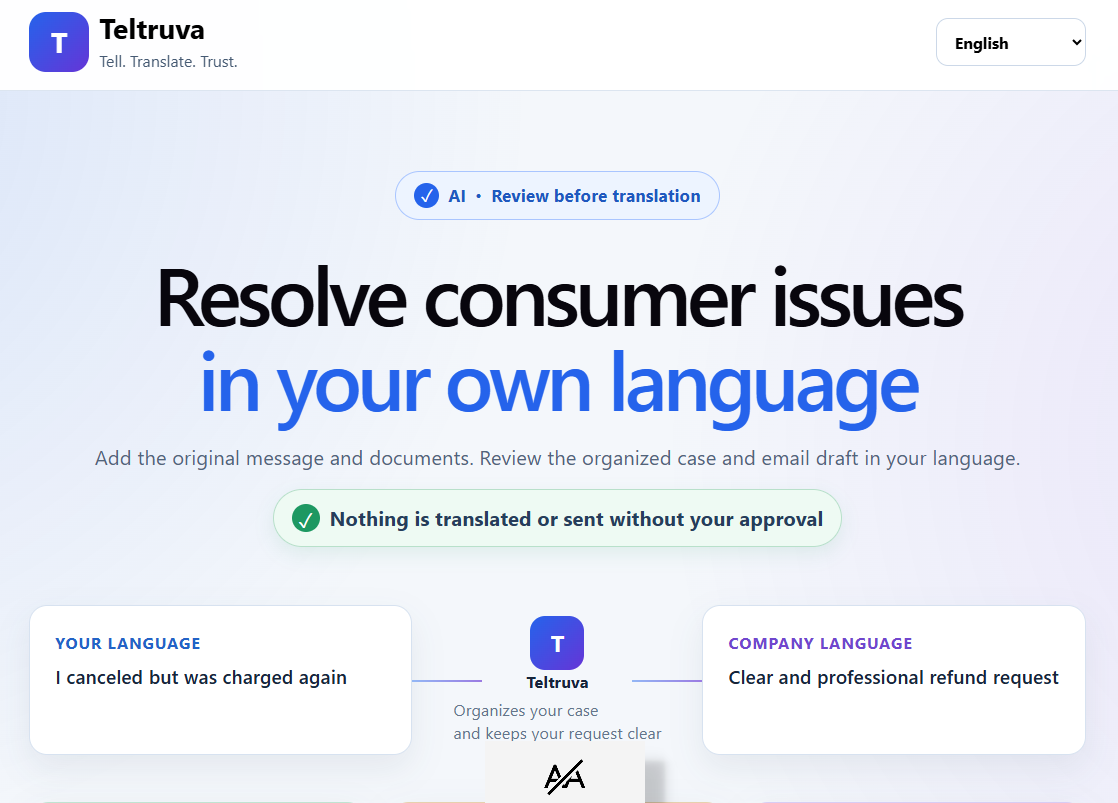
Resolve consumer issues in your own language with AI-assisted case organization and translation.
-
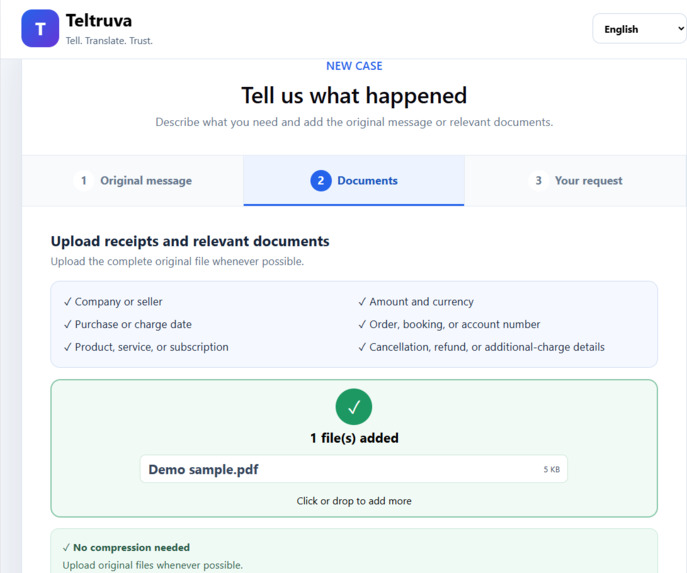
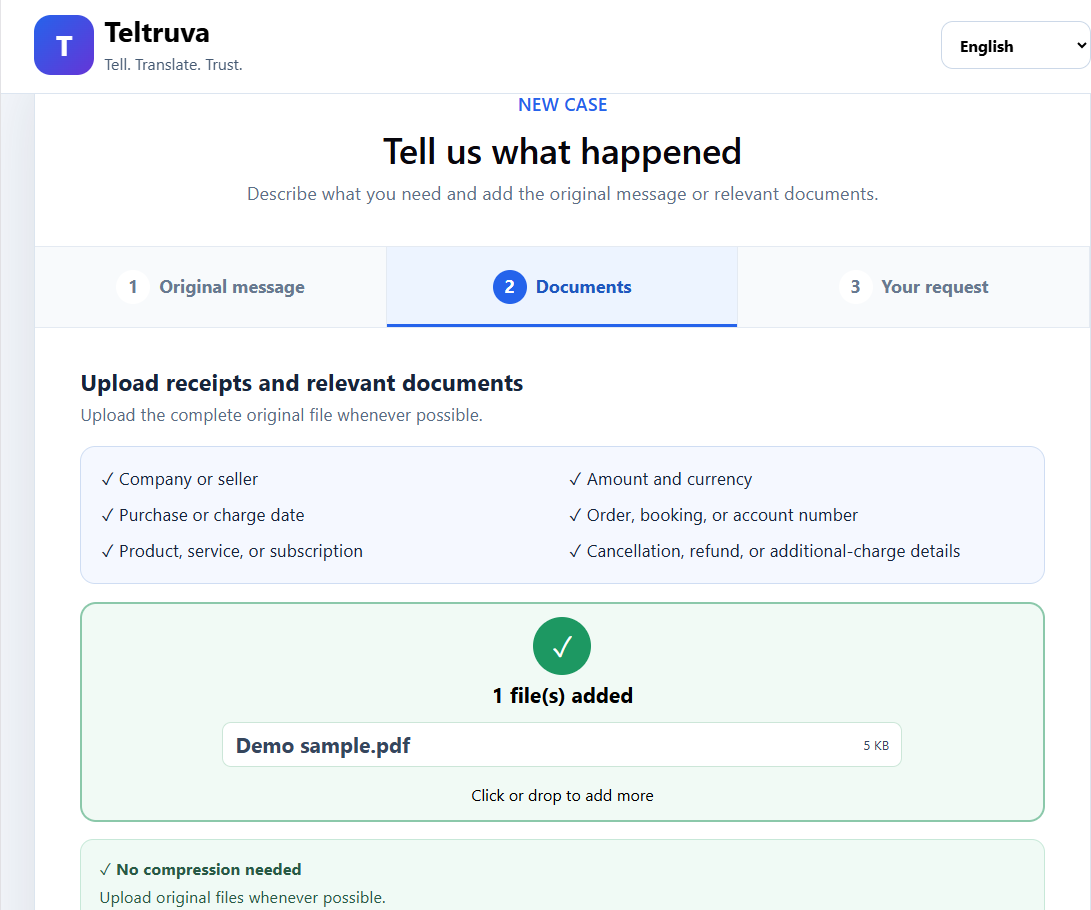
Upload receipts and supporting documents so Teltruva can identify the details needed for the inquiry.
-
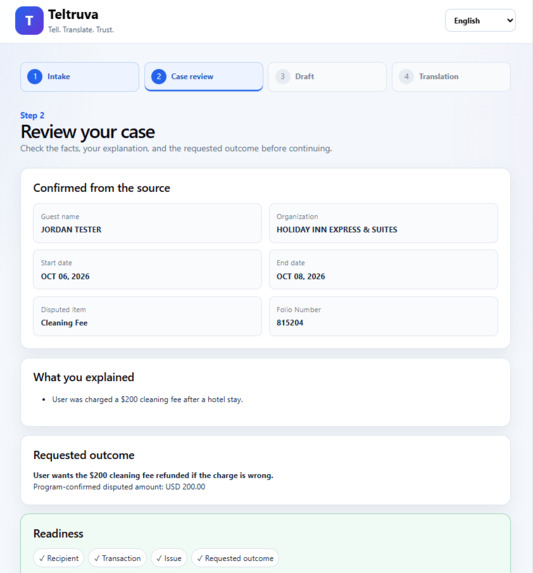
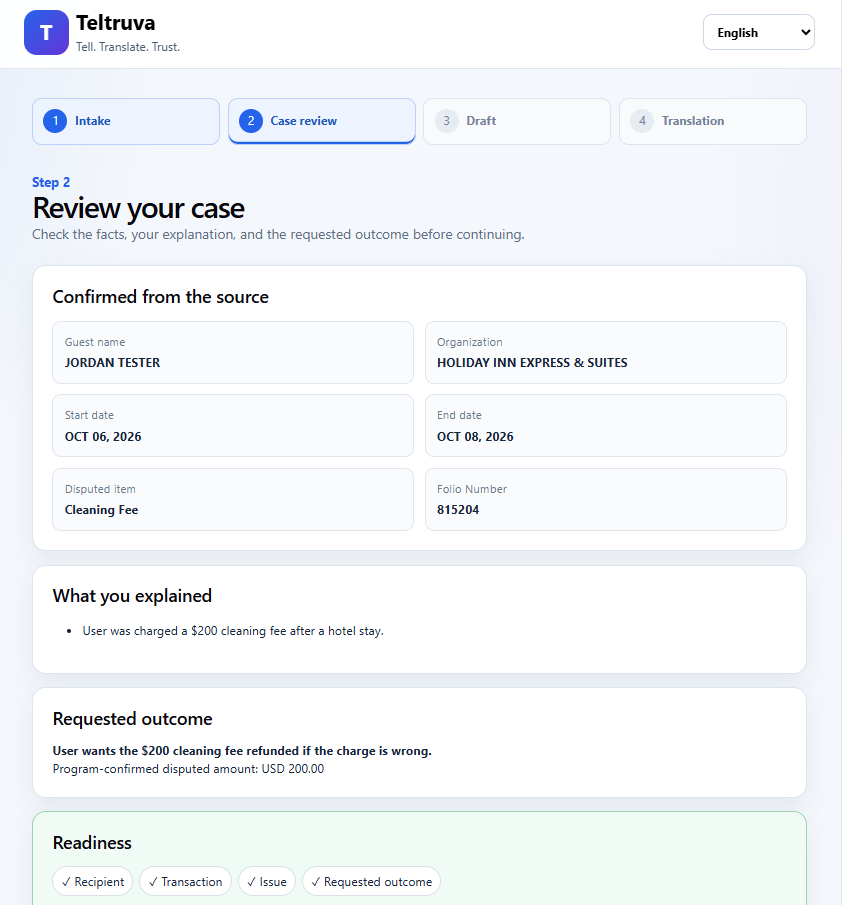
Review source-confirmed facts, the user’s explanation, and the requested outcome before drafting.
-
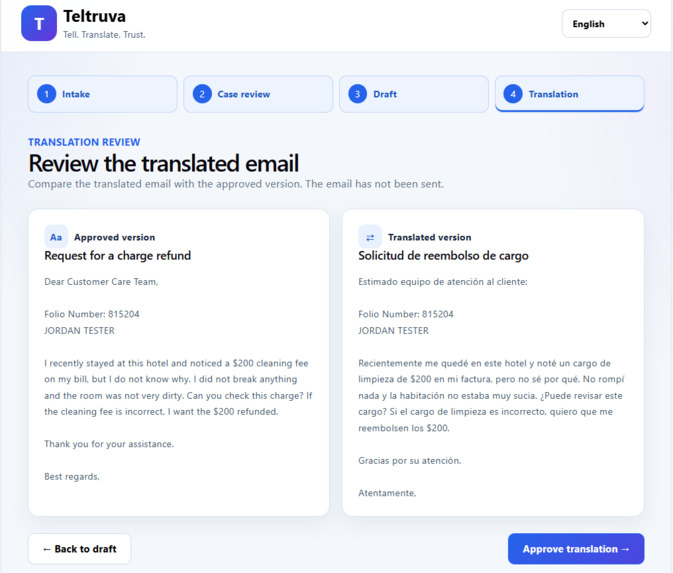
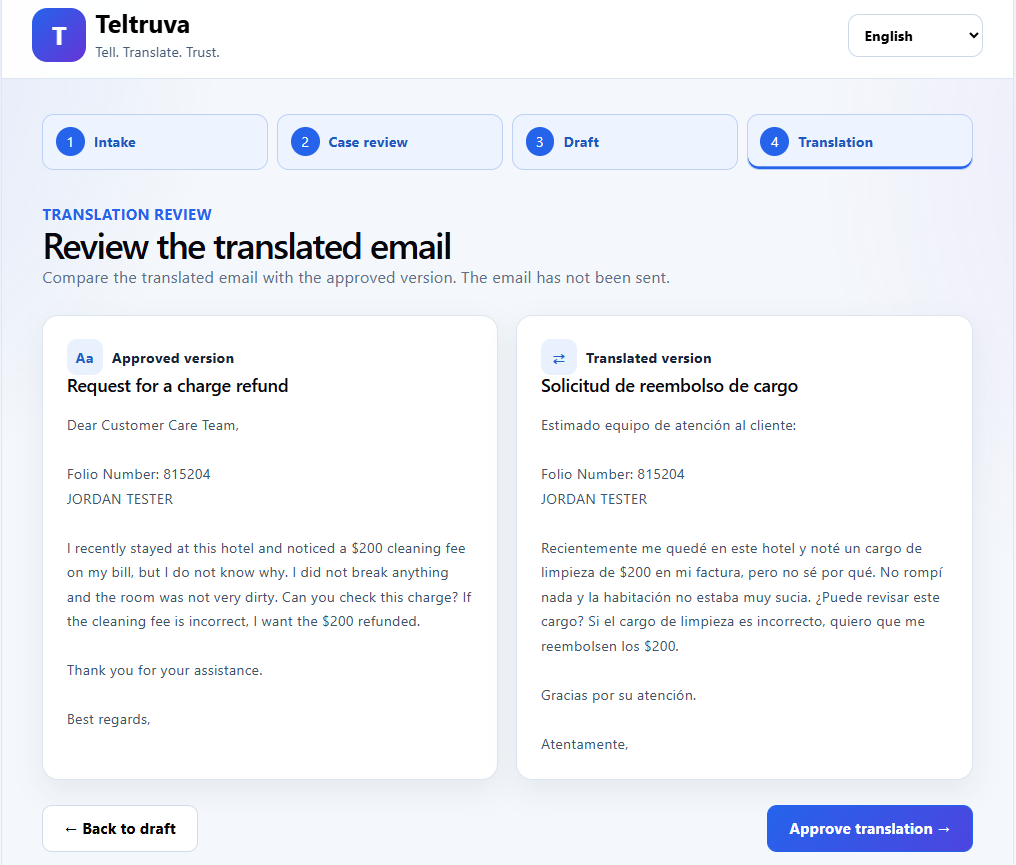
Compare the approved message with the translation before proceeding. Nothing is sent automatically.
-
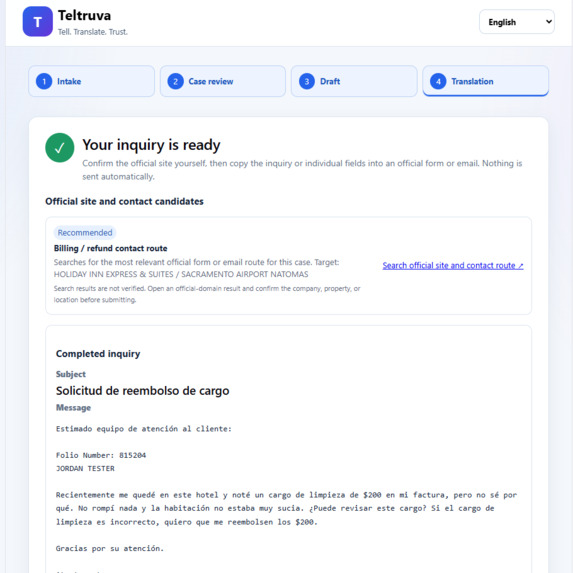
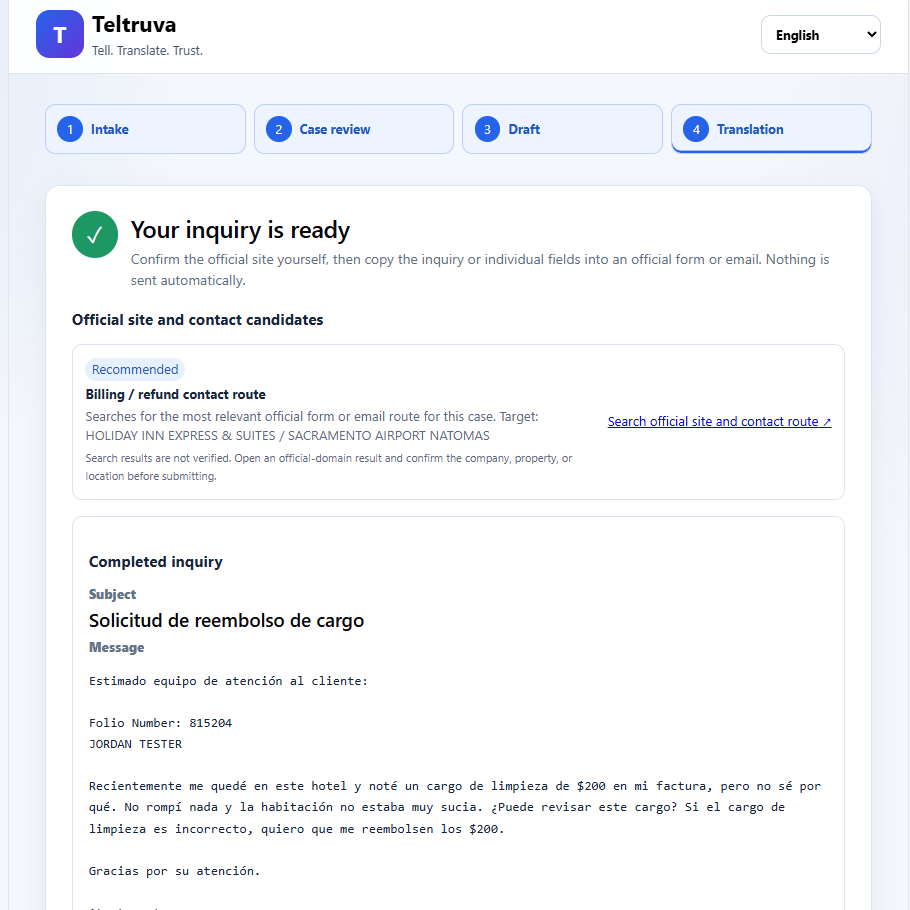
Copy the completed inquiry and verify an official contact route before submitting it by form or email.
Inspiration
A language barrier should not turn a solvable service issue into financial loss.
When people encounter an unexpected charge, a billing error, a cancellation problem, or another service issue in a foreign country, the hardest part is often not understanding that something went wrong. The real challenge is explaining the situation clearly, providing the right evidence, and asking for an appropriate resolution in a language they may not speak confidently.
Existing translation tools can translate words, but users still need to decide what information matters, how to structure the inquiry, and what action to request. Teltruva was created to close that gap.
What it does
Teltruva helps users turn a stressful cross-language problem into a clear and actionable inquiry.
With Teltruva, a user can:
- Describe the problem naturally in their own language
- Upload supporting documents, such as receipts or billing records
- Extract relevant details from the uploaded evidence
- Clarify only the essential information that is still missing
- Review the intended meaning before translation
- Generate a clear and respectful inquiry in the recipient’s language
- Use the resulting message through email, a web form, chat, or another available contact channel
The goal is not simply to translate the user’s words. Teltruva identifies the user’s intent, preserves important facts, and helps communicate the resolution the user is seeking.
How we built it
Teltruva was designed as a focused AI-assisted workflow:
- The user explains the issue in the user’s preferred language.
- The system analyzes the message and any uploaded evidence.
- Relevant transaction details are organized into a structured case.
- The system identifies missing information only when that information is necessary.
- AI generates a recipient-ready inquiry while preserving the user’s intent.
- The user reviews the result before using it through the appropriate communication channel.
The application uses NVIDIA Nemotron 3.5 Lightning through Nebius Token Factory to understand the user’s situation, distinguish confirmed facts from user-provided statements, identify missing information, and generate a recipient-ready inquiry. Teltruva sends structured case information to the model at runtime and returns the result in a format that the user can review before proceeding.
The product interface was built to minimize unnecessary input. Instead of presenting a long complaint form, Teltruva begins with the user’s own explanation and asks for additional details only when needed.
Challenges we ran into
One of the main challenges was distinguishing translation from problem resolution.
A literal translation may be grammatically correct while still failing to communicate:
- What happened
- Which transaction is involved
- Why the user believes there is a problem
- What evidence supports the inquiry
- What response or resolution the user wants
Another challenge was balancing automation with user control. Teltruva should reduce the user’s workload without inventing facts, overstating claims, or sending a message before the user has reviewed it.
We therefore designed the workflow around three principles:
- Preserve the user’s original intent
- Never guess essential transaction details
- Keep the user in control of the final message and communication channel
Accomplishments that we're proud of
We are proud that Teltruva turns a complex and stressful process into a simple sequence that users can understand.
Key accomplishments include:
- Supporting natural-language problem descriptions instead of requiring a complicated form
- Combining the user’s explanation with information extracted from supporting evidence
- Separating intent clarification from final message generation
- Producing a message that is appropriate for the recipient, not merely a literal translation
- Supporting multiple communication channels rather than assuming that every organization accepts email
- Keeping the user involved in reviewing the message before taking action
What we learned
We learned that cross-language communication problems are rarely solved by translation alone.
Users need help organizing evidence, identifying missing information, expressing the desired resolution, and communicating in a tone appropriate for the recipient. AI is most useful when it supports this complete process while remaining transparent about what it knows and what still requires confirmation.
We also learned that a smaller number of carefully designed steps can create more value than a large number of features. For a user already dealing with an unexpected charge or service failure, simplicity is essential.
What's next for Teltruva
The next steps are to:
- Improve document extraction across more receipt and billing formats
- Support additional languages and regional communication styles
- Help users locate official contact channels without guessing contact information
- Provide follow-up message support when the recipient does not respond
- Add privacy-focused case management for repeated or ongoing inquiries
- Test the workflow with real cross-border customer service scenarios
Built With
- javascript
- nebius
- nemotron
- node.js
- nvidia
- ocr
- react
- typescript
- vercel
- vite

Log in or sign up for Devpost to join the conversation.