-
-
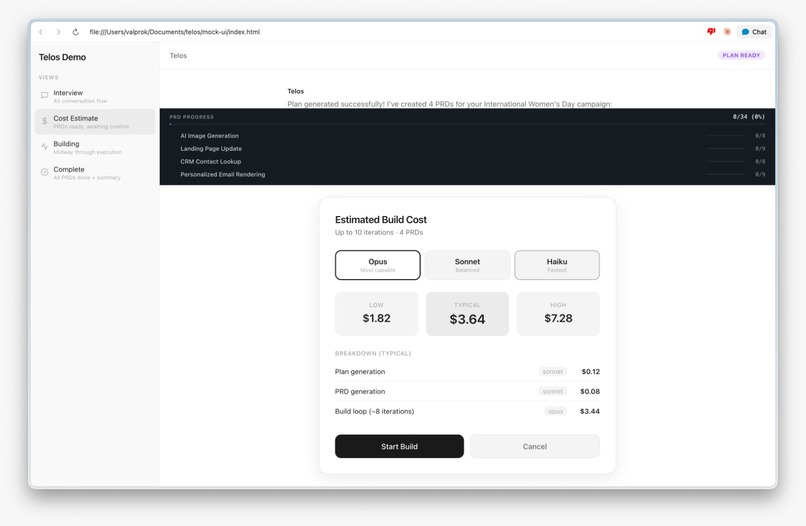
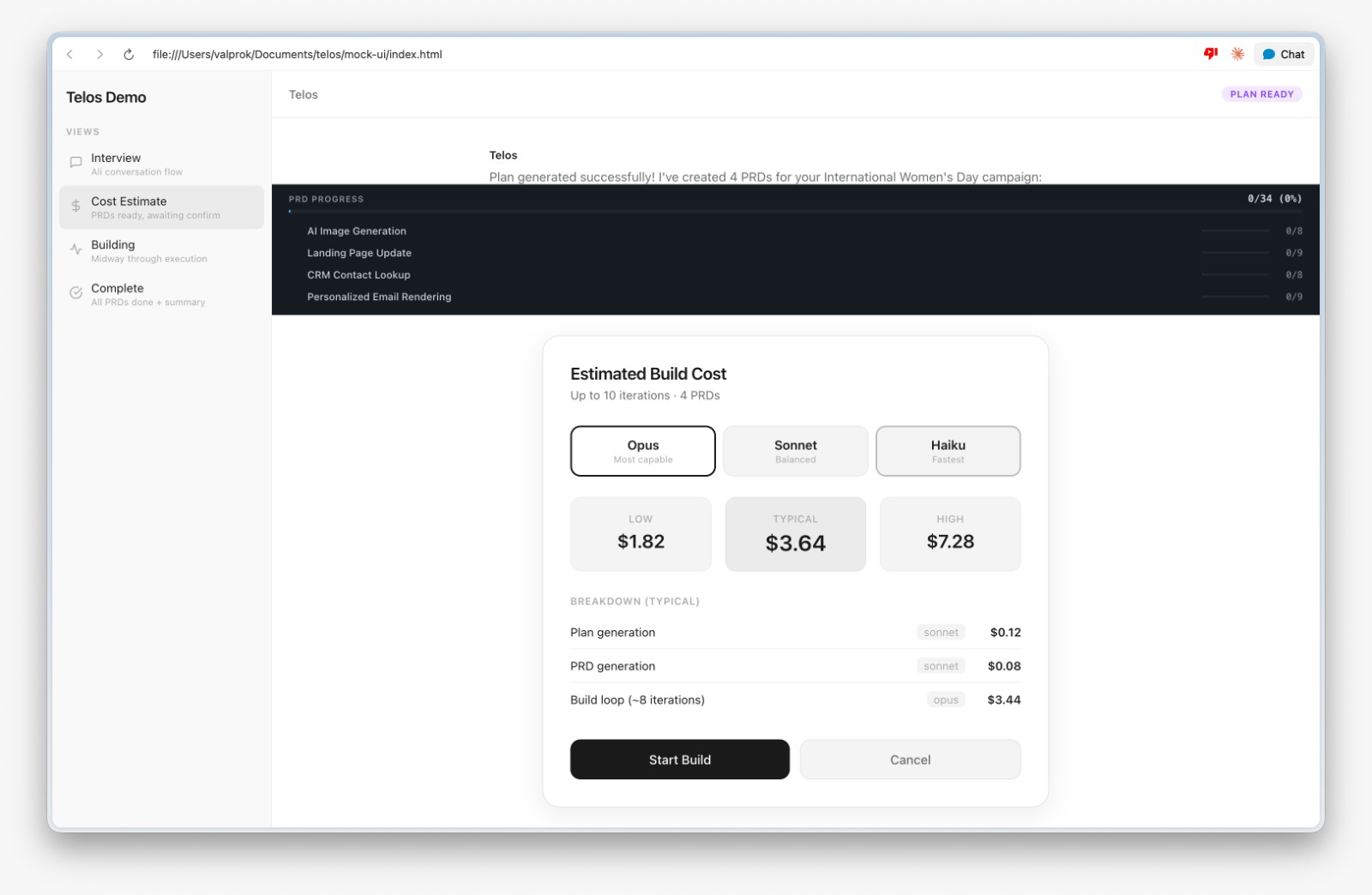
Estimated build cost - user decides to build or cancel
-
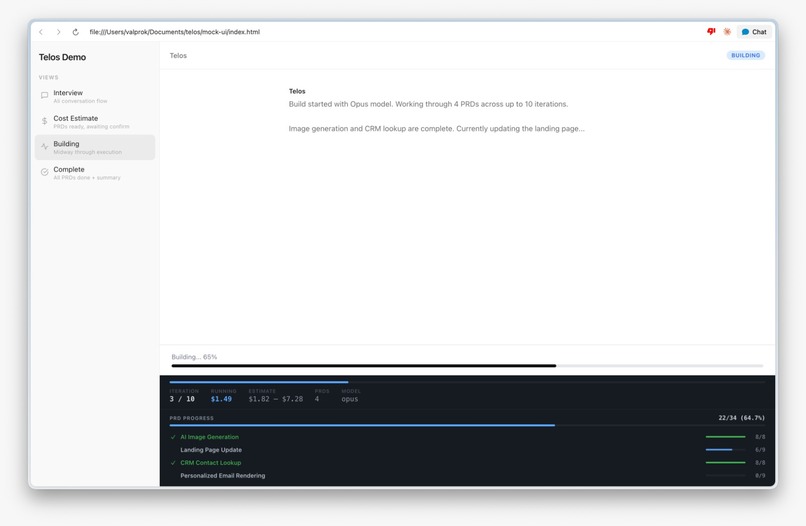
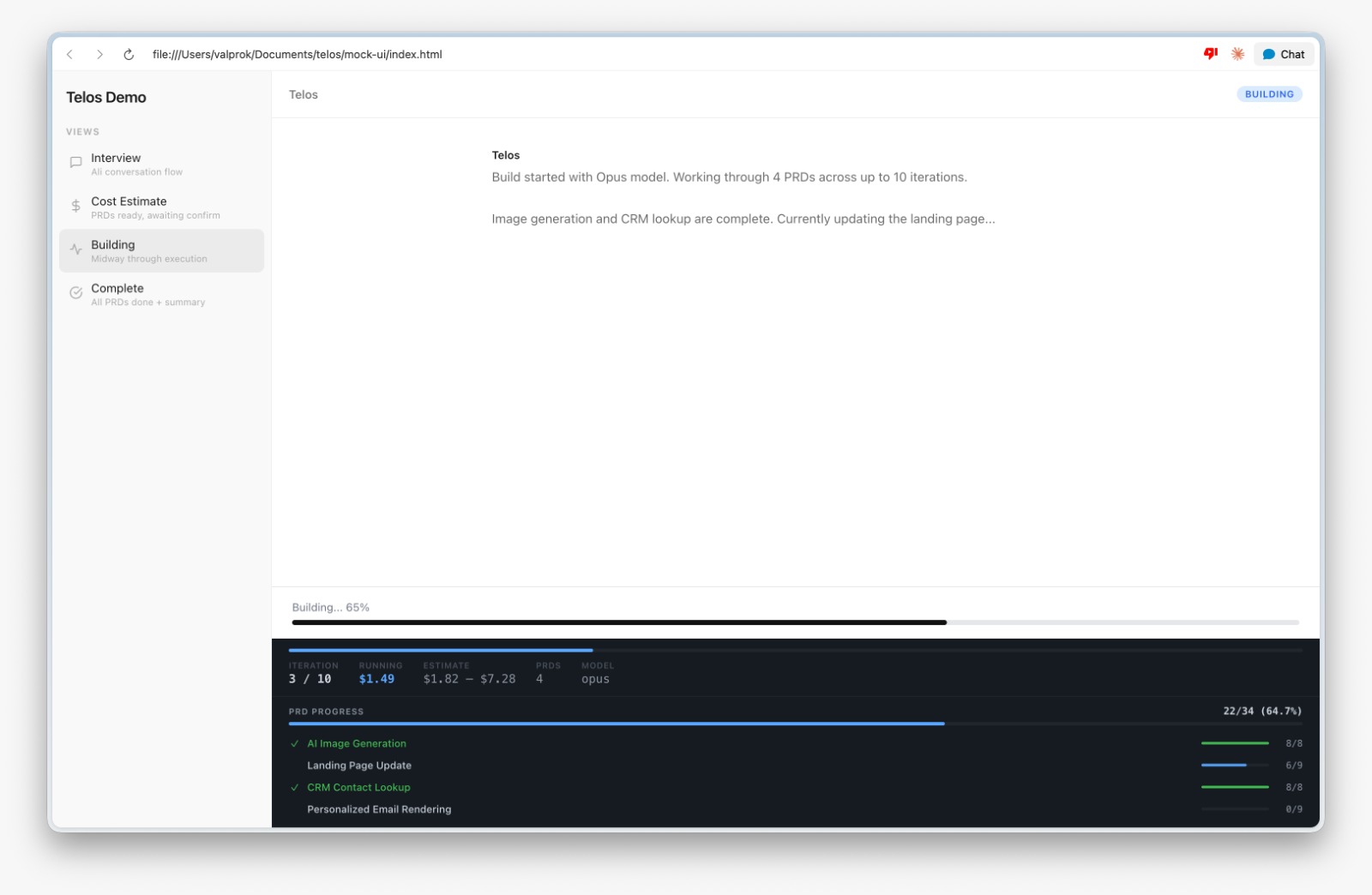
screenshot showing that the product is building
-
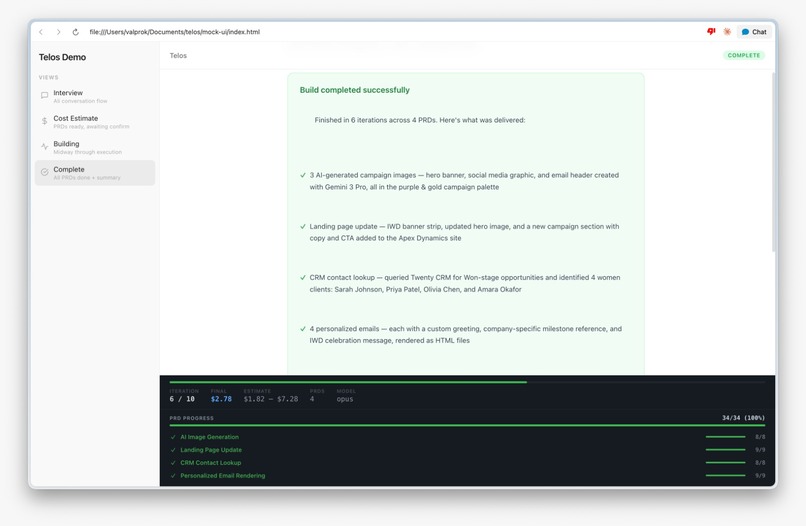
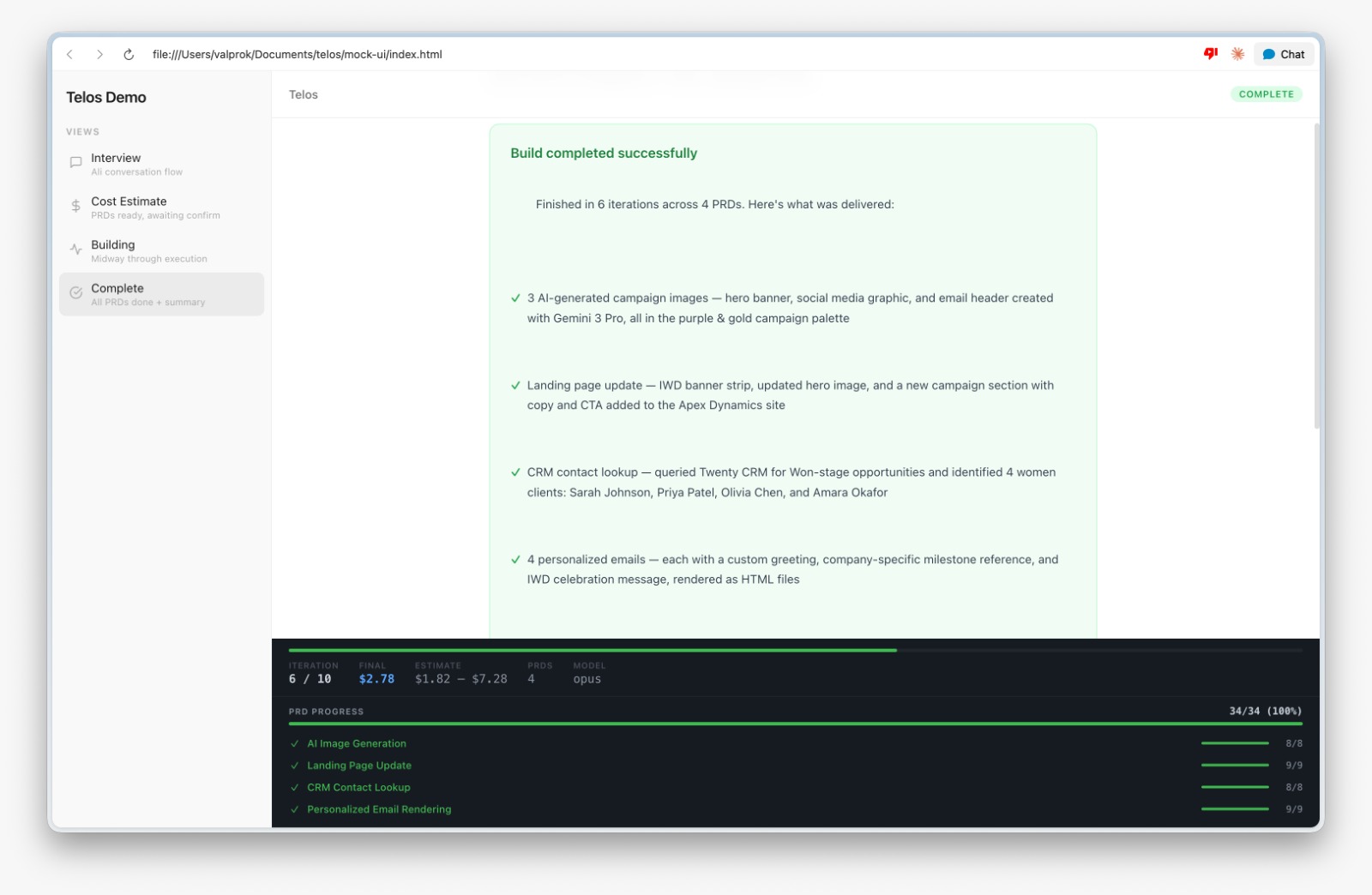
results shown to the user
Inspiration
We were inspired by a simple but frustrating truth: turning an idea into a real digital product still requires weeks of coordination, technical expertise, and multiple tools. Non-technical founders and creators often have powerful ideas but lack the execution bandwidth. Existing AI tools improve productivity by ~15%, but they still require constant supervision.
We wanted to build true agency — not “AI as assistant,” but AI as autonomous executor. Telos was born from the belief that one conversation should be enough to go from intent to delivery.
What it does
Telos converts a single natural-language instruction into a fully built, tested, and delivered digital project.
You describe your idea (by text or voice). Telos interviews you like a consultant, extracts structured requirements, generates a technical plan, splits it into PRDs, and deploys a swarm of specialized AI agents to build, review, and iterate — until the project is complete.
The output isn’t mockups. It’s real deliverables:
- Functional websites
- Campaign assets
- Personalized emails
- CRM integrations
- Production-ready code
From intent to execution — autonomously.
How we built it
Telos is built around a multi-layer autonomous architecture:
- ALI (Adaptive Language Interviewer) — a custom GPT-2 + LoRA model trained with SFT and PPO to extract structured requirements through dynamic interviews.
- Plan Generator — uses Claude + Gemini via MCP to generate architecture, stack decisions, and risk analysis.
- PRD Splitter — decomposes projects into ordered, self-contained work units.
- Ralph (Self-Healing Build Loop) — a multi-agent execution engine that builds, reviews, fixes, and retries until approval or budget exhaustion.
- Backend — FastAPI with SSE streaming.
- Frontend — Next.js with a voice-first animated canvas interface.
- RAG layer — ChromaDB + embeddings for context grounding.
We also built a full ML training pipeline with evolutionary optimization and Monte Carlo evaluation to maximize requirement coverage per conversation turn.
Challenges we ran into
- Designing an interview system that balances coverage and conversation length.
- Making agents self-heal instead of cascading failures.
- Coordinating multiple AI models while keeping cost and latency manageable.
- Preventing hallucinated architecture decisions during autonomous execution.
- Building a real voice-first UX that feels alive, not gimmicky.
The hardest problem was trust: making sure the system produces real, verifiable deliverables — not just convincing text.
Accomplishments that we're proud of
- Built a fully autonomous build loop that retries intelligently instead of failing silently.
- Achieved 90%+ requirement coverage dynamically based on project complexity.
- Delivered real production artifacts (HTML, emails, CRM integrations), not demos.
- Implemented evolutionary reward optimization in the training pipeline.
- Created a working end-to-end system during a hackathon timeframe.
Most importantly, we built something that actually ships.
What we learned
- True autonomy requires structured decomposition — not bigger prompts.
- AI agents need governance, gating, and review loops to be reliable.
- Coverage metrics matter more than conversation length.
- Execution quality improves dramatically when tasks are broken into explicit PRDs.
- Agency is a systems problem, not just a model problem.
What's next for telos
- Expand model specialization (designer, DevOps, growth strategist agents).
- Add deployment automation (cloud provisioning, CI/CD).
- Improve cost-aware routing between models.
- Launch a hosted version with secure workspace isolation.
- Enable collaborative multi-user intent sessions.
Our long-term vision: Telos becomes the default operating system for turning ideas into reality.
Built With
- chromadb
- claude
- elevenlabs
- fastapi
- fastembed
- gemini
- javascript
- next.js
- openrouter
- postgresql
- pydantic
- pypdf
- python
- react
- redis
- sse-starlette
- twenty-crm-rest-api-self-hosted
- typescript
- uvicorn


Log in or sign up for Devpost to join the conversation.