Inspiration
Two moments made Telmed inevitable.
A woman in my community suffered a concussion after slipping in her bathroom. She spent over a month being transferred between hospitals with no specialist available. The nearest qualified neurosurgeon was in London. The delay caused permanent neurological damage. She did not need a miracle. She needed access.
Then it became personal. I suffered from a skin condition for three years that multiple clinics failed to diagnose. Out of desperation, I photographed the affected area, described my symptoms to an AI, and received an accurate diagnosis with a treatment list costing ₦1,400. Within one month, a three-year problem had completely cleared.
That was not just relief. That was proof of concept.
Nigeria has approximately 0.4 doctors per 1,000 people — far below the WHO recommended threshold of 1 per 1,000. For rural communities, the effective ratio approaches zero. Telmed was built to close that gap using artificial intelligence as the first line of medical response.
What It Does
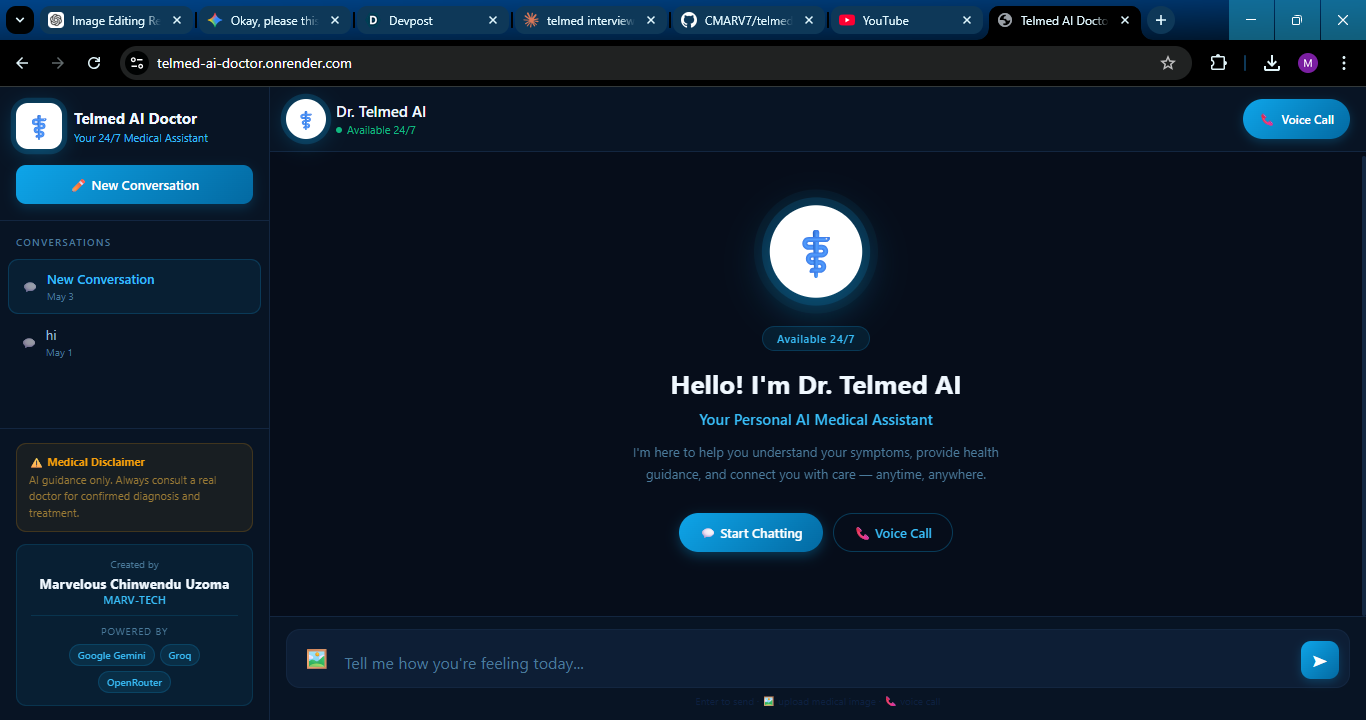
Telmed AI Doctor is a multimodal AI-powered medical assistant delivering primary care guidance to patients with no access to physical healthcare infrastructure.
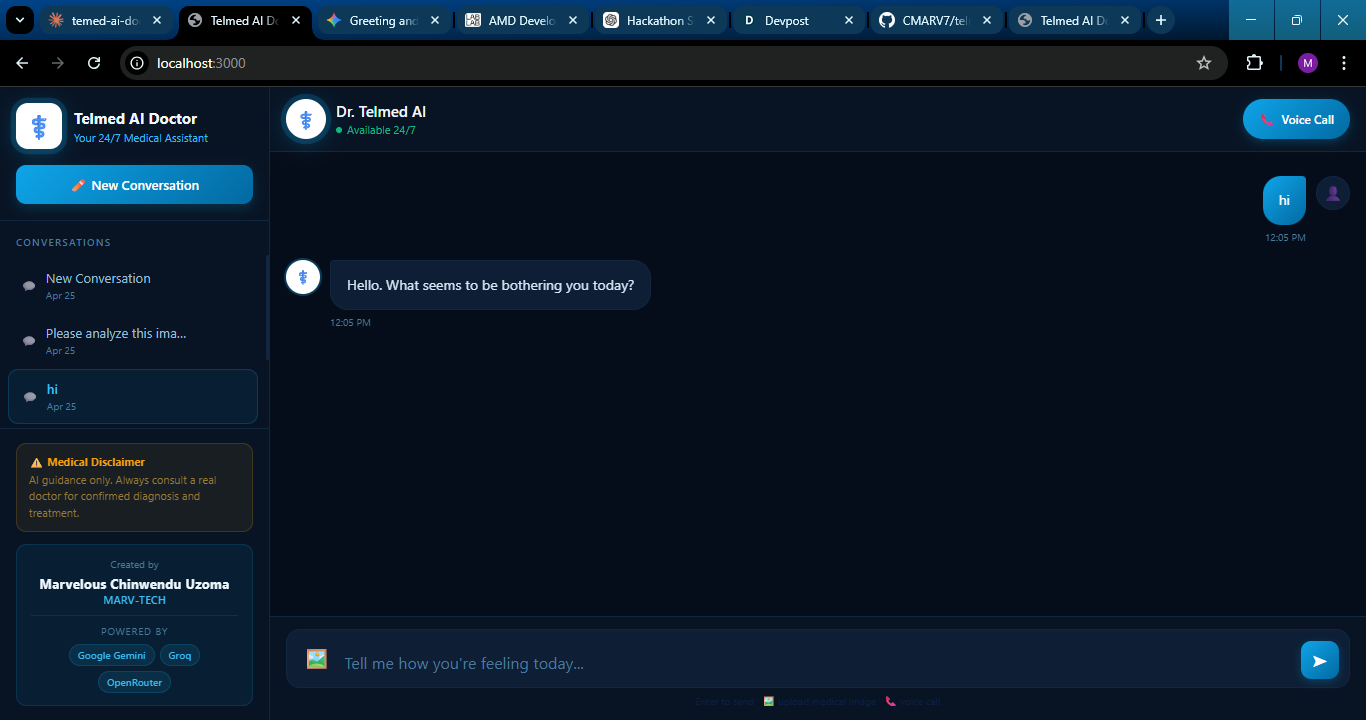
Symptom Assessment — Users describe symptoms via text or voice note. The AI extracts clinical data, asks clarifying questions, and returns a structured diagnostic interpretation with severity classification: Low / Moderate / Urgent.
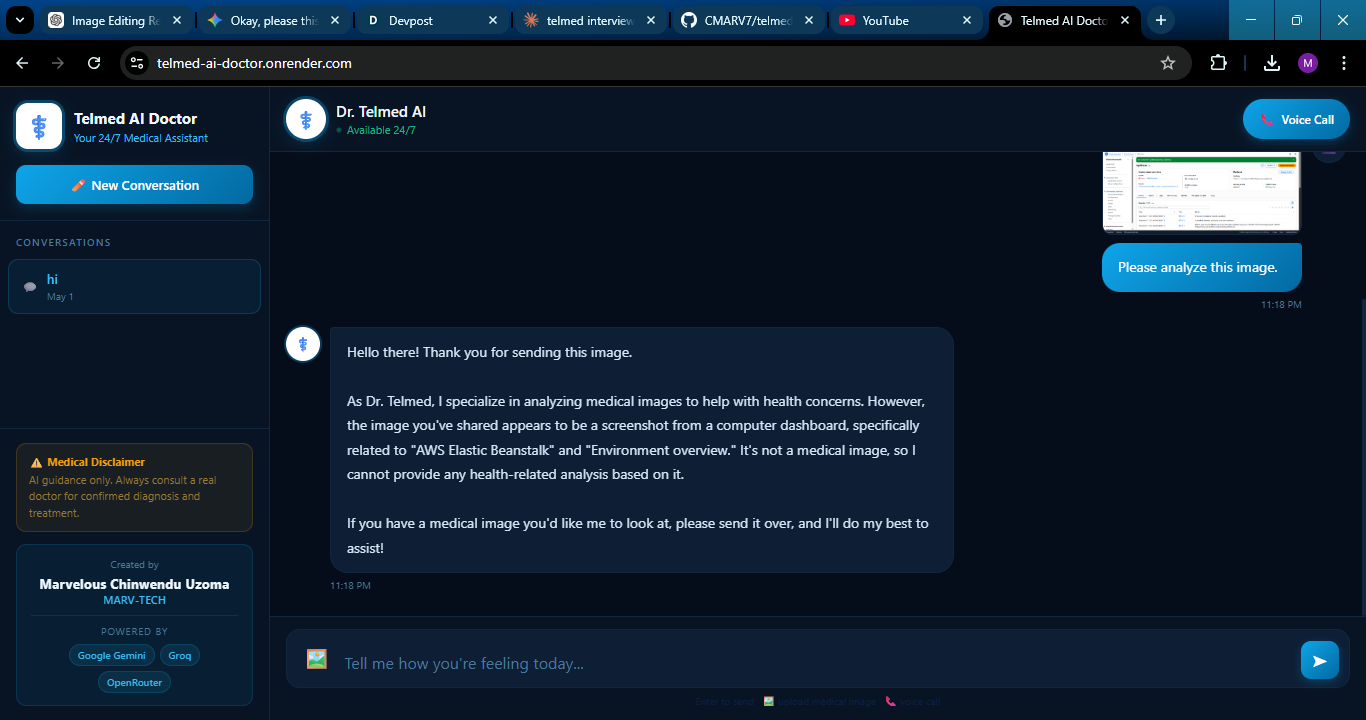
Image-Based Diagnosis — Patients photograph wounds, rashes, or skin conditions. Google Cloud Vision API processes the image; Gemini applies clinical reasoning and returns a diagnostic interpretation with a recommended treatment pathway.
Medication Management — Personalised medication schedules, automated dosage reminders, and drug interaction flags.
Pharmacy Integration — Google Places API directs users to the nearest verified pharmacy to complete the full care pathway.
24/7 Availability — No appointments. No waiting rooms. No transport costs. Accessible on any internet-enabled device, optimised for low-bandwidth environments.
How We Built It
| Layer | Technology |
|---|---|
| Backend | Node.js, Express.js |
| Frontend | HTML5, CSS3, Vanilla JavaScript |
| Primary AI Engine | Google Gemini API |
| Secondary AI Engine | DeepSeek API |
| Image Analysis | Google Cloud Vision API |
| Location Services | Google Places API |
| Database | Firebase Firestore |
| Authentication | Firebase Authentication |
| Infrastructure | Google Cloud Platform |
The AI Doctor runs on a multi-model cross-validation architecture. Gemini handles primary diagnostic reasoning. DeepSeek independently validates the same input. When models disagree on severity, the system always escalates conservatively — erring on the side of patient safety.
The frontend was built in vanilla JavaScript — no framework overhead — to ensure fast load times on low-bandwidth Nigerian mobile networks where 3G remains dominant.
Images are compressed client-side before transmission to reduce data consumption for users on metered mobile plans, then processed through Google Cloud Vision before Gemini applies contextual clinical reasoning.
Challenges We Ran Into
Medical accuracy vs. plain language. The system must communicate clearly to users with zero medical literacy while remaining clinically responsible. Significant prompt engineering was invested in calibrating tone, escalation triggers, and disclaimer framing that builds rather than undermines user trust.
Hallucination risk on clinical output. A single wrong assertion in a medical context is not a UX bug — it is a patient safety risk. The multi-model cross-validation architecture was built specifically to address this. Severity disagreements between models always trigger conservative escalation.
Building for low-infrastructure environments. Unreliable power, inconsistent connectivity, and low-end Android devices are the daily reality for Telmed's target users. Every architectural decision — from image compression thresholds to response payload sizes — was made with this constraint as the primary design criterion.
Validation without a clinical team. At prototype stage, diagnostic output quality was benchmarked against WHO primary care guidelines and cross-referenced across multiple AI models for consistency and safety.
Accomplishments That We're Proud Of
Built a fully functional multimodal AI diagnostic system — text, voice, and image — within a zero-cost API architecture.
Successfully validated the image diagnosis pipeline: skin conditions, wounds, and visible symptoms return clinically coherent interpretations with actionable treatment steps.
Designed the entire platform for real-world African deployment conditions — not for a demo environment.
Built on a validated predecessor: HighAI, an AI blood pressure specialist deployed on AWS for a DevPost Hackathon in December 2025, which proved the core diagnostic loop works reliably in a live production environment.
Solved a problem I personally lived — a three-year undiagnosed skin condition resolved in one month through AI-assisted diagnosis. The founder is the first validated user.
What We Learned
Prompt engineering is clinical engineering. In a medical AI context, how a model is instructed to reason is as important as which model is used. Output framing, escalation logic, and uncertainty communication required as much iteration as the technical pipeline itself.
Free-tier APIs, intelligently orchestrated, are production-viable at prototype scale. The constraint forced architectural creativity that will make the platform more resilient — not less — as it scales.
The real barrier to healthcare AI adoption in Africa is not accuracy. It is trust. Language, tone, and UX design are clinical decisions. A rural Nigerian patient will not use a system that feels foreign or cold.
Context specificity is everything. Generic AI models trained on Western medical data miss Africa-specific disease prevalence, drug availability, and treatment context entirely. Proprietary model training on African clinical data is not optional — it is the long-term product roadmap.
What's Next for Telmed AI Doctor
Phase 1 — User Validation (Current) Deploy to real users in underserved communities across southeastern Nigeria. Collect structured feedback on diagnostic accuracy, UX clarity, and trust factors.
Phase 2 — Clinical Partnerships Establish formal partnerships with Nigerian hospitals, NGOs, and state health ministries to validate outputs against human physician assessments and achieve regulatory alignment.
Phase 3 — Full Platform Build Human doctor video consultations, specialist referral networks, and integrated pharmacy fulfilment across the complete Telmed ecosystem.
Phase 4 — Continental Expansion Scale into Ghana, Kenya, Ethiopia, and South Africa. Localise for language, drug availability, and regional disease prevalence.
Phase 5 — Proprietary African Health Model Train Telmed's own diagnostic model on African-specific clinical data — the first large-scale medical AI built for and from the African healthcare context.
Telmed is not a product. It is infrastructure. The kind Africa should have built a decade ago.

Log in or sign up for Devpost to join the conversation.