-
-
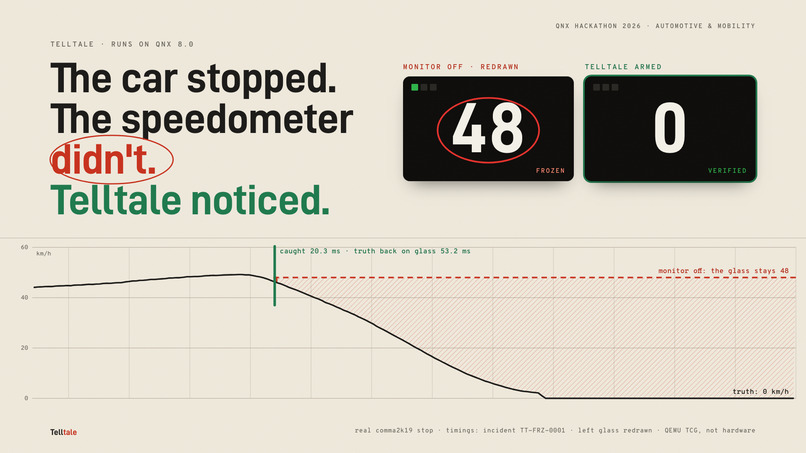
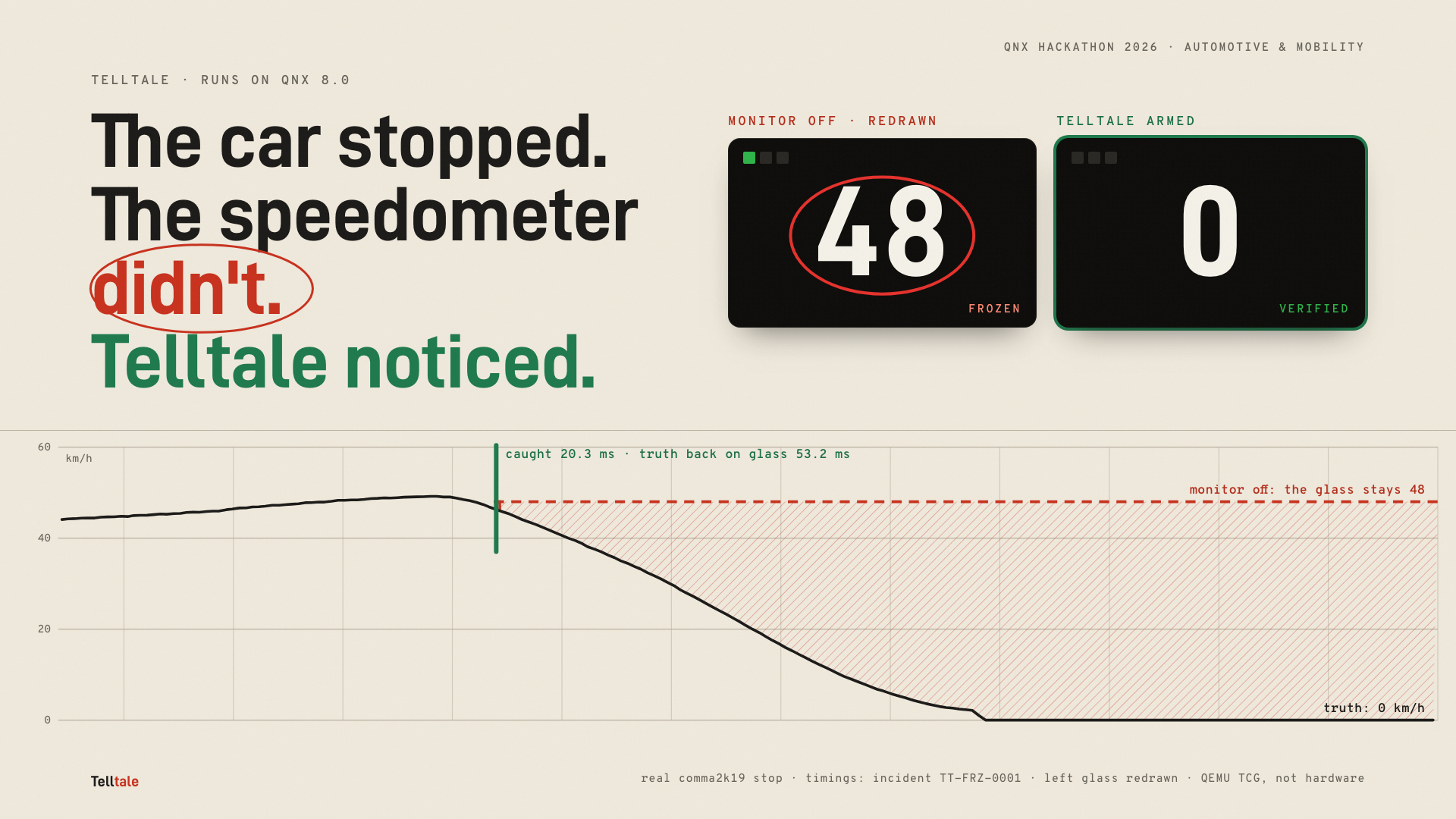
The car stopped; the speedometer didn't. Telltale reads the glass back on QNX 8.0 and puts the true speed on it. (QEMU TCG)
-
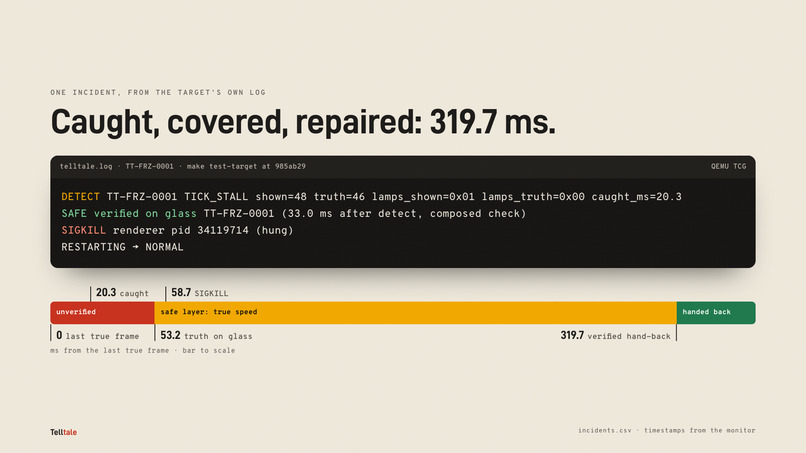
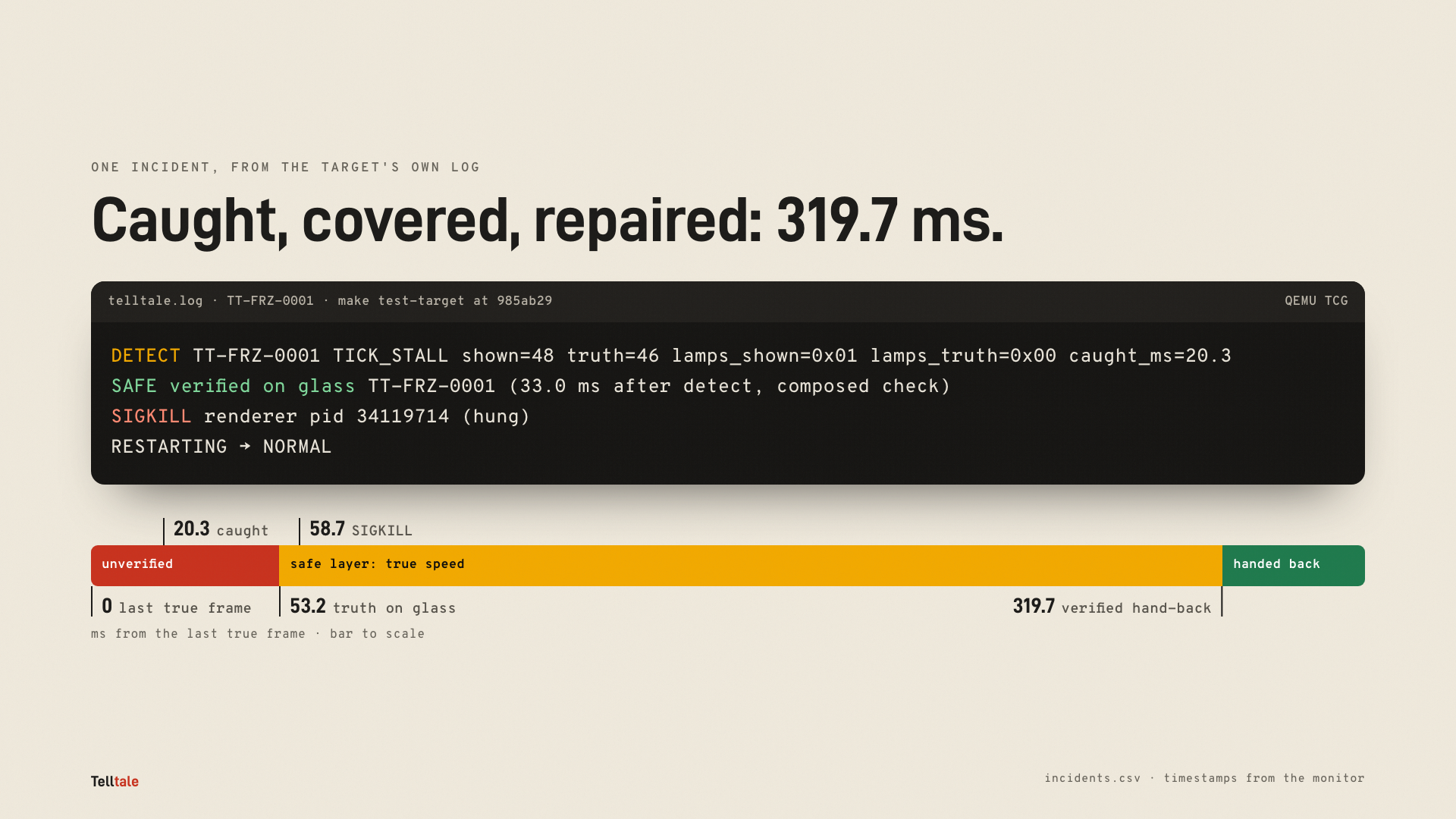
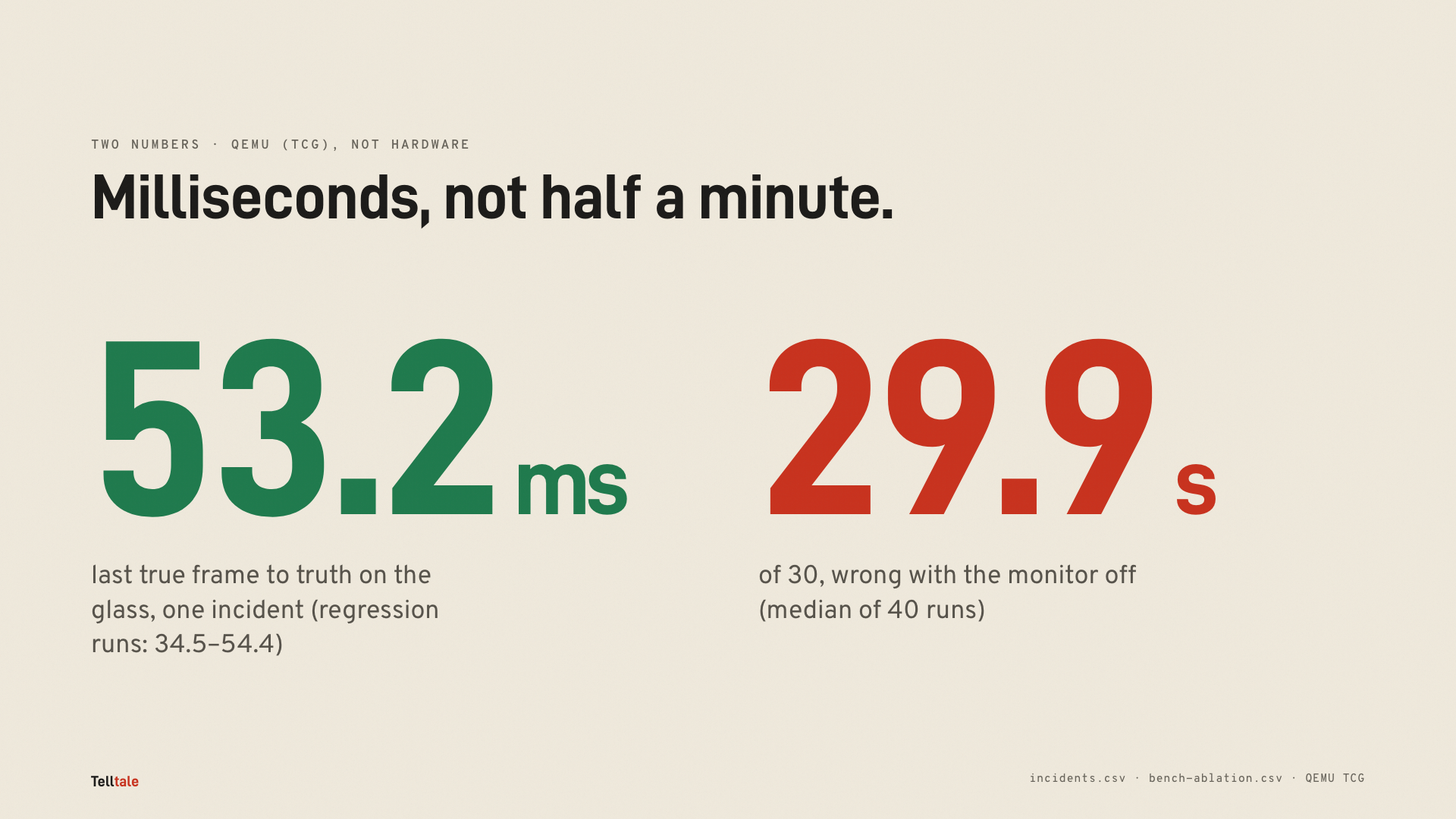
One incident from the target's own log: caught at 20.3 ms, truth on glass at 53.2 ms, verified hand-back at 319.7 ms. (QEMU TCG)
-
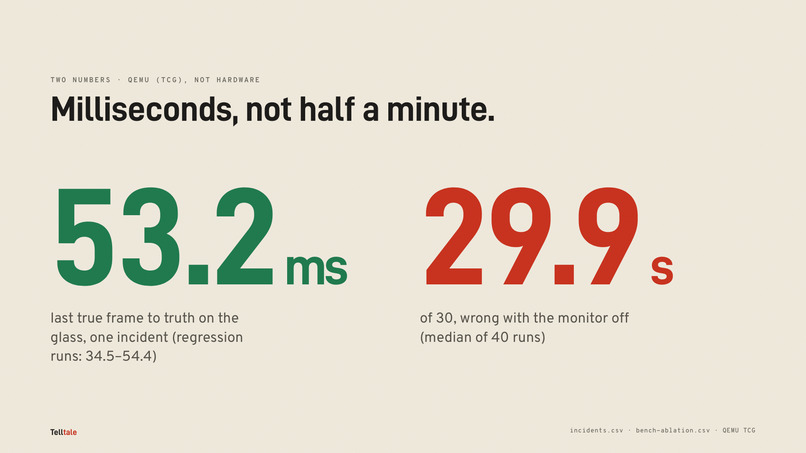
53.2 ms from the last true frame to the truth on glass, vs a median 29.9 s of wrong speed with the monitor off. (QEMU TCG)
-
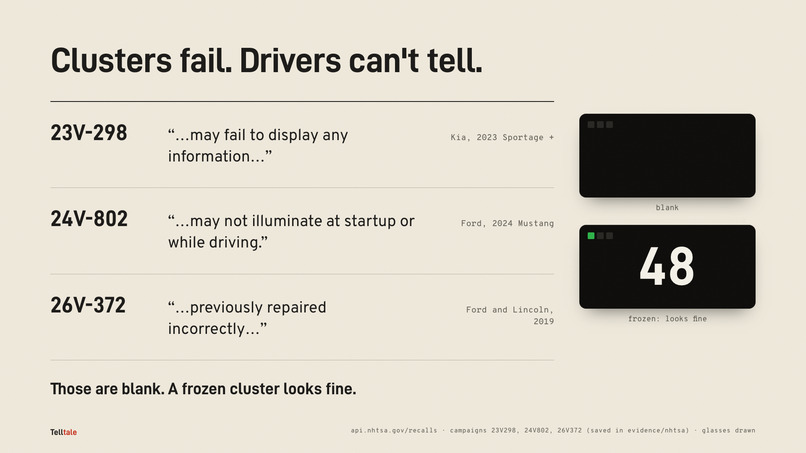
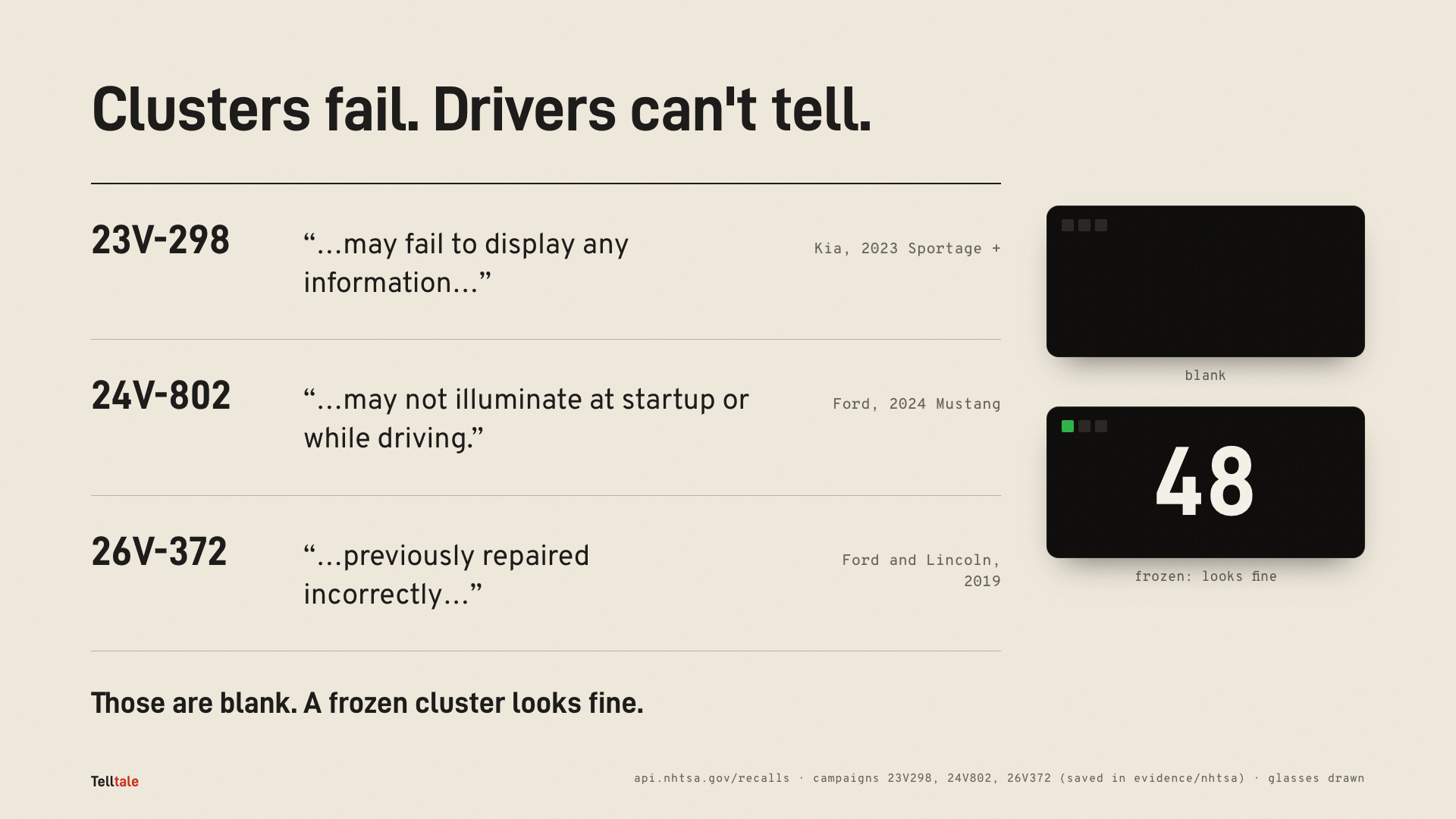
Real NHTSA recalls (23V-298, 24V-802, 26V-372) show clusters going blank. A frozen cluster is worse: it looks fine.
-
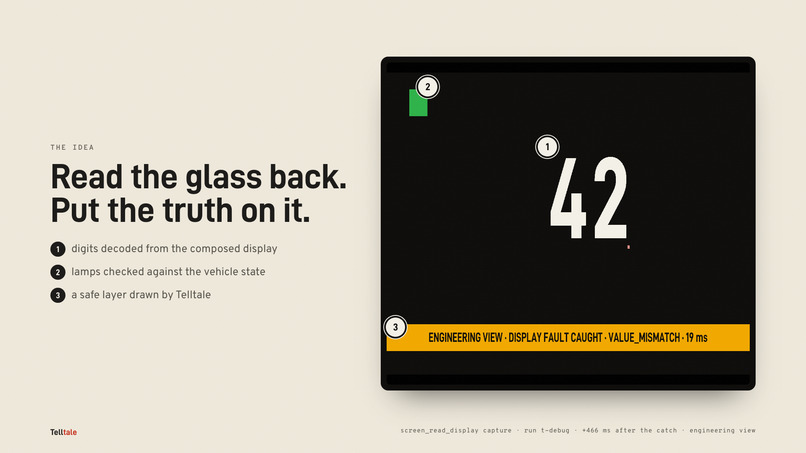
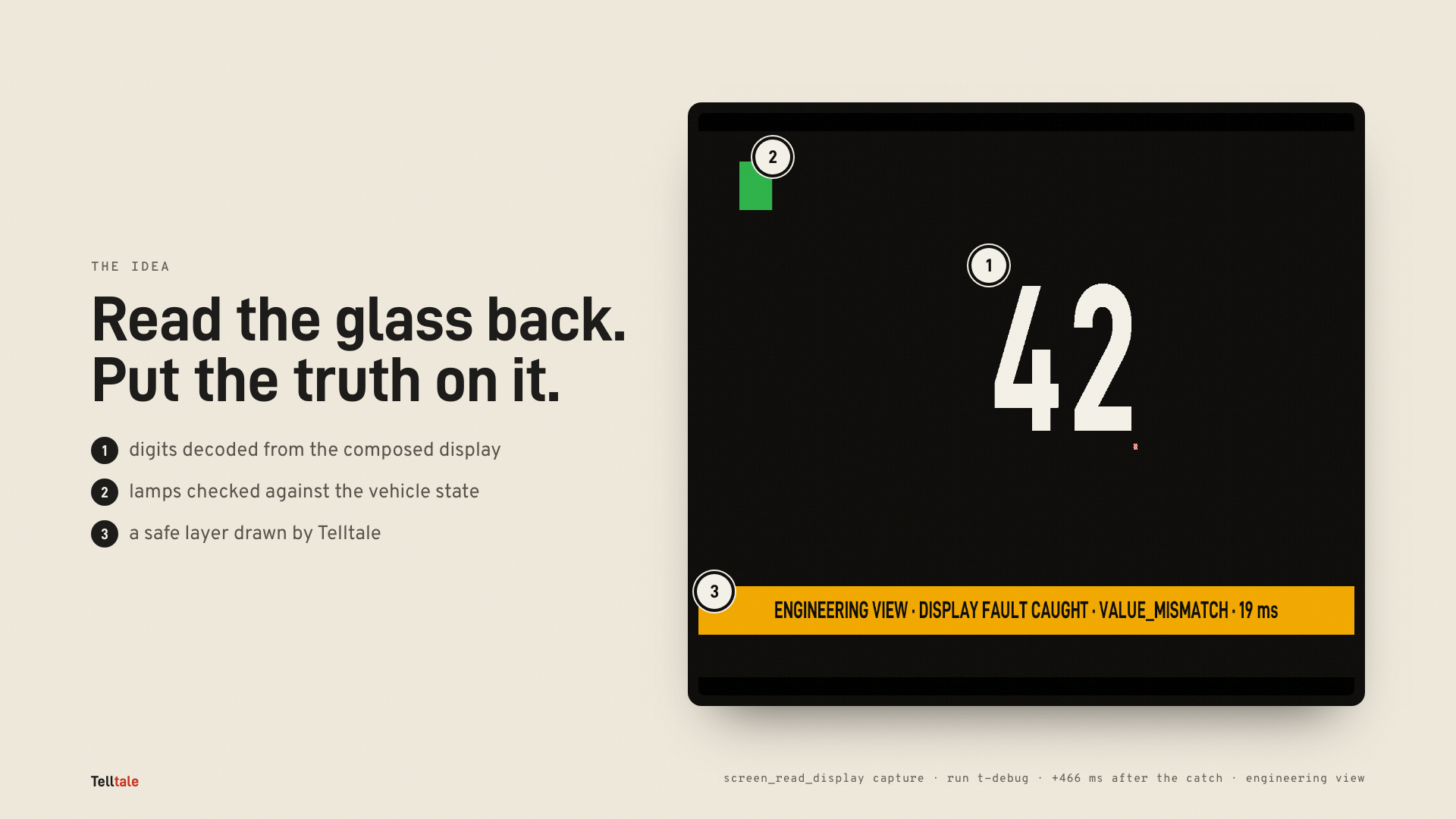
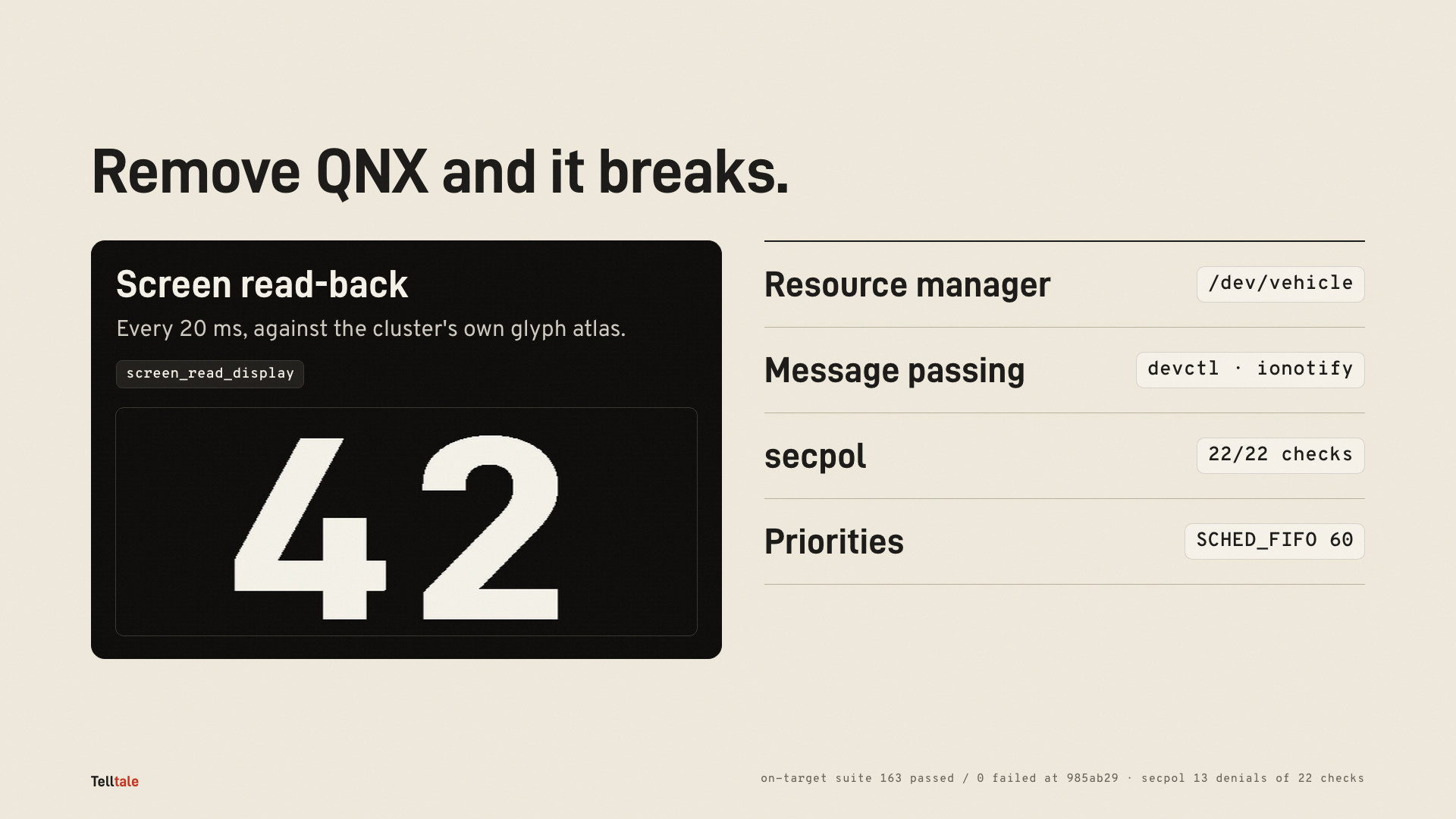
A real screen_read_display capture: digits and lamps decoded from the composed display, and the safe layer Telltale draws.
-
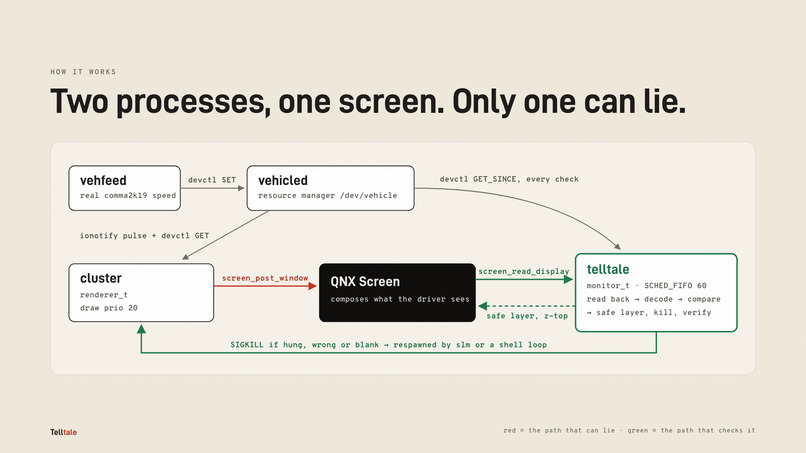
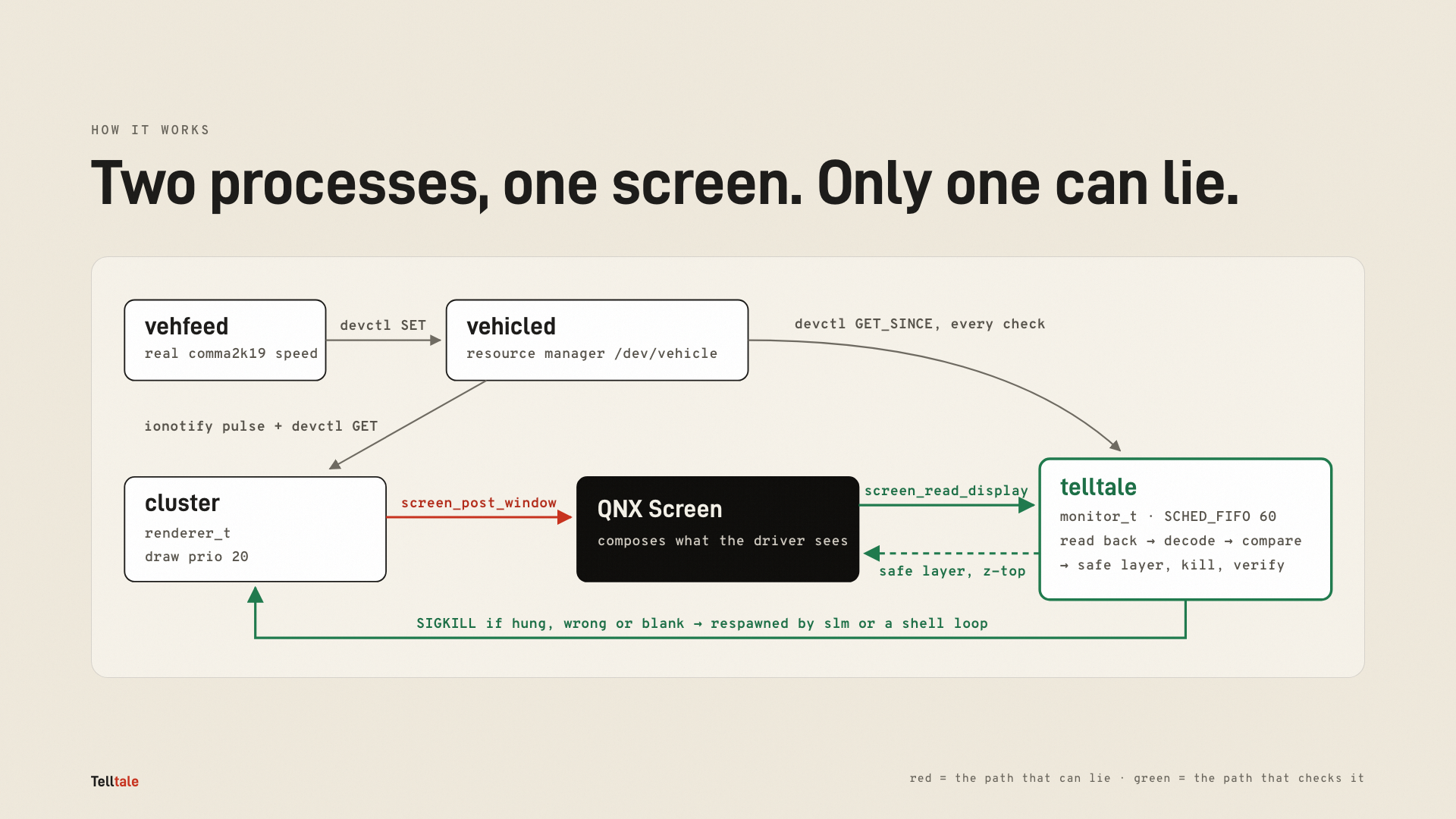
Two processes, one screen. The cluster can lie through Screen; Telltale reads it back, checks /dev/vehicle, and acts.
-
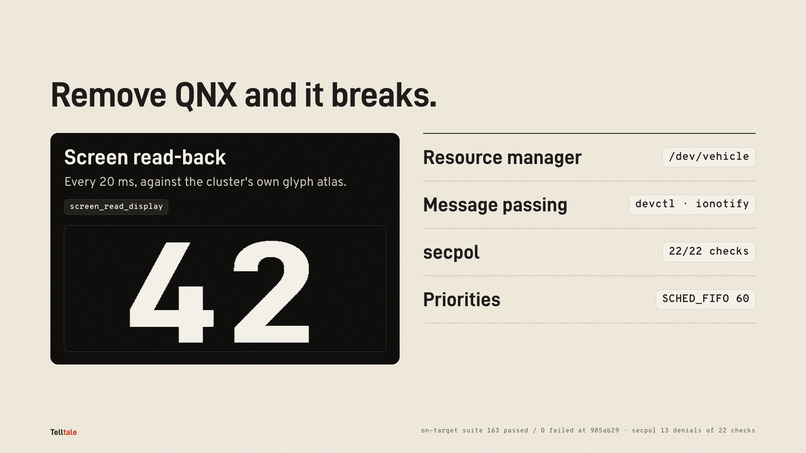
Plain QNX: Screen read-back every 20 ms, a /dev/vehicle resource manager, devctl + ionotify, secpol, SCHED_FIFO 60.
-
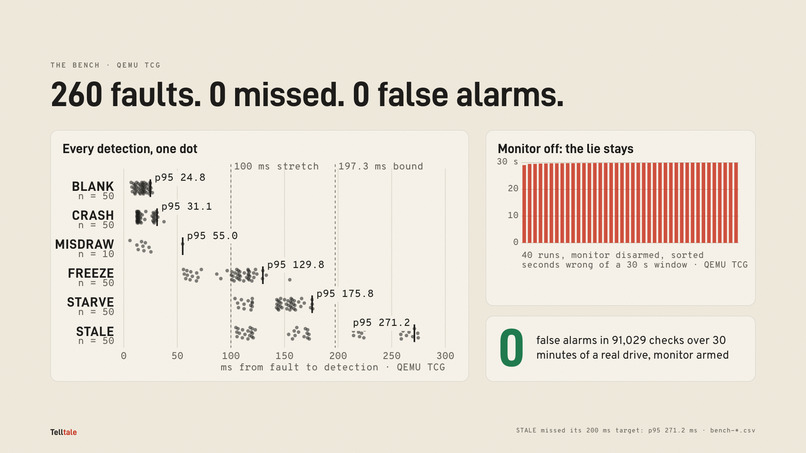
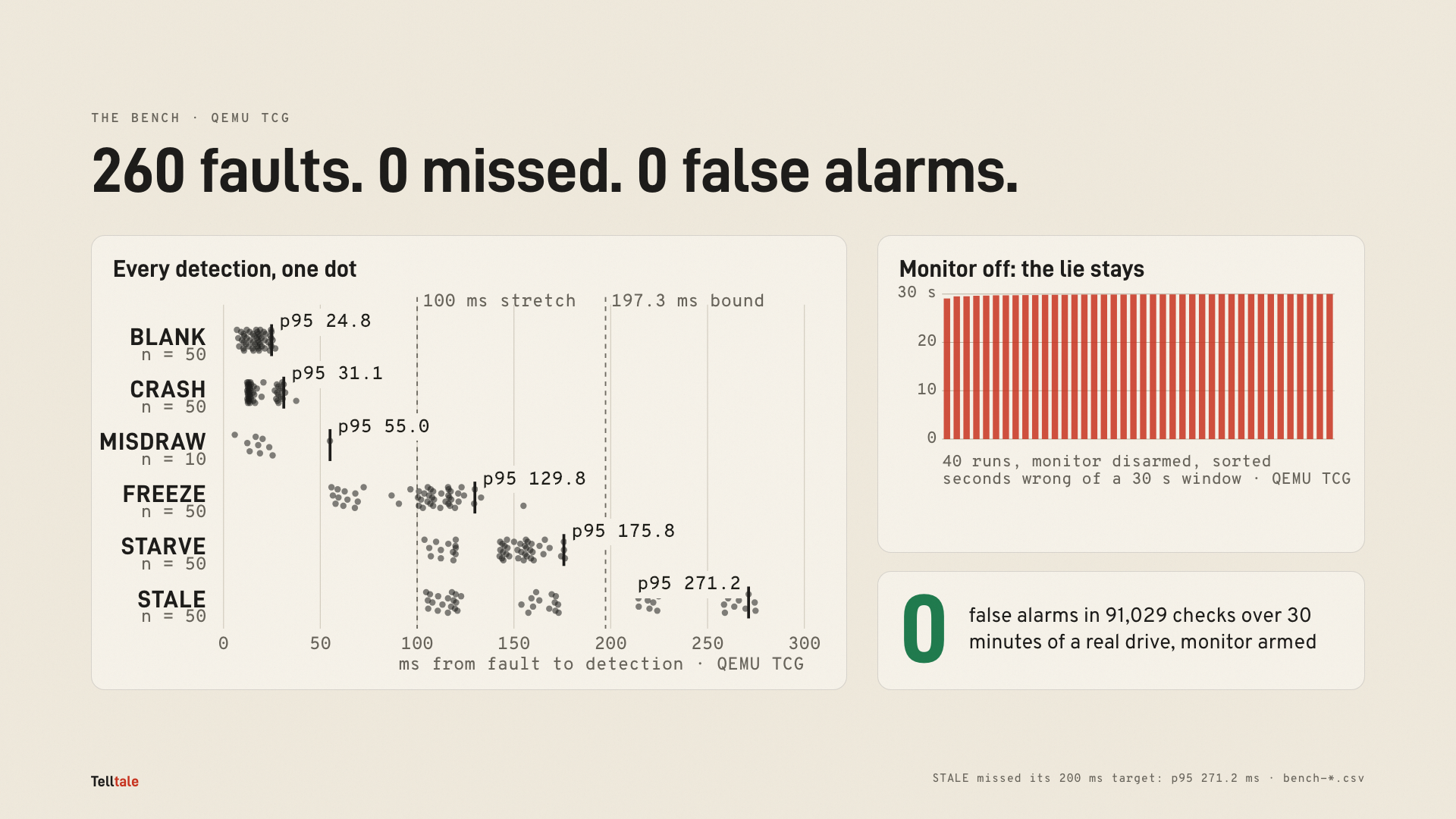
260 injected faults incl. 50 crashes and 10 misdraws: 0 missed. 0 false alarms in 91,029 checks. Misses published. (QEMU TCG)
-
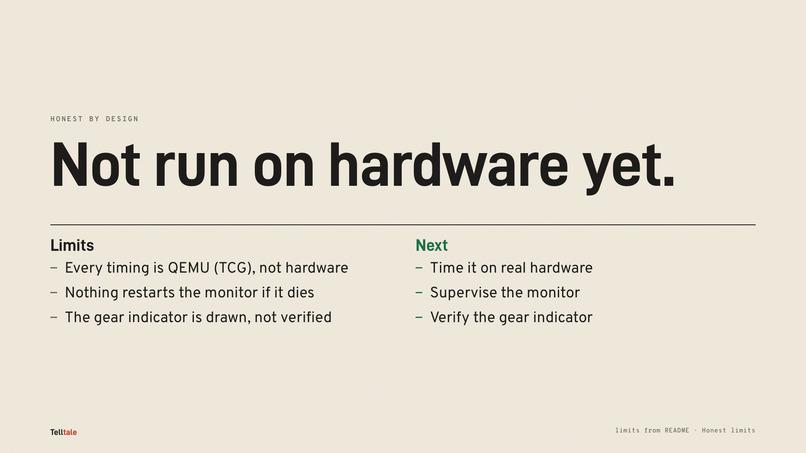
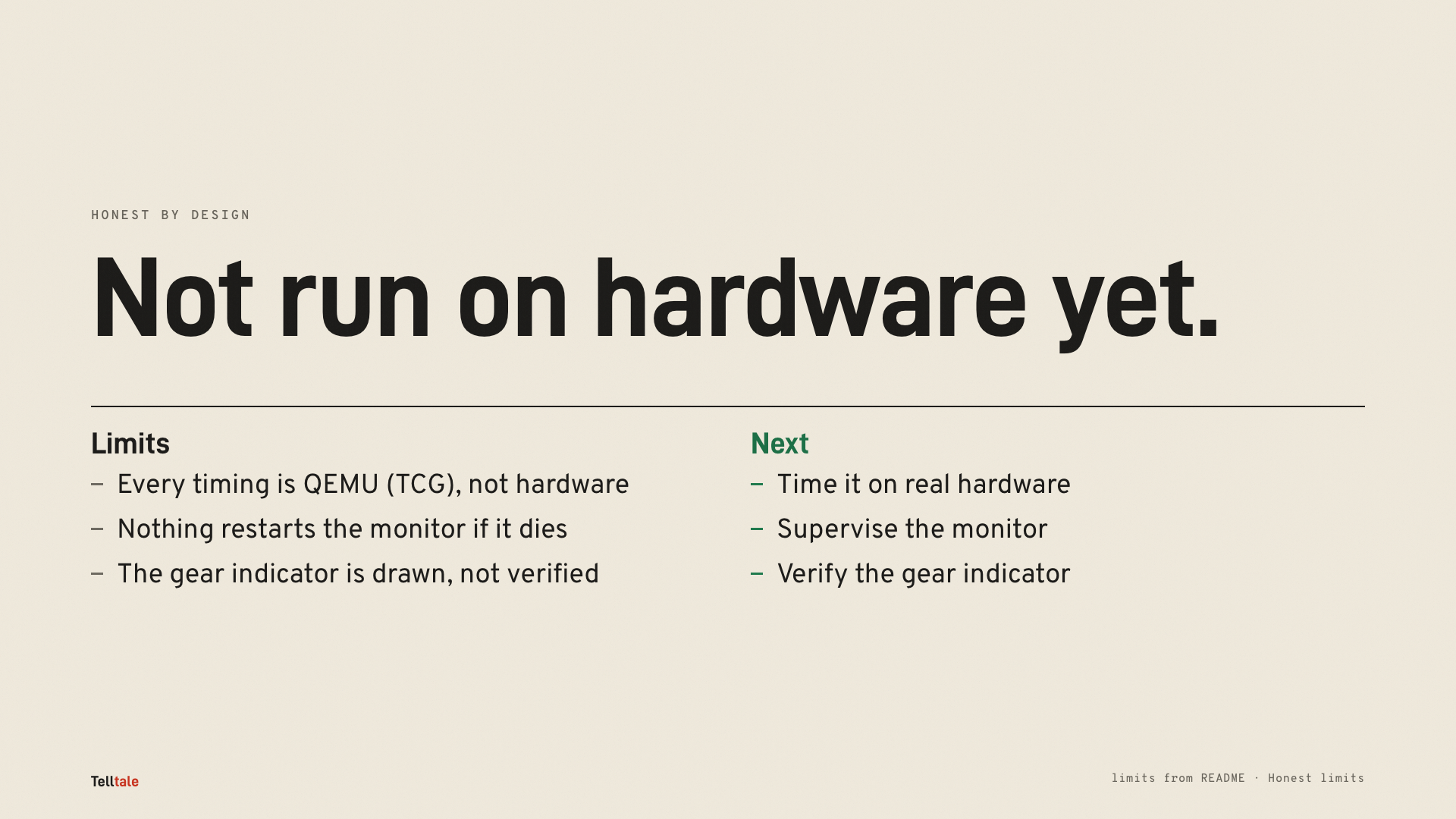
Honest limits: QEMU TCG timing, an unsupervised monitor, unverified gear. Next: real hardware, a supervised monitor, gear checks.
-
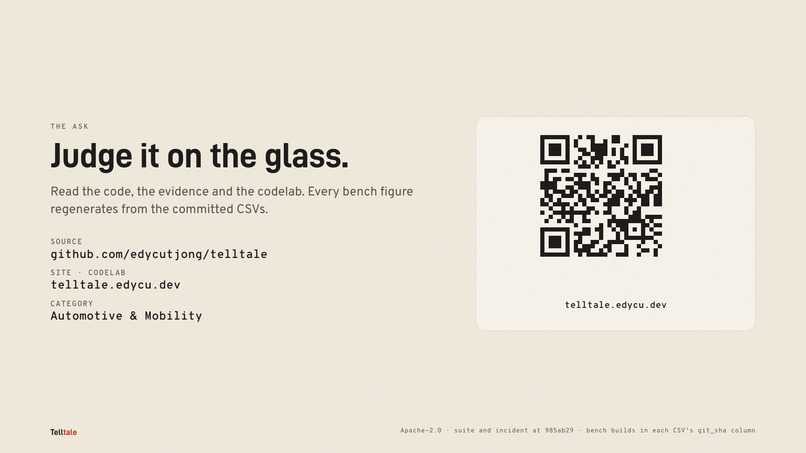
Judge it on the glass: code, evidence and codelab are public, and every bench figure regenerates from the committed CSVs.
Inspiration
A driver brakes to a stop. The cluster still says 48 km/h. The renderer is alive, the watchdog is happy, and nothing checks what the pixels say. Instrument-cluster failures are recalls under US FMVSS 101 (NHTSA campaigns 23V-298 and 24V-802, and 26V-372, which concerns vehicles previously repaired under recall 19V076), but those are mostly blank or dark clusters. We wanted the adjacent failure: a live renderer that keeps drawing a plausible, wrong number.
What it does
Telltale is a separate QNX 8.0 process, at SCHED_FIFO 60 and in its own security type, that reads the composed display back through QNX Screen every 20 ms, decodes the speed digits, six warning lamps and a liveness tick with a deterministic glyph decoder, and compares them with the vehicle state served by a /dev/vehicle resource manager over message passing. On a mismatch it posts a safe layer with the true speed and lit lamps (the driver sees DISPLAY FAULT · SHOWING TRUE SPEED), kills and respawns a hung, wrong or blank renderer (a starved one is left running), hands the display back once the renderer's own window reads true, no tick stall is seen and its tick has moved since the catch, and writes an incident (what was shown, what was true, how long the catch took). It also catches the lie a watchdog cannot see: a live renderer that means 48 and draws 84 would pass its own self-report; the pixel read does not. No machine learning, on purpose: the same frame always gets the same, recomputable verdict.
Measured on the QNX 8.0 target under QEMU (TCG), not hardware timing: 200 injected faults in 4 classes (a real lock-order deadlock, a blank frame, a live-but-stale renderer, a CPU hog that starves the renderer) — 0 missed (bench built at 7592e40; re-checked 25 of 25 at the current monitor f2b8002); detection p95 24.8 ms (BLANK), 129.8 ms (FREEZE), 175.8 ms (STARVE), 271.2 ms (STALE). 50 renderer crashes and 10 MISDRAW runs (the renderer draws the right value with its digits reversed, 74 as 47, or 11 higher when reversing changes nothing, 3 as 14; the video's take is 48 as 84) also 0 missed. 0 false positives in 91,029 checks over a 30-minute real drive. With the monitor off, the display showed a wrong speed or no speed for a median 29.9 s of a 30 s window, and was still wrong at the end of all 40 runs. Not every target was met: the <100 ms stretch target was met only for BLANK, and STALE missed its W+100 ms target (that check has to wait for the true speed to move). We publish those misses.
How we built it
vehfeed replays real CAN speed from the comma2k19 drive dataset (MIT) into vehicled (/dev/vehicle, resmgr + iofunc, ionotify pulses). cluster draws digits, lamps and a tick with Screen. telltale wakes on a timer_create(SIGEV_PULSE) pulse, calls screen_read_display on the digit, lamp and tick regions, decodes against the same glyph atlas, and checks the result against vehicle state. secpol gives the feeder, vehicled, renderer and monitor each a type (22 policy checks, 13 of them denials, in the on-target suite; the timing bench ran without the policy loaded); slog2 carries incidents; slm can supervise the renderer (exercised by an on-target test). Built with qcc from the SDP's Linux host tools in a linux/amd64 Docker container on an Apple-Silicon Mac; run on the QNX Everywhere QEMU image. Bench: one fresh process stack per injection, raw CSV rows in evidence/, tables regenerated byte-identically by scripts/bench_all.sh report. On-target suite: 190 passed / 0 failed; host tests C + Python.
How AI was used: Claude Code was the engineering pair throughout: it wrote and ran code on the QNX guest, drove the bench, and drafted the docs. Outside models reviewed the code and copy blind, and every finding was checked against the tree before it was applied. The product itself uses no AI at runtime. The monitor's verdict comes from a deterministic glyph decoder, so the same frame always gets the same, recomputable result.
Challenges we ran into
- Whether Screen can read the composed display back at all on the QEMU image (it can:
screen_read_displaymatched byte-exact in the gate spike). - A whole-CPU hog starves Screen's own threads, so the safe layer only becomes visible when the hog ends; STARVE is therefore reported as "renderer CPU only" and we make no priority-inheritance claim.
ionotifyon the renderer's data path needsMsgRegisterEvent, which cost time and became a codelab pitfall.- Detection time is dominated by the calibrated
tick_stall_ms(151 ms), not by monitor speed, so the <100 ms stretch target was missed for FREEZE and STARVE (QEMU TCG timing).
Accomplishments that we're proud of
0 missed in 200 injected faults plus 50 crashes, 0 false positives in 91,029 checks, a monitor-off ablation, and a bench whose misses and failed targets are published next to the wins. The full detect-and-recover loop runs and is tested on the QNX target (QEMU).
What we learned
Reading pixels back is a stronger check than any self-report: all 50 BLANK and 10 MISDRAW runs would have passed a renderer self-report check. A QNX resource manager is a very small amount of code for a very large amount of testability (cat /dev/vehicle). Emulator timing needs honest labelling.
What's next
Run on real hardware (Raspberry Pi 5 / a QNX reference board) for hardware timing, supervise the monitor itself, verify gear, follow a moved renderer window, and run the held-out injection variants not yet run (external SIGSTOP, random-time and steady-cruise injections).
Limits
Not certified; no ISO 26262 claim (also stated in the README limits). It sees only what Screen hands it; the physical path to the panel and display-controller CRC units are out of scope. It assumes Screen stays up. Per the QNX docs screen_read_display returns ENOTSUP on a mirrored display. It trusts /dev/vehicle. Capturing the composed display needs Screen's privileged display-manager context, so the monitor holds more than read access.
2-minute judge guide (numbers → evidence, video chapters, how to check without a QNX licence): https://github.com/edycutjong/telltale/blob/main/JUDGE.md
Thank you for your time reviewing this project.
