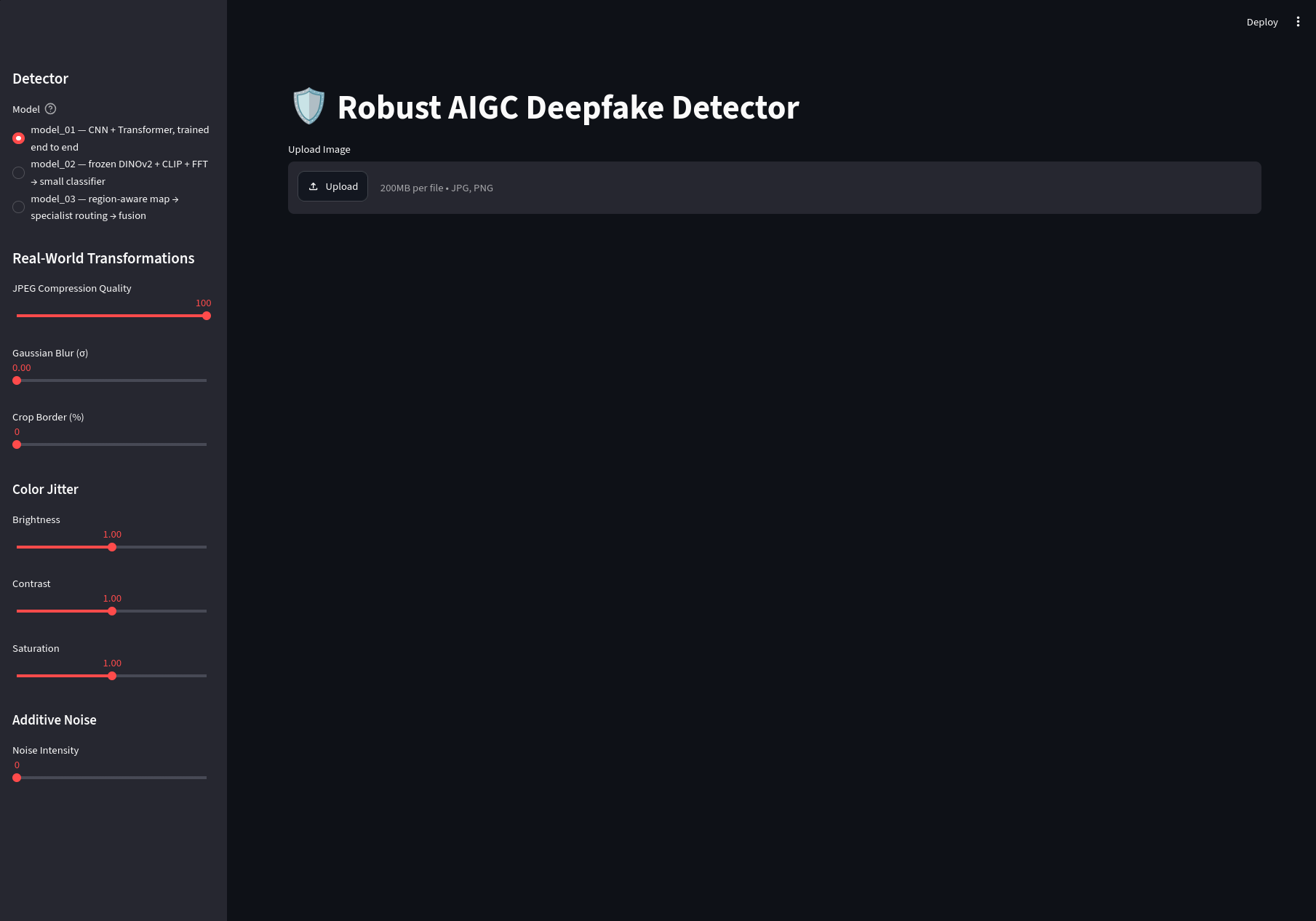
How we built it
Three models, built to disagree with each other.
The feature-based detectors run on hand-designed forensic descriptors — azimuthal spectrum shape, half- and [...] residual moments, channel correlation — fed to either a ~1.2M-parameter MLP or an XGBoost [...]. A generator has to fool a texture model, a semantic model and [...] simultaneously. Extraction caches to disk, so every subsequent experiment costs minutes, and XGBoost's gain table names which physical artifact the detector is keying on.
model_03 — train nothing, localize everything. A multi-scale mapper scores overlapping patches with an existing detector, blends them [into a] dense map, proposes regions by connected components, routes them to forensic specialists, and fuses with shrinkage and noisy-OR. It ships no [...], a prototype of the architecture, and the README tabulates exactly which [numbers] are deterministic.
The benchmark is a first-class [concern]. [The standard benchmark carries a single] generator family at 32×32, so cross-generator transfer is unmeasurable on it. We built three paired datasets at native resolution (ProGAN/LSUN, MidJourney/Open Images, DALL·E 3/Op[en Images]), [and spent most of] that effort removing shortcuts rather than adding data.
Challenges we ran into
Our dataset was separable at AUC > [0.9x] by [size] or artifact. Two independent leaks.
- Resolution. Generated sources are fixed size while real ones are variable, so "how big is it" stands in for the label — residual standard [deviation alone separates] MidJourney from ImageNet at AUC 0.976.
- Compression history. MidJourney ships [losslessly] as PNG while every real-photo corpus ships as JPEG, so "was this [JPEG-compressed]" is a near-perfect proxy — and it's exactly what 64 of our 130 FFT columns measure.
The fix was center crops at native resolution with off[sets] snapped to the JPEG 8-pixel grid, [re-encoding b]oth classes, and a per-family single-scalar shortcut probe re-run [on every build].
Our localization backend was worse [than chance]. IoU 0.460 and patch AUC 0.335 against ground-truth masks — asking a whole-[image detector to score cr]ops doesn't weakly localize, it anti-correlates, tracking local smoothness instead. Two downstream fixes (per-scale isotonic calibration, a coarse-to-fine casca[de]) [...] what a missing signal looks like as opposed to a miscalibrated one.
A metric that improved while the sy[stem got worse]. [Ranking] AUC went 0.460 → 0.955 while real photographs still averaged 0.537 against partially-AI images at 0.311. Within-image ranking is invariant to absolute level, so a m[odel can max] that metric and still flag every authentic photo.
A bug that only surfaced because [...]. Our patch evaluation read logit index 1 while that model's AI class sits at index 0, reporting a well-trained scorer as AUC 0.02. A working model looking broken is the [failure mode almost no] one catches.
The robustness prediction was wrong. We predicted that heavy degradation would drop confidence and collapse verdicts to uncertain — the safe failure. Instead confidence sat at exactly 0.60 in all 14 conditions ([making] the mechanism inert), and under noise σ=0.05 only 9% of images kept the verdict they had when clean while AUC barely moved. Ranking survives; labels churn. A user re-u[ploading a slightly different c]opy gets a different answer.
Accomplishments that we're proud of
The leave-one-generator-out table. [In-distribution, ~0.9x across] all three families. Held out: 0.686 / 0.850 / 0.822 with accuracy near chance — and the failure mode is specific. FPR stays at 1.5–3.4% while F1 collapses, meaning unseen [generators get cl]assified as real. That is the costly direction of error for moderation, [and it is invisible] in a single-generator evaluation. Producing that table, and publish[ing the out-of-di]stribution number, is the contribution we'd defend hardest.
Evidence that localization is worth its complexity. On fully-AI images a whole-image detector wins (0.935 vs 0.889). On partially-AI i[mages it drops to 0.xxx] — while the region-aware pipeline reaches 0.589, a significant gain on the subset where the thesis is actually contested.
We killed our own optimizations whe[n they didn't pay]. The coars[e]-to-fine cascade removed 35% of windows for a 1.19× speedup, and moved scores by up to 0.66 while cutting regions on genuinely tampered images from 4 to 1. Cheap [wins on easy images, wrong answers on] hard ones. It ships off, documented rather than deleted. Separately, mo[ving to batched GPU inference] gave a 3× win and took utilization from 21% to 96%, which is the kind of optimization worth keeping — and larger batches, TF32 and channels_last were all measured and [dropped as no-op]s.
What we learned
Robustness and generalization are d[ifferent axes, and we conflated] both. Degradation was not our binding constraint: AUC held at 0.674–0.802 [aga]inst 0.782 clean. That's less reassuring than it sounds — the sys[tem is blunt rather] than fragile. The real gap is cross-generator, and it is enormous.
Ranking transfers; calibration does not. The in-distribution 5%-FPR threshold calibrates to 0.05–0.12, and on a held-out genera[tor it is simply] wrong. It is why AUC (0.69–0.85) reads so much better than accuracy, [and why any syst]em shipping a fixed 0.5 threshold is making a claim it can't support.
Almost every strong number we prod[uced was worth a second look]. The discipline that actually moved the project was adve[rsarial: assume the number is] lying, find the mechanism, then decide.
What's next for Telltale
- A compound-degradation benchmark. Real re-uploads chain operators — resize, then recompress, then resize again. We're building RealDeg-style chains of N ∈ {1..5} operators sampled with replacement, scored by balanced accuracy, with the sampled sequence recorded so every condition is reproducible.
- Settle the local-artifact hypothesis. The train-crop/resize × test-crop/resize 2×2. Published results show a crop-trained model losing ~8.8 BAcc under resize while a resize-trained model barely moves — and our inference path resizes. A few GPU-hours either confirms the diagnosis or redirects the whole effort.
- Two interventions from the literature, ablated rather than stacked. Texture-aware masking targets cross-generator transfer; deep-feature smoothing targets degradation. They intervene at opposite ends of the network and one paper's method is exactly the category the other argues against. We'll measure, not assume.
- Train the scorer on the distribution the mapper actually queries — patches, with the ambiguous 5–70% mask-coverage band discarded rather than forced to a label, and hard-negative mining on the real-image patches that currently produce every false positive.
- Make confidence mean something. Uncertainty is the safe failure mode for a moderation tool, and ours is currently a constant.


Log in or sign up for Devpost to join the conversation.