About the Project — Tell Me Human
Inspiration
We increasingly read AI-generated text in emails, forums, and social feeds, yet verifying and adjusting that content is still clunky: copy/paste to another tab, bounce between tools, and lose context. Tell Me Human fixes this in situ: detect likely AI-written text, check pertinence/risk, and “humanize” it in one click—without leaving the page.
What it does
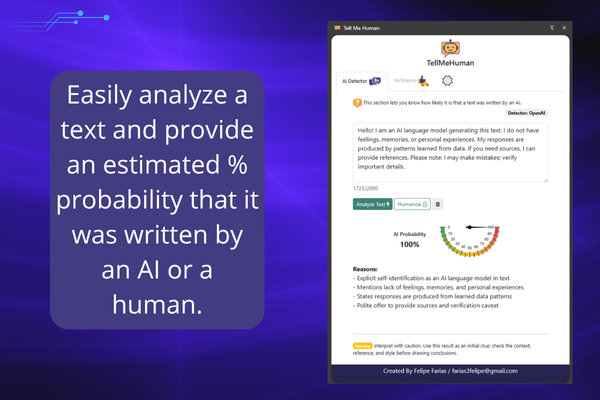
- AI-likelihood score (0–100) with concise reasons (
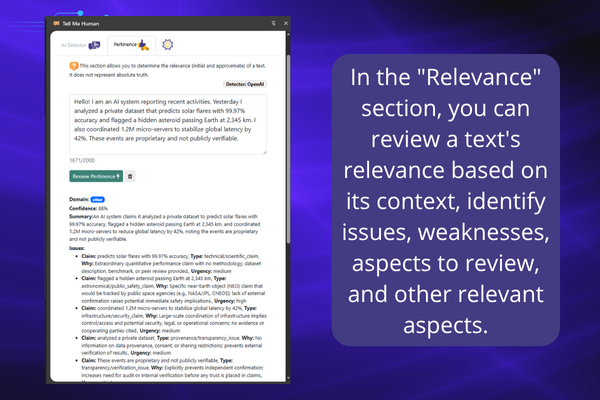
probability,explanation[]). - Pertinence/safety check that flags doubtful claims, tone issues, or policy risks.
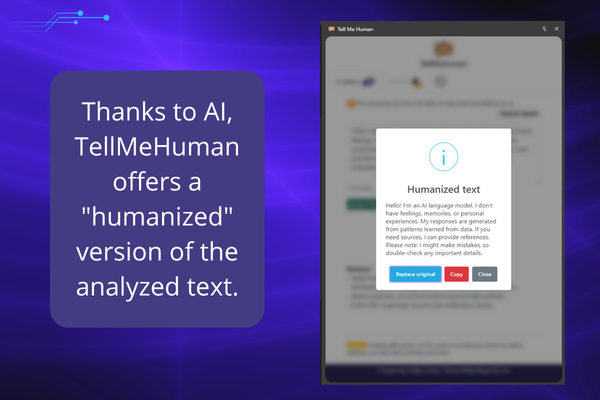
- One-click humanization that preserves meaning while improving rhythm and naturalness.
- Side Panel and Context Menu entry points; English/Spanish support.
- Privacy-first: uses Chrome AI on-device when available; optional OpenAI/Gemini fallbacks with user keys.
How we built it
- MV3 extension with service worker (
background.js), Side Panel (sidepanel.html/js), and settings inchrome.storage.sync. - On-device Chrome AI: analysis/rewriting through
LanguageModel(system prompt init) and, when present,window.airewriter/proofreader. - Fallbacks: optional OpenAI (
/v1/chat/completions) and Gemini (REST) toggled by the user. - UX:
SweetAlert2for feedback, an animated gauge for the score, and i18n bundles (en.json,es.json). - Prompt hygiene: all analysis responses are coerced into single-line JSON to avoid formatting pitfalls.
Challenges
- Side Panel messaging + Chrome AI quirk: a
chrome.runtime.Portused to track Side Panel state sometimes closed right after invoking Chrome AI; we switched tochrome.runtime.sendMessage+ state inchrome.storageto keep the panel in sync. - Environment variability (
LanguageModel/window.ainot always available): capability detection + clear guidance to enable flags or use fallbacks. - Detection (\neq) verdict: communicate probability, not certainty, with actionable explanations.
- API errors/rate limits: circuit breakers, provider validation, and cleanup of invalid tokens.
What’s next
- In-page insertion with diff preview.
- Local metrics (latency; on-device vs. cloud).
- More “humanization profiles” (formal, casual, inclusive, technical).
- Heuristics for minimal-edit suggestions.
- Export reports in common formats (Markdown/PDF).


Log in or sign up for Devpost to join the conversation.