-
-
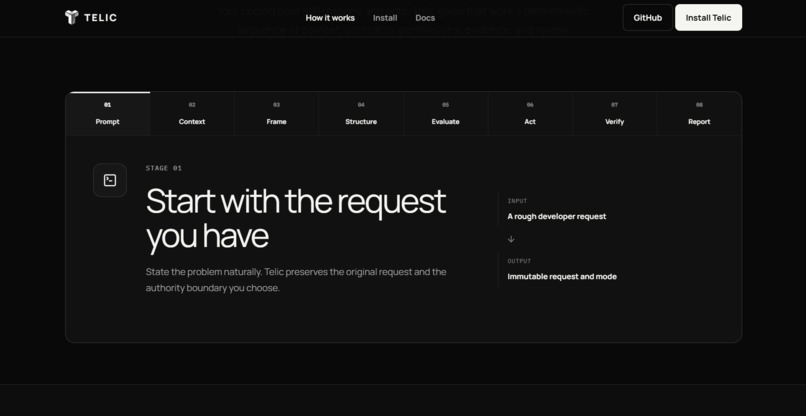
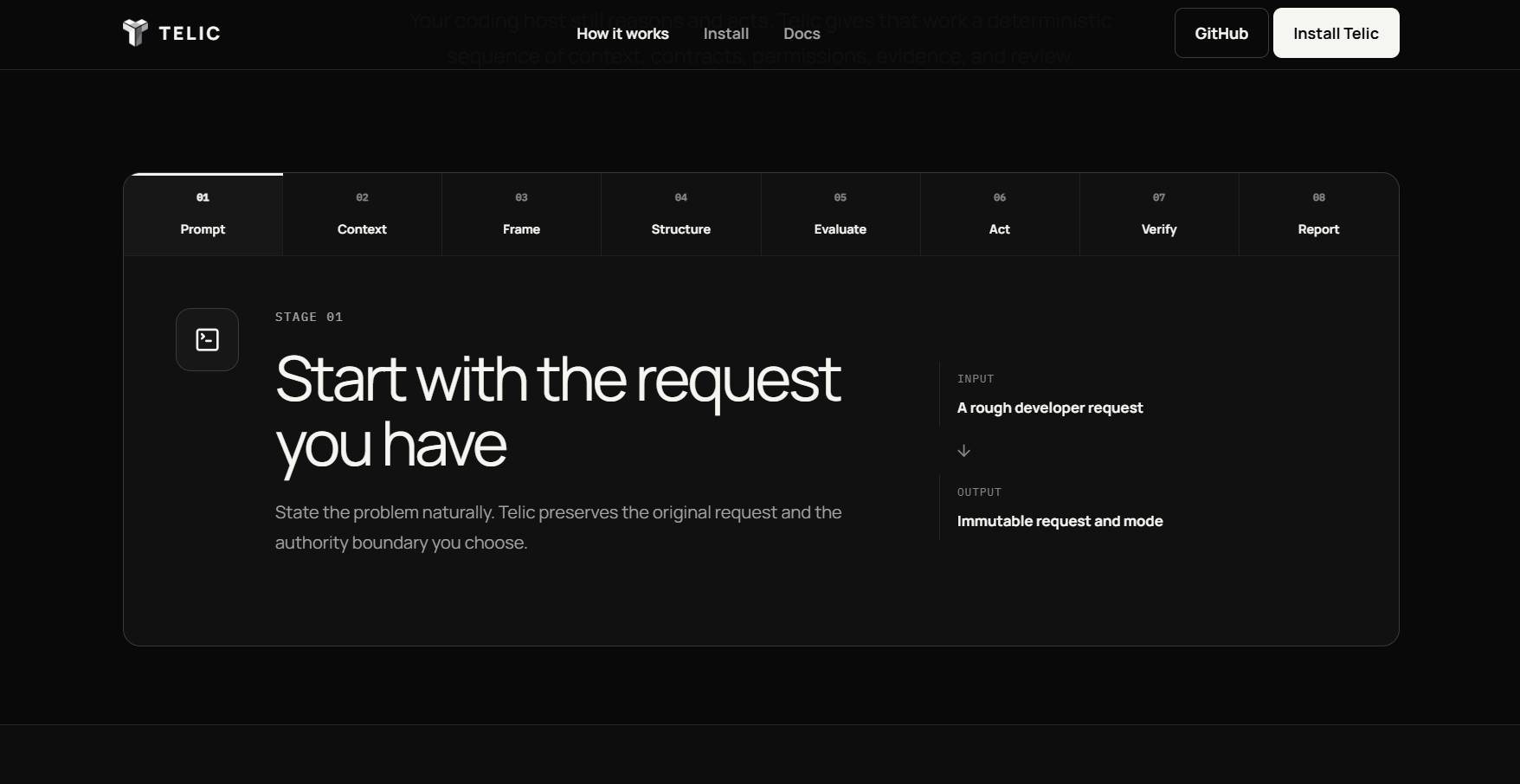
website - about the process under the hood
-
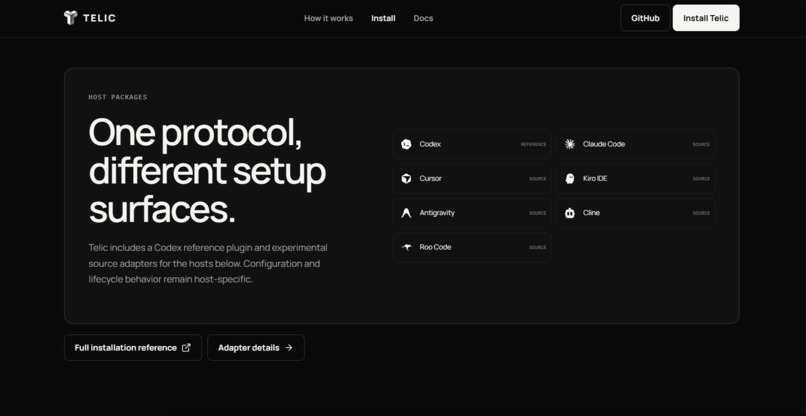
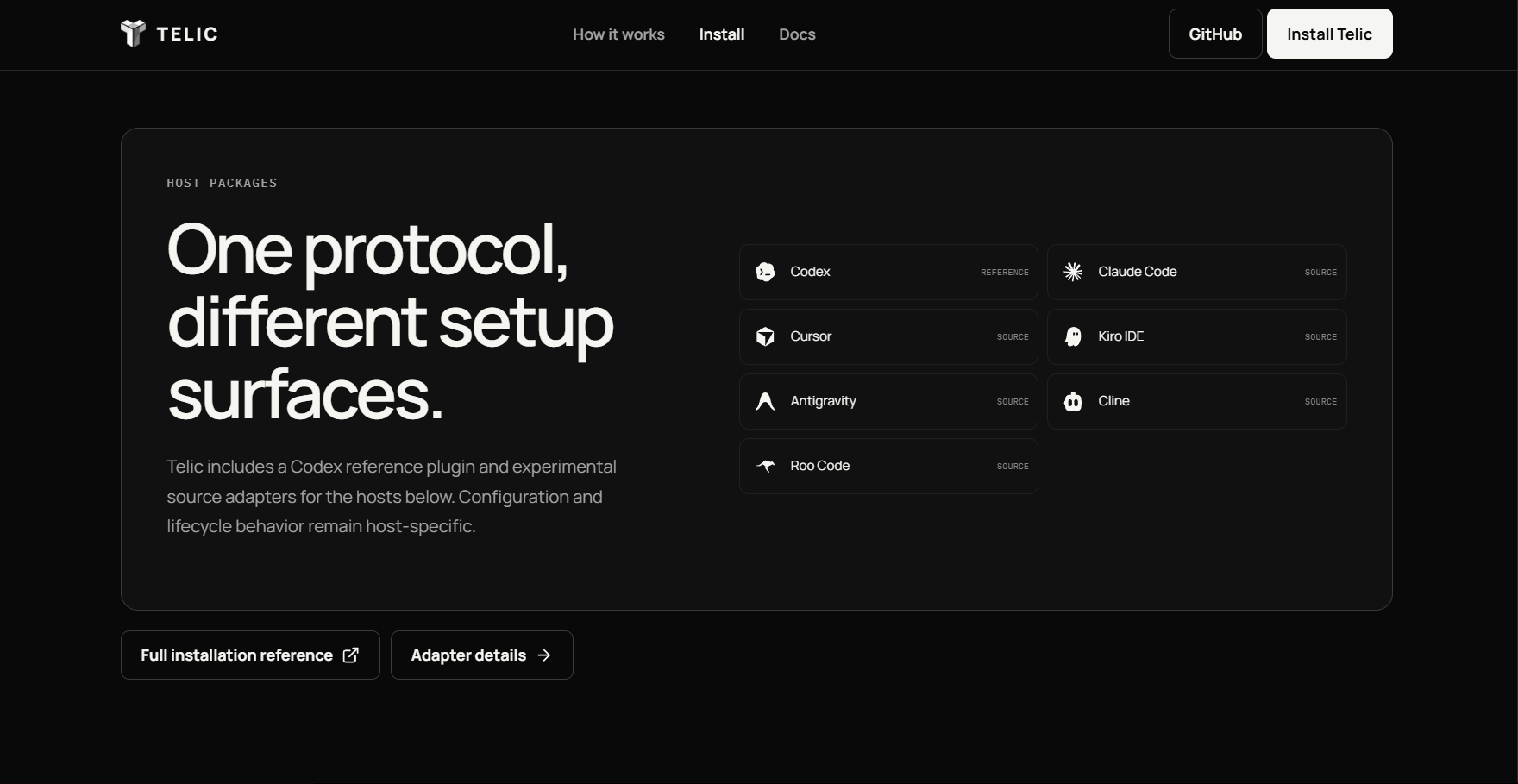
website - showing different setup per different environment
-
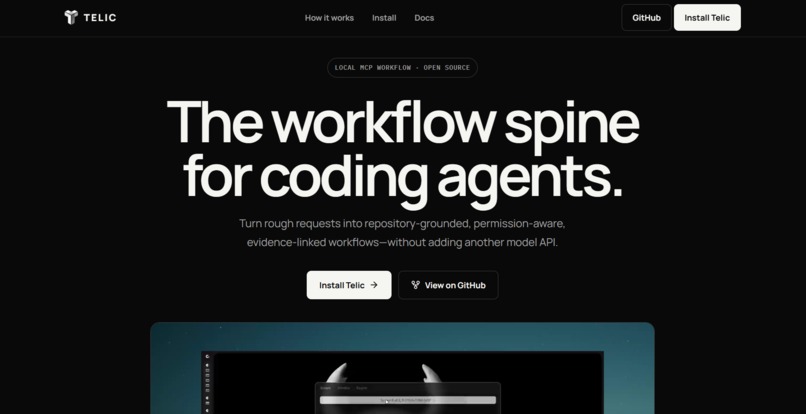
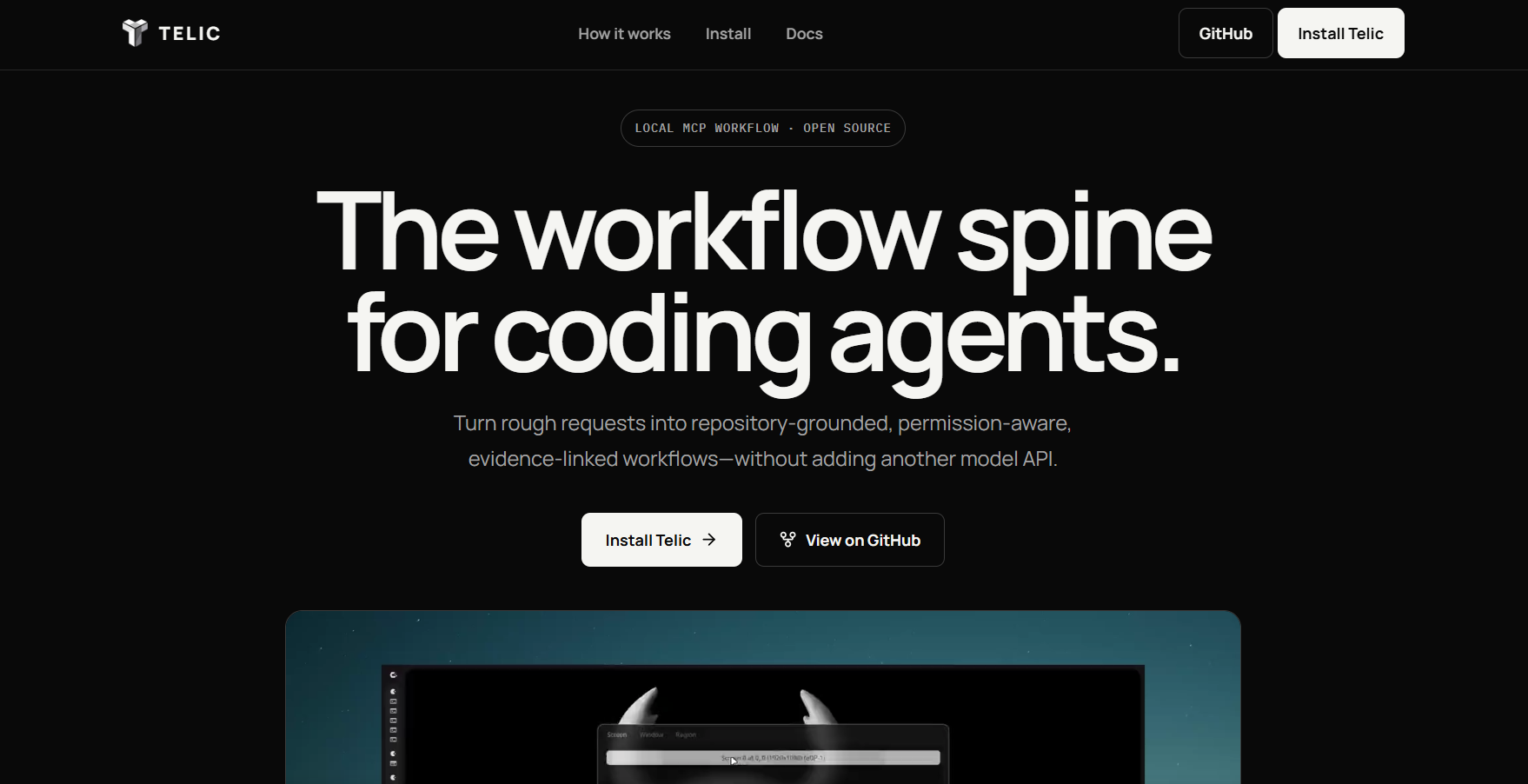
website - landing page
-
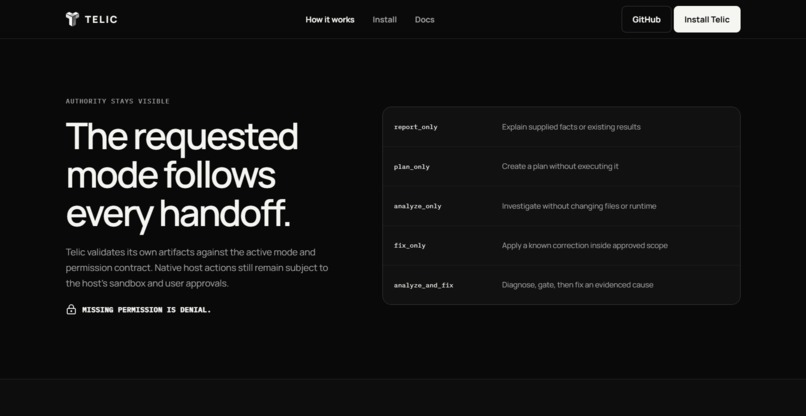
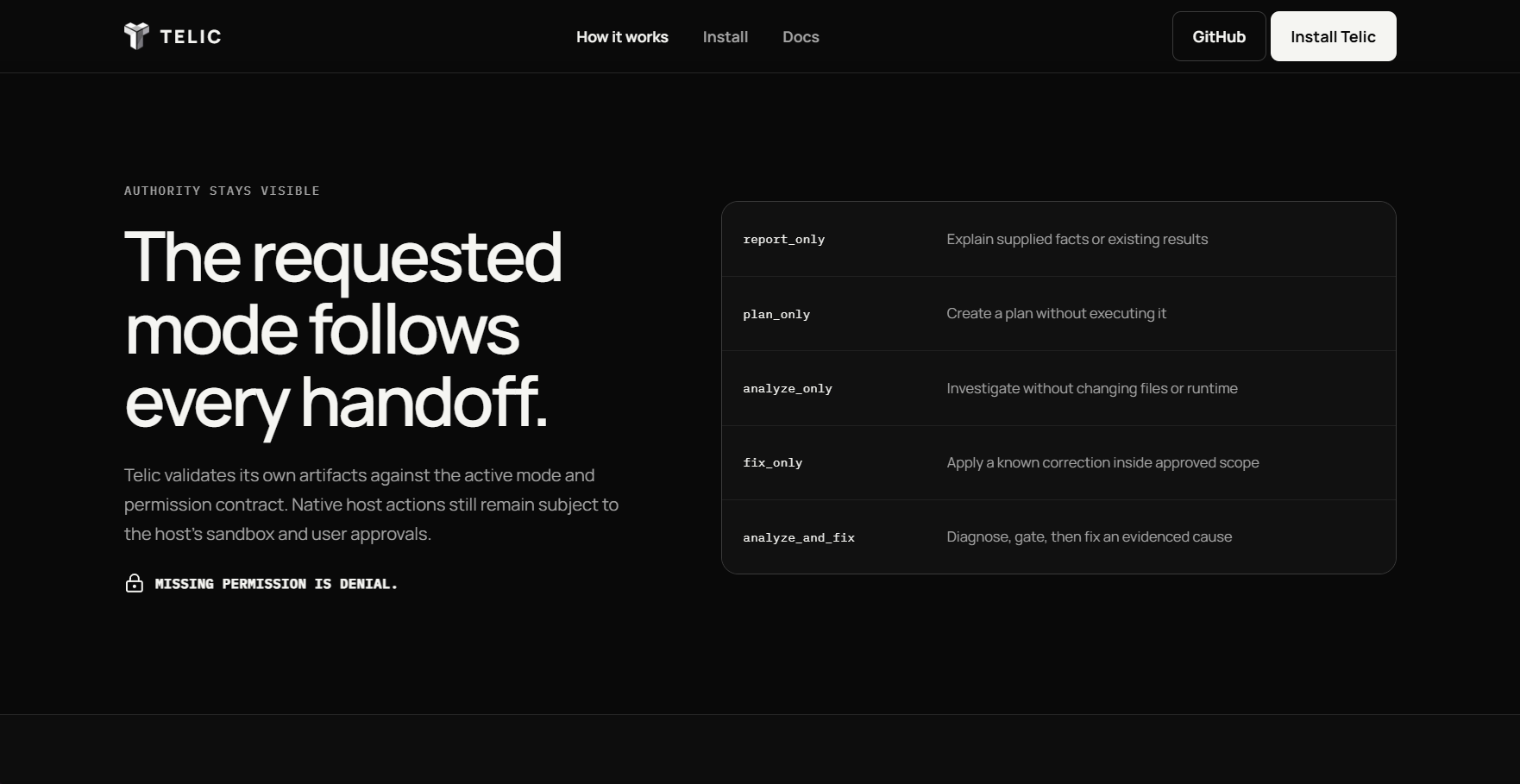
website - tools of telic that it can use
- ) Inspiration
Telic came from a personal problem. After suffering burns while cooking, typing long and highly descriptive prompts became difficult. Even without the injury, I often felt burned out after repeatedly explaining every detail to a coding agent.
I wanted a way to express an intention in simple language without losing quality. Developers should not need to write a perfect specification every time just to get a reliable result. Telic is for people who find complex prompting tiring, repetitive, or inaccessible, and for anyone who wants to spend less energy explaining and more energy building.
2.) What it does
Telic turns a rough coding request into a structured, repository-aware workflow. It reads the available project context, identifies the user’s intention and limits, creates requirements, reviews the task, guides permitted work, verifies the result, and reports the evidence.
The goal is not to make unsupported guarantees or hide uncertainty. Telic reduces guessing by grounding work in the repository and clearly separating what was proven from what still needs investigation.
Instead of writing a long prompt with role, context, constraints, and output requirements, a developer can make a simple request. Telic provides the structure behind the scenes. It works like a small logical development team with defined responsibilities, rather than a single unstructured agent response.
3.) How we built it
Telic was built as a team project. I designed the core idea, architecture flow, workflow pipeline, safety boundaries, and product direction. My original concept was a dynamic multi-agent system where each task creates the right logical roles for that request instead of relying on static agent definitions.
My girlfriend helped polish the website while I rested, created and refined the video demonstration, and improved the project information for a clearer final presentation. Her work helped turn Telic from a technical implementation into a more complete product experience.
During Build Week, we used Codex and GPT-5.6 to refine the plan, identify gaps before implementation, build the local MCP control plane and Codex plugin, create tests, audit the workflow, improve documentation, and build the product website. We used Codex as an engineering collaborator, while we kept ownership of the product direction, decisions, and final review.
The shipped design uses bounded logical roles rather than claiming that it runs five separate hosted AI models. The workflow moves from user intent and repository context to structured requirements, review, permitted execution, verification, and reporting. It also preserves permission boundaries, including analyze-only mode where file changes are not allowed.
4.) Challenges we ran into
The hardest challenge was making Telic work consistently across different AI coding environments. An installation flow that works in one IDE may need different configuration, plugin support, or MCP handling in another. We manually tested multiple environments and improved the setup documentation around the supported Codex path.
Another challenge was workflow artifact duplication. Some artifacts created for handoff between logical stages were being rejected as incomplete or duplicated during controller review. We debugged the pipeline and improved the artifact handling so the workflow could move forward more reliably without bypassing safety checks.
We also had to balance quality with speed. A workflow can become frustrating if it loops forever or asks for too many clarifications. Telic uses bounded review loops so it can improve a task without becoming another source of friction.
5.) Accomplishments that we're proud of
We are proud that Telic can take a vague request and turn it into a grounded investigation. In a real test using KursoKo, a career assessment project, Telic helped investigate why certain school recommendations appeared repeatedly. It found that the issue was not a hidden preference for one school. The main cause was catalog coverage bias amplified by the ranking design, along with repeated school rankings across career cards.
We are also proud that Telic is efficient in a practical way. The goal is not only to reduce tokens in a single prompt. The goal is to help developers reach a reliable answer with fewer repeated prompts, fewer corrections, and less time spent re-explaining context.
Personally, we are proud that we turned an architecture idea into a working product as a team. I specialize in frontend engineering, and Codex helped us implement backend logic, testing, packaging, audits, and documentation. My girlfriend helped make the website, demo, and project presentation clearer and more polished.
6.) What we learned
We learned that agentic workflows need strong boundaries. More steps do not automatically mean better work. Each step needs a clear purpose, permission limits, evidence requirements, and a stopping condition.
We also learned that compatibility should be stated honestly. Telic has a supported Codex plugin path, while other IDE and agent integrations need more testing before they can be presented as fully supported. Clear setup instructions, stable tool contracts, and visible evidence matter as much as the workflow idea itself.
Most importantly, we learned that accessibility and developer productivity are connected. A tool that understands a simple intention can help developers keep working when they are tired, burned out, injured, or simply do not want to write a long prompt for every task.
7.) What's next for Telic
Next, we want to make Telic easier to install and test across more IDEs and agent hosts. We also want to add visual workflow traces so developers can see what Telic understood, what evidence it used, and why it made each decision.
Other future work includes browser and DevTools evidence, stronger context compression, and broader compatibility testing. Telic will remain open source so developers who struggle with excessive prompting, burnout, or accessibility barriers can use it and help shape its future.
Telic helps bridge a developer’s intention with the actual solution they wanted.
Built With
- codex
- gpt-5.6
- model-context-protocol
- next.js
- node.js
- typescript
- vercel
- vitest

Log in or sign up for Devpost to join the conversation.