PPT LINK: https://shorturl.at/g8LSH
Telemetra - Where Every Bit Matters
A Fast, Resilient, and Secure File Transfer System for Unstable Networks
Built by Team Pixie Chicks (VIPS-TC)
- Mitish Raina
- Rishita Sharma
- Paarth Sharma
Overview
Telemetra is an engineering-grade smart file transfer system built for environments with unstable or intermittent connectivity - such as rural medical clinics, disaster zones, racing telemetry systems, and factory–racetrack integrations.
Traditional file-sharing solutions like FTP, SFTP, or HTTP uploads fail or restart from scratch under poor network conditions, wasting bandwidth and risking data loss.
Telemetra ensures speed, resilience, and precision through:
- Adaptive QUIC transport
- Forward Error Correction (FEC)
- Merkle-tree integrity verification
- Real-time monitoring and auto-resume
Problem Statement
In mission-critical environments - where every packet and millisecond count - existing transfer tools collapse under:
- High latency and packet loss
- Frequent network drops
- No resume or verification mechanisms
- Unoptimized retransmission strategies
This leads to:
- Corrupted or incomplete files
- Loss of telemetry or configuration data
- Delayed decision-making and inefficiency
Goal:
Build a resilient file mover capable of secure, prioritized, and lossless transfers - maintaining data integrity and visibility even in the harshest connectivity scenarios.
Solution
Telemetra introduces a multi-channel, adaptive file transfer system that intelligently balances speed, reliability, and security using next-generation networking principles.
Core Innovations
| Feature | Description |
|---|---|
| Auto Resume | Continues transfers from last verified chunk after a network drop. |
| Integrity Assured | Uses SHA-256 hashing & Merkle-tree verification for end-to-end data integrity. |
| High Throughput | Powered by QUIC protocol + parallel chunk streaming + adaptive FEC. |
| Live Monitoring | Real-time dashboard with progress, metrics, and link health visualization. |
| Priority Channels | Critical telemetry is transmitted before background data. |
| Edge Friendly | Lightweight Go-based agent deployable on low-power edge devices. |
How It Works
Workflow
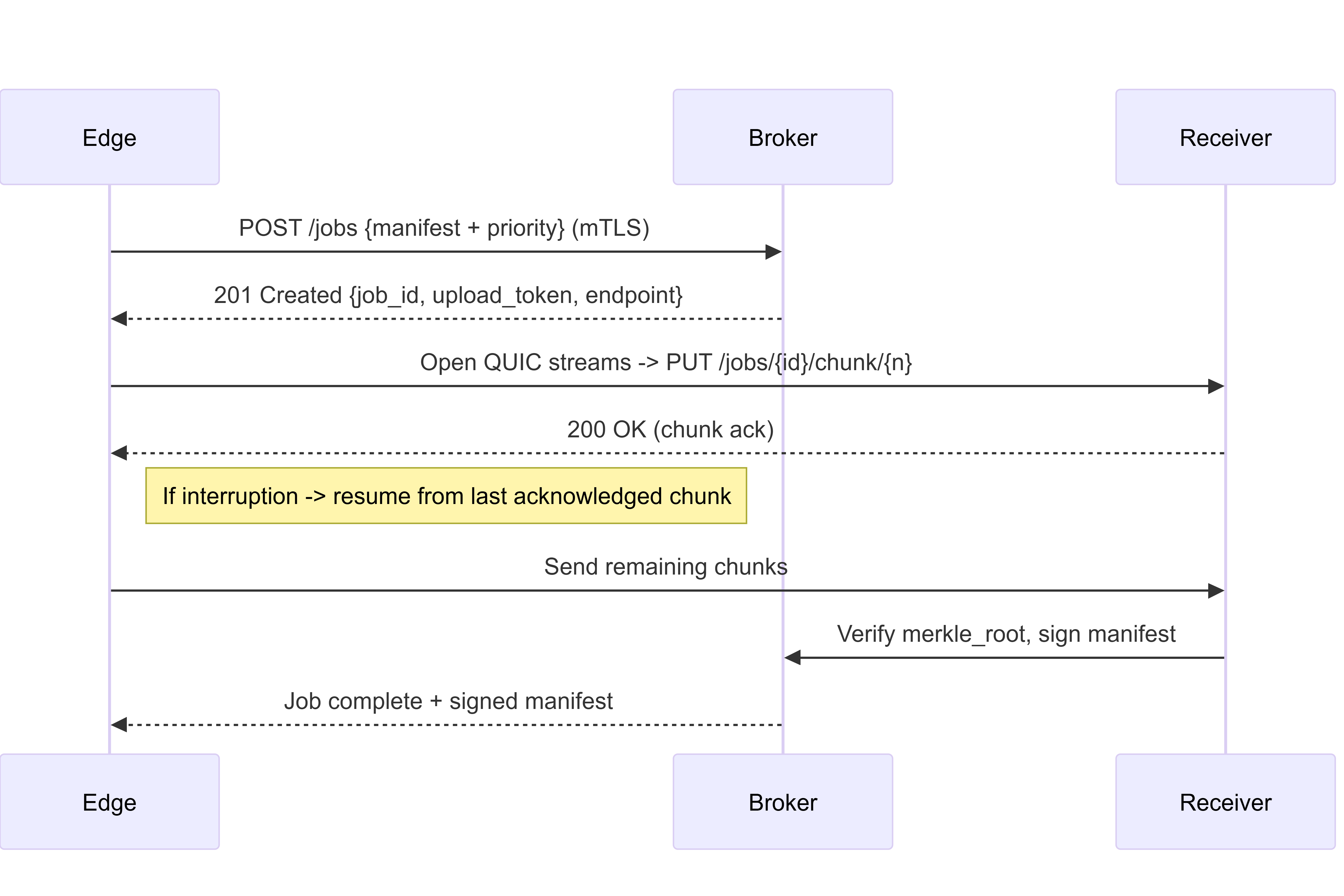
- Edge Agent registers file → generates manifest (chunk list + hashes).
- Transfer Broker authenticates and provides an upload token.
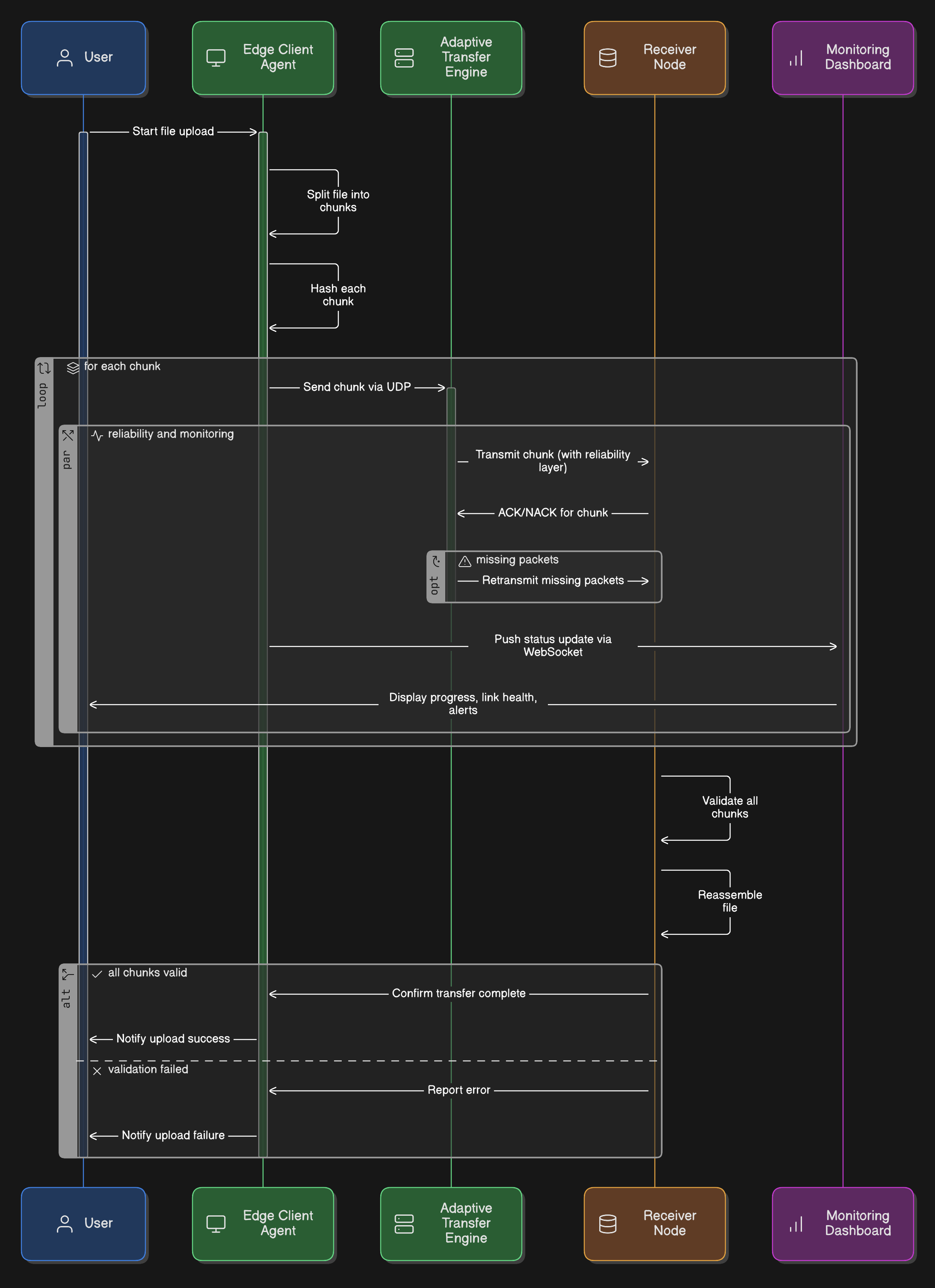
- Chunks are streamed in parallel via QUIC with adaptive redundancy.
- Receiver verifies each chunk → assembles via Merkle verification tree.
- Final Manifest signed and returned to sender confirming completion.
- Dashboard displays live progress, bandwidth, and error statistics.
Sequence Diagram
ALT: If image is not rendering, (https://shorturl.at/nAzTl)
Added them above in project gallery.
Tech Stack
| Layer | Technologies |
|---|---|
| Frontend (Dashboard) | React.js, TypeScript, TailwindCSS, Socket.IO / WebSocket |
| Backend (Core Engine) | Go (Golang), QUIC-Go, gRPC, REST APIs |
| Data Reliability | Klauspost/ReedSolomon for Forward Error Correction |
| Security | mTLS (Agent ↔ Broker), SHA-256 hashing |
| Observability | Prometheus + Grafana for metrics, structured logs |
Architecture
ALT: If image is not rendering, (https://shorturl.at/VwI1f)
Added them above in project gallery.
Key Features
- Resilence: Operates seamlessly under packet loss and disconnections.
- Performance: Transfers data up to 10× faster than TCP-based systems under 5–10% loss.
- Scalibility: Works across cloud, on-premise, and edge devices.
- Security: mTLS + AES-256 + signed manifests ensure end-to-end trust.
- Real-time Insights: Built-in monitoring and analytics dashboard.
Use Cases
- Factory ↔ Racetrack Data Exchange: Transfer car telemetry, configuration files, and sensor data between pit crew and factory in real time.
- Rural & Mobile Clinics: Upload patient imaging and reports securely to central hospitals.
- Disaster Relief Operations: Send situational maps, drone footage, and logistics data reliably from affected areas.
- Remote Engineering & IoT Sites: Sync data from edge sensors or equipment to main control systems.
Business Model
SWOT Analysis
| Strengths | Weaknesses | Opportunities | Threats |
|---|---|---|---|
| Resilence under poor connectivity | High initial development complexity | Untapped Edge computing markets | Competition from Aspera, Signiant |
| Auto-resume and verification | Market entry barriers | SaaS commercialization | Regulatory restrictions |
| Secure and scalable | AI tuning dependency | White-label partnerships | Cybersecurity and scalability challenges |
| Speed and efficiency advantage | Bandwidth Prioritization | Regulatory Push for secure data transfers | Operational scalibility |
Built With
- golang
- grafana
- grpc
- klauspost
- mtls
- prometheus
- quic
- quickgo
- react
- reedsolomon
- socket.io
- typescript

Log in or sign up for Devpost to join the conversation.