-
-
home
-
action
Teleka Chef Agent — From Food Inspiration to Real-World Commerce
Inspiration
Food is one of the few things that connects everyone. Every day, millions of people discover incredible dishes through social media, save recipes, and dream about recreating them. Yet there is a fundamental gap between seeing something delicious online and actually bringing it to the table.
I built Teleka, a food-focused social commerce platform already available on the App Store, to connect food discovery, local businesses, and digital commerce. But I identified an opportunity to take that experience further: what if discovering a dish could automatically become a complete journey from recipe creation to ingredient purchasing and vendor payment?
That question inspired Teleka Chef Agent.
The goal was not simply to build another AI recipe generator. It was to create an intelligent agent that connects food inspiration to real transactions while empowering small local businesses.
This mission is particularly meaningful in Angola, where access to reliable digital payment infrastructure remains a significant challenge for small merchants. I wanted to build something that could make digital commerce more accessible, practical, and valuable for them.
What It Does
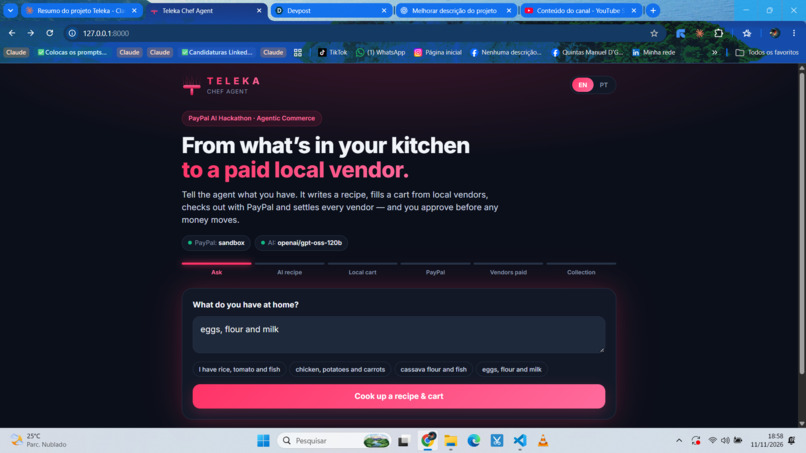
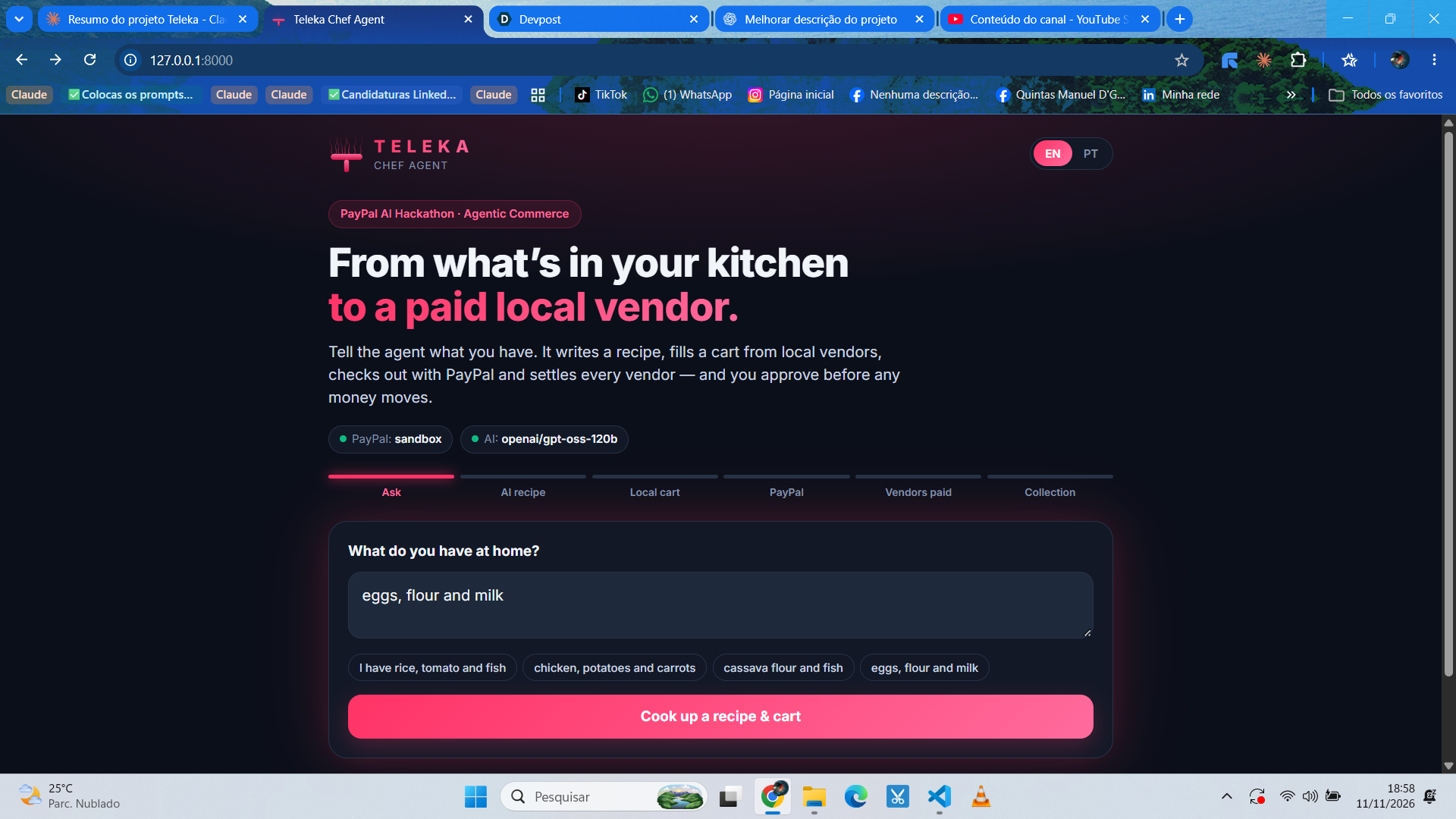
Teleka Chef Agent is an independent, functional extension of the Teleka ecosystem. It transforms the ingredients you already have into a complete cooking and shopping experience.
Simply tell the agent what is available in your kitchen:
"I have rice, tomatoes, and fish."
The AI agent then orchestrates the entire process:
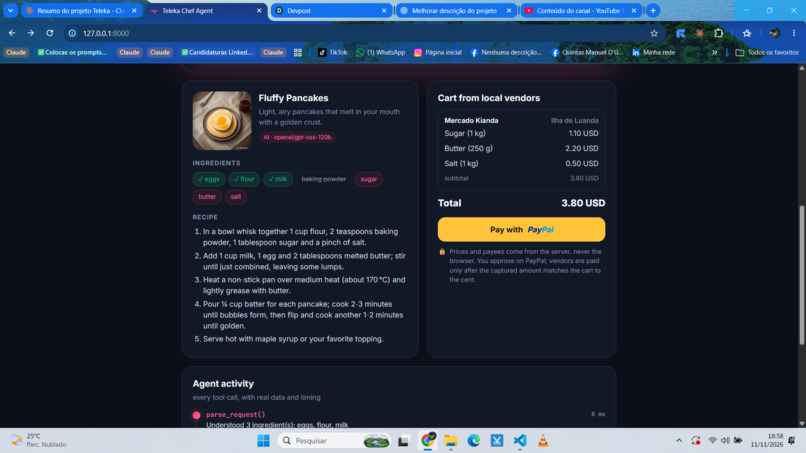
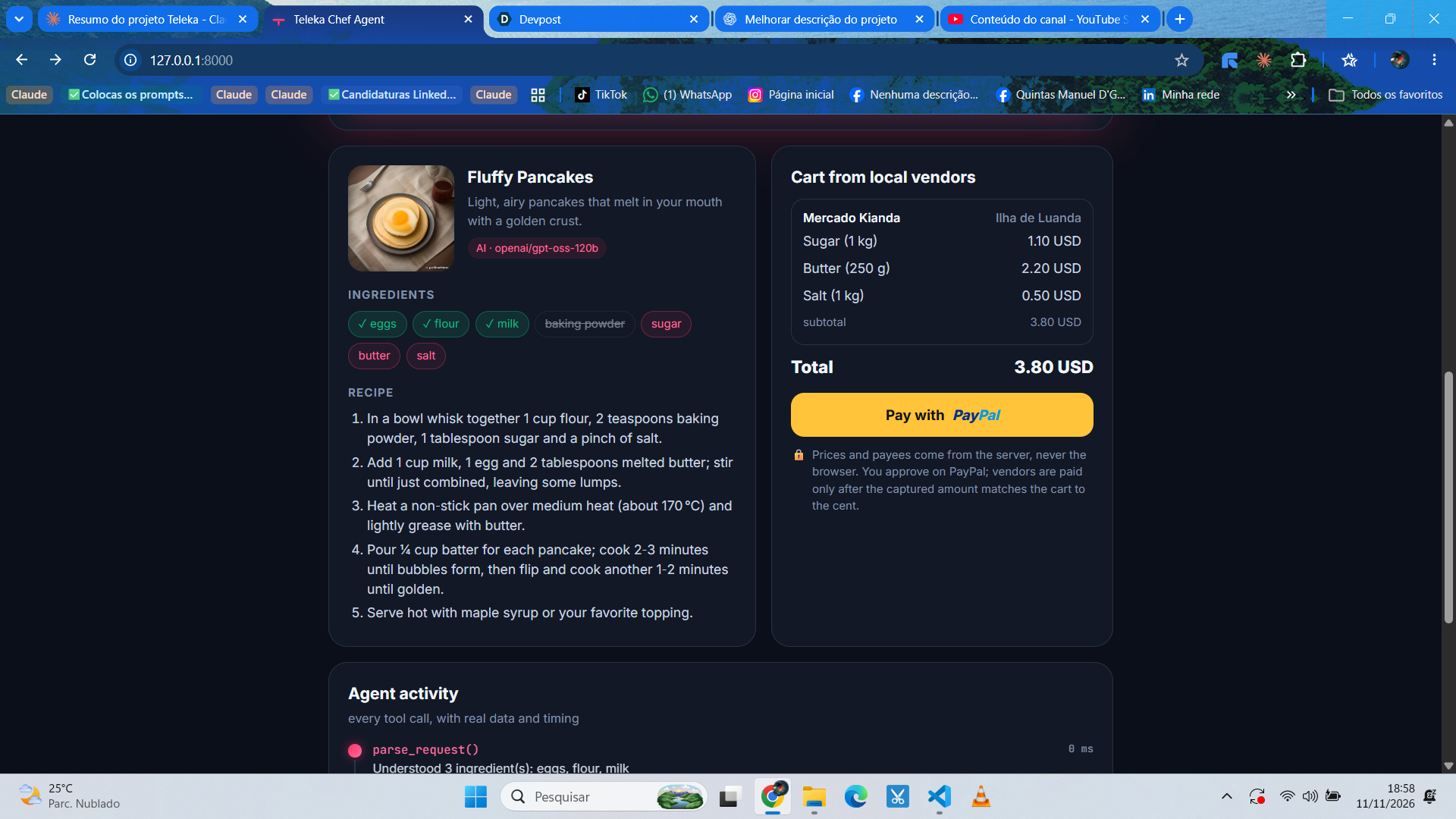
- Creates a recipe: Generates a complete recipe, including its title, preparation instructions, and ingredient list.
- Identifies missing ingredients: Compares the recipe requirements against the ingredients you already have.
- Discovers local vendors: Searches the available product catalog, identifies vendors, and builds a shopping cart.
- Processes payments: Creates a PayPal order and captures the payment only after the customer explicitly approves it.
- Distributes vendor payments: Uses PayPal Payouts to distribute the appropriate share to each participating vendor.
- Completes the social experience: Turns the purchase into a collection on the user's profile, creating new opportunities for discovery and inspiration.
The result is an end-to-end agentic commerce experience: from an idea in your kitchen to a completed transaction that generates value for local businesses.
How I Built It
I designed the system around a modular AI agent architecture, with clearly separated responsibilities and server-controlled financial operations.
- Backend: Python and FastAPI, supported by a lightweight web interface using Teleka's visual identity.
- Agent orchestration: The
agent.pymodule coordinates specialized tools across the complete workflow: recipe generation → product discovery → order creation → payment capture → vendor payouts. - Artificial Intelligence: Recipe generation through Groq using a free, OpenAI-compatible LLM accessed directly through HTTP.
- Payment infrastructure: PayPal Orders API v2 for order creation and capture, and PayPal Payouts API v1 for vendor settlements, using the PayPal Sandbox environment.
- Security-first architecture: The AI determines the dish, but never controls financial decisions. Product prices and vendor payment details come exclusively from the server-side catalog. Shopping carts and order information are stored server-side, and payment confirmation requires only the order ID.
- Payment integrity: The backend validates the order before processing it, prevents unauthorized changes, rejects mismatched amounts, and uses idempotency protections to prevent duplicate payouts.
- Testing and reliability: A fully functional mock mode allows the entire workflow to run offline, without API keys or external network dependencies. Fourteen tests cover critical scenarios, including cart tampering, duplicate confirmation, unapproved orders, and amount mismatches.
My central architectural principle was simple: AI should make the experience intelligent, but the server must remain in control of the money.
Challenges I Ran Into
Building an AI-powered commerce system from Angola presented several practical and technical challenges.
- Payment availability in Angola: PayPal's payment services are not fully available in my country. Rather than allowing this limitation to stop development, I implemented and tested the complete payment workflow using PayPal Sandbox.
- AI SDK compatibility: The OpenAI SDK encountered compatibility issues in my development environment. I solved this by calling the LLM directly through HTTP, reducing dependencies and giving me greater control over the integration.
- Image generation limitations: Pollinations' free image-generation service has rate limits and watermarks. I implemented a best-effort image-generation approach with local fallbacks to keep the experience functional.
- Production infrastructure failure: My production hosting went down during development because of an unpaid hosting service. This reinforced the importance of building a self-contained demonstration that runs independently of production infrastructure.
- Limited development budget: I had no budget for paid AI services. I therefore built the experience using free AI inference and image-generation services, keeping operational costs as low as possible.
Each challenge pushed me to prioritize resilience, independence, and practical engineering decisions.
Accomplishments That I'm Proud Of
My biggest accomplishment is building a functional, two-sided agentic commerce workflow on top of the foundations of an existing product.
Teleka Chef Agent does more than generate recipes or recommend products. It coordinates multiple steps, interacts with payment infrastructure, processes customer-approved transactions, and distributes payments to the businesses supplying the ingredients.
I'm particularly proud of the security architecture. Financial operations remain server-controlled, AI-generated content is validated, transactions are protected against duplicate processing, and the system has a dedicated test suite.
This is not just a visual prototype of what agentic commerce could look like. It is a working implementation of the complete workflow, demonstrated against PayPal Sandbox.
Most importantly, the project explores how AI agents can create economic opportunities for small businesses in emerging markets.
What I Learned
This project taught me how to transform a language model into an agent capable of coordinating specialized tools and executing a multi-step commercial workflow.
I also learned several important lessons:
- How to integrate AI agents with real payment APIs while maintaining strict financial controls.
- Why human approval must remain part of financial transactions.
- How to separate AI decision-making from sensitive business logic.
- How to design resilient systems when external APIs and infrastructure are unreliable.
- How to build and validate an end-to-end product despite limited financial resources.
The most important lesson was that the real value of an AI agent is not simply what it can generate, but what it can safely accomplish.
What's Next for Teleka Chef Agent
This hackathon implementation is the foundation for a much larger vision.
My next priorities are:
- Full Teleka integration: Bring the Chef Agent directly into the existing Teleka application, connecting recipes, social discovery, marketplace listings, and user profiles.
- Asynchronous image generation: Introduce Celery-based background processing, with per-dish image caching to improve performance and reduce unnecessary API calls.
- Stablecoin-powered commerce: Explore PYUSD-based vendor settlements to enable faster, potentially lower-cost digital payments, subject to regulatory, provider, and geographic availability.
- Emerging-market expansion: Adapt the payment and vendor infrastructure to support local businesses in markets where traditional financial services are difficult to access.
- A connected food economy: Build a continuous ecosystem where creators inspire consumers, AI agents simplify purchasing, and local vendors earn revenue.
My long-term vision is to make Teleka more than a place where people discover food. I want it to become an ecosystem where inspiration creates transactions, transactions create opportunities, and technology helps local businesses grow.
Built independently from Angola, with limited resources but a global ambition.
Teleka Chef Agent — From inspiration to the plate. From commerce to opportunity.

