-
-
-
The 007s
Overview
For expectant mothers, one-on-one, in-person consultations with medical professionals may be limited as the result of COVID-19 disruptions, either due to lack of healthcare capacity or potential threat of exposure with in-person visits. This prevents individuals from accessing the healthcare they need. We see an opportunity to use telemonitoring technology as a way to quickly communicate health data to medical providers as well as share information with patient advocates throughout a mother’s pregnancy. With obstetric patients having to attend frequent appointments to monitor the health of the baby and the mother, an application that tracks the mother's pregnancy could reduce the number of required appointments. Additionally, this could provide another means of communicating with a provider, if the mother wants to share updates.
In addition to the increased risk of traveling to doctor's appointments, COVID-19 has also caused restrictions to be created on the number of patient advocates who can attend appointments with the mother. Mothers often choose to share the appointment experiences and key milestones with support people in their lives, including spouses. An application that would allow a mother to share these details with her advocate(s)/support would help include and inform her community about how to best support her.
Team Members
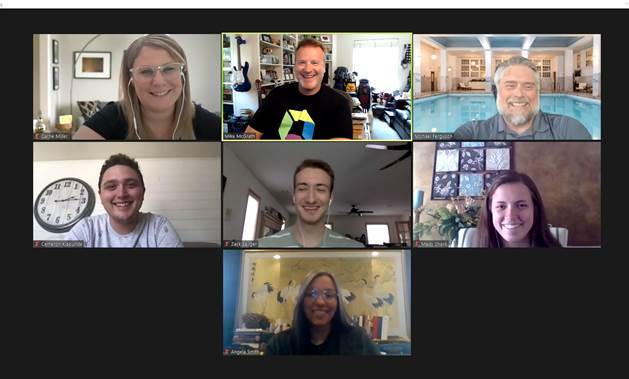
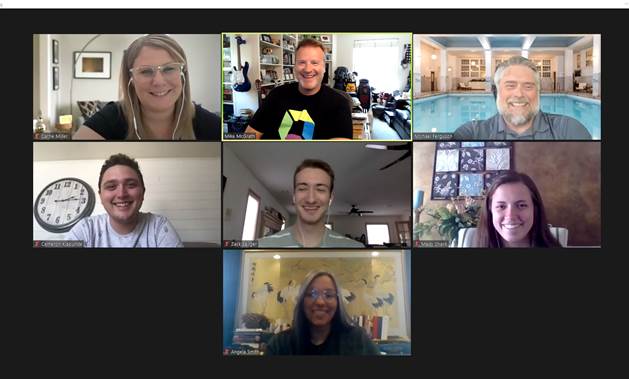
Cameron Klabunde (Software Developer, Junior Chemistry and Psychology student at Wabash College) Cameron worked on developing the back-end of the application using Python and Flask. He also contributed to the production of the script for the presentation.
Carrie Miller (Project Manager, GTM Development, DHSc student at ATSU) Carrie worked on the EA, BMC, VPC, & Customer Personas, and GTM strategy/sales pitch. She was responsible for customer discovery & connection to patient/physician users for beta and user experience test feedback.
Zack Seliger (Software Developer, Senior Computer Science at Indiana University Bloomington) Zack worked on the front-end, which was coded in Javascript and React.
Mady Shank (Software Developer, Senior Mechanical Engineering at Purdue) Mady contributed to developing the back-end of the application through Flask and Python. She additionally helped compile the final presentation, devPost, and abstract.
Angela Smith (Product Strategy, Senior Economics at IUPUI, Incoming MBA at IU Kelley) Angela contributed to the go-to-market strategy, including the EA, value proposition, BMC, and presentation. Angela also led Nona's website prototype using Figma.
How did you decide on this customer segment, problem, and solution?
With one team member having ten years of healthcare experience, a clearer understanding of the impact that COVID-19 has had on patient care was provided to the team. While there are already several applications that address the monitoring of chronic health conditions, the need to track the vitals of expectant mothers and their babies has increased due to the restrictions of COVID-19. After initially identifying this need, an Environmental Analysis was conducted and determined that in addition to COVID-19 considerations, the need for equitable resources for expectant mothers and telemonitoring platforms is only increasing. To confirm our initial analysis, we submitted questions to our SMEs regarding the novelty of a remote pregnancy monitoring application and what they felt should be included that would vary from the resources that are already available. We also discussed the feasibility of a web application with our coaches.
How did your team build and iterate on the solution?
Due to our team member’s relationships with physicians and expectant mothers, we were able to discuss features of this application that would be most useful and convenient for our target consumers. We determined a web application would better address technology accessibility for most patients, compared to a mobile application. Initial pages of the application were prototyped in Figma to allow the team to easily visualize what the application would look like and make it easy to transfer that vision to a web application. While we were designing the look of the application in Figma, we began implementing this design on a web application using React. The back-end of the application was developed using Flask. At several points throughout the build process, the application was deployed and presented to physicians and expectant mothers. They were instructed to navigate through the website and provide feedback or ways the tool could be improved. For example, the first iteration of the application focused largely on the patient’s experience while using Nona. After consulting with physicians, they suggested including a page that demonstrates what the healthcare provider sees upon logging into the Nona application. The second iteration included an example of a dashboard that a physician would see. Having feedback is a vital measurement of success, so our team ensured that both patient and physician feedback was obtained and addressed in our solution.
Key Metrics
Marketing
Addressable market:
When looking at the usability of this tool, we reflected on the CDC reporting of 3,791,712 births in the United States in 2018. Of this, only 6 to 8% are considered high risk pregnancies - leaving over 90% of obstetric patients as low-risk pregnancies.
Looking more closely at Indiana, the CDC reported 81,646 births occurred in the state, consisting of 75,115 low-risk pregnancies in Indiana annually.
With Nona being offered free to all obstetric patients (regardless of high- or low-risk), if 5% of the population used our tool, we would service an average of 4,082 patients annually. This would lead to healthier and happier pregnancy journeys for the state of Indiana.
The United States Bureau of Labor Statistics reported an estimate of 18,590 obstetric physicians in the United States in 2018. While Indiana did not report the number of obstetric physicians within the state, our team looked at the surrounding states (Ohio, Illinois, Michigan, and Kentucky) to obtain an average of 640 physicians. Again, if a take rate of 5% was obtained, Nona would capture 32 obstetric physicians in the state of Indiana to incorporate this tool into their practice.
The average birth rate for an obstetric physician annually is 105 which could lead to 3,360 patients being captured annually through their physician. This would generate a revenue stream of $67k-$100k annually just in the state of Indiana, without taking into account other potential revenue from monitoring devices or data aggregation services.
Customer Discovery/Product
6 interviews conducted (patient customer, physician customer, business advisor), 15 beta tests conducted, and 4 user acceptance tests conducted.
Technical Architecture
Web Application Architecture Front-End Web Framework/User Interface [React (Javascript, CSS, HTML)] -- Heroku -- Back-End Web Framework [Flask (Python)] -- Database [MySQL]
Key Tools, Libraries, and Frameworks
Business Strategy
Mural: We used Mural to complete our business strategy assessments, including the customer profile, value proposition, and business model canvas. Mural has built in templates that are easy to use.
Prototyping
Figma: Figma allows the team to easily visualize what the web design would look like and then transfer both the vision and underlying code to a web application.
Adobe Illustrator: Adobe Illustrator was used to develop a logo. It is an industry standard for graphic design.
Web Application
React: Known as an industry standard tool for making a platform. This tool ultimately could be used if we were targeting a larger audience.
Flask: We decided to use Flask because it is compatible with the Python programming language, which some of our team had experience with.
MySQL: Database tool that is another industry standard that was selected due to team familiarity. GitHub: GitHub served as a repository for code. It is an industry standard for code sharing and merging.
GitHub: GitHub served as a repository for code. It is an industry standard for code sharing and merging.
If you had another 5 weeks to work on this, what would you do next?
With the limitations that the given 5 weeks presented on our solution, the amount of time that was allotted for interviews and feedback was limited and is something that we would re-visit. Additionally, to improve the metrics that Nona can track, the team hopes that Nona can be paired with hardware technology to monitor fetal heart tones, the baby's kicks, the mother's weight, and the mother's blood pressure. By providing this medical equipment to patients, the mothers will have the ability to more easily, conveniently, and reliably monitor the metrics displayed on the Nona application. Nona would also be further developed to include patient and advocate support resources to prepare for pregnancy, labor, and post-partum. Lastly, Nona would feature a comprehensive pregnancy report generated for the mother, which she can use as a keepsake or reference for future pregnancy planning.
From the physician's perspective, Nona will be compatible with the provider's current EMR/EHR services to allow for a natural integration of telemonitoring and telehealth services. Additionally, the team would like to consider the possibility of using aggregate patient data dashboards to assist healthcare providers in addressing widespread needs across the population of expectant mothers, with PII and HIPAA guidelines considered. With healthcare equity being one of the driving forces behind creating this technology, data and information gathered from pregnancies could help provide better resources to women with less access to prenatal care.


Log in or sign up for Devpost to join the conversation.