Inspiration
At one of my startups, we spent time and money building a mobile app where users could send voice messages that turned into posts on a shared blog. It flopped. Later I realized we could’ve tested the idea way cheaper—just by setting up a WhatsApp or Telegram number and having a person handle messages manually. No app needed.
Now with LLMs, we don't even need a human to run the test. Just hook an LLM into the Telegram API, give it some instructions, wire up a few tools, and let it handle the chats. You just monitor how the conversations go.
What it does
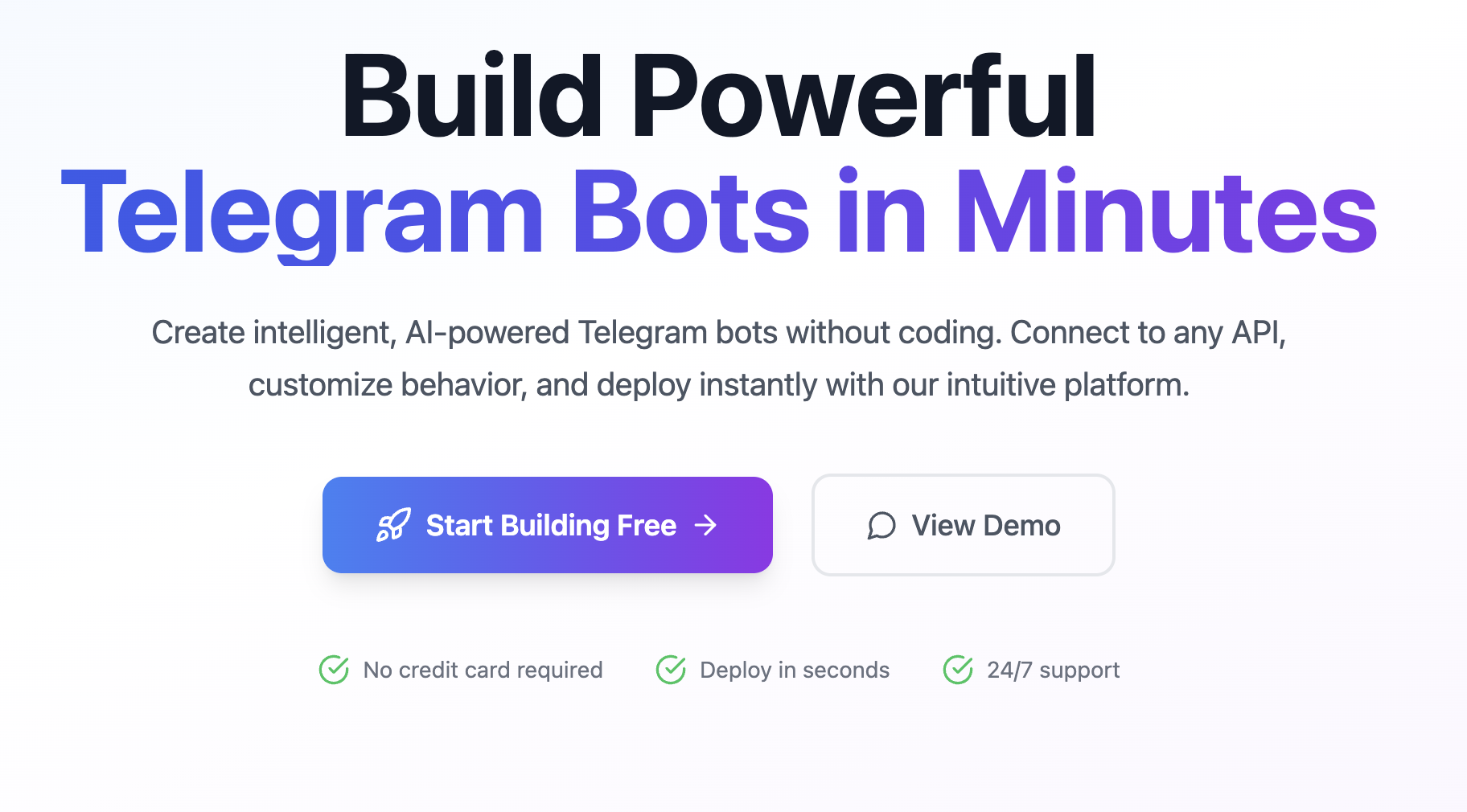
The platform lets you build a Telegram bot by submitting a bot API token from BotFather and plain English instructions for the bot’s behavior. That’s all you need to get rolling.
How it is built
I used Supabase for the backend (separate post on why it's one of the better serverless picks for AI streaming: https://medium.com/@mitek99/build-an-ai-powered-chatbot-with-vercel-ai-sdk-and-supabase-edge-functions-4cd051eac9ec).
Telegram webhooks and messaging run through an edge function built with Claude Code, inside Windsurf and Cursor. I stick to IDEs for backend work.
Frontend’s built with Bolt.
Challenges I ran into
Biggest issue: no time. This is a side project, and I’ve got a full-time job, a family, and just picked up a gravel bike.
Accomplishments that I'm proud of
- It works, and I shipped it on time
- Came up with Async Tool Calling and used it in this project: https://medium.com/@mitek99/asynchronous-tool-calling-in-llm-inference-eadd13801300
- Designed the Webtools interface as an alternative to MCP (which is an overbuilt mess: https://medium.com/@mitek99/mcps-overengineered-transport-and-protocol-design-f2e70bbbca62). Webtools spec is still in progress (https://github.com/ai-1st/webtools)
What's next for Telegram Bot Builder
- Dig deeper into the Telegram API and handle more use cases, like bots in group chats
- Port a few popular MCP servers to Webtools and get them running in the cloud
- Choose a relevant domain name
Built With
- bolt
- deno
- supabase


Log in or sign up for Devpost to join the conversation.