-
-
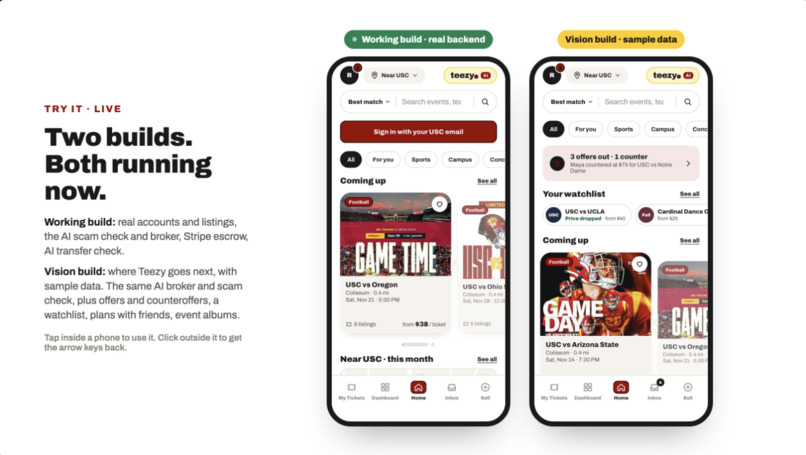
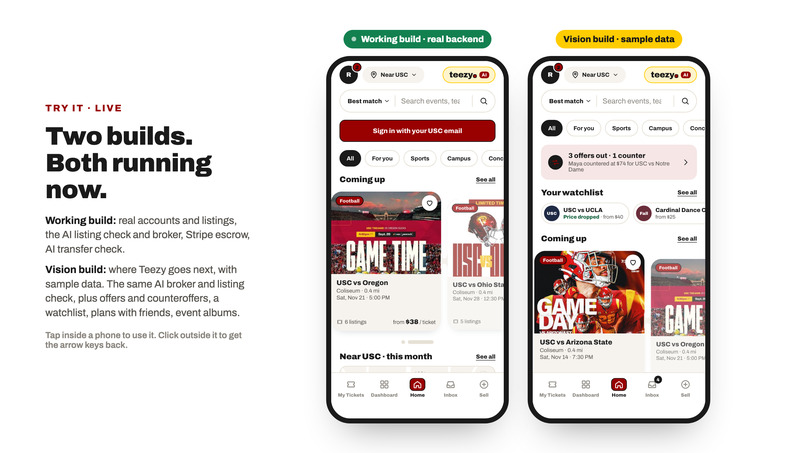
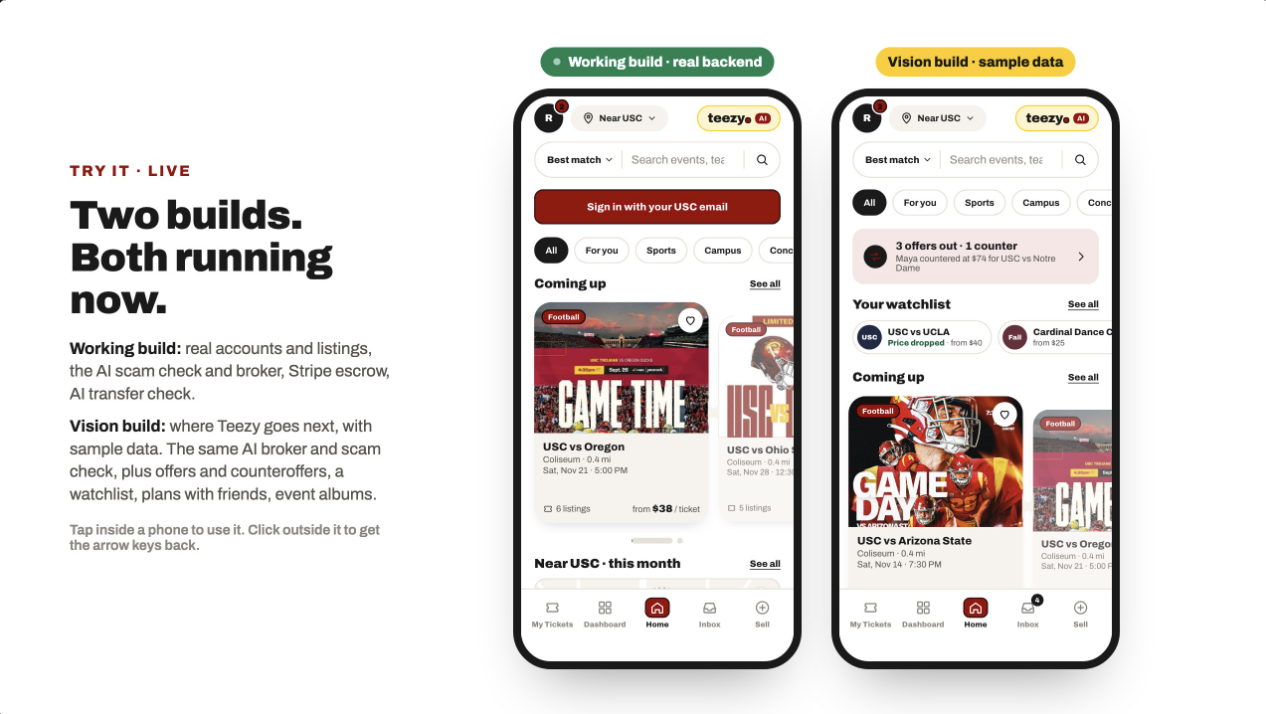
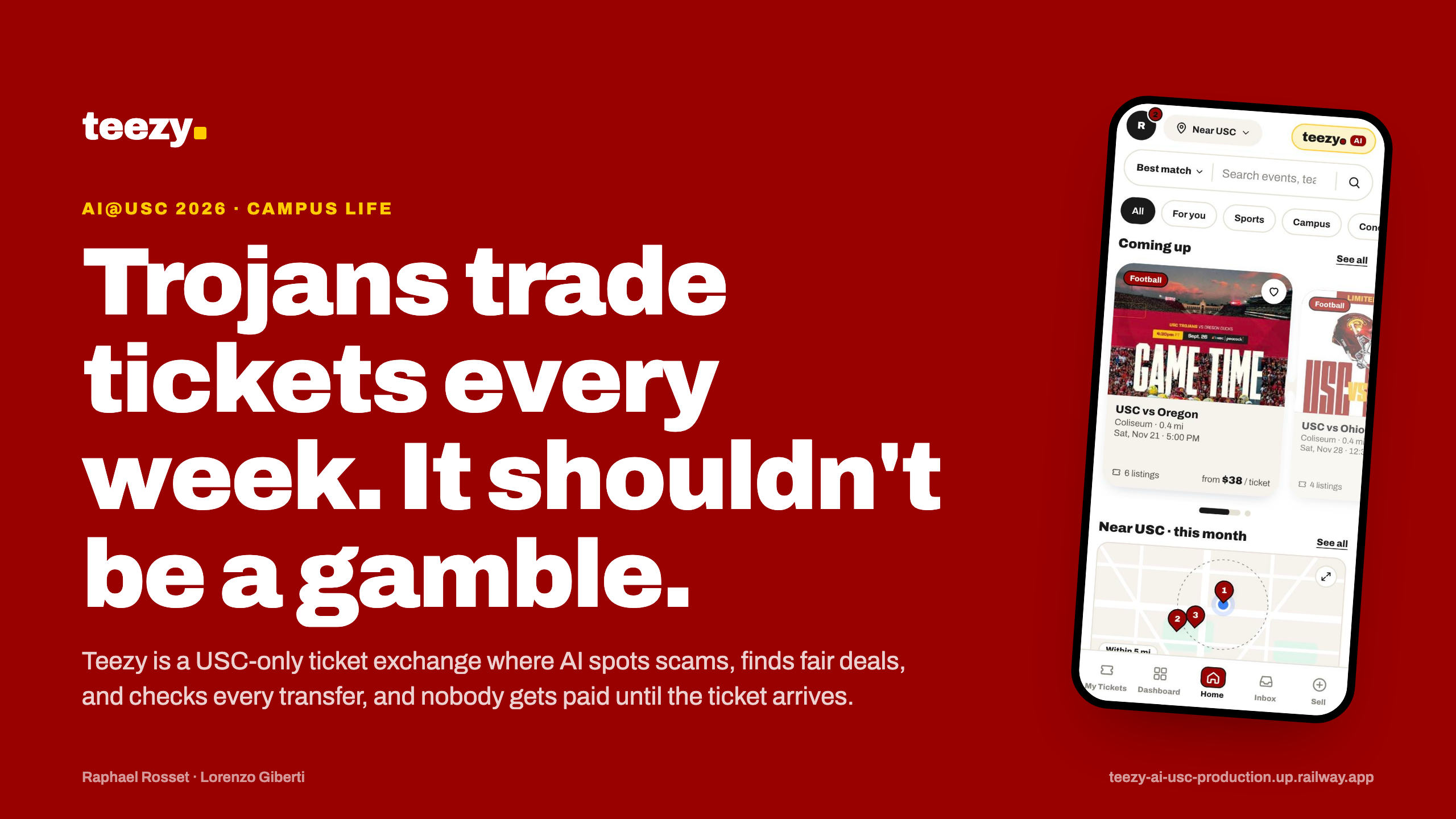
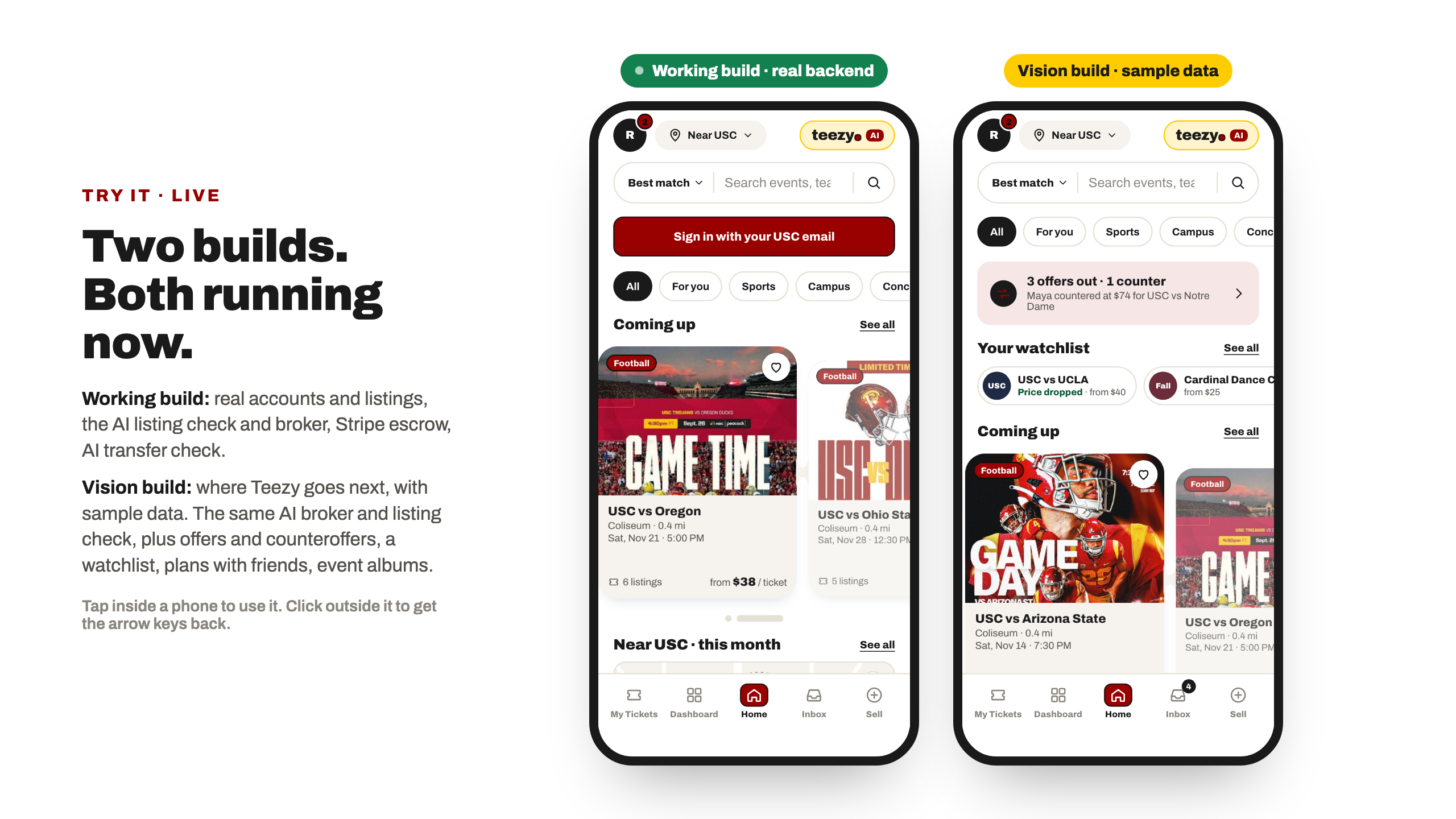
Both versions of our demo
-
-
-
-
-
-
-
-
-
-
-
-
-
Inspiration
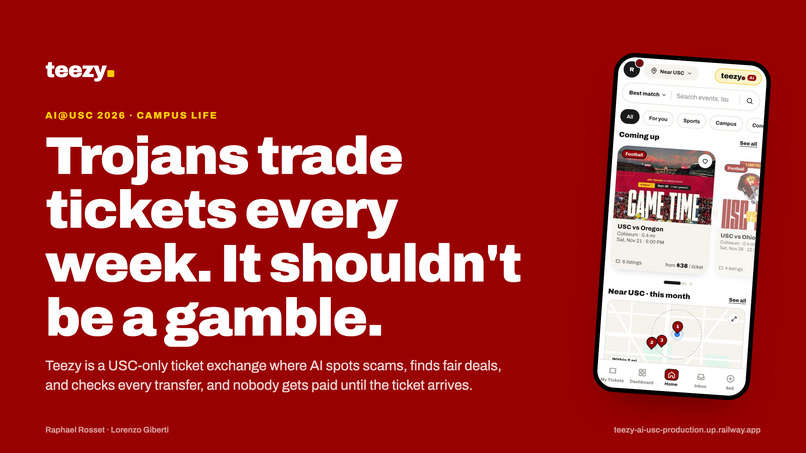
This problem started with us. One of us was scammed on GroupMe trying to buy a ticket to the Oregon game. The other had three tickets go to waste because we didn’t know a good place to sell them. One of us lost money because there was no safe way to buy, and the other lost value because there was no good way to sell.
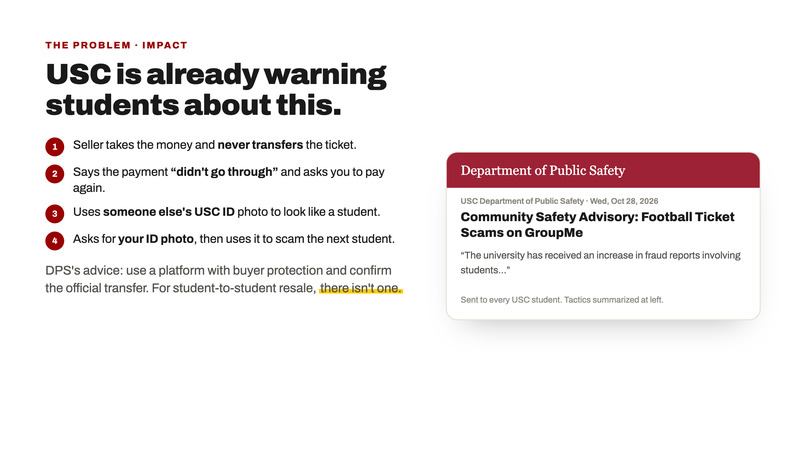
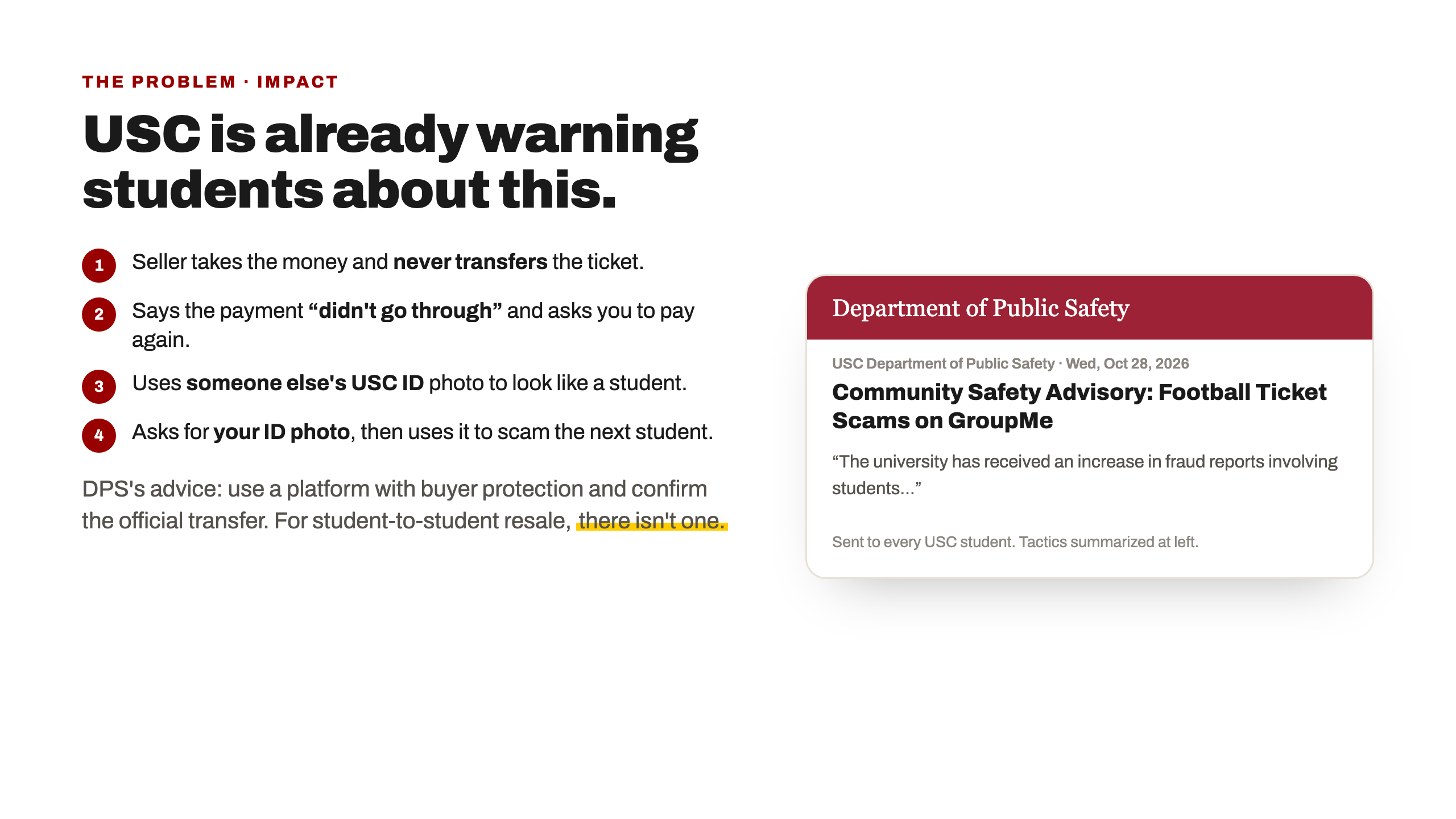
On October 28, 2026, USC’s Department of Public Safety emailed every student a Community Safety Advisory about football ticket scams on GroupMe. Students paid for tickets that never arrived. Scammers claimed a payment “didn’t go through” to get paid twice, used other students’ USC ID photos to look legitimate, and asked buyers for their own ID photos to scam the next person.
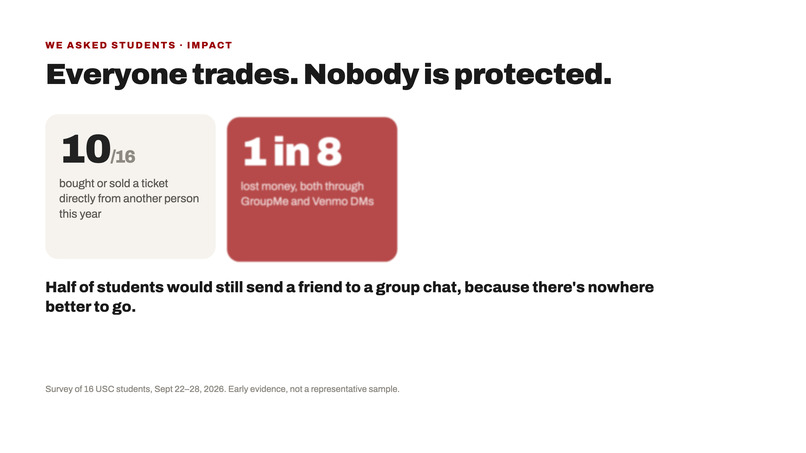
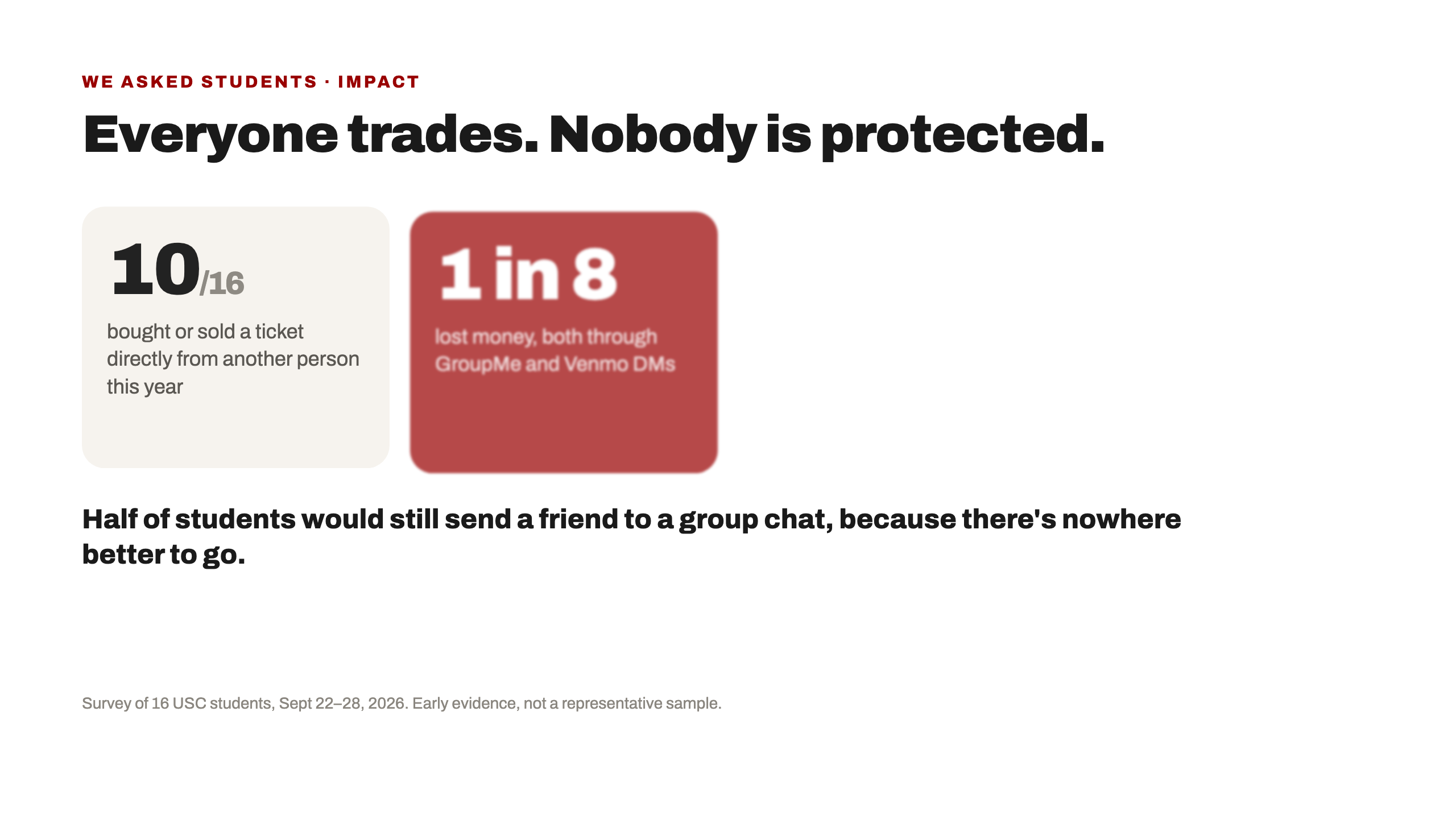
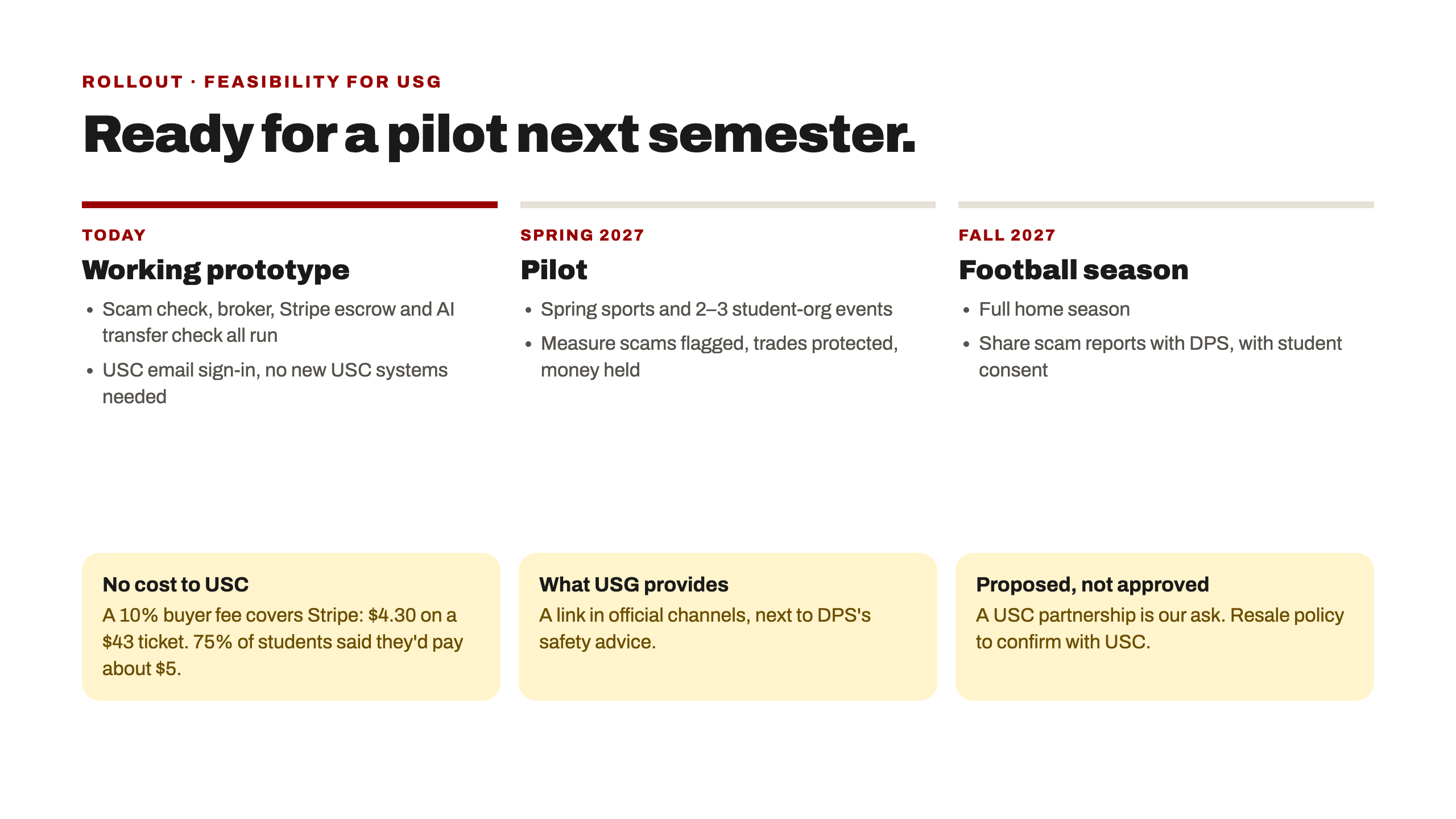
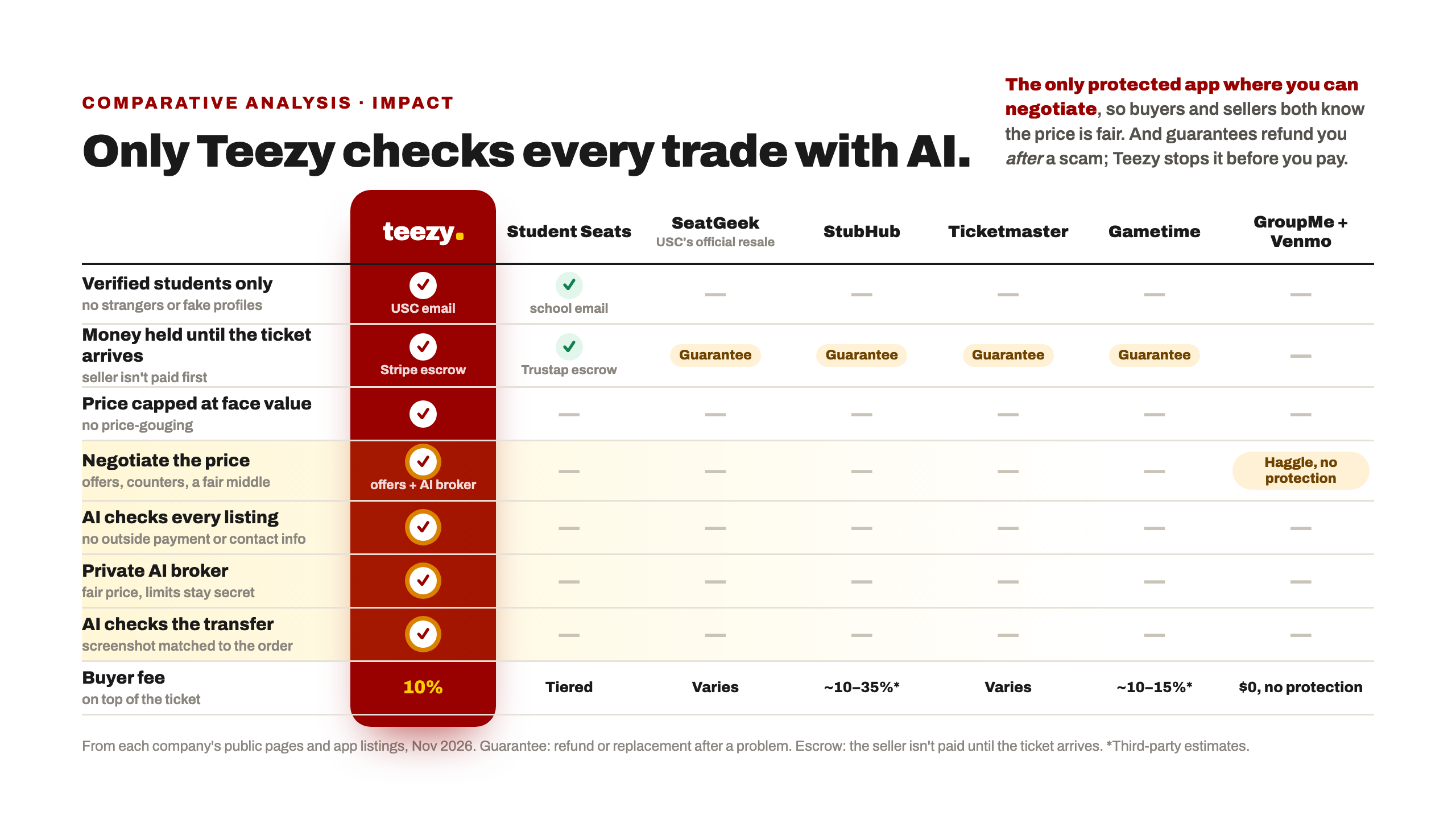
We surveyed 16 USC students. All 16 had bought or sold a ticket directly from another person in the past year. 12 of 16 used group chats, Venmo/Cash App DMs or cash. 1 in 8 had lost money, both times through GroupMe and Venmo. None knew of a student ticket app with scam protection, and 12 of 16 said they would pay about $5 for a guaranteed-safe trade with a verified student.
DPS’s advice is to use a platform with buyer protection and confirm the official transfer. For students selling to students, that platform didn’t exist. And the group chat has a second problem beyond fraud: a ticket posted at 11pm gets buried, and the student who wants it never sees it.
What it does
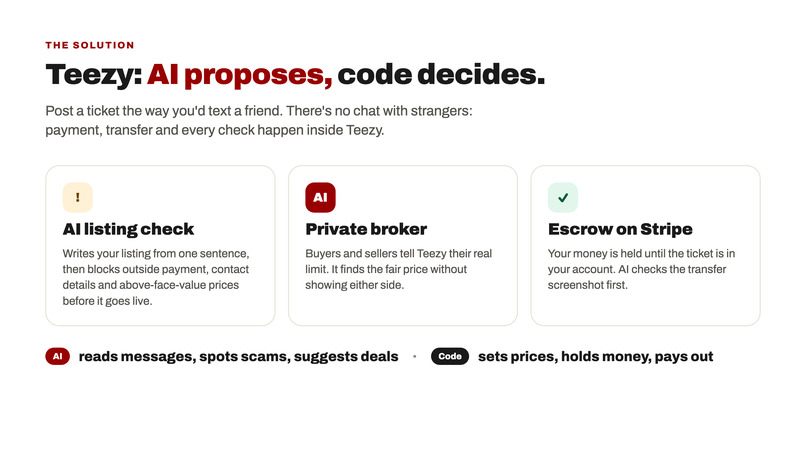
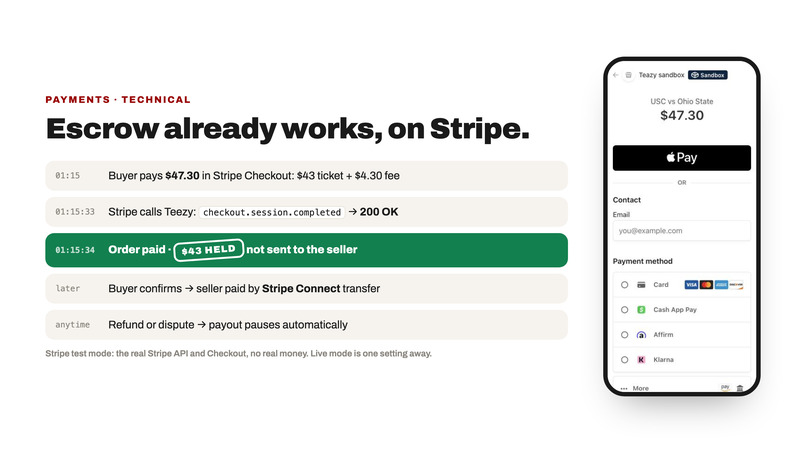
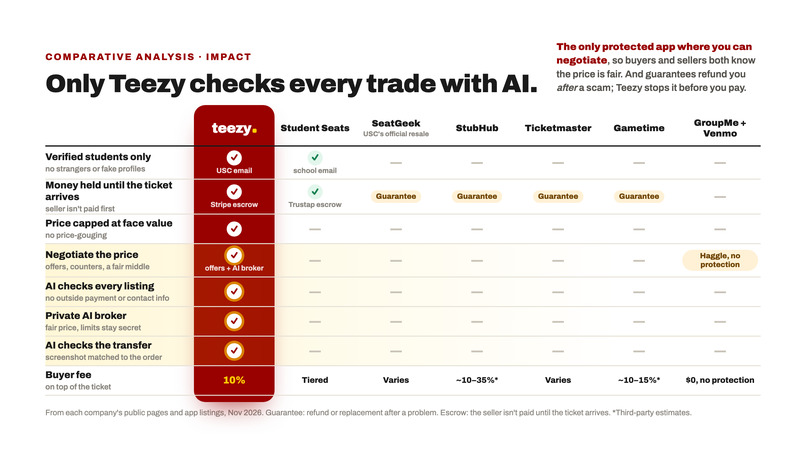
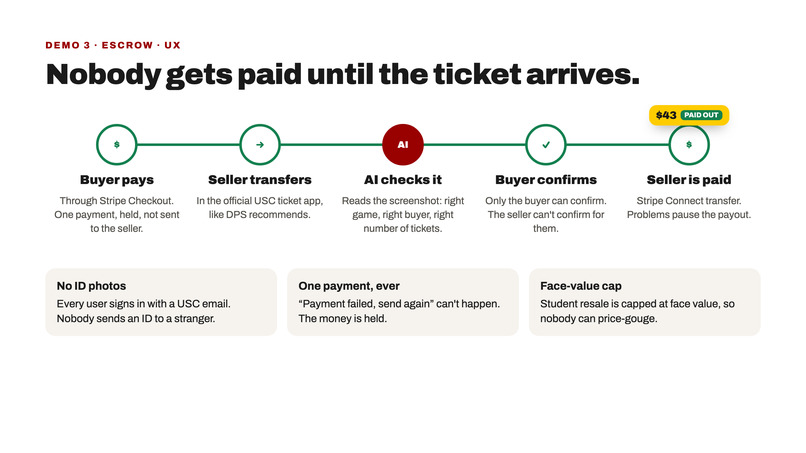
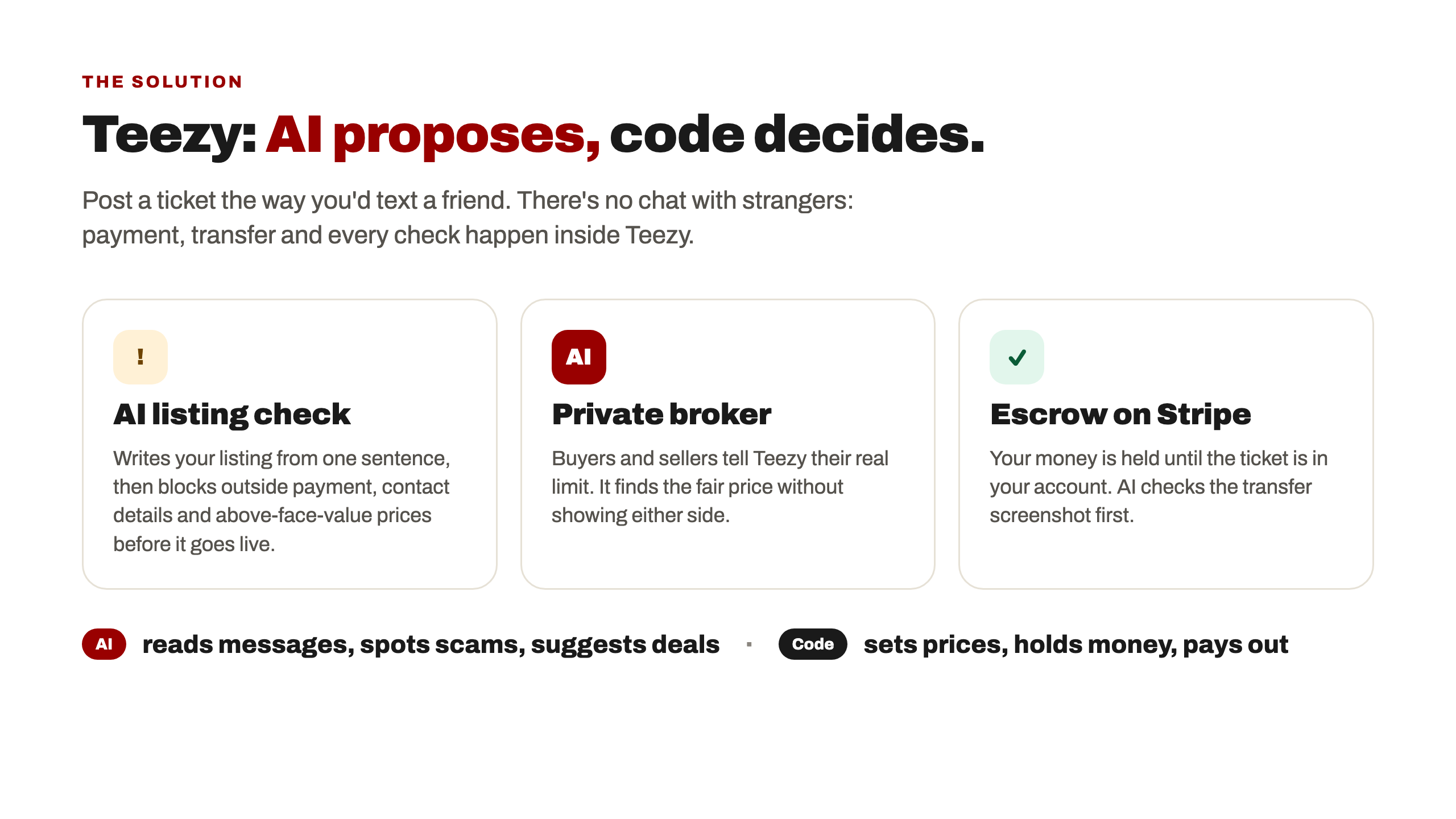
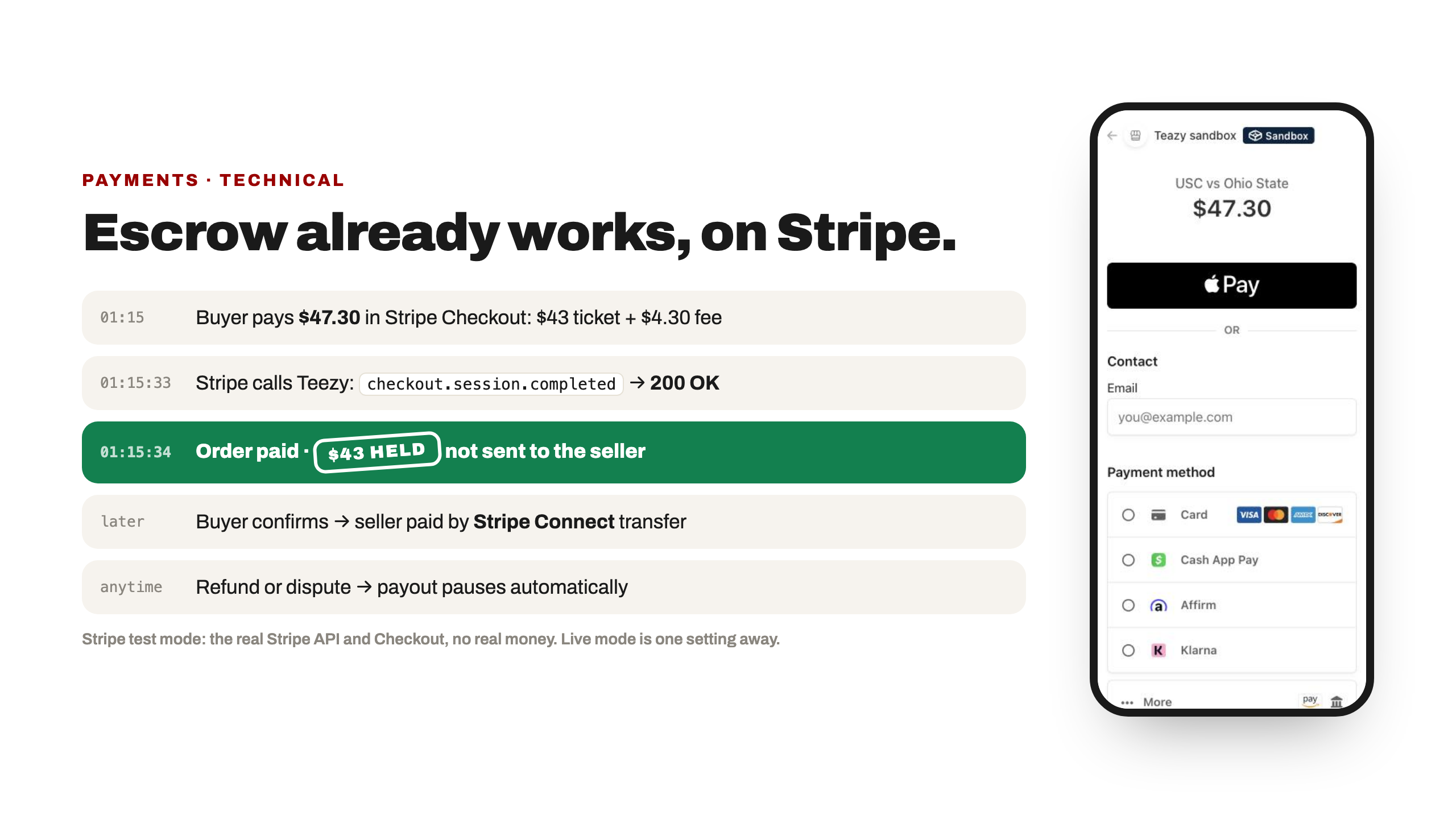
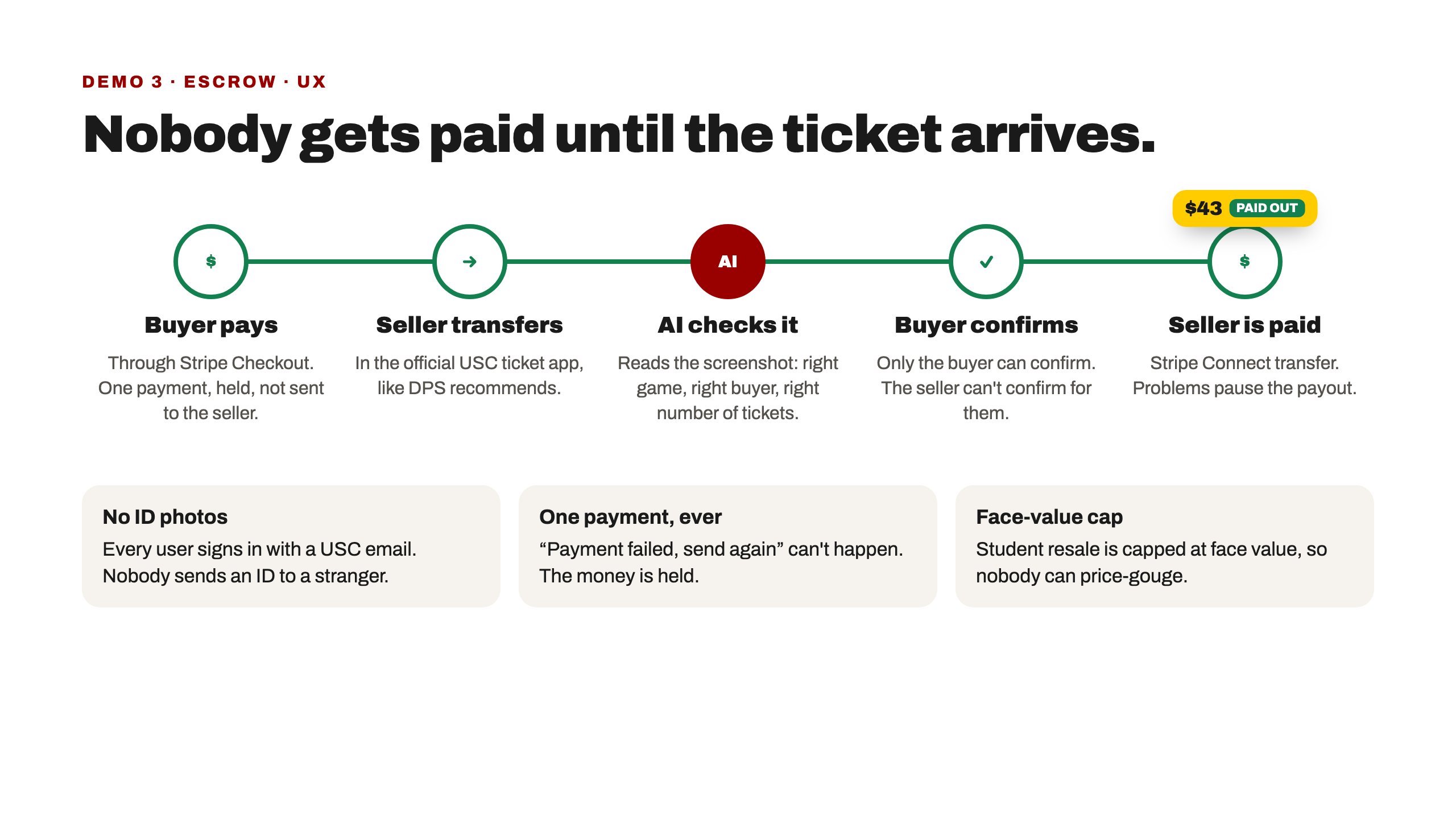
. Escrow-held ticket transfers (scam prevention): the buyer pays once through Stripe Checkout and the money is held, not sent. The seller transfers the ticket in the official USC ticket app. The buyer uploads a screenshot and Claude's vision checks it: right game, right name, right number of tickets, any signs of editing. Only the buyer can confirm. Then the seller is paid through a Stripe Connect transfer. Refunds and disputes pause the payout automatically. There is no "payment failed, send it again," because nobody is ever paid before the ticket arrives.
2. AI recommendation system (matching demand to supply): every listing and every "looking for" request becomes a structured order. Teezy matches each buyer's demand to the supply that actually fits it in the most optimized way possible, and shows each seller the demand their ticket can serve, instead of leaving both sides to scroll a group chat.
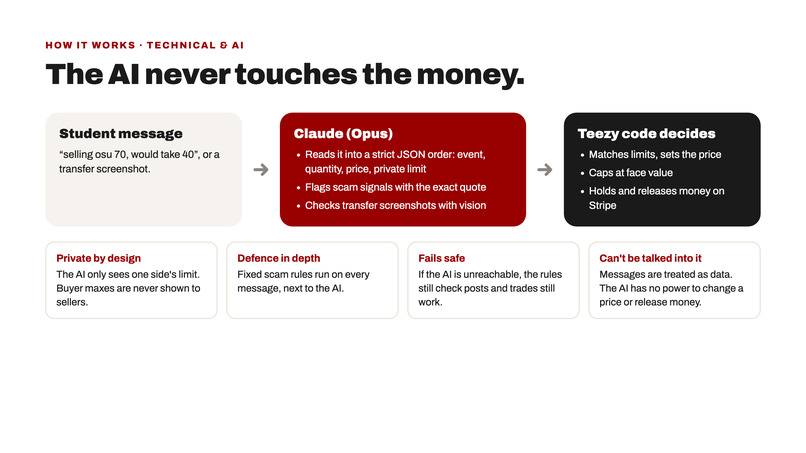
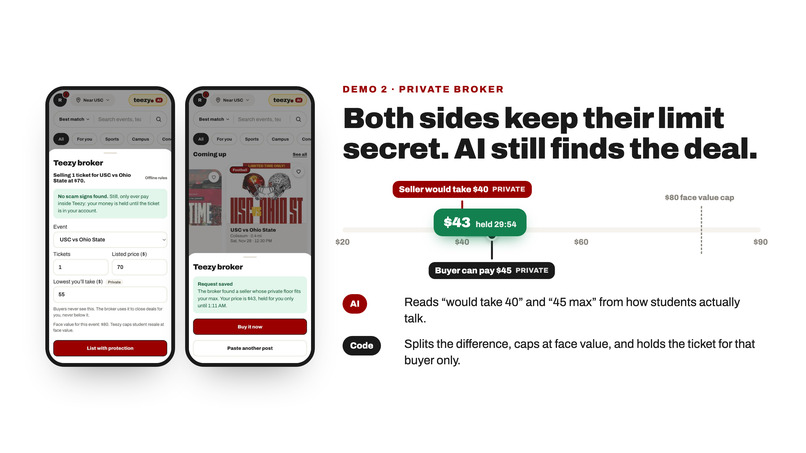
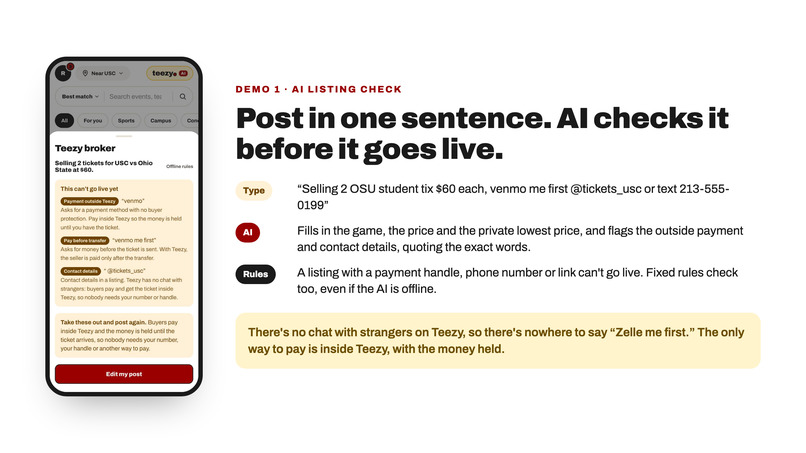
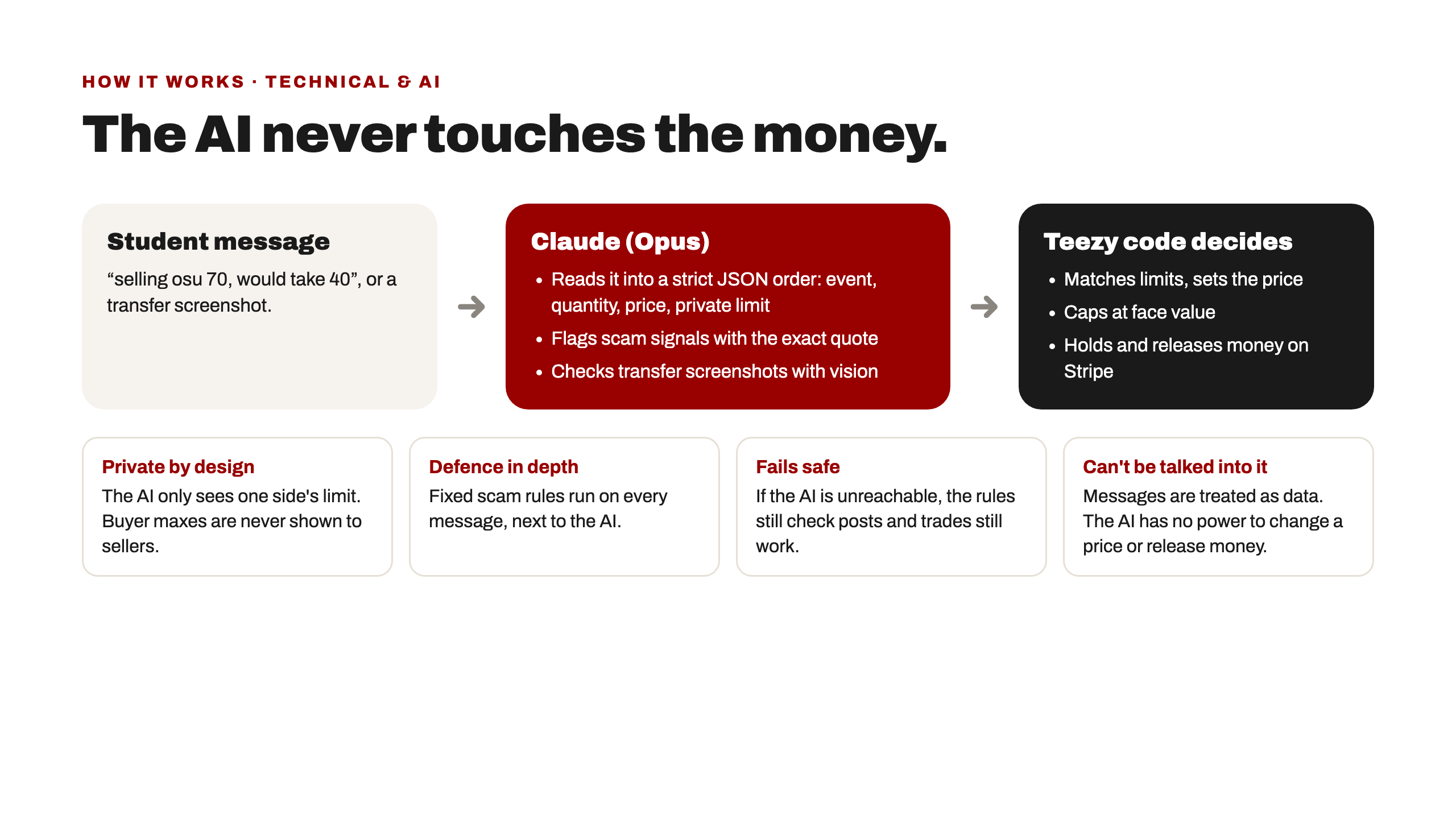
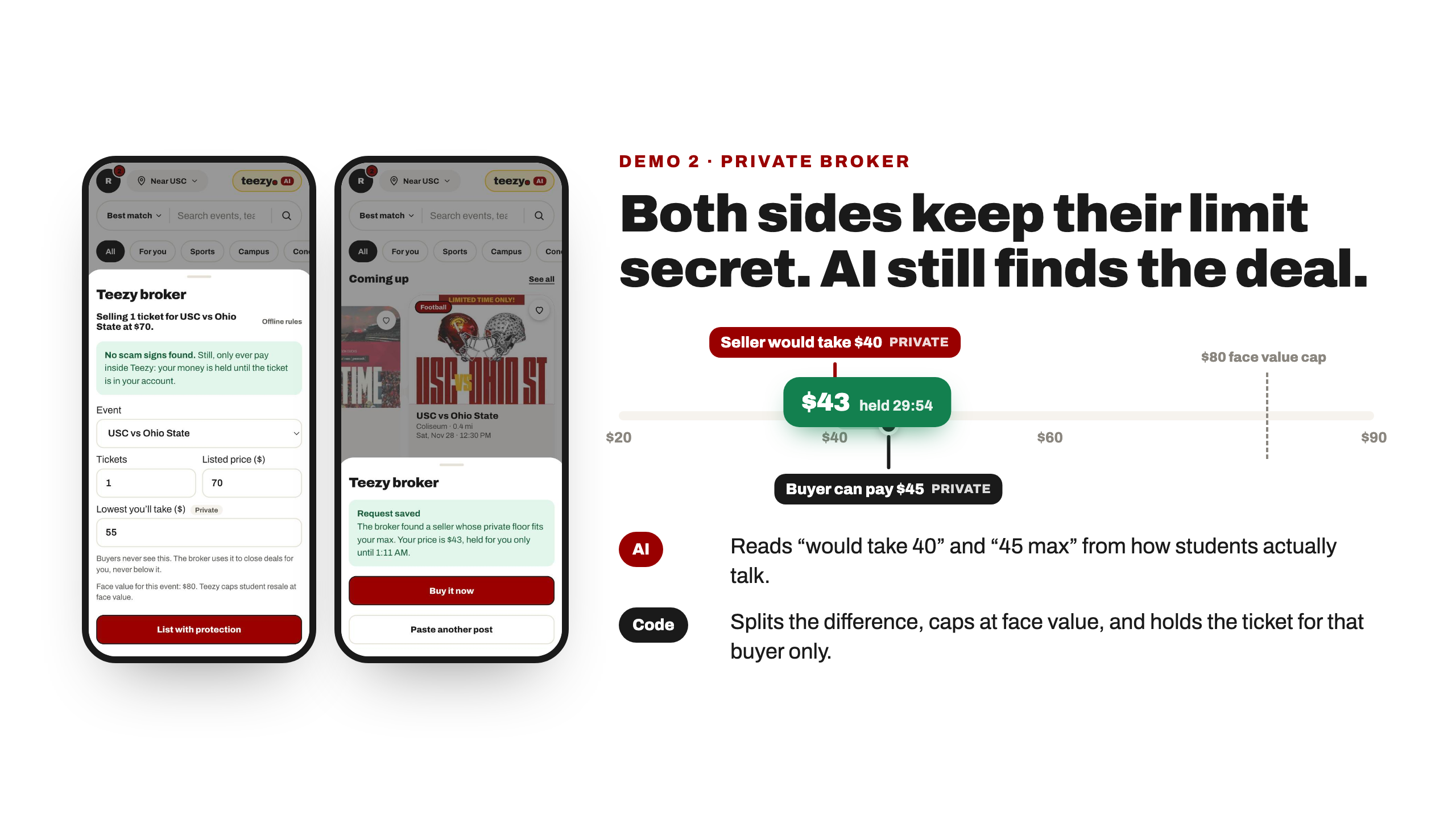
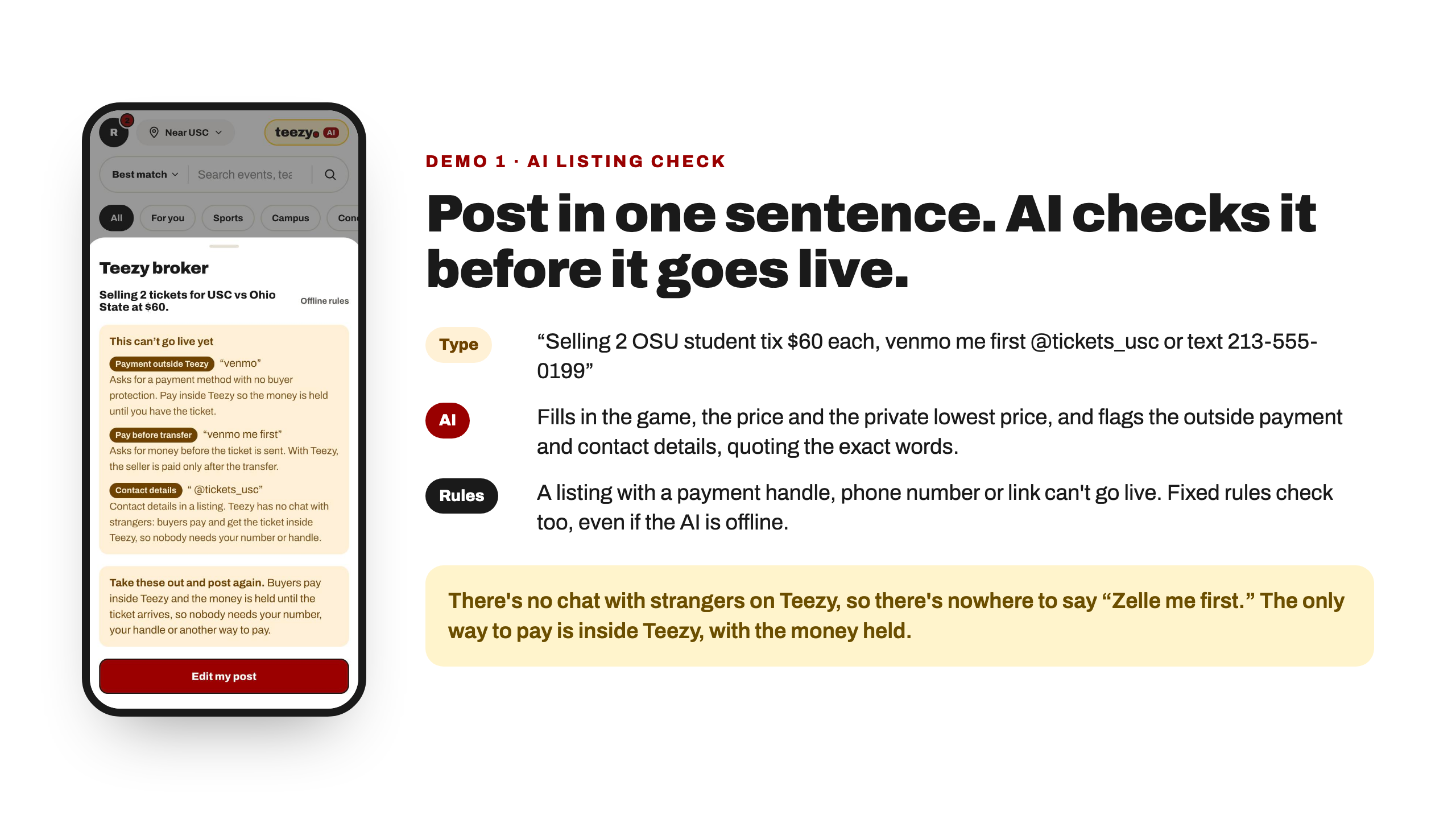
3. Private AI broker: paste "selling my Ohio State ticket, want 70, would take 40" or "ISO Ohio State, 45 max." Claude turns it into an order, including the private limit nobody says out loud in a group chat. When a seller's private floor meets a buyer's private max, Teezy sets a fair price in between, caps it at face value, and holds the ticket for that buyer for 30 minutes. When they're close but don't overlap, both get a private offer. Neither side ever sees the other's number.
How we built it
AI: Claude (claude-opus-5-5) through the Anthropic SDK, with structured JSON outputs for reading posts into orders and vision for checking transfer screenshots. Every AI call checks for refusals and cut-off answers and falls back to fixed rules if the AI fails. Matching and pricing: the recommendation layer pairs demand with supply. Money decisions (price, hold, payout) are made by code, never by the AI. Backend: Node 22, Fastify, PostgreSQL, pg-boss background jobs, and server-sent events for live updates. Payments: Stripe Checkout for buyers, Stripe Connect for seller payouts, webhooks for payment state, delayed transfers, refunds and dispute handling. All in Stripe test mode. Frontend: a mobile-first single-page app in USC cardinal and gold.
Challenges we ran into
The cold start problem. A marketplace is useless with no sellers and no buyers, and a student won't list a ticket on an app nobody has opened. We attacked it from both sides: • Seed from where students already trade. The broker reads a pasted GroupMe post ("selling..." or "ISO...") and turns it into an order, so supply and demand can come from the group chats students already use instead of a blank app. • Make thin markets work. The broker matches on private limits, so a single seller and a single buyer can close a deal, and near-misses get private offers rather than a dead end. Early users get a result without needing a crowd. • Give both sides a reason to show up first. Buyers get escrow in a space where 1 in 8 surveyed had lost money. Sellers get a pool of verified students with live demand, and the 30-minute hold makes a match feel like a real deal, not a notification. 12 of 16 surveyed said they would pay about $5 for exactly this. • Launch narrow. One high-demand event at a time (home football, where the DPS scam wave happened) so supply and demand are concentrated in the same place instead of spread thin across the whole campus. Keeping private limits private. Our first broker message quoted a buyer's private max back to a seller as "the highest offer." We rebuilt the market facts the AI sees so it only gets public numbers. The AI only ever sees one side's limit. Holding a brokered deal. Once the broker lowered a price for one buyer, anyone could have bought it first. We added a 30-minute hold, visible only to the matched buyer, that is released the moment they buy. Verifying a transfer without trusting the seller. The buyer's screenshot is checked by vision for game, name, ticket count and edits, and only the buyer can release the money.
Accomplishments that we're proud of
A real Stripe test-mode purchase works end to end: Checkout, the webhook, the money held, and payout only after the buyer confirms. The broker finds a deal neither side could have found in a group chat, without either side revealing their number. A single pasted group-chat message becomes a matched, protected trade.
What we learned
The AI is most useful where students already are, reading what they actually type, and it should never be the part that moves money. Splitting "AI reads, matches and suggests" from "code decides and pays" made the system both more capable and easier to trust. We also learned that for a marketplace, trust and liquidity have to be built together: escrow gives people a reason to join, and matching gives them a reason to stay.
What's next for Teezy
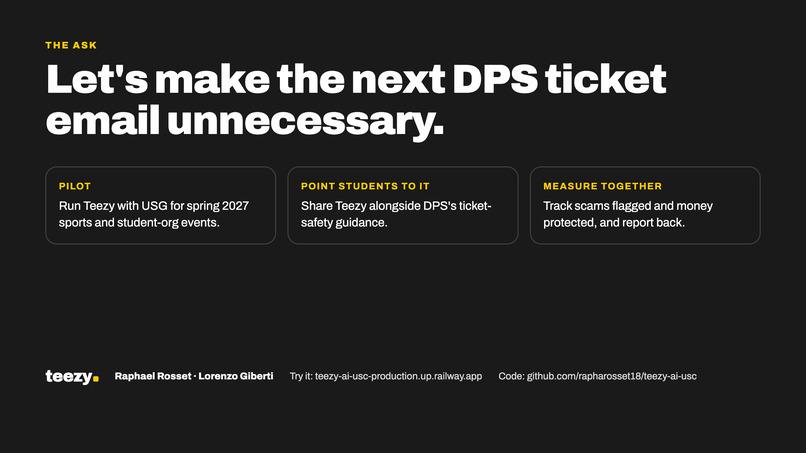
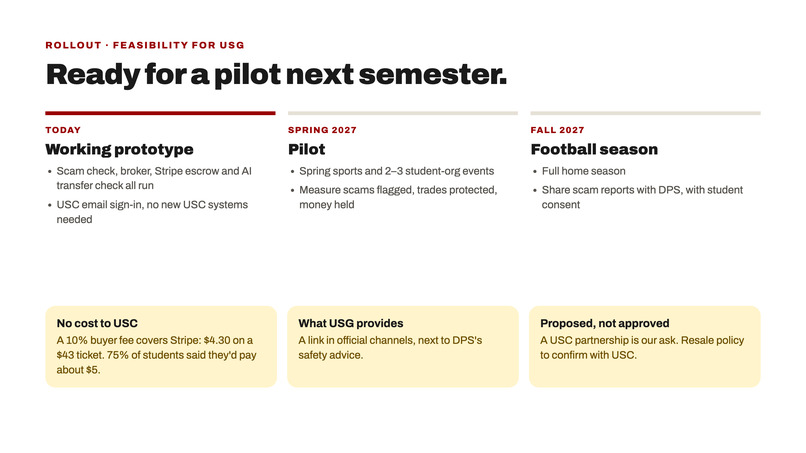
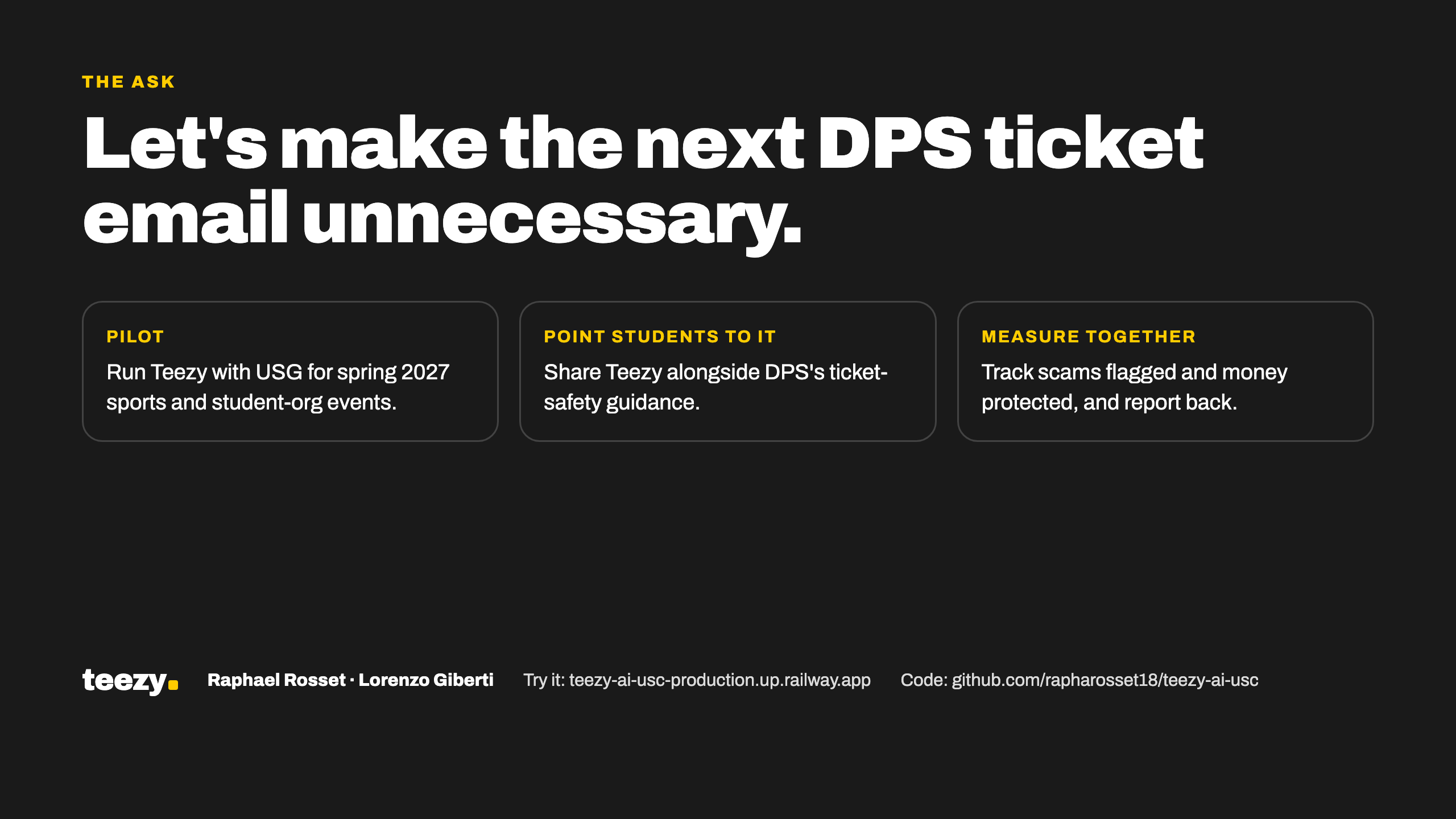
Spring 2027 pilot with USG: spring sports and two or three large student-org events. Success metrics are about cold start: listings and requests per event, match rate, time to first match, and money held and released safely. Fall 2027: the full home football season, sharing scam reports with DPS with student consent. What we need from USG is a link in official channels next to DPS's ticket-safety advice. A USC partnership is our proposal, not something USC has approved, and resale policy needs to be confirmed with USC.
Built With
- claude
- css3
- github
- html5
- javascript
- postgresql
- railway
- resend
- stripe
