Inspiration
Giving a teenager their first digital money is stressful for parents. Hand over a card and you lose control. Keep control and the teen never learns. We wanted a wallet where parents set the rules and teens still make their own choices, and where every rupee spent comes with a small lesson about money.
What it does
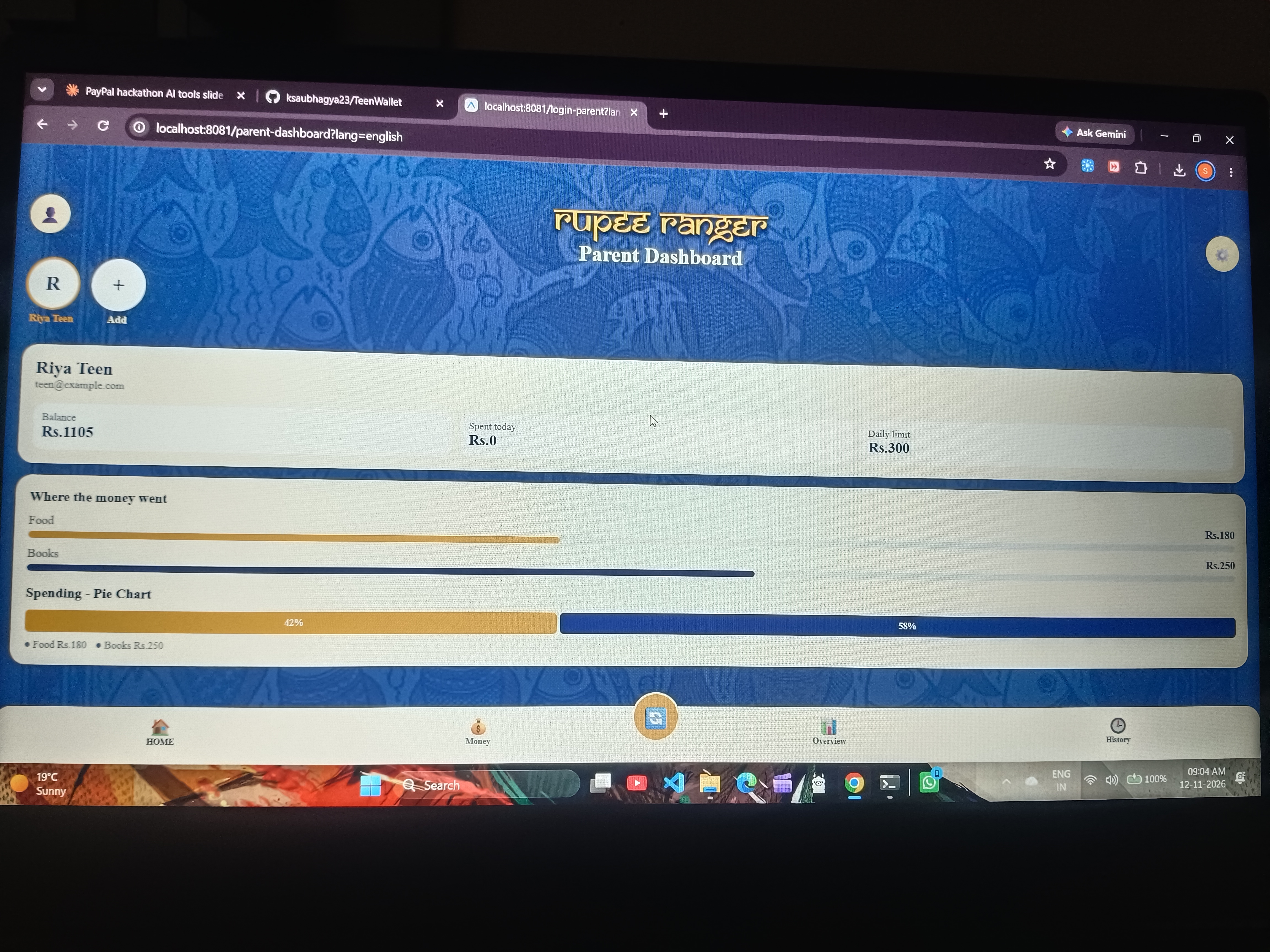
Parent-Controlled Teen Wallet is a mobile app with two roles.
- Parents link their teen's account, add money through PayPal, and set a daily spending limit and blocked categories such as games.
- Teens see their balance, pay merchants, and get an instant yes or no. A payment is declined with a clear reason if the balance is too low, the daily limit is used up, or the category is blocked.
- Teens learn: they create savings goals and move money into them, take short lessons with quizzes, earn badges, and ask a money tutor questions that are answered from the lessons.
How we built it
- Mobile app: React Native (Expo).
- Backend: Node.js and Express, deployed on Render, with PostgreSQL on Neon.
- PayPal: Orders v2 in the sandbox. The backend creates the order, the parent approves it in PayPal, and the backend captures it and credits the wallet.
- Ledger: all money is stored as whole paise in an append-only ledger, and a balance is the sum of its rows, so it can never drift. Payments lock the wallet inside one transaction, so two payments at the same moment cannot both pass the checks.
- Rules engine: checks run in a fixed order: balance, then daily limit, then blocked category.
- Currency: the app shows rupees, while the sandbox charges dollars at a fixed demo rate:
$$\text{USD} = \frac{\text{paise}}{100 \times 85}$$
- Testing: the PayPal flow was first proven in Postman, then built into the backend with automated tests for the rules, the money maths and the PayPal client.
Challenges we ran into
- The PayPal sandbox rejected our first payments ("seller doesn't accept payments in your currency") until we used matching US sandbox accounts.
- The capture call failed with
UNSUPPORTED_MEDIA_TYPEuntil we sent an empty JSON body with the right content type. - A top-up must never be credited twice, so each PayPal order id is stored once and the credit is idempotent.
- A deleted file crashed our first deploy on Render, which taught us to check what the server loads before every push.
What we learned
Money software is mostly about being strict: integer amounts, one source of truth, and clear reasons for every refusal. We also learned how much faster a team moves when the API is documented early.
What's next
Live product prices for savings goals, parent alerts when a payment is declined, and a smarter tutor.
Try it:https://expo.dev/accounts/saubhagya23/projects/RupeeRanger/builds/86343870-0eba-4fb4-b0d9-003a43ceb7e0 · Code: https://github.com/ksaubhagya23/TeenWallet
Built With
- bcryptjs
- expo.io
- express.js
- github
- javascript
- jwt
- neon
- node.js
- paypal
- pg
- postgresql
- postman
- react-native
- render
- rest-api
- vs-code
- zod
