-
optichar_app_demo
Inspiration
Our inspiration came from real-world frustrations experienced by EV drivers: long waiting times at charging stations, uncertainty about charger availability, lack of integration between route planning and charging, and inefficient charging habits that negatively impact battery health. We noticed that while many apps focus on locating chargers, very few address the queue problem. EVs don’t refuel instantly — they charge over time. This insight led us to focus on waiting times as a key variable in trip optimization. From there, the idea of a digital queue (ticketing) system was born.
What it does
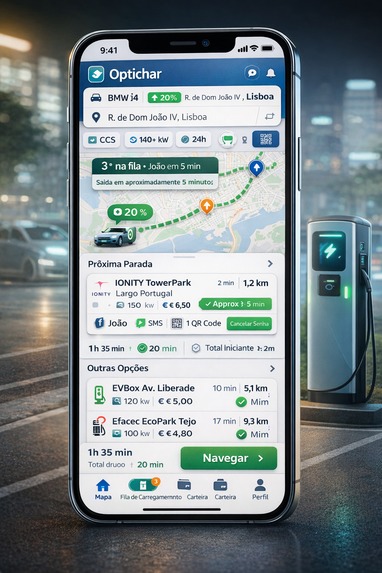
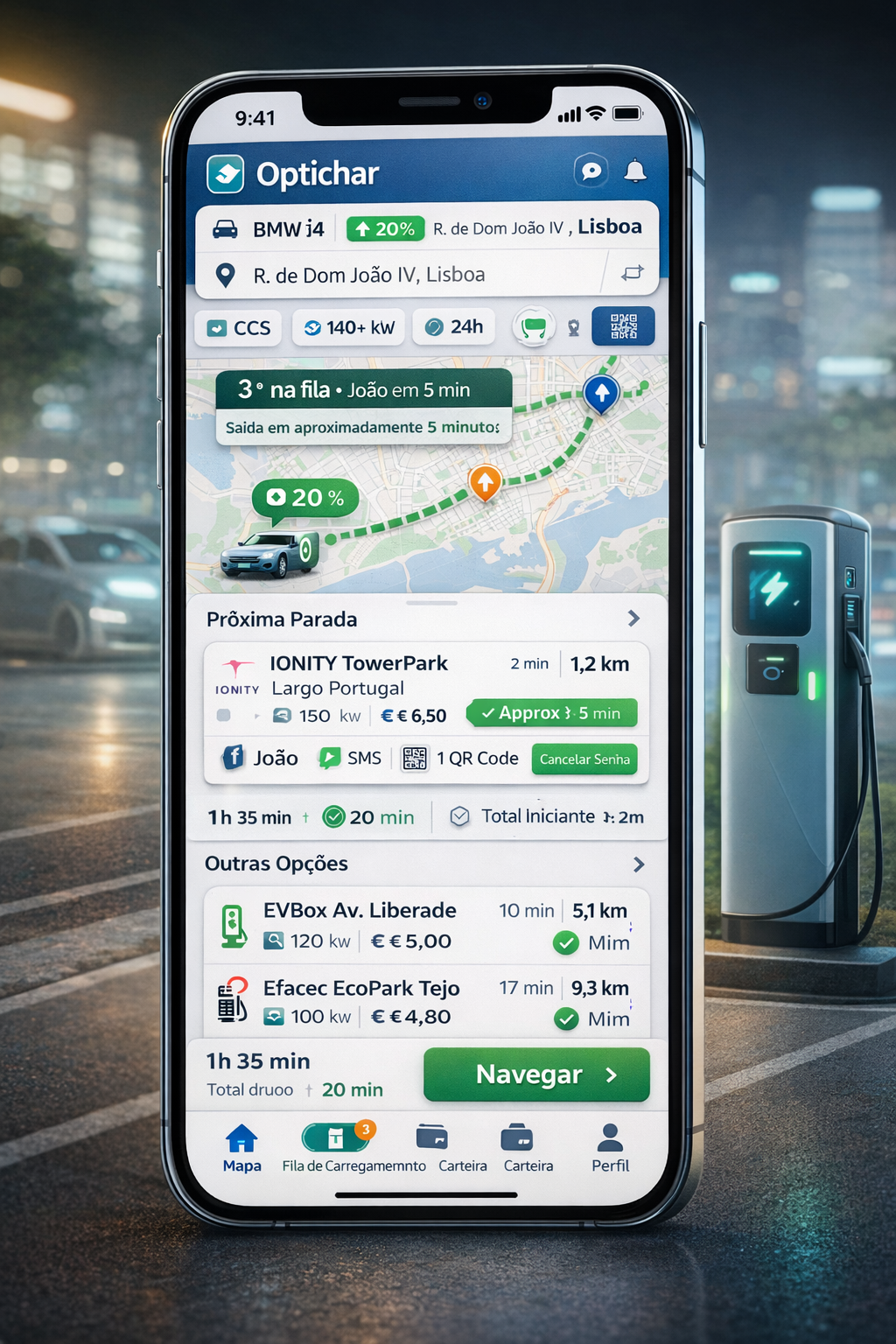
Optichar is an intelligent mobile application that optimizes routes for electric vehicles by integrating strategic charging stops tailored to the user’s vehicle, battery level, connector type, charging speed, operator, and accessibility needs. Key features include: Route planning with optimized charging points (battery range 20%–80%) Cost estimation for charging sessions needed to continue the trip A digital queue system (“senhas”) that estimates waiting times at chargers Charger filtering by distance, price, operator, connector type, and accessibility Support for both long trips and immediate, nearby charging needs Connection to all verified public charging stations, enabling future data collection and infrastructure optimization Digital wallet for secure charger authentication Notifications with real-time updates on queues and charger status
How we built it
The project was conceptually designed using principles from industrial engineering, operations research, and systems optimization. We modeled total travel time as the sum of four components: T_total = T_drive + T_detour + T_wait + T_charge This formulation allowed us to clearly justify the importance of queue estimation in route optimization, showing that waiting time at charging stations can be as critical as driving or charging time itself. The system architecture was designed to be scalable, enabling future integration with vehicle systems and charging infrastructure APIs. User experience and accessibility were central to our design decisions. To ensure inclusivity, we included features such as QR code and SMS-based queue registration, allowing users without the mobile app to interact with the system.
Challenges we ran into
One of the main challenges was finding a way to differentiate our solution from existing EV charging apps. Most platforms focus on charger location and availability but ignore waiting times entirely. Designing a realistic and fair digital queue system that could work both online and on-site required careful thought, especially regarding inclusivity, data reliability, and user adoption. Another challenge was balancing technical ambition with feasibility, ensuring that our solution remained realistic while still being innovative.
Accomplishments that we're proud of
Designing a novel digital queue system applied to EV charging Integrating sustainability, efficiency, and battery health into route optimization Creating an inclusive system usable by both app users and non-users Developing a solution with strong potential for scalability and real-world impact Applying engineering and management concepts to a real societal problem
What we learned
This project reinforced the importance of: User-centered design in engineering solutions Data-driven decision-making for mobility optimization Considering time, cost, and sustainability simultaneously Team collaboration under time and scope constraints We also gained a deeper understanding of electric mobility ecosystems and the complexity behind EV infrastructure management.
What's next for Optichar
In the future, we aim to: Integrate real-time data from charging networks Improve queue prediction accuracy using historical data Align the platform with Smart Cities and energy grid systems Enable direct integration with vehicles to pre-condition batteries before charging Use anonymized data to support technological evolution and infrastructure planning Optichar has the potential to become not just a charging app, but a decision-support platform for sustainable electric mobility.

Log in or sign up for Devpost to join the conversation.