-
-
Site
-
-
-
PatronuX TaskFlow
Tagline: Just tell it. PatronuX handles the rest.
Primary Track: Alexa+ Mini Challenge: AWS Builder
Inspiration
Managing tasks and reminders usually requires users to manually enter a task, select a date, choose a time, and configure a reminder.
We wanted to make this interaction more natural.
Instead of opening a traditional To-Do application and filling multiple fields, users should simply be able to say what they need.
For example:
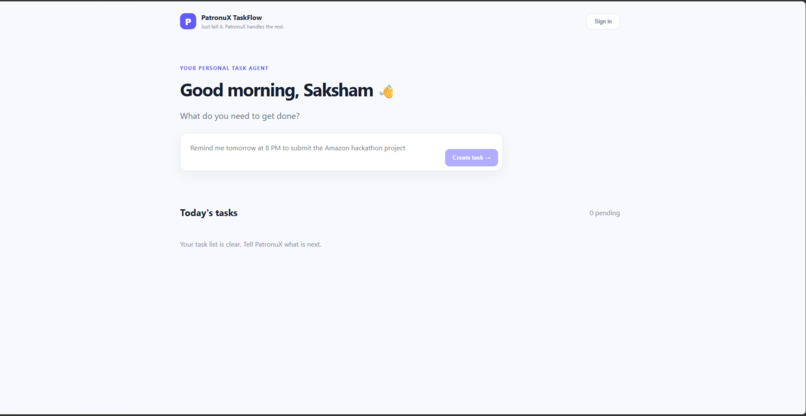
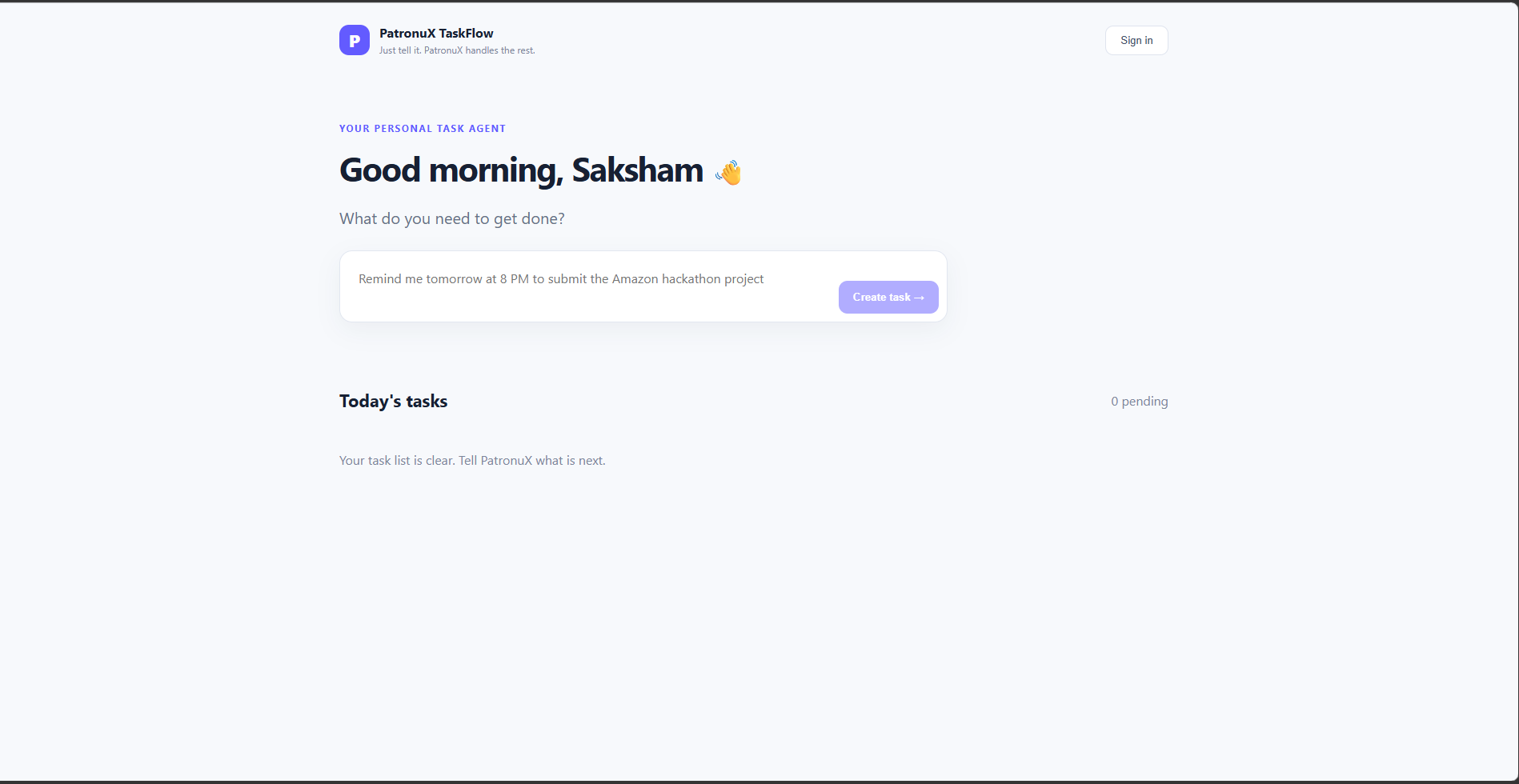
"Remind me tomorrow at 8 PM to submit the Amazon hackathon project."
PatronuX TaskFlow is inspired by the idea that task management should be conversational and action-oriented.
The goal is not just to understand what the user says, but to actually take action on it.
What it does
PatronuX TaskFlow is an AI-powered task and reminder agent that allows users to create and manage tasks using natural language.
A user can type or speak a request such as:
"Call Ayush Friday at 6 PM."
The system understands the request and extracts:
- Task: Call Ayush
- Date: Friday
- Time: 6:00 PM
- Reminder: Enabled
It then automatically:
- Creates the task.
- Stores it in the database.
- Schedules the reminder.
- Triggers the reminder at the correct time.
- Sends an email notification.
Users can also ask:
- "What tasks do I have today?"
- "What do I have tomorrow?"
- "Mark my CN assignment as complete."
- "Delete my project reminder."
The project uses Alexa+ through a self-hosted MCP server, allowing Alexa+ to interact with real PatronuX task-management tools.
Main MCP Tools
create_task
list_tasks
get_task
complete_task
delete_task
schedule_reminder
How we built it
We built PatronuX TaskFlow as a full-stack AI agent using Angular, NestJS, TypeScript, MCP, and AWS services.
Technology Stack
Frontend
- Angular
- TypeScript
- HTML/CSS
Backend
- NestJS
- TypeScript
- REST APIs
- JWT Authentication
AI
- Amazon Bedrock
Amazon / AWS
- Alexa+
- MCP with Streamable HTTP
- Amazon Bedrock
- Amazon DynamoDB
- Amazon EventBridge Scheduler
- AWS Lambda
- Amazon SES
- Amazon Transcribe (optional voice input)
Architecture
                    USER
                      │
             Voice / Natural Language
                      │
              ┌───────┴────────┐
              │                │
           Alexa+          Angular Web
              │                │
              └───────┬────────┘
                      │
                      ▼
             PatronuX MCP Server
                      │
                      ▼
               Amazon Bedrock
                      │
               Intent Extraction
                      │
                      ▼
                 Task Service
                  /        \
                 ▼          ▼
            DynamoDB    EventBridge
                           Scheduler
                              │
                         Reminder Time
                              ▼
                           Lambda
                              │
                              ▼
                            SES
                              │
                              ▼
                       Email Reminder
Amazon Bedrock handles natural-language understanding and converts user requests into structured task information.
DynamoDB stores tasks and reminder information.
EventBridge Scheduler handles scheduled reminders.
Lambda executes the reminder action, while Amazon SES sends the notification email.
The Alexa+ integration is implemented through a self-hosted MCP server using Streamable HTTP, allowing the conversational interface to call real PatronuX tools.
Challenges we ran into
One of the biggest challenges was converting natural-language requests into reliable structured actions.
A sentence such as:
"Remind me sometime tomorrow to finish the report."
does not contain an exact time, so the agent should not simply guess.
We designed the system to recognize missing or ambiguous information and ask the user for clarification when required.
Another challenge was connecting the AI layer with actual actions. We wanted the system to do more than generate a conversational response. The AI needs to interact with the task database and scheduling system safely.
Integrating the MCP server with the task-management backend also required careful tool design, validation, authentication, and error handling.
Finally, scheduling real reminders required coordinating DynamoDB, EventBridge Scheduler, Lambda, and SES into one reliable workflow.
Accomplishments that we're proud of
We are proud of turning a simple task-management concept into an action-oriented AI agent.
Instead of:
User → Form → Task
PatronuX enables:
User → Natural Language → AI → Action → Scheduled Reminder → Notification
We are particularly proud of:
- Building a real MCP-based Alexa+ integration.
- Creating task-management tools that can be called by the agent.
- Using Amazon Bedrock for natural-language understanding.
- Automatically scheduling reminders using AWS.
- Connecting EventBridge Scheduler, Lambda, and SES for real notifications.
- Designing the system with a modular NestJS backend.
- Creating a web dashboard for task management.
- Keeping the architecture extensible for future agent capabilities.
Most importantly, the project demonstrates that PatronuX can understand what a user wants and actually do something about it.
What we learned
Through this project, we learned that building an AI agent is different from building a normal chatbot.
A useful agent needs to:
- Understand user intent.
- Convert natural language into structured data.
- Validate AI-generated information.
- Decide when clarification is required.
- Call tools safely.
- Interact with external services.
- Maintain state.
- Perform real-world actions.
We also gained practical experience with:
- Amazon Bedrock
- Alexa+
- MCP and Streamable HTTP
- DynamoDB
- EventBridge Scheduler
- AWS Lambda
- Amazon SES
- Agent-oriented backend architecture
The project helped us understand how AI can be connected to real software systems instead of being limited to generating text.
What's next for TechX
For the next stage, we want to expand PatronuX beyond basic task and reminder management.
Future versions could include:
- Recurring tasks
- Smart priority detection
- Calendar integration
- WhatsApp notifications
- Push notifications
- Voice-first task management
- Intelligent task rescheduling
- Context-aware reminders
- Location-based reminders
- Multiple notification channels
- Team and shared task management
- AI-generated daily schedules
We also want PatronuX to evolve from a task-reminder agent into a broader personal productivity agent capable of understanding a user's goals and helping them complete tasks across different services.
Our long-term vision is simple:
Don't just remind people what they need to do. Help them get it done.
Built With
- angular.js
- nestjs

Log in or sign up for Devpost to join the conversation.