-
-
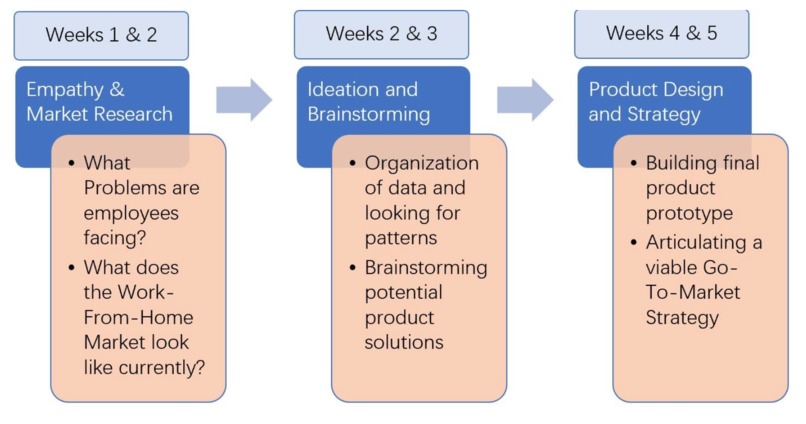
Iteration Steps
-
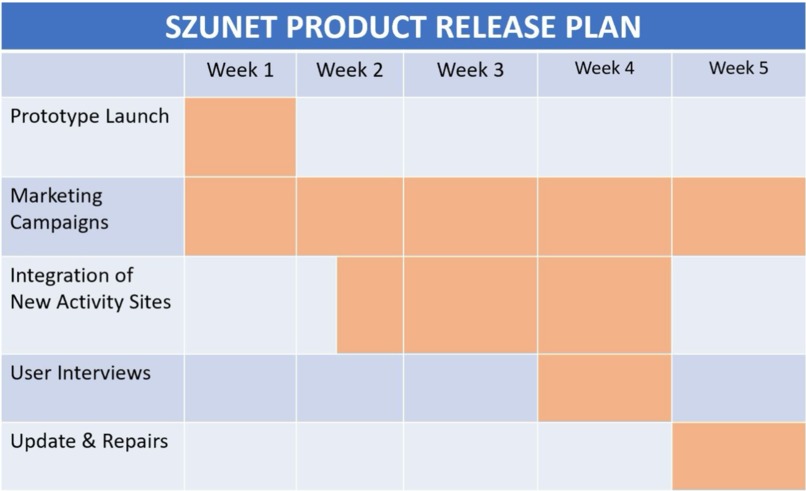
Product Release Plan
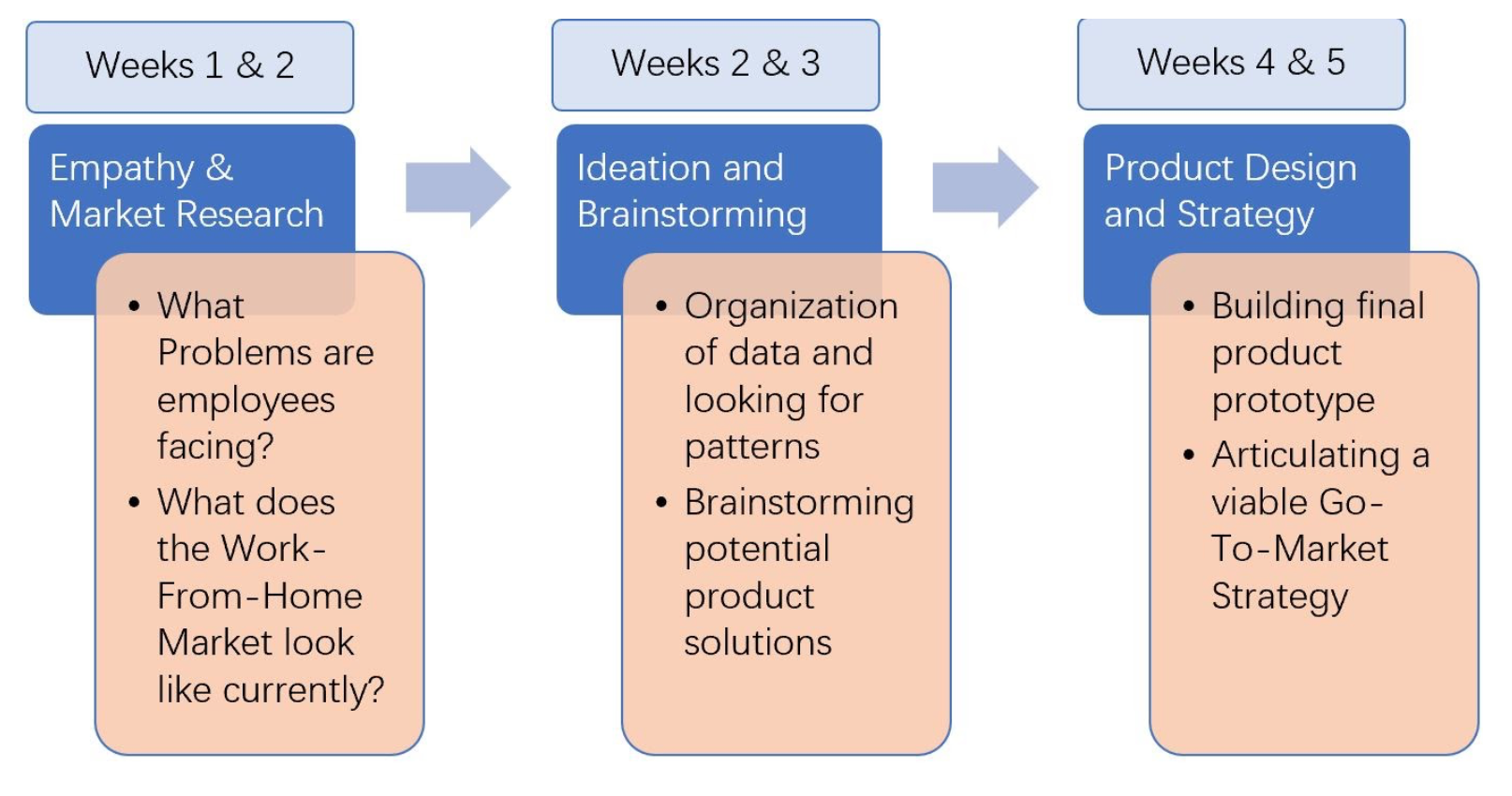
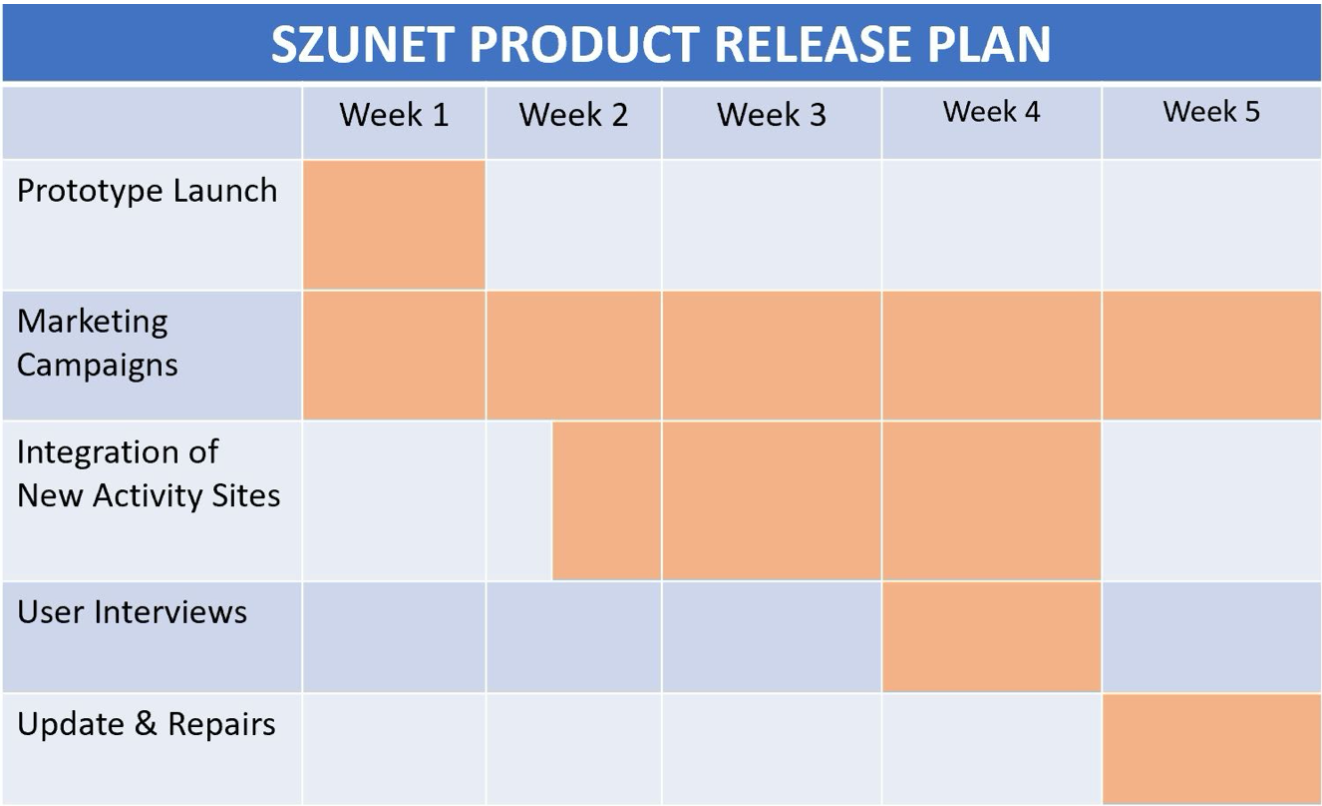
Overview
“Frankly, my day-to-day interaction with clients hasn’t changed much. However, I miss the simple and casual interactions between my team and other office workers I don’t see anymore. It’s hard to replicate those online, and most attempts are just awkward.” - Steve, Chicago based Consultant.
With the mass migration to Work From Home that ensued following the global pandemic of Covid-19, the work environment changed permanently for worse and for better. Current technology infrastructure allowed for a manageable transition to remote work in many industries. However, some aspects of the office were not as easy to replicate. Many professionals working from home struggled to communicate casually in what was previously considered “water-cooler-talk.”
It was in combating the issue of a lack of casual and friendly interactions that our team, Creative Mode, developed Szunet, in an effort to connect employees in a casual setting multiple times throughout the day. The goal of Szunet is to allow for short and meaningful team breaks that are non-disruptive to employees' workdays and actually boost productivity. The main value proposition behind Szunet is the ability for co-workers to connect casually, seamlessly throughout their work-day. In these short 5 weeks, we developed a working prototype and formulated a Go-to-Market strategy with awesome growth potential.
Team Members
Alexander Habjan will be a senior at Valparaiso University pursuing a BS in Computer Science and Spanish. As a member of the Pro Team, Alex helped with prototyping, designing, and deploying the slack app, and developed the logistics and interface for the web application.
Benjamin Smith will be a senior at the Rose-Hulman Institute of Technology studying Computer Science. As a member of the Pro Team, Benjamin helped with prototyping, designing and developing features, and making sure features were feasible to make within the deadline.
Emma Croxford will be a Junior at the University of Indianapolis, studying Mathematics, Data Science, History, and Spanish. As a member of the Go Team, Emma contributed to Environmental and User persona research and helped formulate the Go-To-Market Strategy.
Erik Sullivan will be a junior at Indiana University in the Fall, studying Business Economics and Public Policy Analysis. As a member of the Go Team, Erik contributed to empathy research and helped formulate the Business Model Canvas and Go-To-Market strategy
Si Hyun Kim is a second-year Emerging Media Design and Development grad student at Ball State University. He helped delegate responsibilities and monitor weekly milestones as the team’s project manager. He also designed prototypes and performed user testing as the team’s UX Designer.
How did you decide on this customer segment, problem, and solution?
In deciding on a customer segment, problem, and solution, we began with the challenge Techpoint provided us, to “determine what positive or negative impact working from home is having on productivity or employee sustainability.” Through empathy research, we discovered many positives of working from home such as increased family time and lack of time wasted in commuting. However, solutions spur from problems, so we instead focused on the negatives of working from home on productivity and employee sustainability.
In communicating with family members, our coaches, and other working professionals, the theme of “breaks” was reoccurring. Many employees realized they were taking no breaks throughout their workday, and when they did they missed their casual interactions with co-workers that were commonplace in the office. Many sources, including a recent MIT study titled “Productivity through Coffee Breaks,” reveal that a lack of healthy breaks is highly detrimental to employees productivity and their mental health.
The problem Creative Mode decided to approach is the inability for co-workers to connect casually throughout the day while working from home. While there are some applications that connect co-workers, and video chats like Zoom allow for group meetings with “face-to-face” interaction, these alternatives are often awkward and integrated poorly into employees day-to-day.
It was through ideation-sessions, visualized later in the abstract, that Creative Mode formulated the concept of Szunet. Szunet provides productive breaks, boosting co-worker interaction and employee mental health. As a Slack Channel with a friendly bot, Szunet can be utilized in connecting co-workers through online activities. Although just a prototype, Szunet is already functional in connecting users through the online game code-names. Work-From-Home presents many new challenges, and it took innovation, creativity, and a positive attitude from Creative Mode to develop a solution to combat a lack of co-worker interaction.
As for our Customer Segment, Creative Mode decided upon tech professionals in the Indy area as our starting target demographic. Firstly, with ties to Techpoint and the Indy community, the selection of our home region was logical. Next, we decided upon the tech industry as we feel professionals are highly innovative and likely to adopt new products. Additionally, a high percentage of the tech community uses Slack.
Szunet is an innovative, already functional product tackling a tangible and real problem in today’s Work-From-Home lifestyle. It has awesome growth potential and a viable go-to-market strategy.
How did your team build and iterate on the solution?
As a team, we first organized our empathy research data into categories. Subsequently, we developed how-might-we questions from the categories and began proposing potential solutions during our ideation session. After deciding on a couple of solutions, we developed low-fidelity prototypes, which we then tested and received feedback from potential users. Based on our user testing, we further decided on our idea of Szunet and moved on to building our mid-fidelity prototype. View the Iteration Steps Graphic Provided
Key Metrics
We conducted 8 qualitative empathy research interviews, in addition to a quantitative google form survey. We found our qualitative research interviews were much more beneficial, as they quickly became conversations wherein our interviewees could articulate their pains of working from home, and give us real-time feedback on developing solutions.
An important metric to record following the launch of Szunet will be its Net Promoter Score. In order to record this, 2 weeks into having Szunet installed into users' slack, they will be messaged by the bot prompting them to complete a one-question survey of “How likely are you to share Szunet with a friend?” The percentage of users that answer 9 or 10 on a 1-10 scale will be recorded as our NPS. An achievable goal for Szunet’s NPS within its first year of release is 20%, as that will enhance a rapid growth in users.
Another key metric for Creative Mode to monitor will be Szunet’s daily active users. With a direct correlation between a growth in users and revenue growth, it will be important to take note of how quickly Szunet is growing, as too rapid of expansion could result in growth pains or an inability for the technological infrastructure to support so many users.
While Szunet is currently a prototype, no active contracts with activity sites have been established. However, if we had a contract signed, one key metric within it is the revenue per click that Creative Mode will receive upon a user clicking into an activity site. Our research suggests that 1 cent per click is industry standard, thus we will implement that into our first contracts.
A combination of daily active users, daily clicks, and revenue per click leads to perhaps the most important metric, revenue. Szunet is currently operating at zero cost, so all revenue becomes profit. However, when more programmers are hired and marketing campaigns are implemented, Creative Mode must diligently monitor cash flows and ensure that Szunet remains profitable. With the high growth potential of Szunet and its minimal expenditures at an early stage, Creative Mode is confident Szunet will be highly lucrative and be profitable within its first year of release.
Technical Architecture
Szunet required three parts to fulfill the application. First was a bot application, which would receive relevant information from Slack and return a useful response. The bot consists of a few Javascript files that handle requests and create events. Second was the Slack servers, which housed our bot and provided a reference to our web application and sent information to our bot. And third was the web application, which contains our primary workflow. The web application would have video and other chat functionality, as well as temporary users, and an external reference to activities that would provide meaningful breaks for employees.
Key Tools, Libraries, and Frameworks
Trello: We chose Trello to organize our workflow because it provided everyone with a visual on the progress of the Pro and Go squad. Additionally, it helped prioritize what our next steps were and always remind us of our overarching goals.
Google Drive: Used to share documents for planning and external resources. We chose this library because all of us have familiarity with it, primarily through school.
Slack: Slack was the main tool of communication for our team. We also based the application off Slack API and integrated a bot into a separate Slack workspace to test functions.
AWS: We chose AWS for web hosting because it has a free tier and we were familiar with it. We wanted to implement the app through AWS but ended up switching to Glitch due to communication difficulties, so we are using AWS for specifically web processes.
Glitch: We didn’t expect to use Glitch for our code, but it provided a free host for our bot application and was very easy to integrate.
GitHub: Easy to use toolchain, used for sharing code. Kept the Pro squad together in iterations and workflow.
Javascript libraries: Several libraries were required from Javascript to complete the communication between the Slack servers and our bot application, including Axiom, querystring, express, crypto, and debug for console logging.
Adobe XD: Used for prototyping the Slack and web applications. Adobe XD was very useful for keeping all members on the same page with how the prototype will look and what features will need to be included.
If you had another 5 weeks to work on this, what would you do next?
The first and most obvious next step for Creative Mode following the launch of the Szunet prototype is to integrate new activity websites within the current framework. While the prototype only connects users to the online game code-names, the integration of new activity sites such as Kahoot, Skribbl.io, Cards Against Humanity, Chess, Trivia, etc will allow Szunet to reach a broader spectrum of users and generate more revenue with more clicks.
The Szunet web application would also need to undergo regular maintenance with the addition of temporary users, video and text chat, and preferences and support ticket functionalities.
Marketing Campaigns will begin immediately following the prototype launch. The two main forms of marketing will be through direct contact of communications teams at Indy Tech companies and through the Techpoint Newsletter. Ultimately, Szunet will have the most success spreading through grassroots marketing. In sticking to that strategy, Creative Mode will target some of TechPoints’ closest and largest tech partners and allow the network of indy tech professionals to spread Szunet organically.
The following Product Release Plan details the next steps for Creative Mode following the Szunet Prototype release on August 1st. It sees Szunet being further developed, marketed, and updated. This will allow for an official Szunet product release at the start of September in 2020. View the Product Release Plan graphic provided


Log in or sign up for Devpost to join the conversation.