-
-
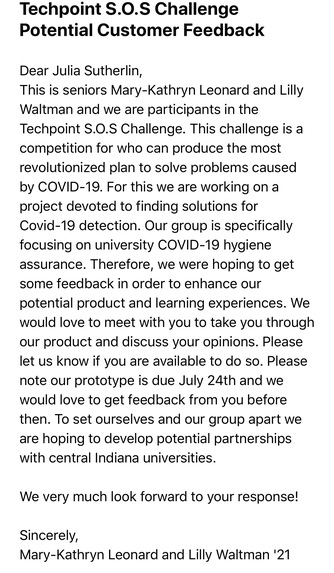
Communicate with Risk Management at DePauw University
-
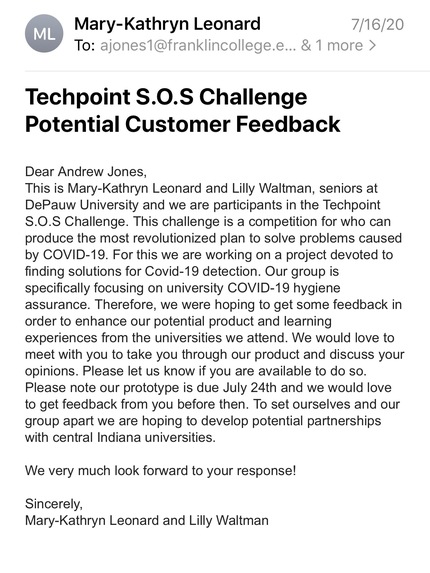
Communication with at Vice President of Student Development at Franklin College
-
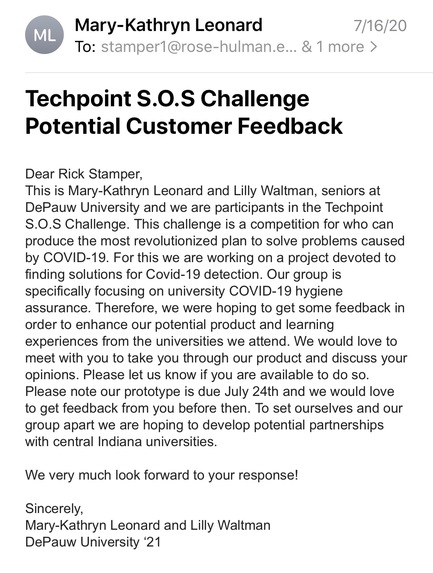
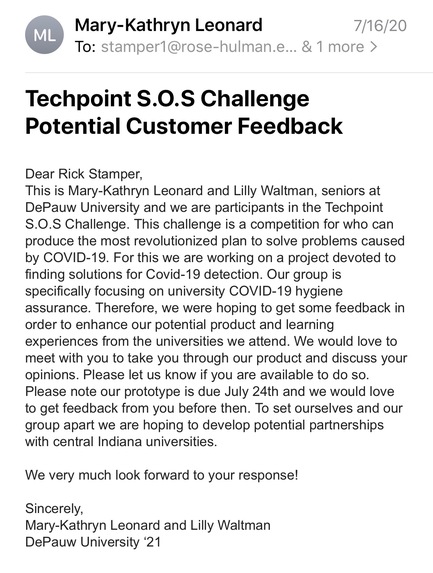
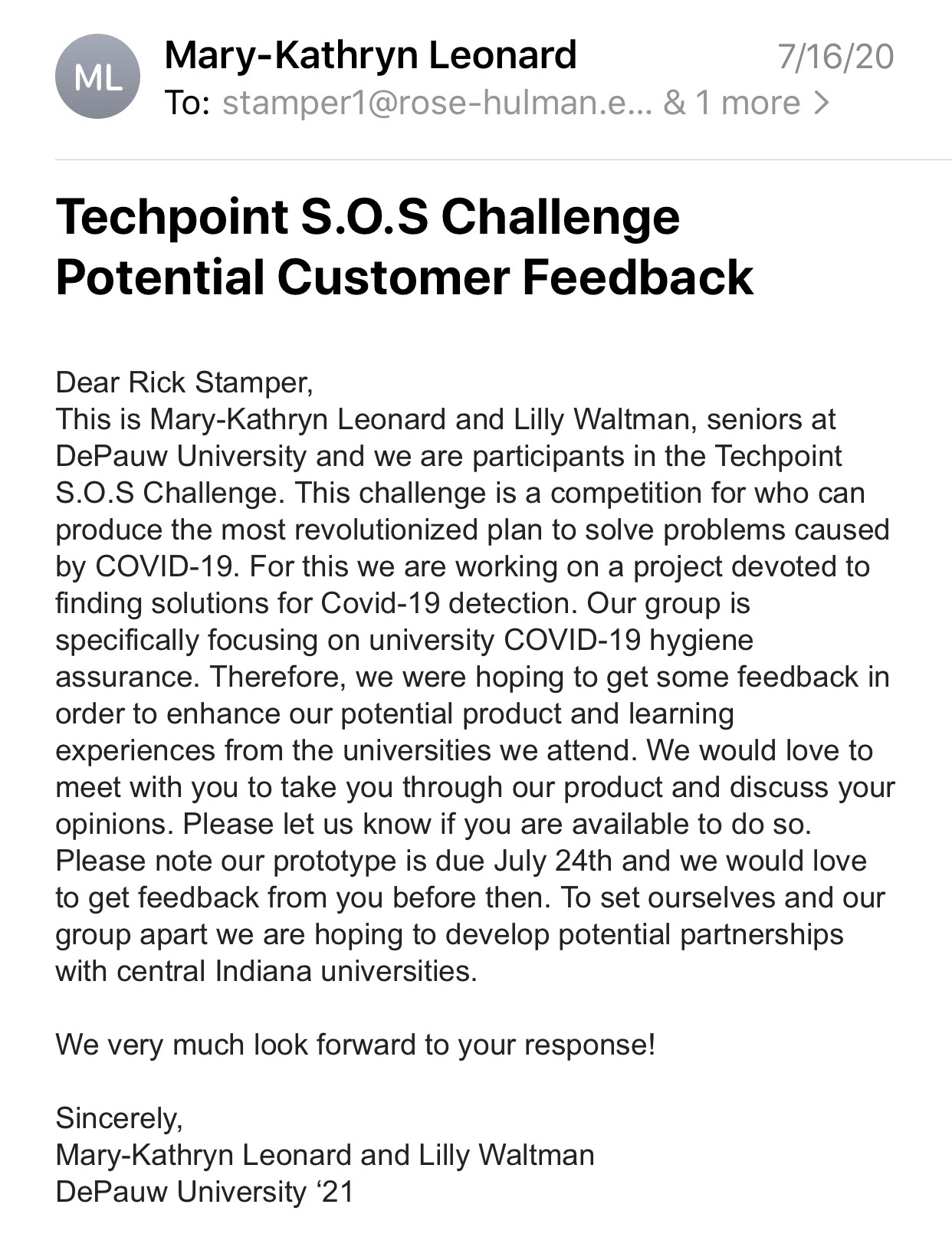
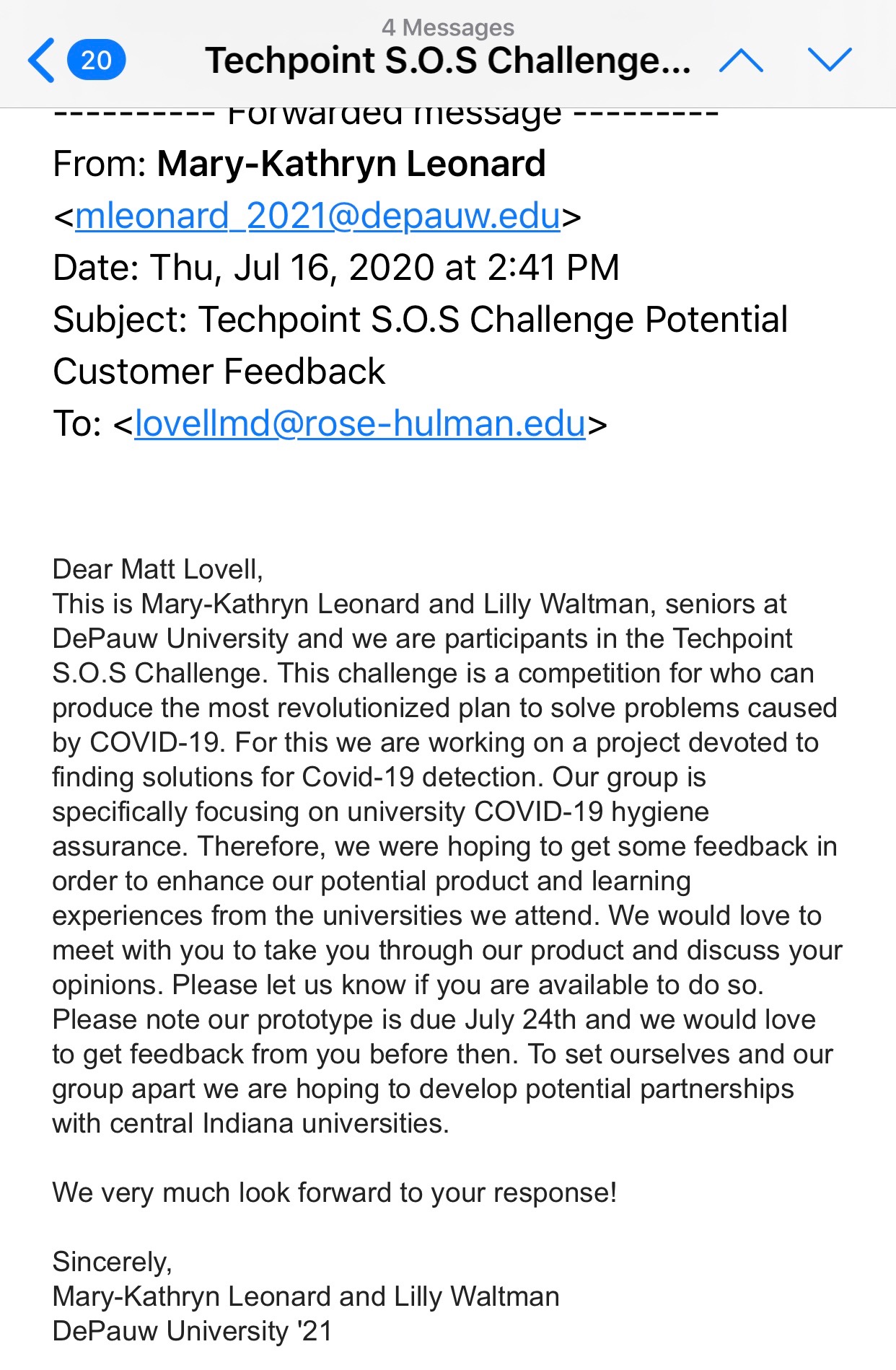
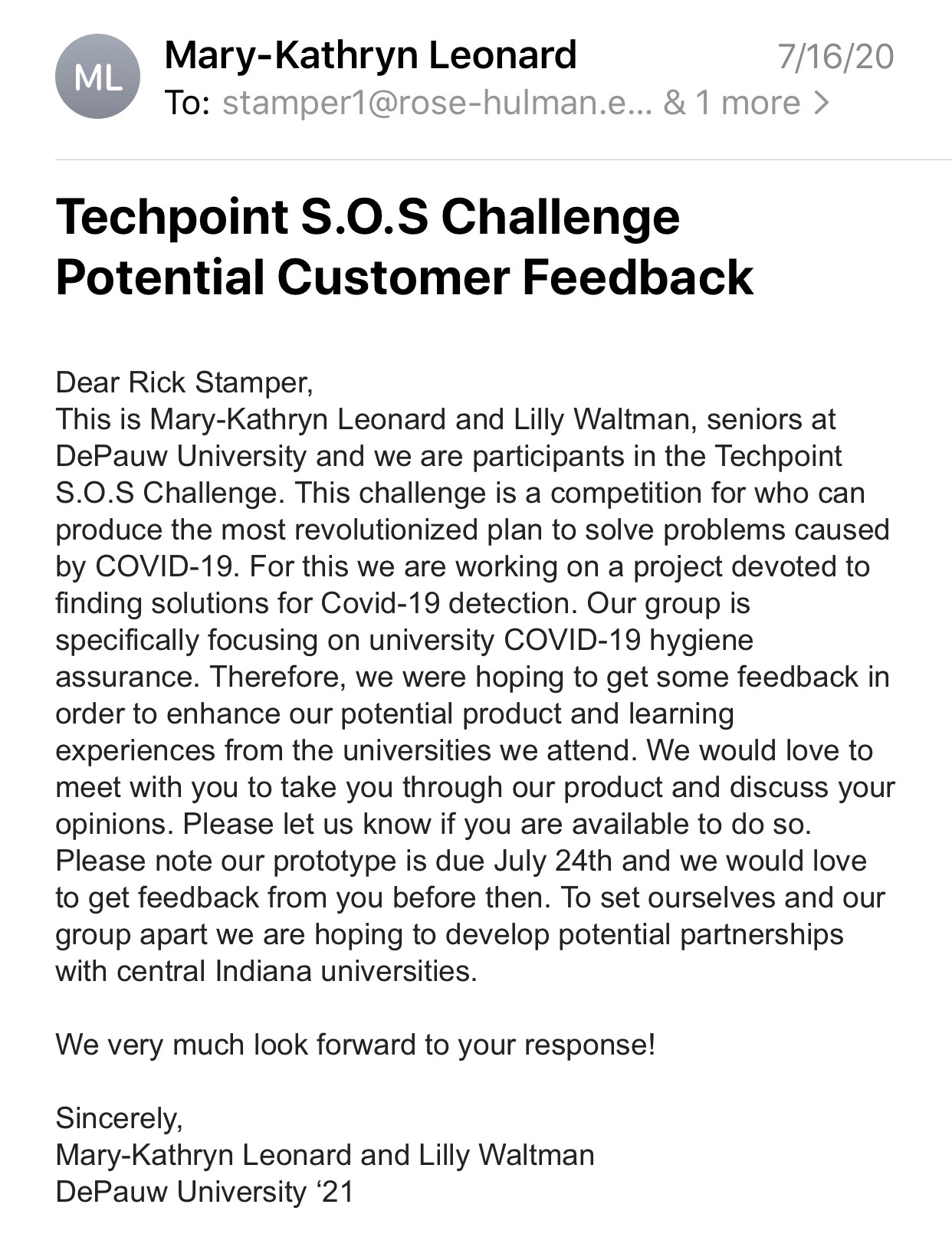
Communication with Vice President of Academic Affairs at Rose Hulman
-
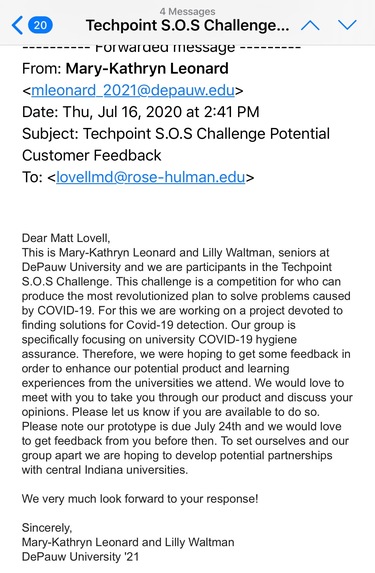
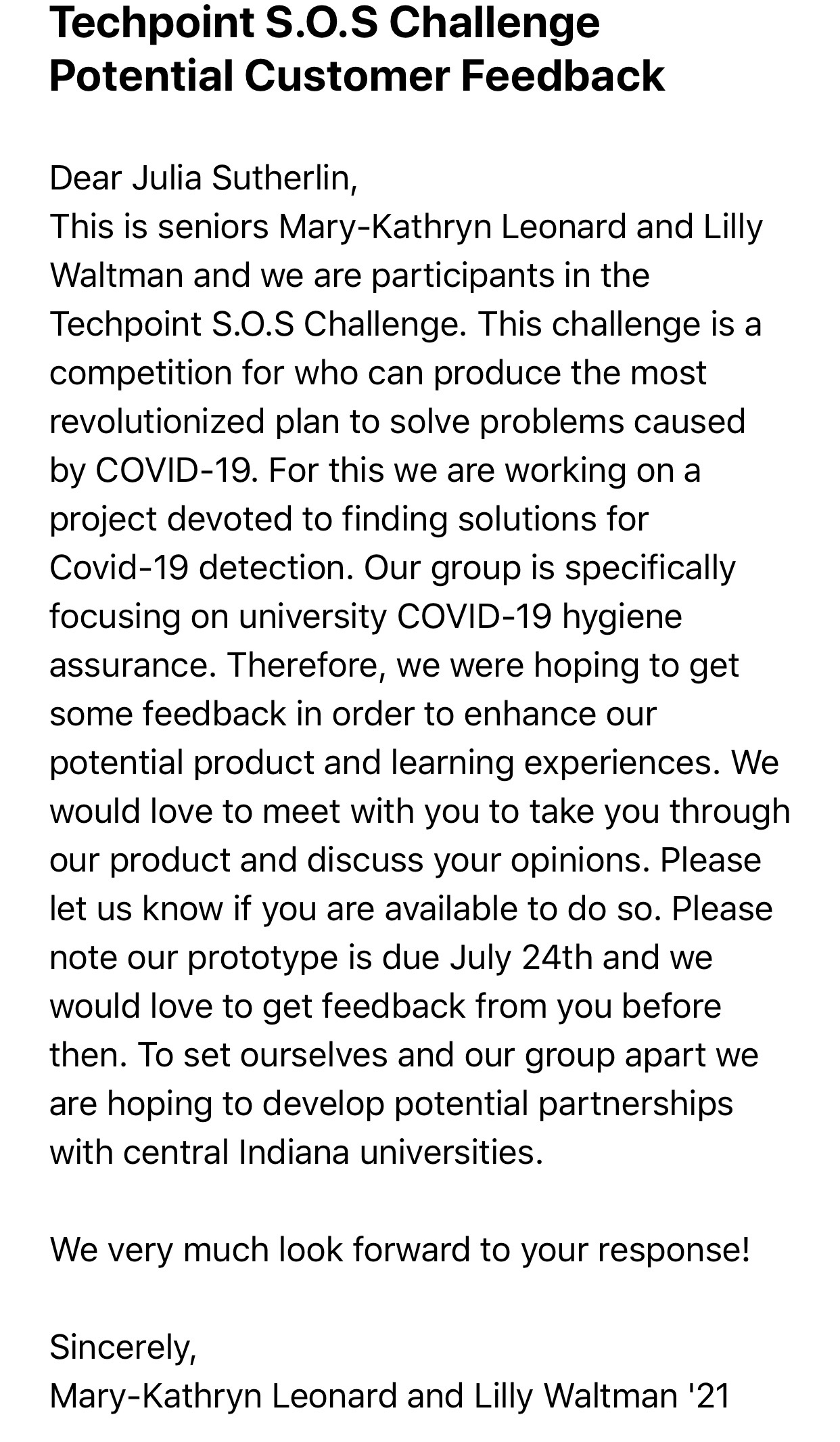
Communication with Senior Director of Institutional Research, Planning and Assessment
-
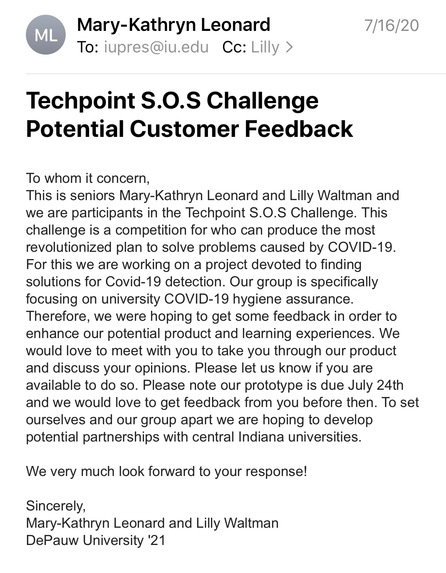
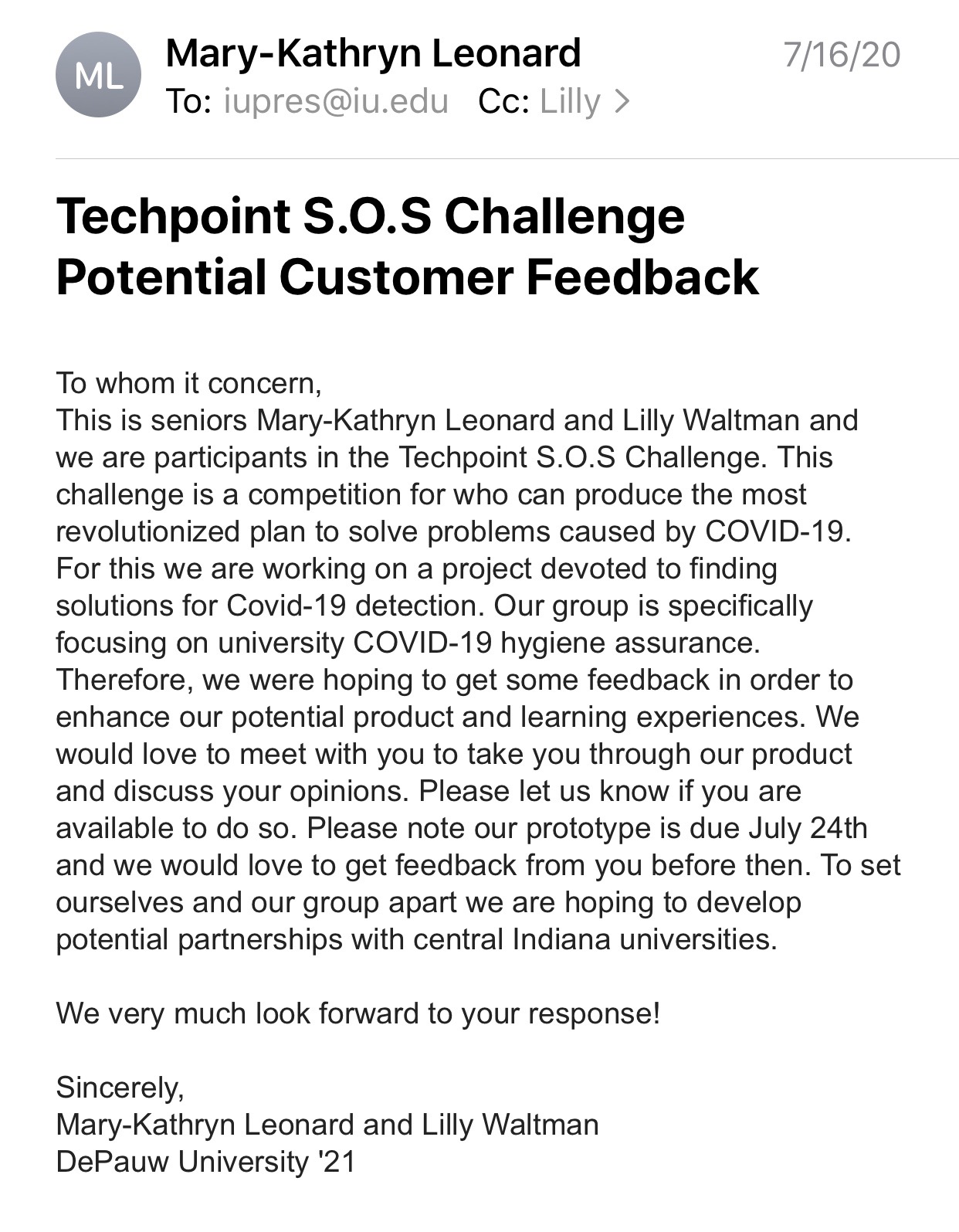
Communication with Indiana University
-
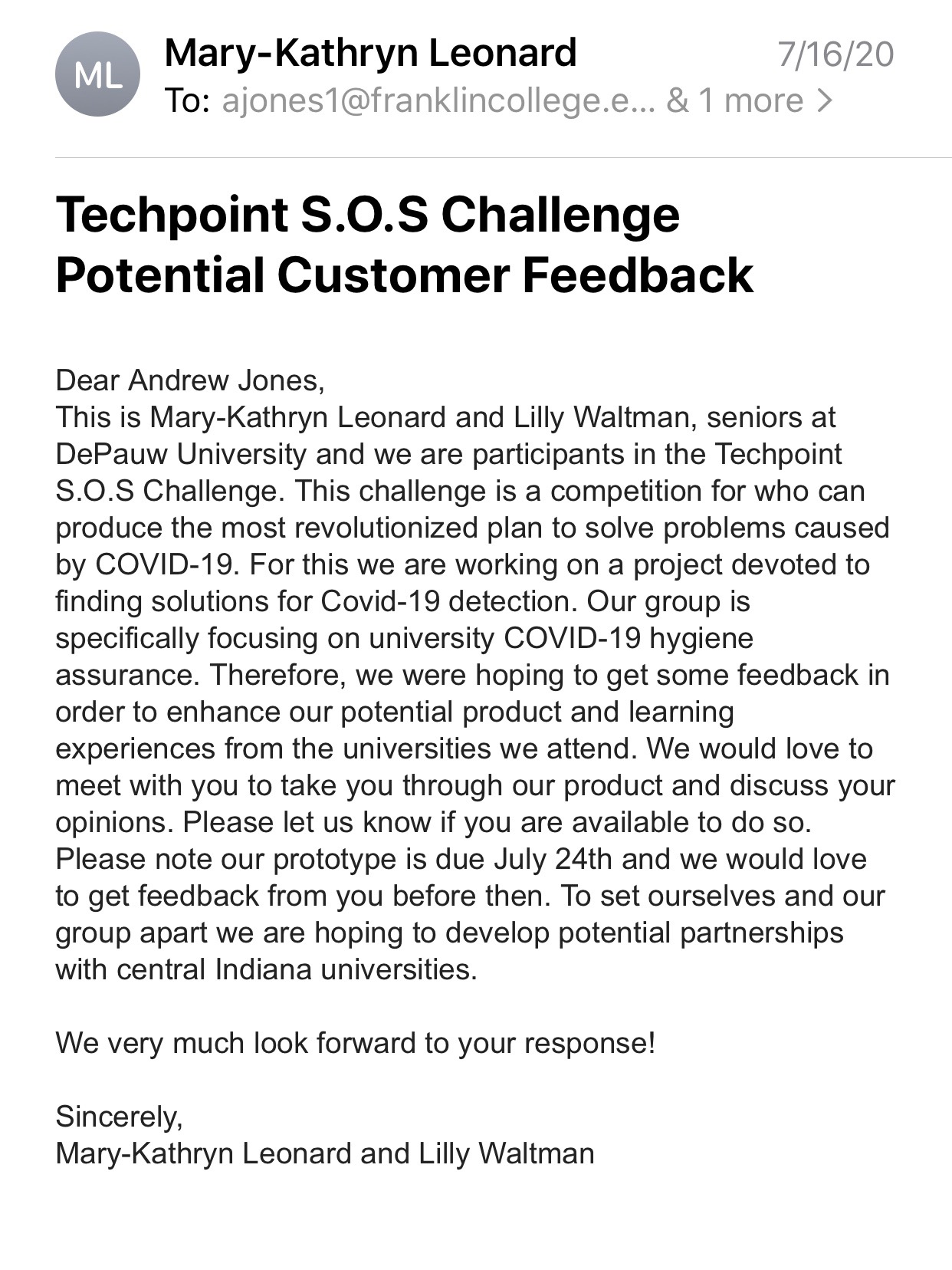
Communication with Vice President of Academic Affairs and Dean of Franklin College
Abstract
Overview: The problem we are aspiring to provide a solution to is COVID-19 outbreak detection on college campuses. We want to give students, faculty, staff and administrators the autonomy to feel safe navigating work and school. We plan to do this by allowing them to insight to the following: guidelines being followed/not followed by campus buildings, whether large numbers are social distancing, and updating facilities if a location is out of hand sanitizer or other supplies through our live reviews. It is important to note that we also have put much consideration into post COVID-19 applications of our product for the sake of ensuring future relevance. This app will help them not need to increase staff since there will be a system to help them adhere and data to prove. This is because we will offer the following: building check in system, customer response/health and safety and reservation systems. Please note that not only does this product have scalability to hosts of universities and colleges but also businesses and other public places. We chose to narrowly focus on the universities our group members attend for the sake of articulating a specific, well understood and well thought out business model and reasonable product experience and features. As for the product development, after a long time of in depth brainstorming, our group concluded that we were not going to take the obvious route of contact tracing when approaching this topic. We decided that we wanted to play a more proactive role in the fight against COVID-19 and find a more proactive way that could majorly decrease the spread on COVID-19. We then dawned on the idea of creating an interface that let people rate and make an appointment for public areas so that there is total transparency on how safe a place is. We wanted to let people gain knowledge about the place they were planning on going before they even step out of the house. Then, we focused our idea on what might be one of the main reasons that there would be a second wave of coronavirus in the American colleges. With colleges reopening and several students from all over the world starting gathering in large groups, this poses a large threat to college students, professors and family members of said college students. We believe that having a system to track and maintain order and capacity limits, that also informs students about safety precautions that they need to follow will greatly decrease the spread of the coronavirus and help calm down the inevitable spread when colleges start.
Team Members: Daniel Su(Software Developer, Junior Electrical Engineering Minoring in Mathematics & Computer Science @ Rose-Hulman Institute of Technology) Daniel is in charge of all the back end development of the website and product testing and debugging the system when errors occur. Aaron Lack (Software Developer, Junior Informatics @ IU Bloomington) Aaron focused his work primarily on front end web development but also made a storyboard for our product for my biggest contributions. Aaron assisted the Go team by calling college friends to obtain customer feedback on our prototype. He also played a key role in the development and presentation of our final product presentation documents and video. Jacob Laub (Data Analytics, Senior majoring in Quantitative Analysis, Minor in Accounting @ Franklin College) Jacob spent the majority of his time focused on creating data models, which he used to create graphs that are located on the information page on the website. In addition to this he also created a presentation using Prezi in order to summarize our final product. Lilly Waltman(Marketing and Business Development and Marketing, Senior Global Health and Spanish Major with Business Administration Minor @ DePauw University) As a member of the Go Squad, Lilly focused on the delivery of the prototype to get feedback from students that currently attend DePauw. She worked with Mary on the business model analysis, as well as conducting customer feedback surveys from admin at DePauw and Rose-Hulman. She worked with Jacob and Aaron on creating the Prezi and was also one of the presenters for the proposal submission. Mary-Kathryn Leonard(Project Manager, Senior Biochemistry @ DePauw University) Mary was responsible for collaborating with the group to establish workable meeting times. In addition, she coordinated the assignment of tasks based on what group members were able and willing to complete given their expertise. As for her Go Squad related duties, Mary developed the business model and helped with emailing potential customers and key partnerships for prototype reviews and feedback. Like many others in the group, Mary also conducted customer feedback surveys.
How did you decide on this customer segment, problem, and solution? Our team decided on a very focused and narrow customer persona, problem, and solution. We wanted to focus on something we knew we could bring value to.. so what better to choose than helping solve the problems of college students/universities in Indiana? We chose to have both a business to business and business to customer relationships. We want to work with universities to provide licensed services to college students as well as university communities. Team 4’s Action Plan was based on the following list of core essential questions:
- Who are the most profitable segments? Probably not college/college students Appealing to employees to sell whatever our product is could be more profitable, this means business to business could be most profitable as well. What is feasible? Research!
- What are the most optimal communication channels for customer segments? Depends on demographics(i.e. social media or press releases or other channel) Potentially university managed communications? Incentives?
- How do we develop customer relationships? Ask customers sets of questions We worked with undergraduate students from several universities and Academic Affairs the outcome of the plan, inpart, resulted in feedback from administrators at DePauw University and Rose Hulman Institute of Technology. We obtained opinions and information from these sources about the problem for which we are offering a solution. For this, we interviewed a total of twelve individuals who were all knowledgeable in one way or another about the challenge of continuing the college experience amidst COVID-19. This feedback was primarily based on the prototype we had developed already. From these interviews we found the following trends that reinforced the value of our product: On a scale of 1-5 all interviewees said that COVID-19 hygiene is important to them, especially on college campuses. All interviewees stated that on a scale of 1-5 they answered four or five indicating that they would be very likely to use our product to ensure their safety and autonomy when navigating campus. 11 of the 12 people interviewed stated that they would definitely be interested in using our product in order to safely and autonomously navigate campus amidst the COVID-19 pandemic and beyond. We also identified many possible features or minor solutions that were previously unknown to us by conducting these customer feedback interviews. This data was used to expand the scope or our product to better meet the needs of our potential customers. The most creative and often informative section of the feedback was when we asked if the interviewees had any additional comments. This is where we found the idea for food ordering or delivering from university run cafeterias. Another concept we learned from the feedback was to slightly improve the comment system within our product. Due to this, we were able to fully articulate the need to filter and resolve comments made by university community members in a timely fashion. By using these interviews to guide our scope, we continued our customer driven plan to further refine our product.
How did your team build and iterate on the solution? When we began this project, we knew that we ourselves were best equipped to identify solutions to problems caused by COVID-19 on college campuses. We chose this because we are acutely aware of how unnatural and uncomfortable the college experience was during Spring 2020 and needed to find a solution for ourselves and our peers, professors and extended university communities. It was clear that the need for autonomy in a time of endless unknowns was where we could provide help. Overall, we have found ourselves to be resource, finance, offer and customer driven, though mostly offer and customer driven iven the nature of our product. As for the product development itself, the thought process for adding features suggested in customer feedback/prototype testing was to improve our existing idea as well as allow the product to be potentially more customizable. This was primarily influenced by customer feedback interviews which we focused on heavily for the sake of truly applying our product to not only our perception of customer needs but also confirmed needs.
Key Metrics: Our team conducted a total of 12 interviews for customer feedback. Specifically, we talked with two University administrators, one professor, one Silicon Valley Executive and eight college students. All claimed they are concerned about COVID-19 hygiene on college campuses, that they thought our product was easy to navigate and would use it based on storyboards, as well as mostly agreeing the product would be implementable at their school. Customer Discovery and Product 12 interviews conducted: 2 University Administrators 1 Professor 1 Silicon Valley Executive 8 Current undergraduate or 2020 undergraduate students Questions asked: On a scale of 1-5, how likely are you to use this product? On a scale of 1-5, how important is Covid-19 hygiene in a college or university setting? On a scale of 1-5, do you find the rating system useful? On a scale of 1-10, how did you feel about usability? One being confusing and ten being very easy to understand. On a scale of 1-5, do you believe this product could be implementable in your school? Does our application/website remind you of other apps/websites you’ve used for purposes unrelated to Covid-19? If anything, what do you think needs to be improved about this product in order for you to use it?
Technical Architecture: We had a long discussion about this and ended up seeking guidance from Andy Hagerty. He suggested that we build our website on visual studios using the programing language C# because Daniel and Aaron were currently more familiar to Java which shared some syntax similarities with C#. We also have a GitHub that we share all our files, pictures, and code.
Key Tools, Libraries, and Frameworks: (5-10 most important tools in your solution, why you chose them, and how you used them) Visual Studio- main coding IDE used the build the website. MVC - Model View Controller, the main framework for developing our website with the ASP.NET framework. A combination of C#, HTML, CSS programming languages. GitHub - used to share code, information and images used to build the website Adobe Xd - used for designing a storyboard for our product/solution. R-Studio - Used to develop data models and create graphs of COVID-19 cases, tests, and deaths from Monroe County. Microsoft Excel - Used to COVID-19 data from all counties to slice it down just to data from Monroe County. If you had another 5 weeks to work on this, what would you do next? If we had 5 more weeks to work with, we would roll out the use of our product with the opening of our partnered/likely partnering universities. We would finish up and add features(list unfinished features). Assuming our product does exceptionally well at our partnered/potentially partnering universities we would attempt to partner with more Indiana-located universities in order to increase usage of our product for the sake of keeping as many college campuses safe as possible. We would conduct student customer feedback surveys to analyze whether or not the app/website is valued by college students.
All items have been completed and are turned in below.


Log in or sign up for Devpost to join the conversation.