-
-
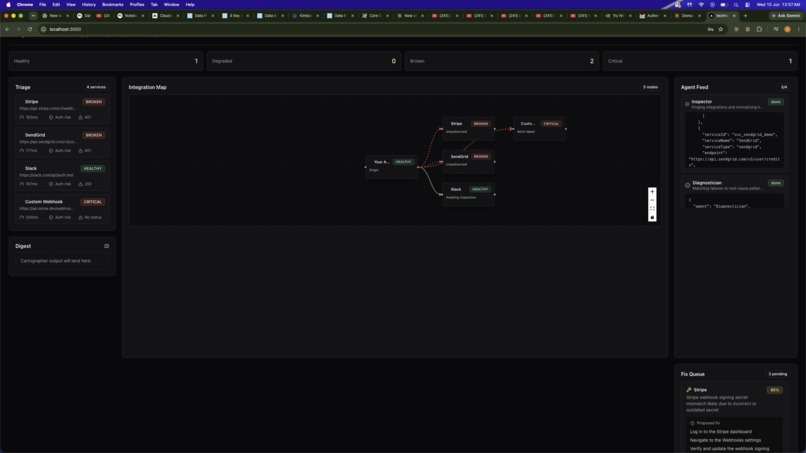
Dashboard that fixes all
🔧 technology.plumbing
The AI plumber that watches your integration layer so you don't get that 3am call.
Live at → technology.plumbing
The Problem
Every production app runs on invisible plumbing — Stripe webhooks, SendGrid quotas, Slack integrations, custom API endpoints. These pipes fail silently. A signing secret rotates during a Friday deployment. A quota hits 94% on Sunday night. A webhook starts returning 500s at 2am.
You find out when a customer tweets at you.
Integration failures cause 35% of critical outages (Gartner, 2023). Yet there's no tool that watches your integration layer the way Datadog watches your infrastructure or Sentry watches your errors.
Until now.
The Solution
technology.plumbing is a 4-agent AI pipeline that inspects, diagnoses, fixes, and maps your third-party integrations — before your users find the flood.
Inspect → Diagnose → Fix (human-approved) → Map
You connect your services. The agents do the rest.
How It Works
🔍 Agent 1 — The Inspector
Pings every configured integration. Validates auth tokens via live test calls. Measures latency. Captures HTTP status codes and error signatures.
Output: structured health JSON per service — HEALTHY, DEGRADED, BROKEN,
or CRITICAL.
🩺 Agent 2 — The Diagnostician
Takes every failing or degraded service and reasons about root cause using Claude's understanding of service-specific error patterns.
- Stripe 401 → signing secret mismatch, not an outage
- SendGrid at 94% quota → will cap in ~48hrs at current send volume
- Custom webhook 500s → upstream timeout pattern, not your code
Output: diagnosis + confidence score (0–100%) + recommended fix per service.
🔧 Agent 3 — The Plumber
Generates a specific, step-by-step fix plan for every high-confidence diagnosis. Presents it to you for approval before touching anything.
Human-in-the-loop is non-negotiable. The AI finds the leak. You decide when to fix it.
🗺️ Agent 4 — The Cartographer
Aggregates all agent outputs into a plain-English daily digest and the data powering the live integration map.
"3 pipes healthy. 1 leaking. 1 about to burst. Your Stripe issue started 3 days ago and correlates with your last deployment."
Key Features
| Feature | Description |
|---|---|
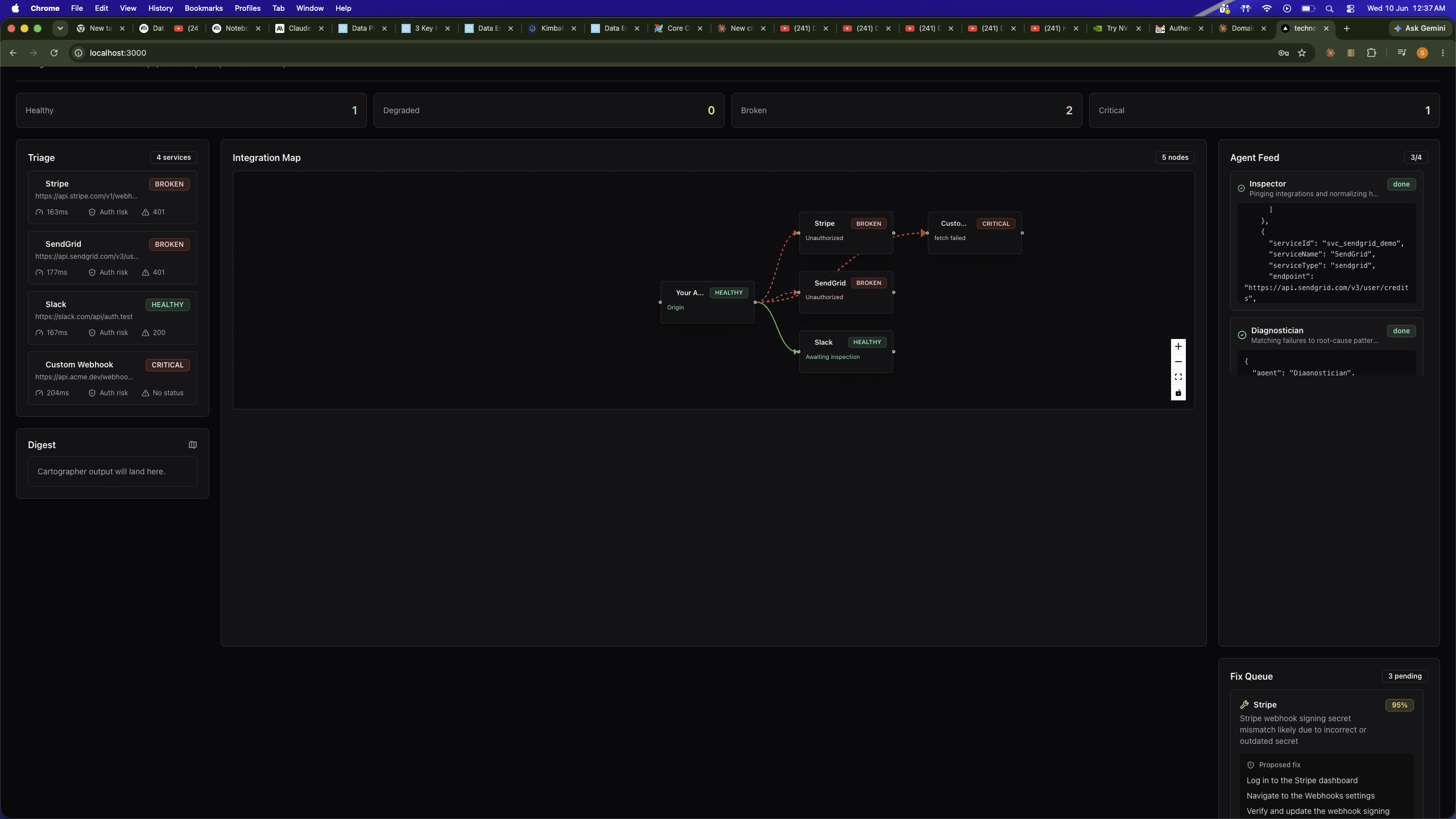
| Live Agent Feed | Watch all 4 agents reason in real time — token by token |
| Triage Dashboard | Health badges per service, updated after every pipeline run |
| Fix Approval Queue | AI proposes fixes with confidence scores. You approve or skip |
| Integration Map | Visual node graph of your stack, color-coded by health status |
| Digest Panel | Plain-English summary from the Cartographer — ready for standup |
| Demo Mode | Full pipeline simulation with pre-seeded realistic data — no API keys needed |
Architecture
┌─────────────────────────────────────────────────────────┐
│                    User Interface                        │
│  Config → Run Pipeline → Agent Feed → Map → Fix Queue   │
└────────────────────┬────────────────────────────────────┘
                     │
         ┌───────────▼───────────┐
         │   Next.js API Routes  │
         │  (server-side only)   │
         └───────────┬───────────┘
                     │
    ┌────────────────▼─────────────────┐
    │         4-Agent Pipeline         │
    │                                  │
    │  [Inspector]  ──fetch()──►  Raw  │
    │  health JSON                     │
    │       │                          │
    │       ▼                          │
    │  [Diagnostician] ──Claude──► Why │
    │  it broke + confidence           │
    │       │                          │
    │       ▼                          │
    │  [Plumber] ──Claude──► Fix plan  │
    │  + human approval gate           │
    │       │                          │
    │       ▼                          │
    │  [Cartographer] ──Claude──►      │
    │  Digest + map data               │
    └──────────────────────────────────┘
                     │
         ┌───────────▼───────────┐
         │    Anthropic Claude   │
         │  claude-sonnet-4-...  │
         │  (streaming, 3 calls) │
         └───────────────────────┘
Agent Chaining Pattern
Each agent's output JSON is injected as structured context into the next agent's system prompt. No raw text is passed between agents — always typed, validated JSON. If an agent returns malformed output, the pipeline retries once before surfacing a graceful error state.
Tech Stack
| Layer | Technology |
|---|---|
| Framework | Next.js 14 App Router + TypeScript (strict) |
| Styling | Tailwind CSS + shadcn/ui (dark theme) |
| AI | Anthropic Claude (claude-sonnet-4-20250514) via streaming API |
| Visualization | React Flow — live integration node graph |
| State | React useState / useReducer + localStorage for service config |
| Deployment | Vercel — public URL, zero-config |
Project Structure
technology-plumbing/
├── app/
│   ├── page.tsx                    # Main dashboard
│   ├── layout.tsx                  # Root layout + dark theme
│   └── api/
│       ├── inspect/route.ts        # Agent 1 — Inspector (fetch-based)
│       ├── diagnose/route.ts       # Agent 2 — Diagnostician (Claude)
│       ├── fix/route.ts            # Agent 3 — Plumber (Claude + approval gate)
│       └── digest/route.ts         # Agent 4 — Cartographer (Claude)
├── components/
│   ├── AgentStatusFeed.tsx         # Live streaming agent progress
│   ├── TrigeDashboard.tsx          # Service health list + badges
│   ├── FixApprovalQueue.tsx        # Human-in-the-loop fix cards
│   ├── IntegrationMap.tsx          # React Flow node graph
│   ├── DigestPanel.tsx             # Cartographer plain-English summary
│   └── ConfigModal.tsx             # Service endpoint + label input
├── lib/
│   ├── agents.ts                   # Agent prompt templates + output schemas
│   ├── integrations.ts             # Service ping logic (fetch-based)
│   ├── demo-fixtures.ts            # Pre-seeded demo mode data
│   └── types.ts                    # Shared TypeScript interfaces
└── AGENTS.md                       # Codex/agent guidance for this repo
Getting Started
Prerequisites
- Node.js 18+
- An Anthropic API key
Local Setup
git clone https://github.com/saurin16/technology-plumbing
cd technology-plumbing
npm install
cp .env.local.example .env.local
Add your key to .env.local:
ANTHROPIC_API_KEY=sk-ant-...
npm run dev
# → http://localhost:3000
Try Demo Mode
No API keys needed. Click "🔧 Demo Mode" on the dashboard to run the full pipeline with pre-seeded realistic data:
| Service | Status | Issue |
|---|---|---|
| Stripe | 🔴 BROKEN | 401 — signing secret mismatch (3 days) |
| SendGrid | 🟡 DEGRADED | 94% monthly quota — caps in ~48hrs |
| Slack | 🟢 HEALTHY | All clear |
| Custom Webhook | 🔴 CRITICAL | 500s for 2 hours — upstream timeout |
Deployment
Deploy to Vercel
npx vercel --prod
Set environment variable in Vercel dashboard:
ANTHROPIC_API_KEY = sk-ant-...
The API key never touches the client bundle. All Claude calls are server-side
only via /api/* routes.
Security Model
- API keys: server-side only, never in client bundle
(
grep -r "ANTHROPIC_API_KEY" app/returns zero results outside/api) - localStorage: only stores service labels and endpoint URLs — never secrets
- Human-in-the-loop: Agent 3 cannot execute any fix without explicit user approval. The gate is enforced server-side, not just in the UI.
- No database: zero PII stored — all session state is in-memory
Why "technology.plumbing"
The domain is the product name is the problem statement.
Plumbing is the infrastructure everyone depends on and nobody thinks about — until it fails at the worst possible moment. Technology plumbing is your API layer: Stripe, SendGrid, Slack, webhooks, OAuth tokens. It works invisibly until it doesn't.
We didn't start with an idea and search for an available domain. We started with the domain and built the product it deserved.
The Market
- 2.5M+ teams deploy on Vercel/Netlify with 3+ third-party integrations
- 35% of critical outages trace back to integration layer failures (Gartner)
- Zero direct competitors solving this with an AI reasoning layer
- Pricing model: $49/month per workspace — same motion as Datadog but for the integration layer, not the infrastructure layer
Built For
DeveloperWeek NYC 2026 Hackathon name.com — Domain Roulette Challenge
Domain selected: technology.plumbing
License
MIT
Built in 24 hours. The plumbing was already broken before we got here.
Built With
- anthropic
- api
- claude
- css
- flow
- next.js
- react
- shadcn/ui
- tailwind
- typescript
- vercel


Log in or sign up for Devpost to join the conversation.