Inspiration
As interns at GovTech, we have had the opportunity to work with government data and understand how it can support better decisions for Singapore. We wanted to put what we have learned into action by tackling a meaningful social issue: helping older residents stay connected to their communities.
The number of seniors living alone in Singapore is increasing, while access to Active Ageing Centres (AACs) may vary across neighbourhoods. We were inspired to explore how data could help planners identify underserved areas and make more informed decisions about outreach and future AAC locations.
What it does
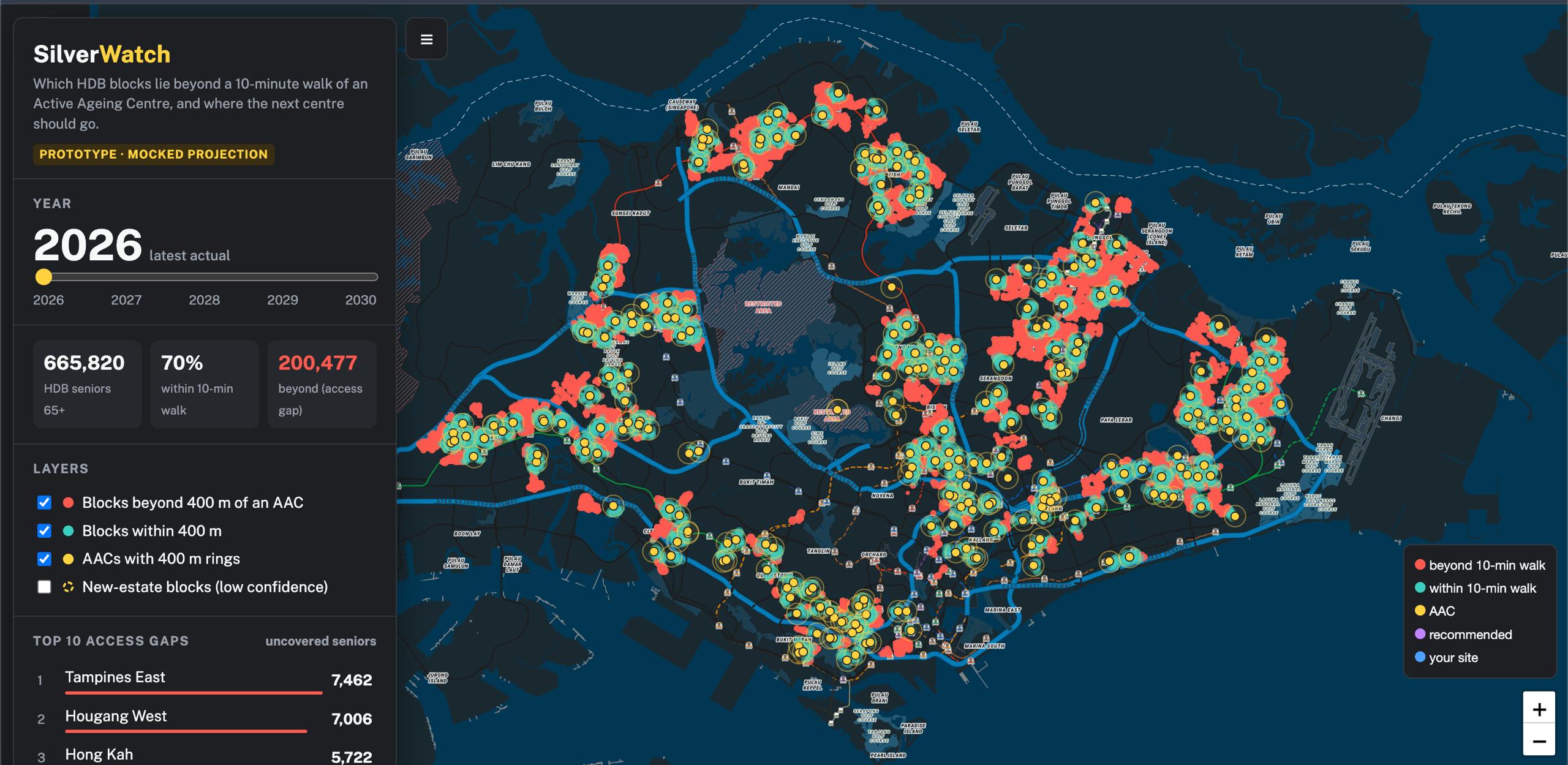
SilverWatch is a proposed data-driven platform that will help planners identify neighbourhoods with limited access to Active Ageing Centres. It will aim to:
- Estimate how the senior population may change from 2025 to 2030.
- Measure AAC accessibility at the block and subzone levels.
- Rank neighbourhoods based on potential isolation risk and access gaps.
- Recommend locations for new AACs or outreach events.
- Allow users to manually select a potential location and assess its impact on coverage.
- Provide a Genie space where coordinators can ask questions about the data in plain English.
Our goal is to help coordinators move beyond identifying problems and take targeted, data-informed action.
How we plan to build it
We plan to build SilverWatch on Databricks using a medallion architecture.
Data from SingStat, data.gov.sg, AIC and URA will be stored in a Unity Catalog Volume and ingested using Lakeflow and Auto Loader. We will implement data-quality checks to detect issues such as invalid or incorrectly geocoded locations.
The data will be transformed through bronze, silver and gold Delta tables. We plan to evaluate several forecasting approaches, including a naïve model, the Hamilton–Perry method, and Hamilton–Perry combined with gradient boosting. MLflow will be used to track experiments, compare models and register the best-performing model.
The final outputs will be presented through a Databricks App containing an interactive map, risk ranking, location recommender and click-to-place tool. We also plan to develop a Genie space so coordinators can explore the results through natural-language questions.
Challenges we anticipate
One major challenge will be combining datasets with different geographic boundaries and levels of detail. Population data may be provided at the subzone level, HDB information at the block level, and AAC locations as individual points. We will need to carefully geocode, standardise and join these datasets to produce meaningful accessibility estimates.
Forecasting the future senior population will be another challenge. We want the predictions to be useful without overstating their certainty, so we plan to compare multiple models and evaluate them through backtesting.
We also anticipate the challenge of translating a complex analytical workflow into an interface that is understandable and useful for non-technical coordinators. This will require us to focus on clear rankings, visual explanations and actionable recommendations.
Accomplishments we hope to achieve
We hope to develop an end-to-end prototype that connects data ingestion, quality checks, forecasting, geospatial analysis, machine learning and decision support in one application.
In particular, we aim to ensure that SilverWatch does more than visualise underserved areas. By recommending potential locations and allowing users to test how a new AAC could improve coverage, we hope to make the tool practical for planning outreach and community support.
We would also be proud to apply concepts from our internships to a real social problem and demonstrate how government data can support more inclusive and connected communities in Singapore.
What we hope to learn
Through this project, we hope to learn how to turn raw public-sector data into a useful decision-support tool.
We also hope to gain practical experience in evaluating forecasting models, building reproducible data pipelines on Databricks, performing geospatial analysis and communicating technical insights to non-technical users.
Most importantly, we hope to better understand how data products can translate analysis into meaningful action.
What's next for TechGoodies
Our immediate next step is to build the proposed data pipeline, forecasting models and accessibility analysis, followed by the risk-ranking system, recommender and Databricks App.
Beyond the hackathon, we would like to improve SilverWatch with more detailed measures of accessibility, such as walking routes, public transport connectivity and mobility-related constraints.
We also hope to incorporate additional indicators of social isolation, validate the recommendations with community stakeholders and improve the forecasting models as more recent data becomes available.
In the longer term, we would like to explore whether the same approach could support the placement of other essential community services.
Built With
- databricks

Log in or sign up for Devpost to join the conversation.