Inspiration
We're Texans, and we've watched Houston have its worst day more than once. Each time, the damage happened at three different moments, and we kept seeing the same failures:
- Before the storm. During Hurricane Harvey, hundreds of thousands of cars flooded. Many were parked in driveways. Moving them a few blocks the day before would have saved them. People were warned, but nobody told them, "Your car, on your street, will be under water."
- During the storm. 911 lines were overloaded. People trapped at home posted on social media to ask for rescue, and volunteers sorted the requests by hand. When Hurricane Beryl and Winter Storm Uri knocked out power, people who depend on medical equipment, like oxygen concentrators, were among the most at risk and the hardest to reach.
- After the storm. Families waited weeks for claims to be paid. Meanwhile, storm-chasing contractors knocked on doors and pushed them to sign over their insurance claims.
Most disaster tools focus only on the hours of the flood. We saw the biggest chance to help, and to save money, at the two ends: preventing losses before landfall and settling claims fairly after it. So we built LifeLine as one text conversation that stays with a family through the whole event.
What it does
LifeLine is an AI agent that people talk to by text, over iMessage or SMS. It works in English or Spanish, and nobody has to install an app.
An insurer makes or loses the most money at the two ends of a disaster. Before landfall, every car moved and every window boarded is a claim that never gets filed. After landfall, every claim paid quickly and fairly costs less to handle and keeps a customer. LifeLine is built around those two ends, and one text conversation connects them through the storm:
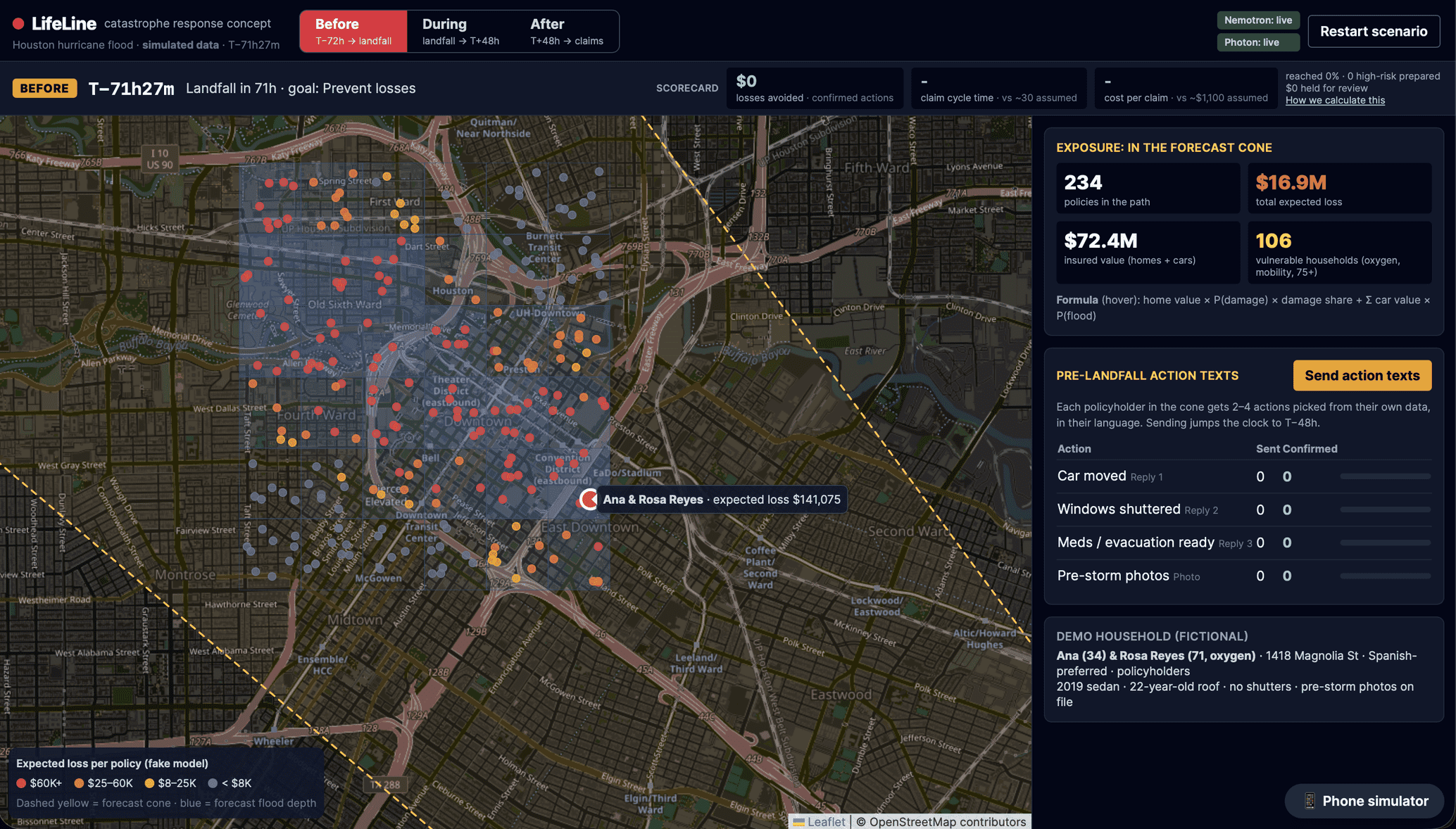
- Before (prevent the loss): A forecast map shows every policy in the storm's path and its expected loss. Each household gets a personal plan by text, like "Move your car to higher ground. Reply 1 when done." Each confirmed reply adds to the avoided-loss total.
- After (pay the claim): Small claims with pre-storm photos and no warning signs are paid automatically, within hours. Larger claims go to adjusters. When a contractor's pattern looks suspicious, the claim goes to a person for review. LifeLine never denies a claim on its own.
- During (the bridge): State Farm isn't the rescuer, and LifeLine doesn't replace 911. But the storm is when a family most needs to hear from its insurer, and it's when the facts of the claim are created. An NVIDIA Nemotron agent reads messages like "water coming in, my mom is on oxygen," and a transparent score shows responders who to reach first. A silence map flags blocks where people stop replying. What families report during the storm, like water inside the house, is saved, so their claim starts half-filled afterward.
- Scorecard: Avoided losses, claim cycle time and cost per claim, each next to a baseline labeled "assumed."
The phases build on each other. The trust earned before the storm is why people answer during it. What they say during it is what makes the claim fast after it.
We count avoided losses only for actions a family confirmed:
$$\text{Avoided loss} = \sum_{\text{confirmed actions}} \text{value at risk} \times P(\text{damage at that address})$$
How we built it
- Backend: Python and FastAPI, with SQLite for data. A simulated clock runs from 72 hours before landfall to days after it.
- AI agent: NVIDIA Nemotron 3.5 Super through NVIDIA's API. The agent uses tool calls to look up a household, check flood depth, record needs, compute the score, find a shelter and write the reply. The dashboard shows every step in an agent trace.
- Fallback: If the model doesn't respond, a rule-based agent takes over, so nobody gets left without an answer.
- Messaging: Photon on a real iMessage line, so real phones can take part.
- Frontend: React, Vite, Tailwind and Leaflet maps. It has Before, During and After tabs, the forecast cone, the silence map, a three-lane claims board and a phone simulator.
- Data: Real policyholder data is private, so we generated about 400 fictional households, plus response teams, shelters, contractors and claims. Every rate and baseline is labeled as an assumption.
Challenges we ran into
- Turning one tool into a full journey. We started with a triage tool. Then a State Farm judge pushed us to focus on the business value before and after the storm. We added both phases without breaking the triage features that already worked.
- Time before landfall. Supporting the days before the storm meant our clock, scoring and silence map all had to handle negative time. That surfaced a lot of edge cases.
- Keeping the ranking honest. When our demo family first ranked third, other households really did need help more. We didn't change the scoring rules to push our family to the top. The rules stay the same for everyone.
- Messaging rules. A shared iMessage line can't send the first message, so people opt in by texting LifeLine first.
- Setup under pressure. We got Photon and Nemotron access during the event and had to find a model that handles tool calls well.
Accomplishments that we're proud of
- One family's whole story works end to end: a Spanish action text before the storm, a rescue request that jumps to the top during it, and an auto-paid claim after it.
- Nemotron runs the full agent loop, and anyone can read each step it took.
- The silence map finds the people who don't text, not just the ones who do.
- Every dollar figure comes with its formula and an "assumed" label.
- Our fraud rules send claims to a person. They never deny them.
What we learned
- Insurers create the most value at the edges of a catastrophe. One confirmed "car moved" text before the storm is worth more than any dashboard during it.
- In an emergency, people need to trust the system. Responders have to see why someone is ranked first.
- Silence is data. The households that don't answer are often the ones to check first.
- AI should stay out of life-or-death math. Let it read and explain, and let a clear formula decide priority.
What's next for LifeLine
Our goal stays the same: warn people before, find them during and pay them after, all in one conversation. Next, we want to add:
- Mitigation offers: after the storm, a list of homes that a roof or shutter upgrade would have protected, paired with a premium discount.
- An escalation ladder: for people who don't reply, a second text, then a phone call, then an in-person welfare check.
- Real damage assessment: a vision model that reads damage photos, in place of our placeholder images.
- Real numbers: every assumed rate calibrated with real catastrophe and claims data.
- More channels: WhatsApp and voice calls in the same conversation.
Built With
- fastapi
- imessage
- leaflet.js
- nvidia-nemotron
- photon
- python
- react
- tailwind

