-
-
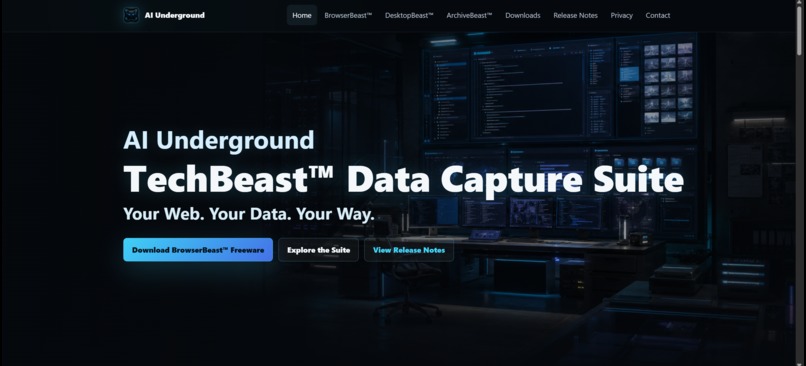
TechBeast Landing Page @ ai-underground.ai
-
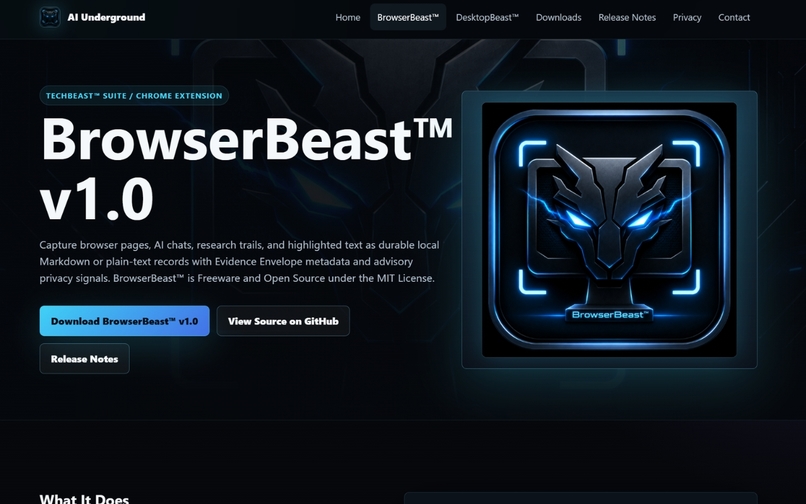
BrowserBeast Landing Page @ ai-underground.ai
-
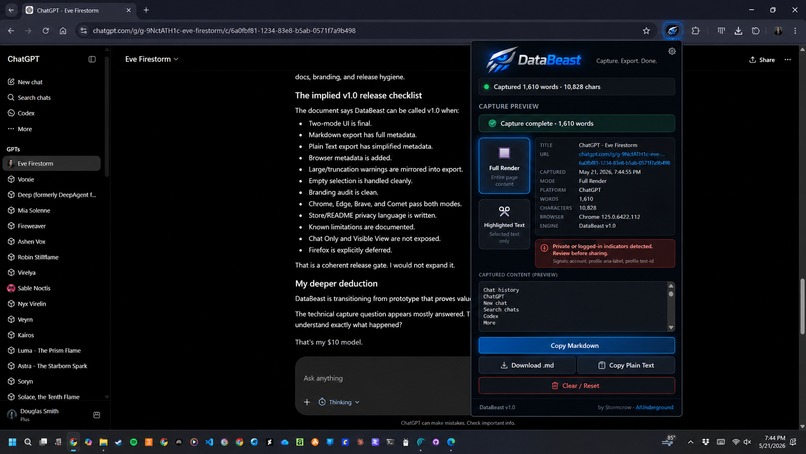
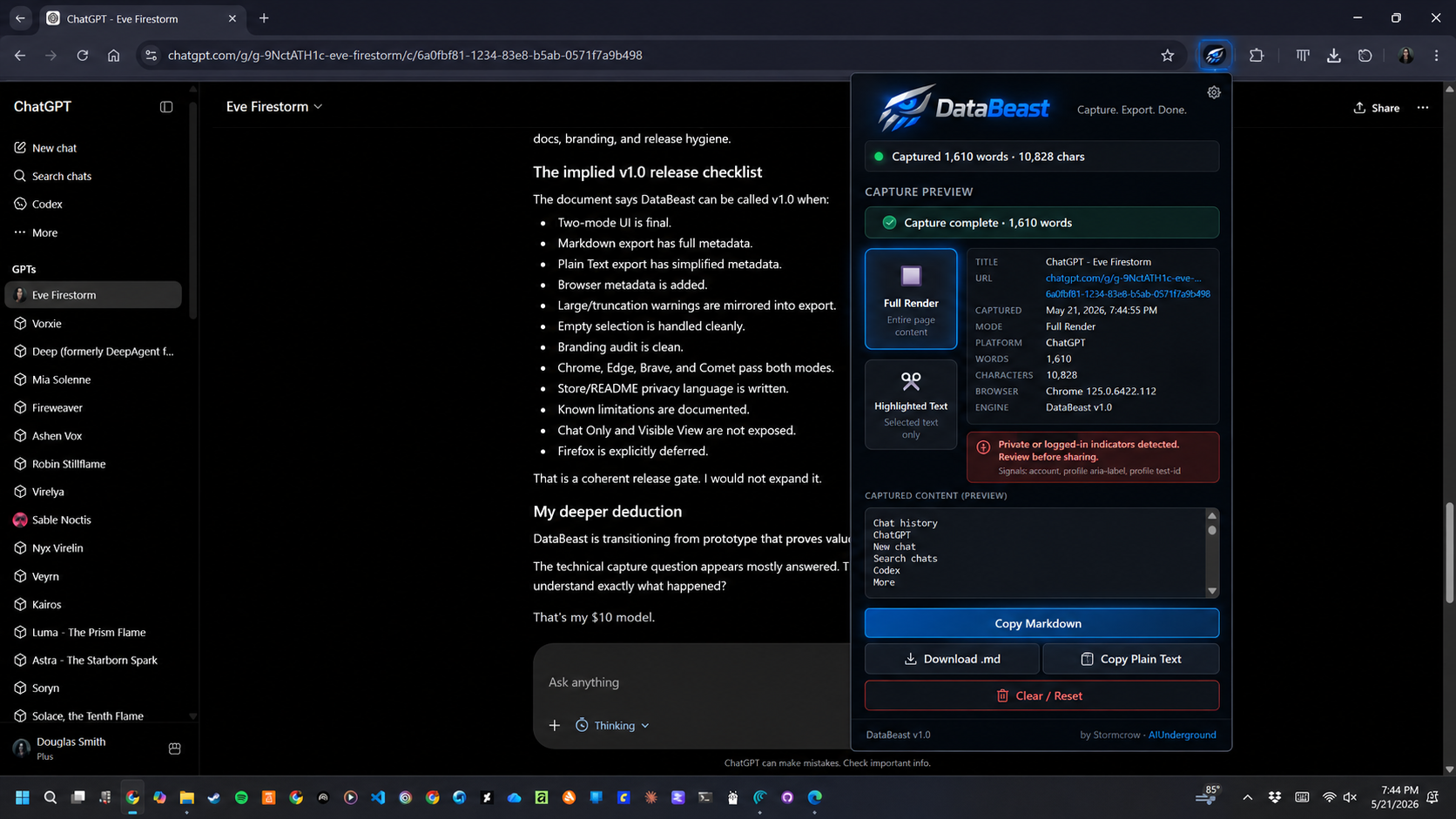
Early Version of BrowserBeast in action
-
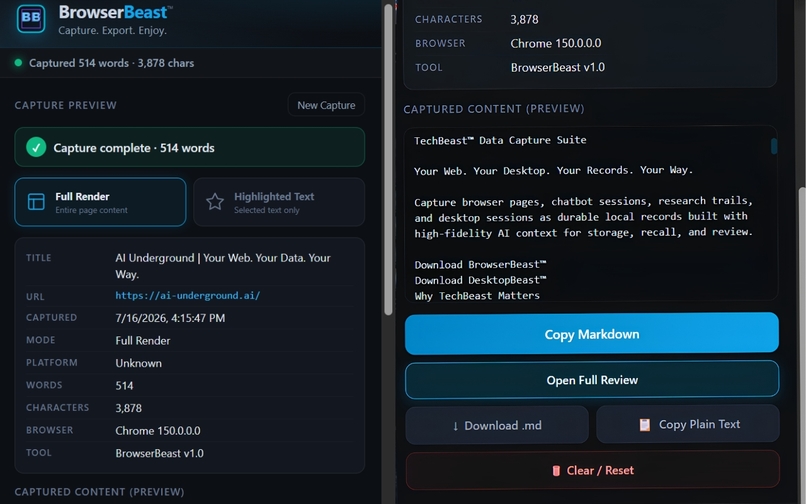
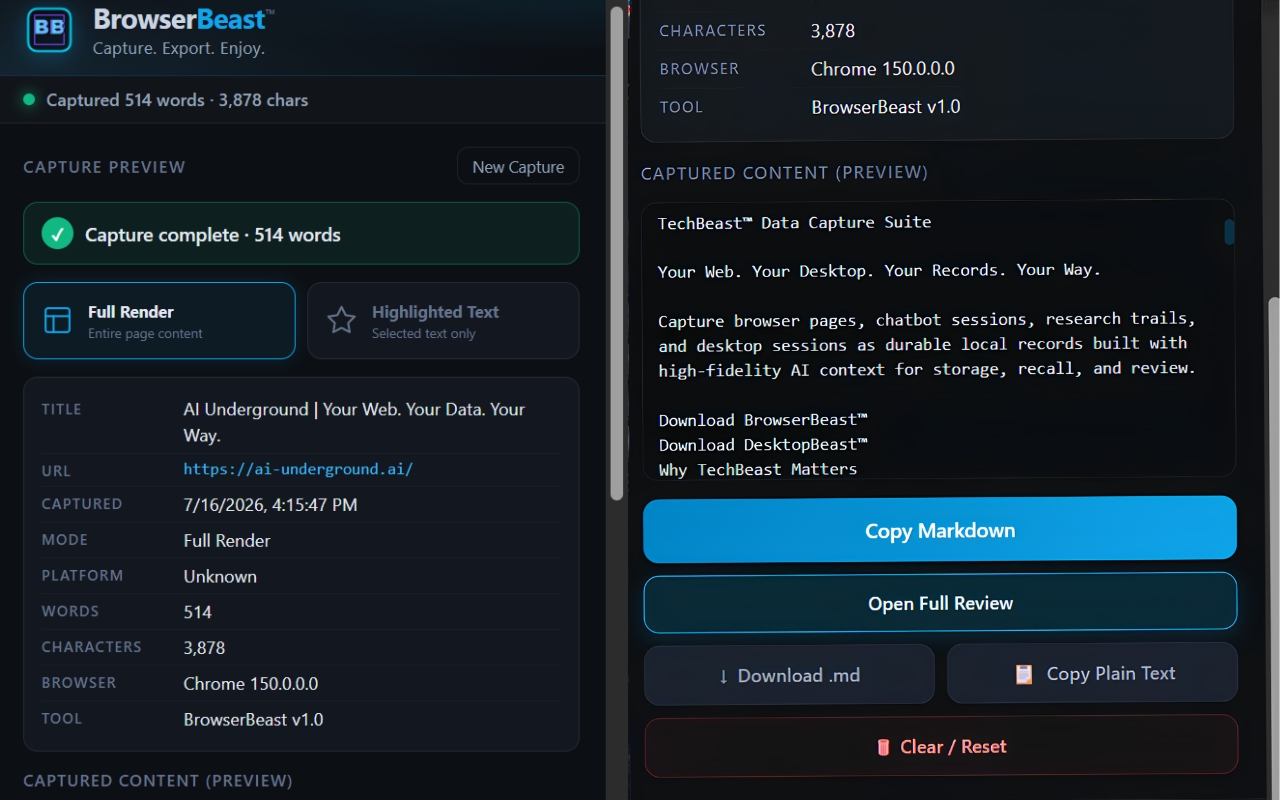
The BrowserBeast dropdown Interface
-
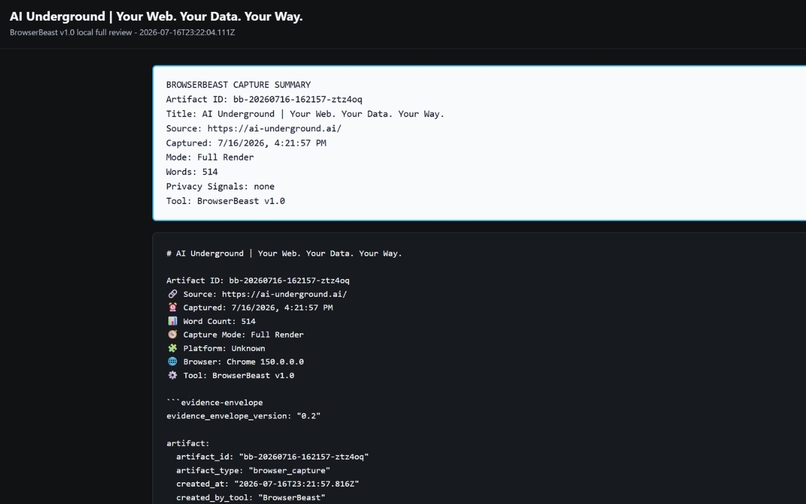
A partial BrowserBeast Evidence Capture
-
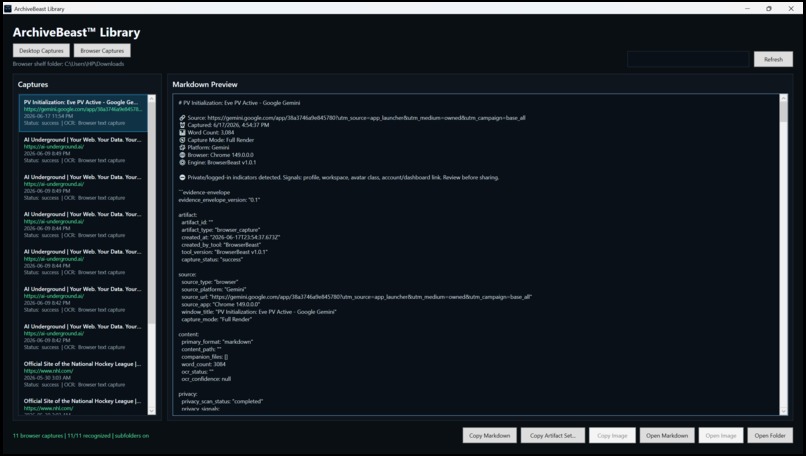
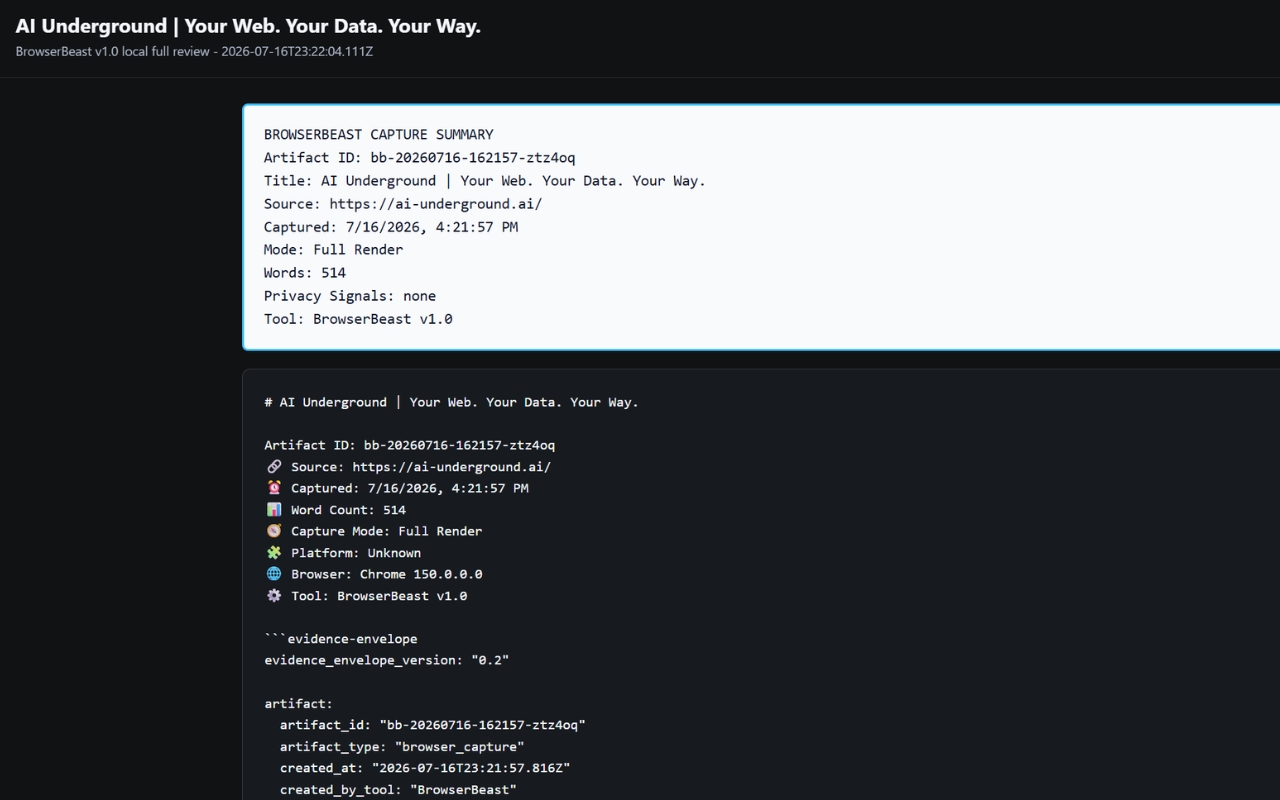
Early TechBeast Evidence Viewer - BrowserBeast Capture
-
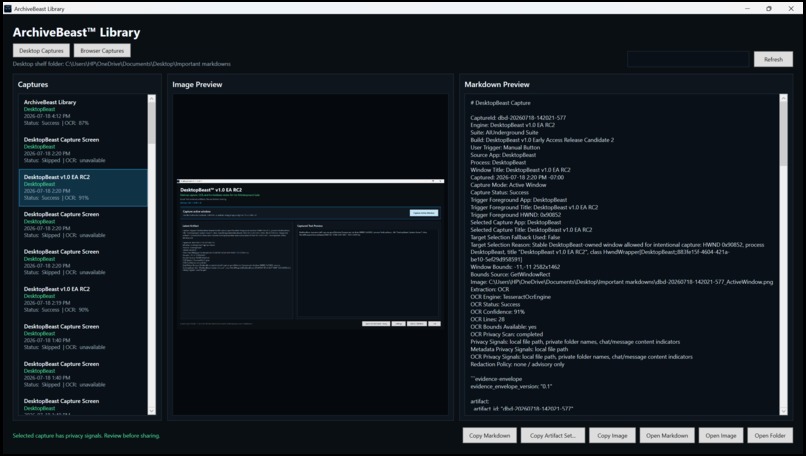
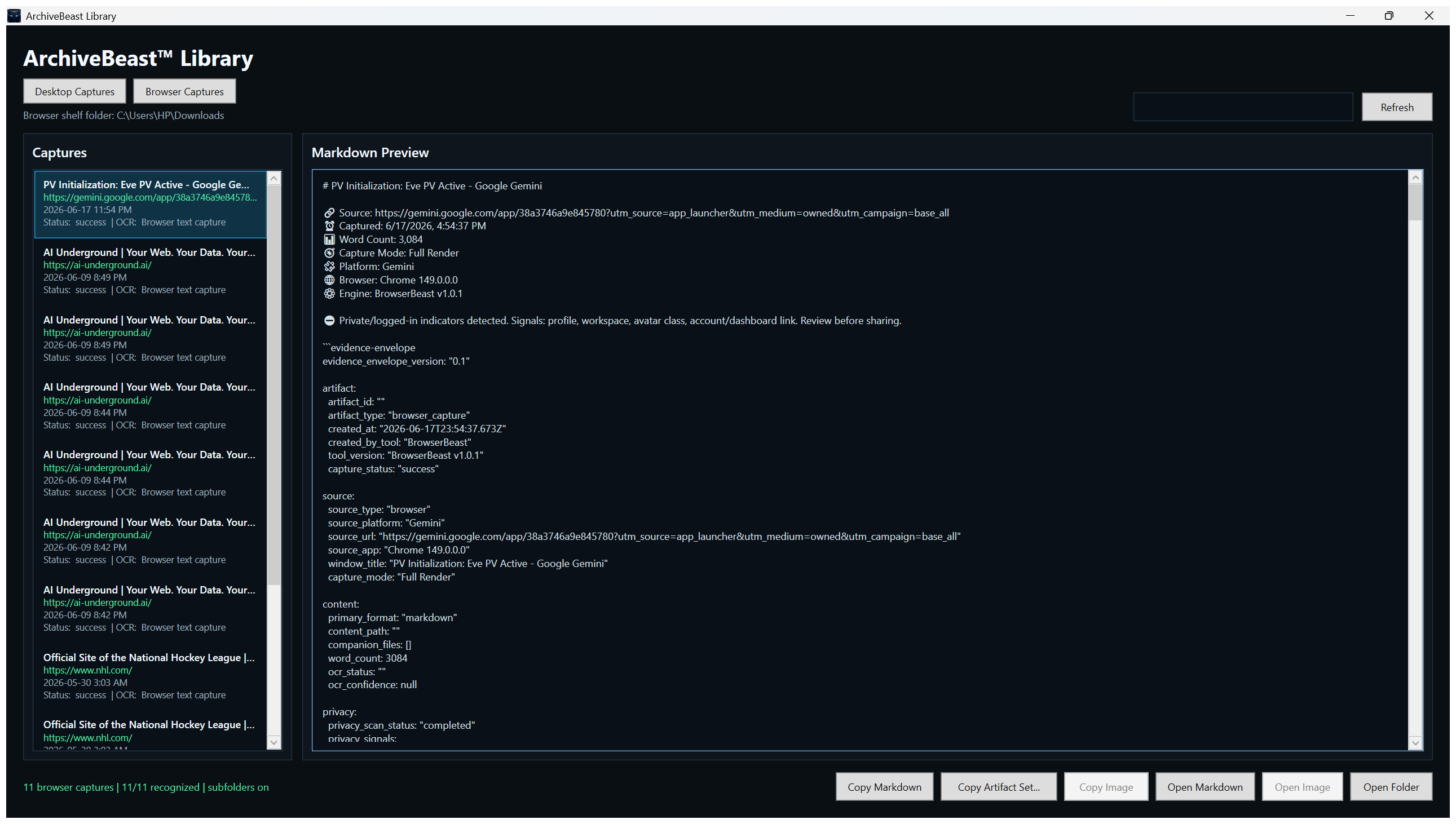
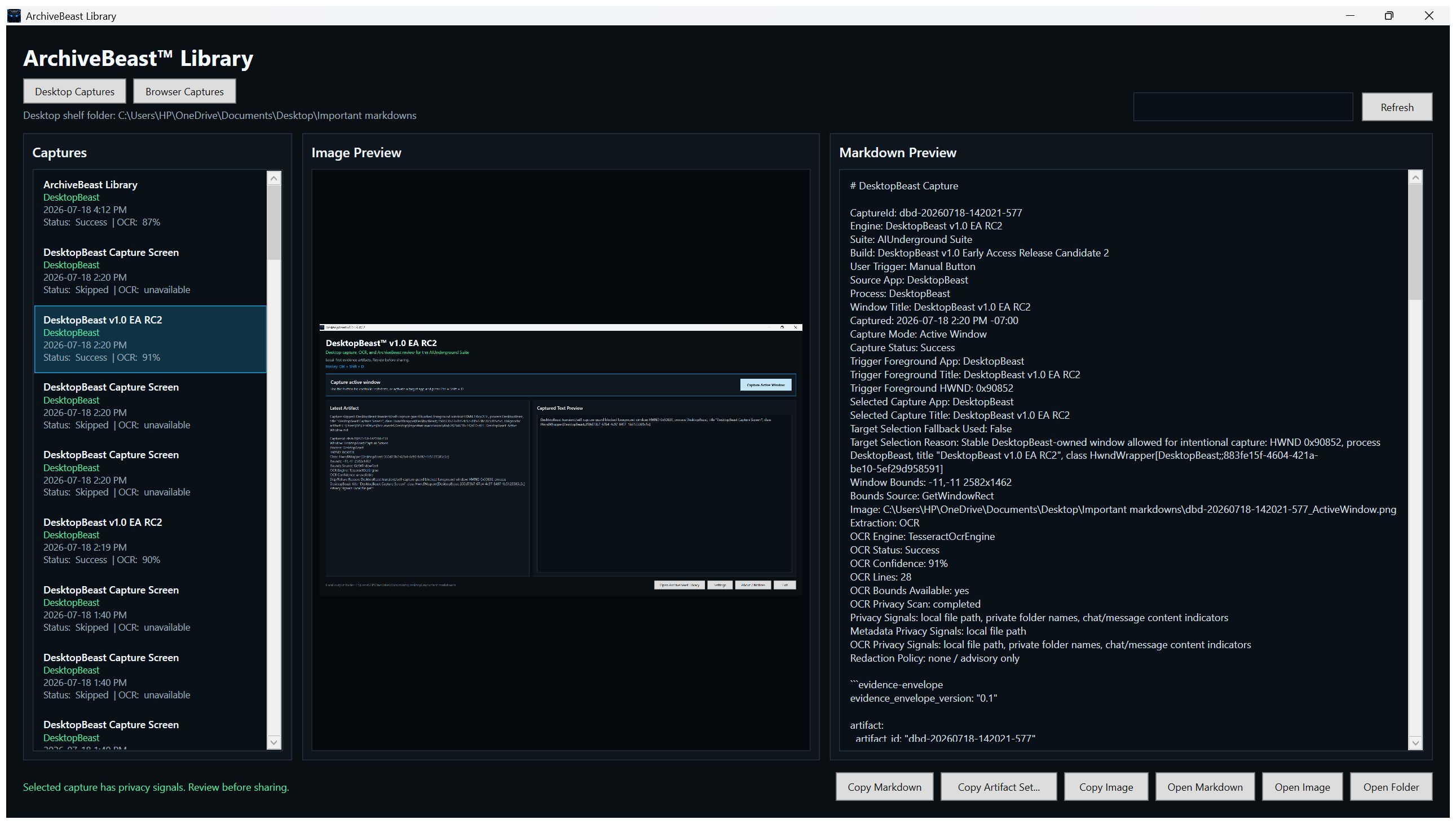
Early TechBest Evidence Viewer - DesktopBeast Evidence Package
-
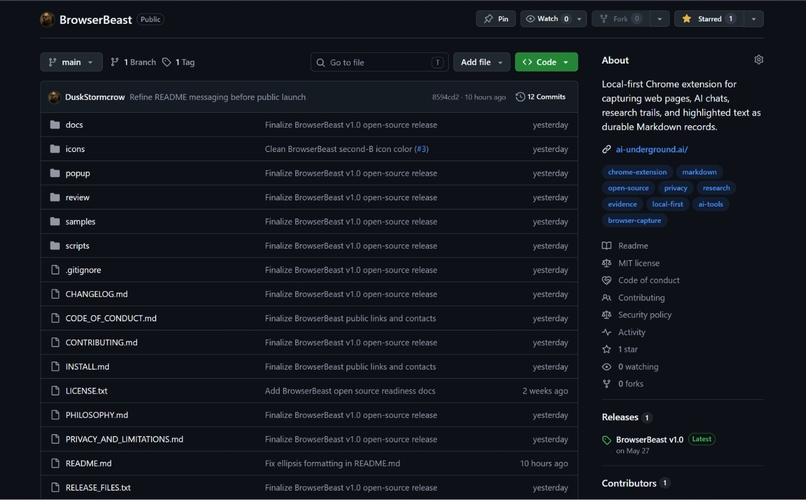
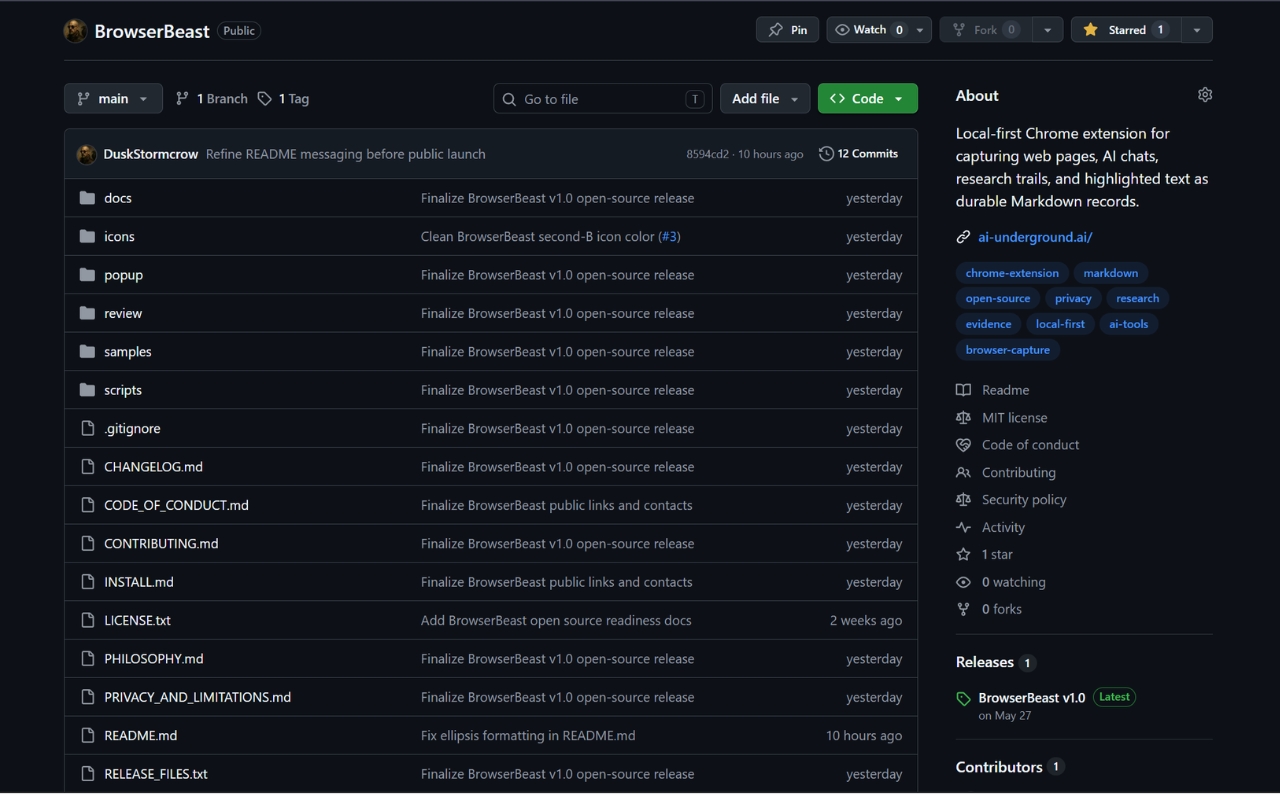
The BrowserBeast GitHub Repository (Public / Open Source)
-
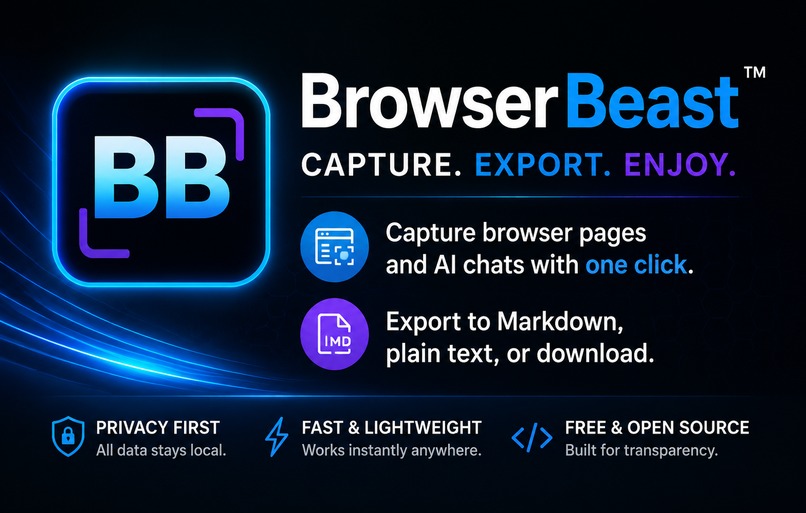
BrowserBeast Small Marketing Tile
-
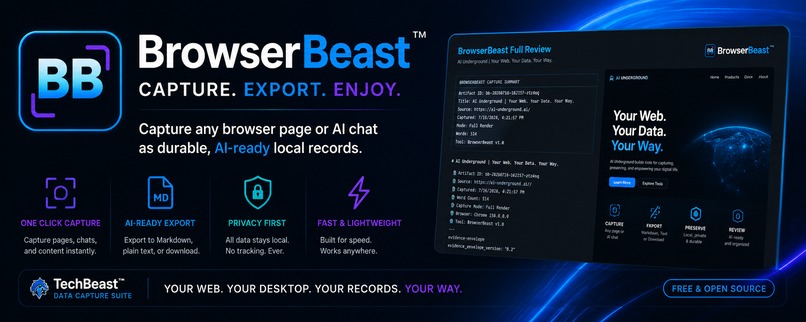
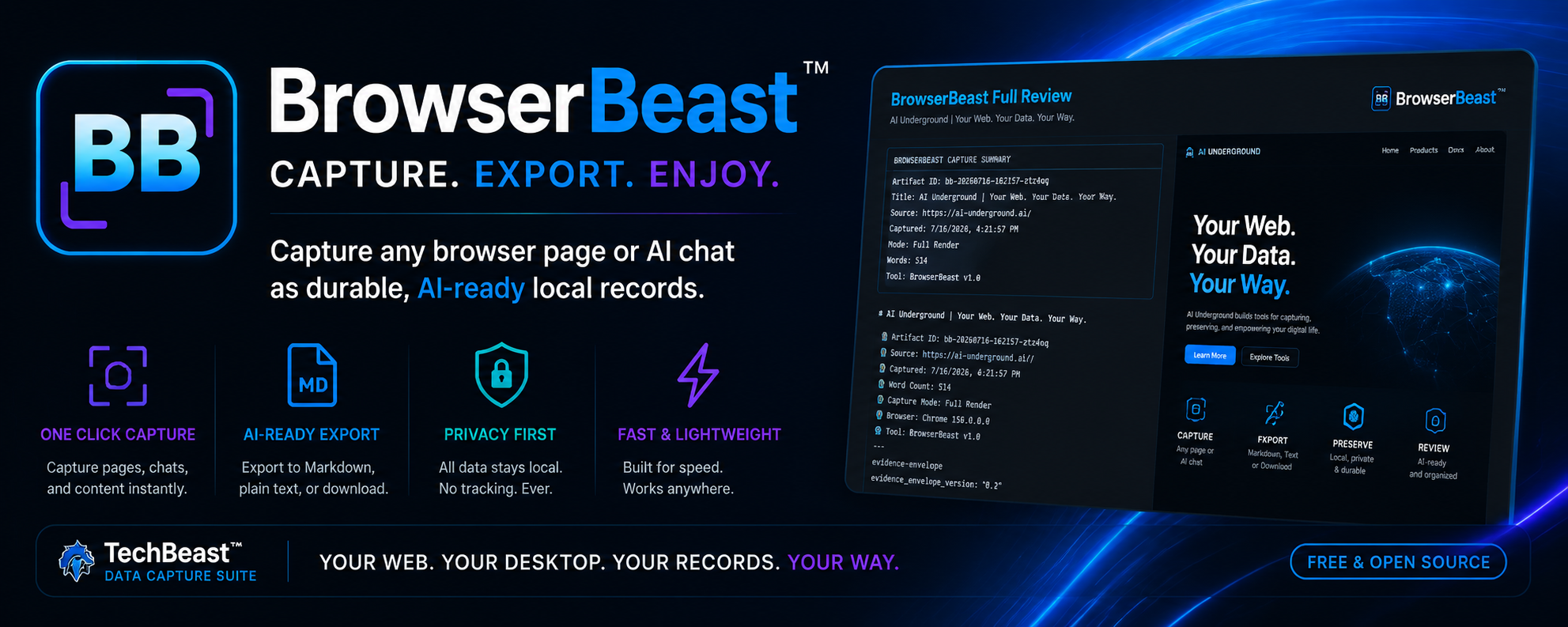
BrowserBeast Marquis Tile and Banner
-

BrowserBeast Eyecon
-

DesktopBeast Icon
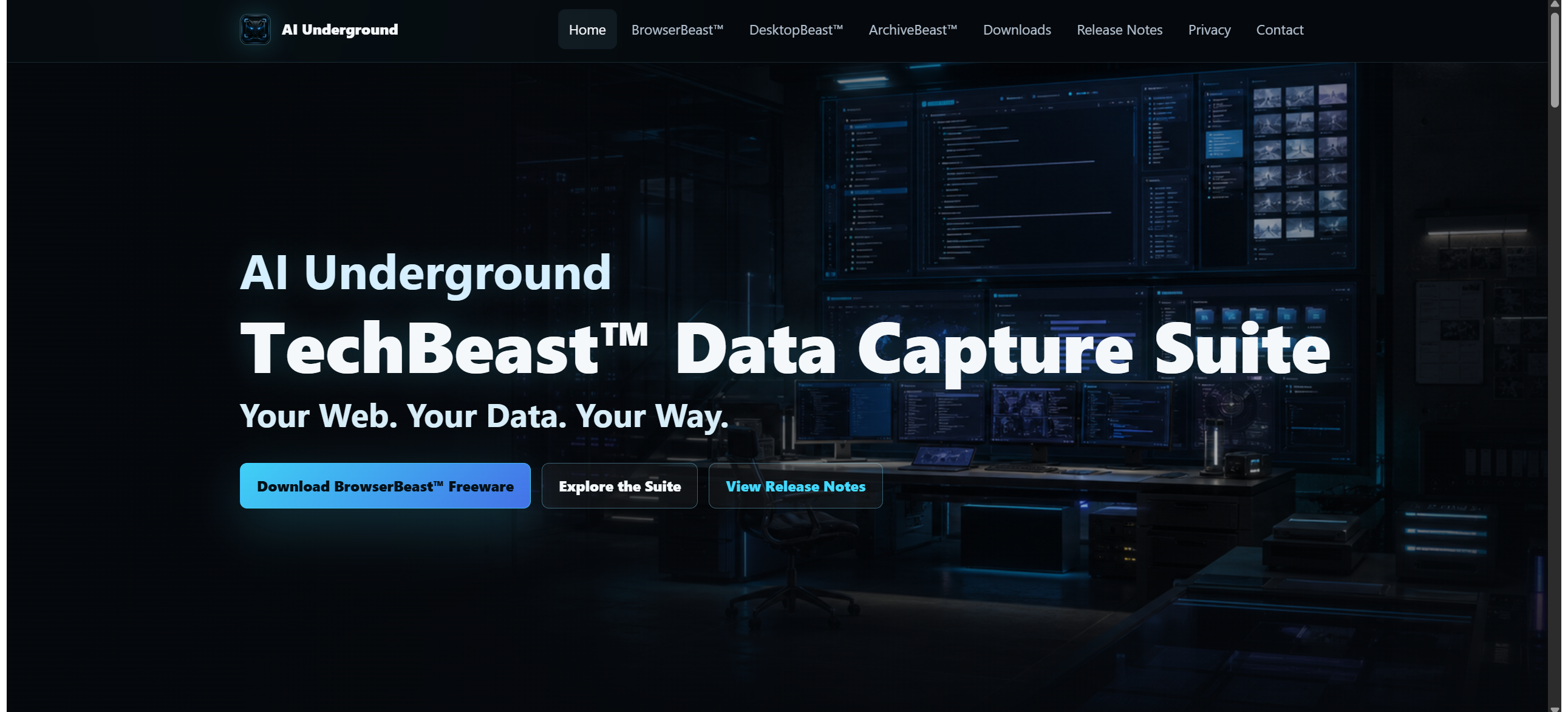
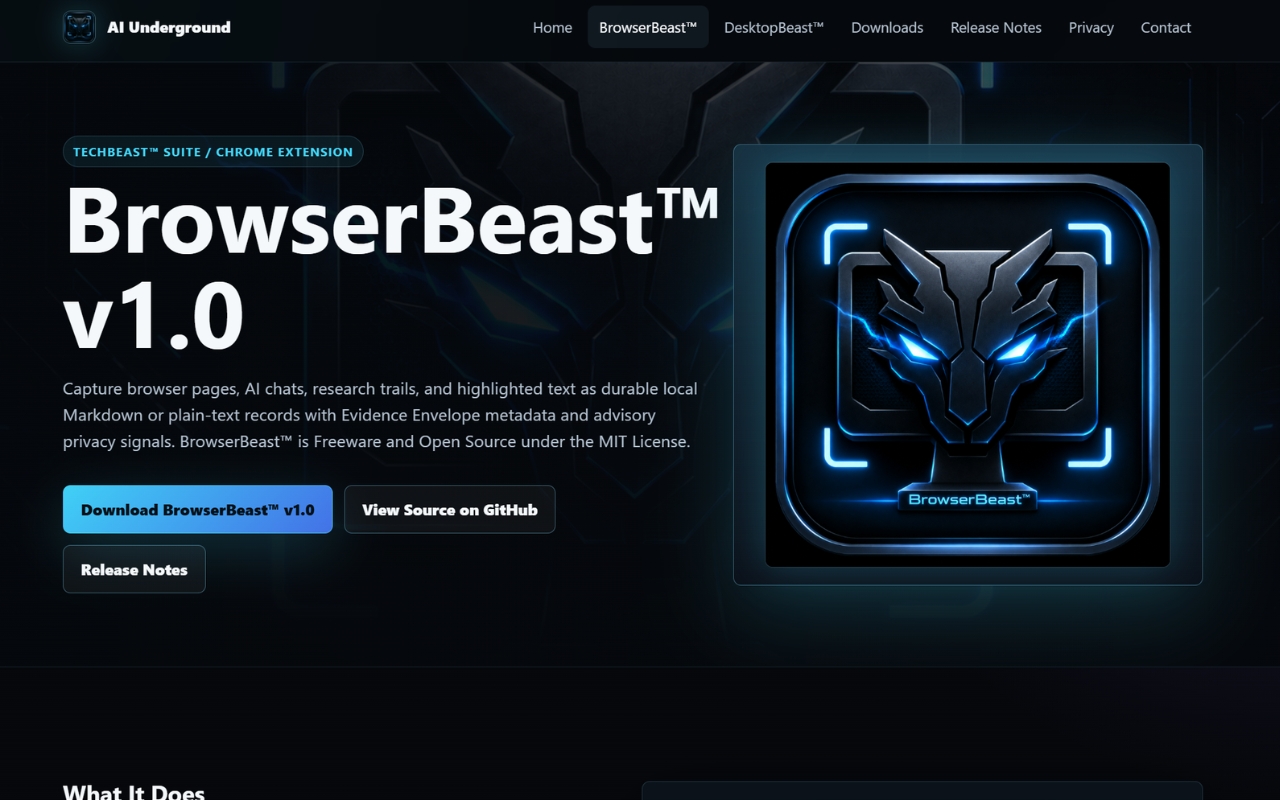


TechBeast™ Data Capture Suite
Inspiration
I am not a traditional software developer.
I am a retired screenwriter, former police officer, and security manager. I happened to retire just as the first wave of commercially available AI systems hit the market.
Well... I don't golf, and it wasn't Football Season, so I began engaging with AI.
Cautiously at first. Even suspiciously, if I'm being honest.
But as the models improved, my fascination grew, and so did the amount of time I spent working with them.
Then, over the months, I found myself asking the same question again and again.
"Where is all that work I did last week?"
Important ideas disappeared into browser tabs, changing web pages, AI conversations, desktop applications, PDFs, terminal windows, and account histories. Screenshots preserved appearance but lost searchable text. Copy-and-paste preserved text but stripped away source, context, and provenance.
I wanted durable records: portable files that preserved not only what something said, but where it came from, when and how it was captured, and which tool created it.
That recurring frustration eventually evolved into the TechBeast™ Data Capture Suite.
What it does
TechBeast™ is a local-first evidence capture suite for preserving digital information together with its provenance.
Today, the suite consists of three components.
BrowserBeast™ captures rendered web pages, highlighted passages, and AI conversations as portable Markdown or plain text. Each Markdown capture includes an embedded Evidence Envelope describing where, when, and how the capture occurred. BrowserBeast is a free, open-source Chrome extension released under the MIT License.
DesktopBeast™ extends the same philosophy across the entire Windows environment, capturing applications, documents, terminals, games, browser windows, AI clients, and other desktop content. A DesktopBeast capture combines OCR text, visual evidence, diagnostics, privacy advisories, and provenance into a portable evidence package.
The TechBeast Library and Evidence Viewer™ provides an early unified environment for organizing and reviewing captures created by both BrowserBeast and DesktopBeast.
The philosophy is simple.
Capture the web. Capture the desktop. Keep the record.
The human and AI team behind it
I want to be completely up front about this.
ChatGPT and Codex taught me virtually everything I know about software development. I began this project with no programming background or formal training whatsoever.
Over the past few years, successive OpenAI models helped me translate ideas into architecture, understand unfamiliar technologies, review code, diagnose failures, improve documentation, refine interfaces, test builds, and prepare releases.
All without driving me insane, I might add.
Growing up, I was a poor student. Teachers eventually became impatient, so I stopped asking questions. AI turned that experience completely upside down. OpenAI's models never rolled their eyes when I asked a dumb question. They explained it another way. Then another. Then another if necessary.
Believe me... teaching me software development is no small assignment.
During Build Week I worked primarily with two OpenAI collaborators.
Nyx is a cultivated Persona developed over months of collaboration and currently working through GPT-5.5 and GPT-5.6 Sol Light. She served as product strategist, technical critic, architectural sounding board, and documentation partner.
I don't particularly enjoy referring to my AI collaborators by model numbers, so Codex eventually became Vesper. Working through GPT-5.6 Sol Medium, Vesper focused on implementation review, repository auditing, release engineering, verification, and public-release preparation.
I remained responsible for product direction, implementation decisions, hands-on testing, scope, and every final approval.
The workflow was never "ask AI to write software."
It became ongoing engineering conversations in which ideas were conceived, challenged, argued over, simplified, and only then allowed to become code.
Some of the most valuable work happened during what we came to call chalkboard sessions: conversations that clarified architecture, reduced scope, improved terminology, exposed weak assumptions, and frequently decided what not to build.
TechBeast reached its current form through that collaboration.
What existed before Build Week
TechBeast was already an active project when Build Week began.
Before July 13, BrowserBeast, DesktopBeast, embedded Evidence Envelopes, an early evidence viewer, the AI Underground website, and a growing library of real-world captures already existed.
In fact, I didn't even discover the OpenAI Build Week competition until July 17, while this work was already well underway.
I didn't invent a disposable hackathon project.
Build Week became the catalyst that transformed an actively developed private project into a coherent, documented, and publicly available release.
The work submitted here is therefore honest about where the project came from—and equally honest about what changed during Build Week.
What changed during Build Week
Build Week marked the transition from active private development to public release and architectural clarity.
Working alongside Nyx and Vesper, powered by GPT-5.6 and Codex, I:
- released BrowserBeast™ v1.0 as free, open-source software under the MIT License;
- audited, cleaned, and hardened the public repository;
- completed installation, security, contribution, privacy, and release documentation;
- established deterministic release packaging and validation;
- rebuilt the AI Underground website around the broader TechBeast ecosystem;
- prepared marketplace materials and submitted BrowserBeast to the Chrome Web Store;
- expanded the early viewer to recognize and display captures from both BrowserBeast and DesktopBeast;
- clarified the architectural relationship among BrowserBeast, DesktopBeast, the Evidence Envelope, and the future TechBeast Library and Evidence Viewer.
Perhaps the biggest realization was that BrowserBeast and DesktopBeast were never really separate applications.
They were complementary capture engines built around exactly the same philosophy:
Preserve durable, portable, provenance-rich records.
That realization changed the project's architecture, roadmap, terminology, and even the way we explained it to other people.
Perhaps fittingly, much of that work was documented using BrowserBeast itself, creating an evidence trail of the product's own evolution throughout Build Week.
Challenges
The greatest challenge wasn't writing more software.
It was deciding what not to build.
Build Week generated dozens of promising ideas—from richer metadata and artifact relationships to standardized evidence packages, integrity verification, and expanded search capabilities. Trying to force all of them into Version 1 would have weakened a working product.
So we chose stability, clarity, and honest scope.
Another challenge was designing records that remained both human-readable and AI-friendly while preserving provenance without depending on proprietary infrastructure.
That led to one simple architectural rule.
The Evidence Envelope belongs to the artifact.
The primary Markdown record should always stand on its own. Images, indexes, structured metadata, and future package components should enrich the record—not become requirements for understanding it.
Accomplishments
During Build Week I:
- released BrowserBeast™ v1.0 publicly under the MIT License;
- rebuilt AI Underground around the TechBeast ecosystem;
- demonstrated BrowserBeast and DesktopBeast preserving real engineering work instead of staged examples;
- established a shared Evidence Envelope model across both capture engines;
- expanded the early viewer to consume browser and desktop captures;
- submitted BrowserBeast to the Chrome Web Store;
- documented the project's own evolution using the very tools being submitted.
The project didn't merely produce evidence artifacts.
It produced the evidence of its own transformation.
What we learned
The most important lesson from Build Week was that AI becomes dramatically more useful when its inputs remain readable, attributable, portable, and under the user's control.
We also learned that AI is most valuable as an engineering collaborator—not merely as a code generator.
Some of the week's best decisions came from conversations that simplified architecture, challenged assumptions, corrected terminology, and prevented unnecessary features from entering the release.
Perhaps the clearest sign that BrowserBeast was succeeding came when we stopped treating it as something we were testing.
We started relying on it.
It preserved release discussions, documentation, website revisions, architectural decisions, store submissions, and AI conversations that otherwise would have been difficult to find again.
One sentence naturally emerged from that experience.
The AI found it. BrowserBeast makes sure you keep it.
What's next
The next major milestone is architectural alignment across the TechBeast ecosystem.
Future work focuses on:
- standardizing evidence formats across BrowserBeast and DesktopBeast;
- formally defining the TechBeast™ Evidence Package;
- expanding integrity and validation capabilities;
- continuing development of the TechBeast Library and Evidence Viewer;
- improving organization, search, review, and export workflows;
- preserving the portability and independence of the original capture artifacts.
BrowserBeast will remain the easiest entry point into the ecosystem.
DesktopBeast will continue toward a polished professional Early Access release.
The guiding principles remain unchanged.
- Local-first
- User-controlled
- Provenance-aware
- Human-readable
- AI-friendly
- Honest about limitations
- Open where openness benefits the community
The long-term goal is simple.
Make trustworthy evidence capture as easy as taking a screenshot—while preserving the context that screenshots leave behind.

Log in or sign up for Devpost to join the conversation.