-
-
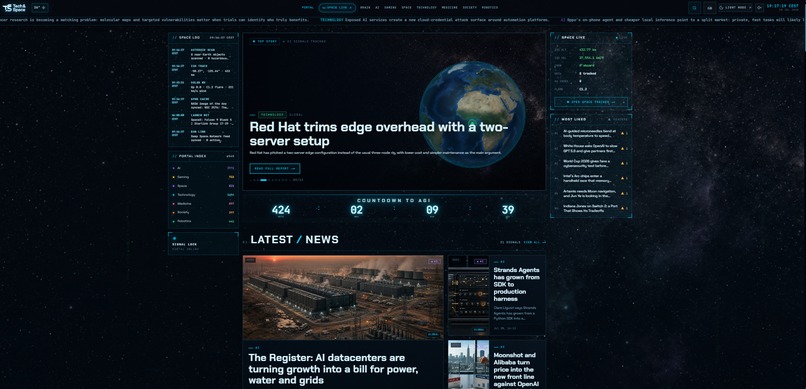
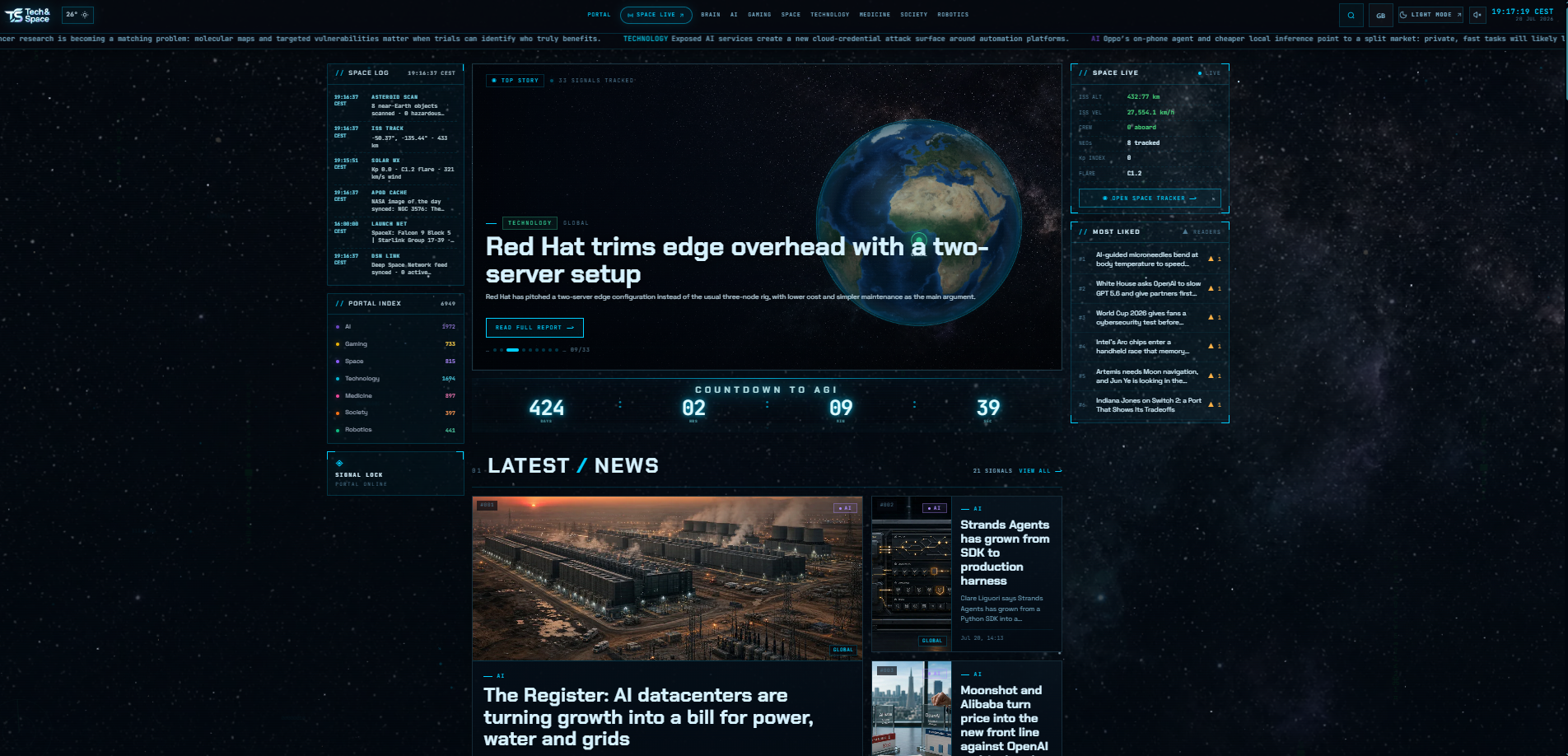
Tech&Space portal hero page
-
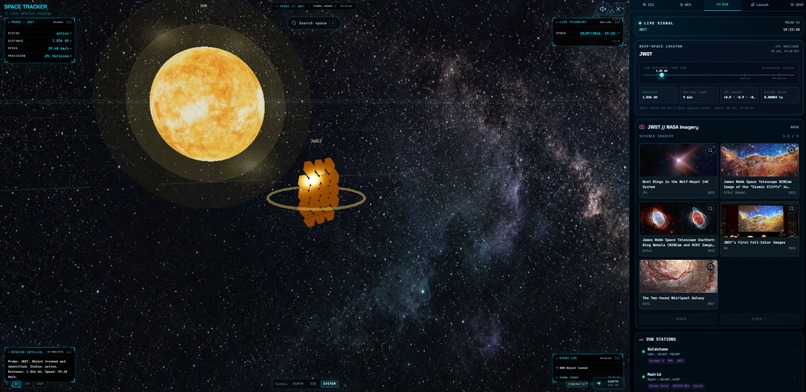
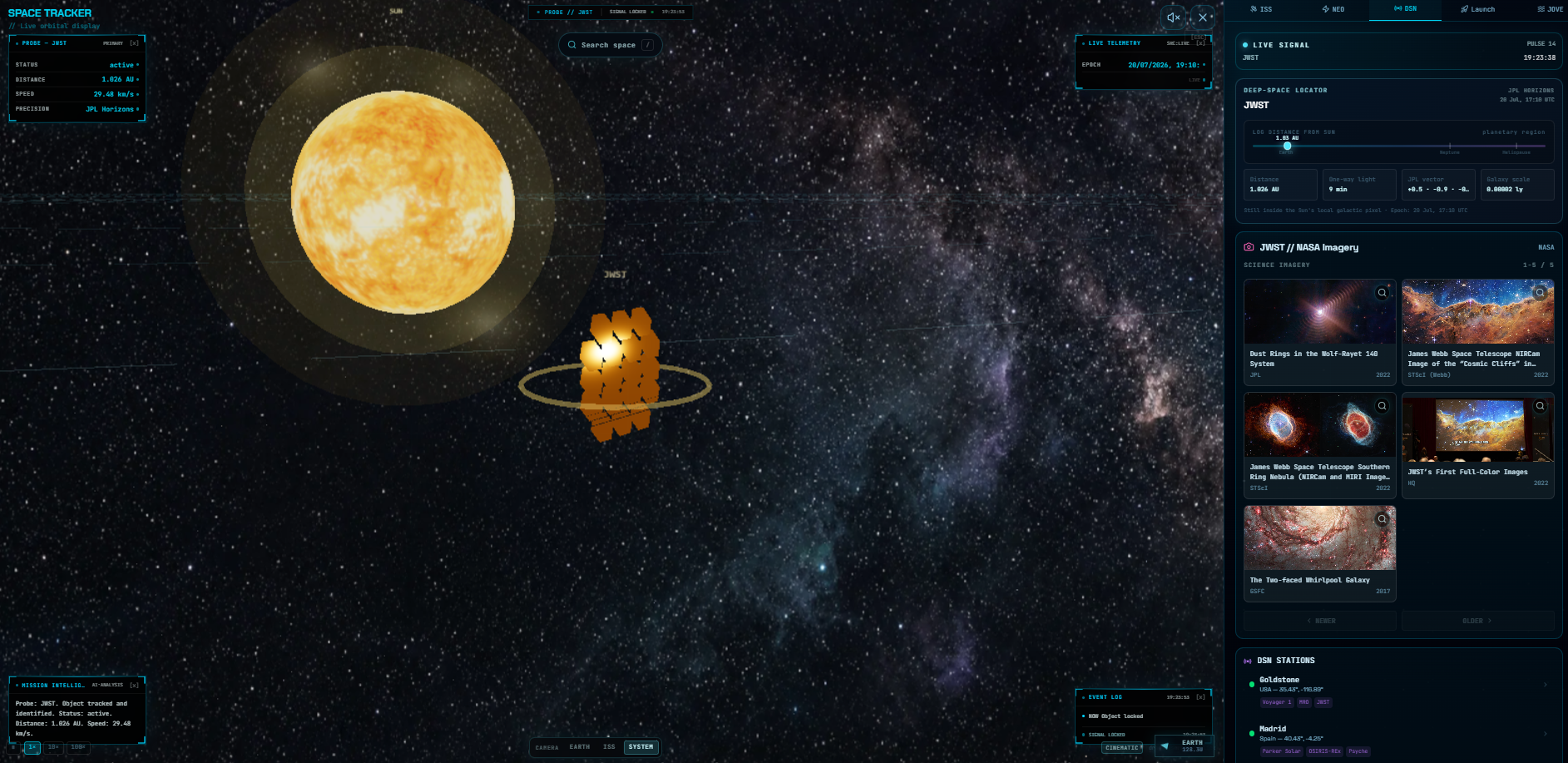
Space tracker LIVE
-
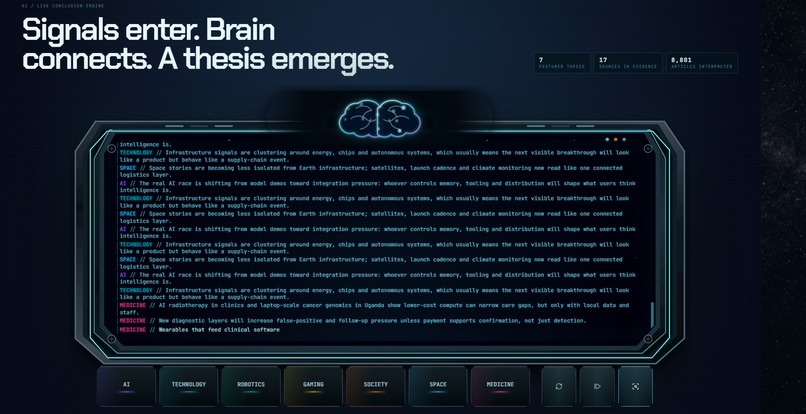
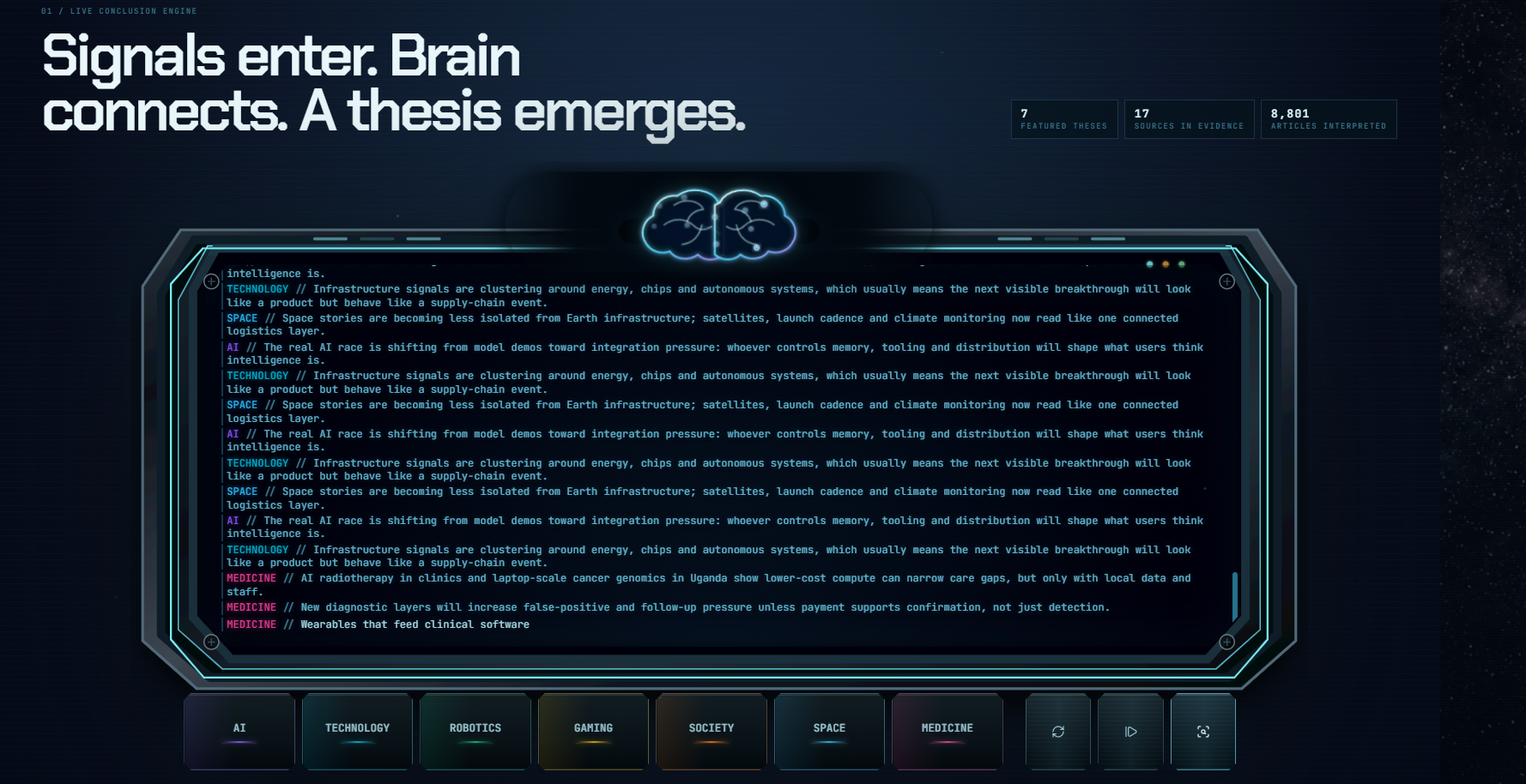
Brain conclusions
-
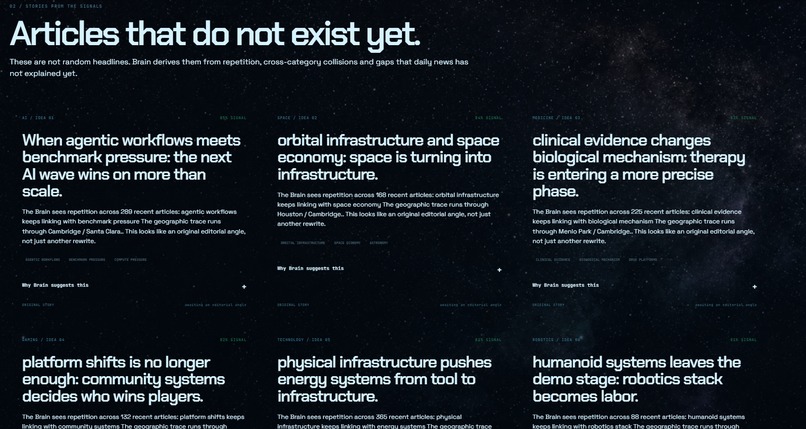
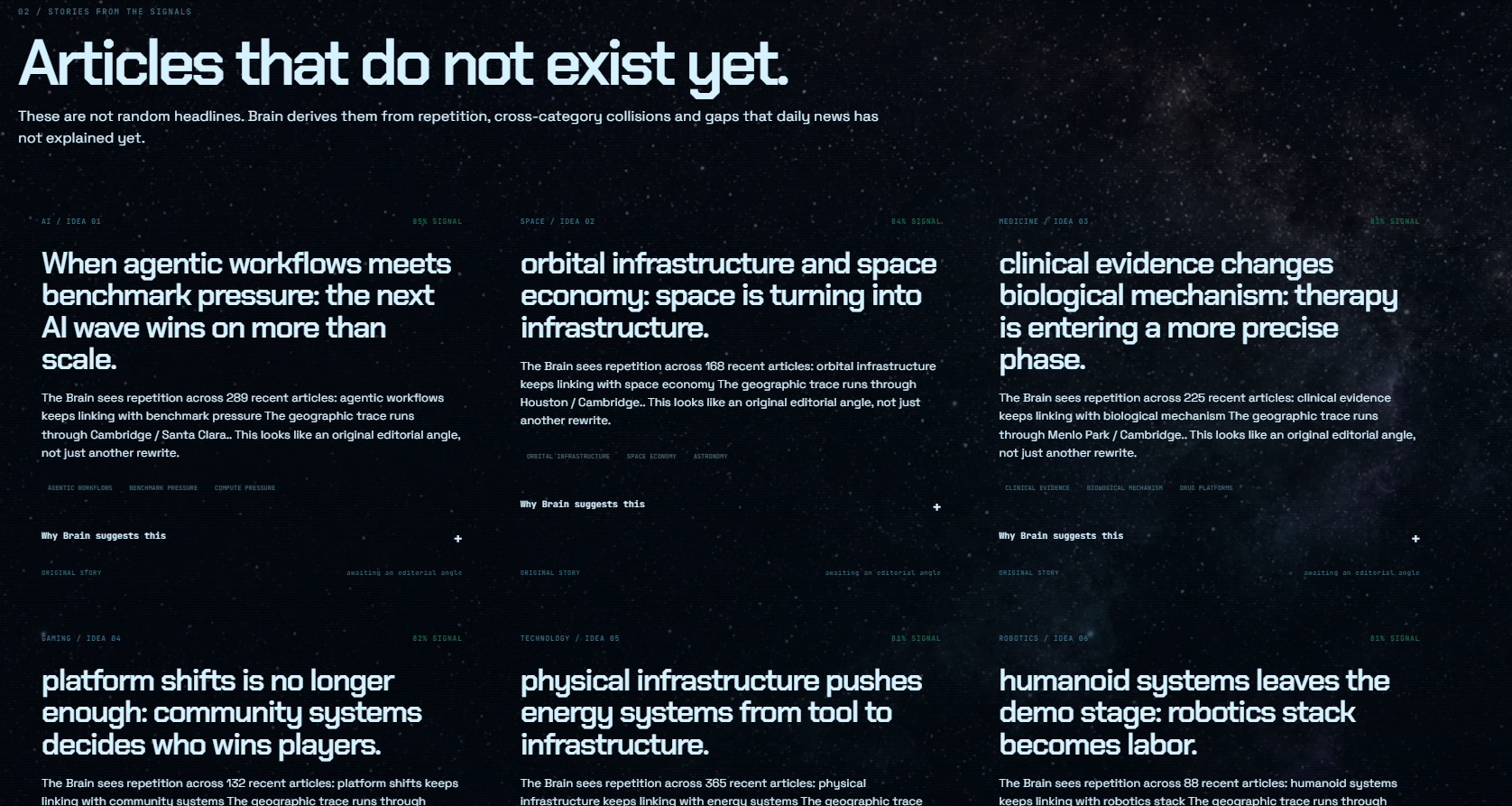
Brain creating new articles
-
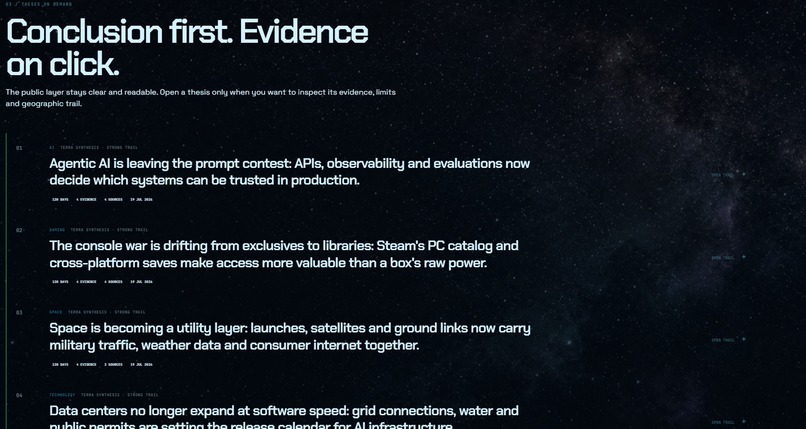
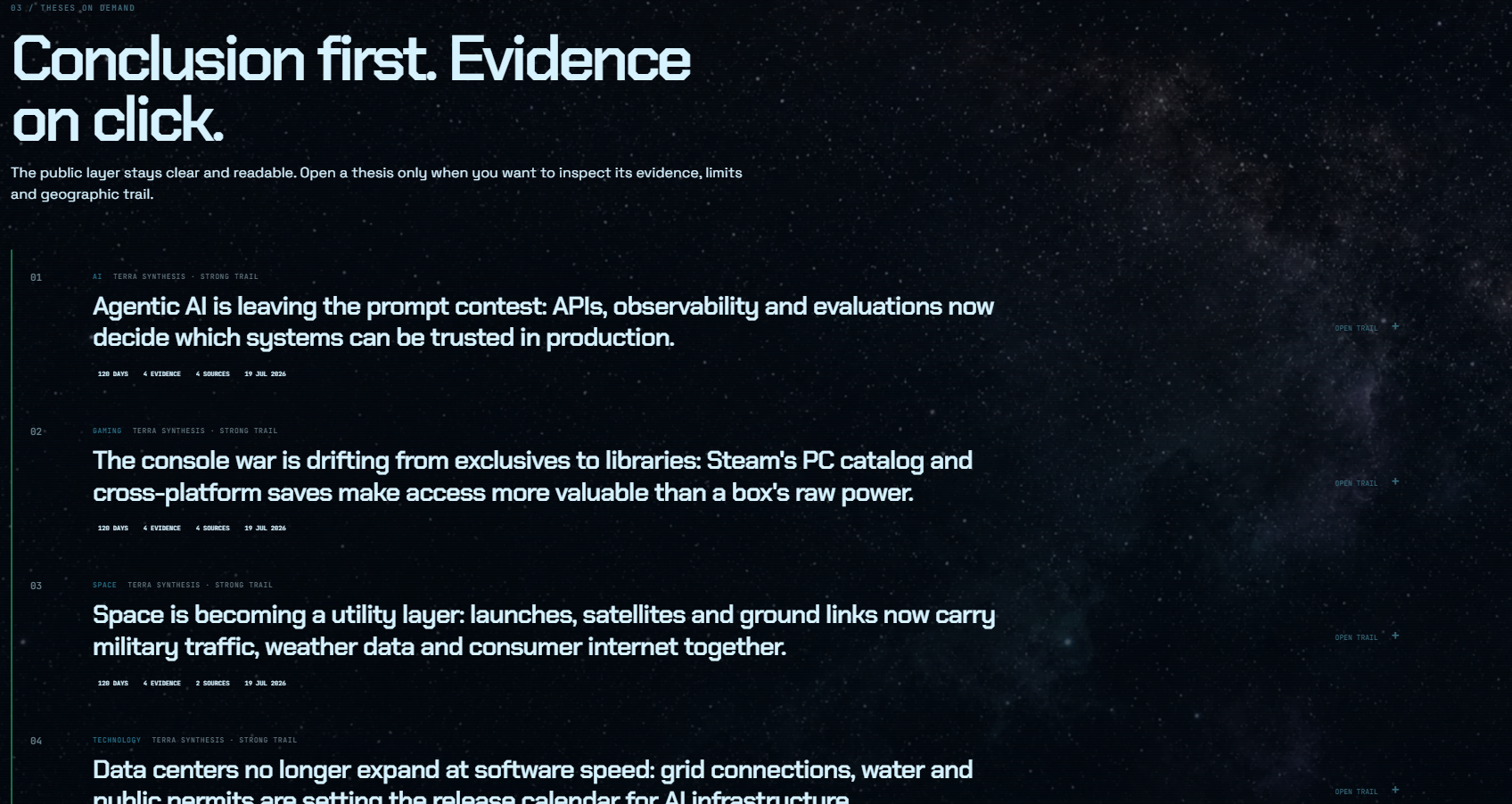
Brain theses
++Inspiration
I originally built TECH&SPACE for myself.
I follow artificial intelligence closely and usually want to test new models, products, and tools as soon as they appear. I am also interested in space, robotics, medicine, gaming, and the broader impact of technology on society.
The problem is that there is now too much happening for one person to follow.
Every day, dozens of potentially important stories appear across different fields. I can spend hours following AI and still miss something important in space, robotics, medicine, or gaming. I still love gaming, even though I rarely have enough time to actually play.
TECH&SPACE started as my attempt to collect all of those interests in one place.
I wanted a portal that could continuously discover, organize, explain, and connect the developments I care about. I also wanted it to work in English, Croatian, and German instead of existing only as another English-language technology site.
Over time, I realized that collecting and summarizing news was not enough.
The more interesting question was: What do all these developments mean when we look at them together?
That idea became Brain.
Brain is designed to remember previous events, compare them with new information, connect developments across different categories, and produce conclusions about what may be changing and why it matters.
During OpenAI Build Week, I extended TECH&SPACE from a multilingual publication into a connected AI intelligence platform.
++What it does
TECH&SPACE combines four main experiences: the Intelligence Portal, Brain V2, Mission Control, and Space Live with Space Tracker Pro.
Intelligence Portal
The main portal covers artificial intelligence, technology, space, robotics, gaming, medicine, and society.
The system can prepare approximately 50 to 60 new articles per day across English, Croatian, and German. The goal is not volume for its own sake. The goal is to create a useful daily overview of technological change that one person could never manually assemble.
Codex is involved throughout the platform.
It helps process incoming stories, prepare articles, generate new article images, maintain multilingual content, improve recommendations, diagnose production problems, and validate the system before deployment.
The portal includes related stories, category pages, article recommendations, mobile swipe navigation, multilingual discovery, SEO metadata, sitemaps, and production-safe content rendering.
I wanted the homepage to feel like a live technology portal rather than a simple list of headlines. Readers can move from current stories into Brain conclusions, deeper categories, related themes, and interactive space experiences.
Brain V2
Brain V2 is the most important part of the project for me.
Incoming stories are converted into structured knowledge containing the main claims, entities, themes, evidence signals, and possible long-term importance.
Brain compares new information with a 60-day active field of recent developments and with deeper historical memory. This allows it to notice relationships that may not be visible inside a single article.
An AI infrastructure story, for example, may become more meaningful when connected with developments in energy, semiconductors, robotics, medicine, regulation, or data centers.
GPT-5.6 Terra is integrated as the deep reasoning runtime inside the Brain conclusioner.
Codex launches the conclusioner in an ephemeral, read-only environment with maximum reasoning effort. The model receives recent memory, historical context, evidence metadata, source diversity, counter-signals, and multidisciplinary reasoning instructions.
It produces structured multilingual output containing public theses, supporting evidence, confidence boundaries, counter-signals, editorial connections, original article opportunities, and durable memory notes for future runs.
The public conclusion remains short and readable. I do not want visitors to face a wall of internal analysis.
However, the evidence is retained and can be opened when someone wants to inspect the reasoning more closely. Brain also shows signals that could weaken or contradict its conclusion.
Brain is not intended to be another summarizer. Its purpose is to connect events across time and categories, identify larger mechanisms, and sometimes suggest what may happen next.
It can also identify gaps in TECH&SPACE coverage and propose original articles that have not yet been written.
Mission Control
Publishing dozens of articles every day creates another problem: one person cannot manually prepare every social post, language version, publishing time, preview, and export.
Mission Control turns selected articles into coordinated multilingual campaigns.
From one article selection, the system can prepare English, Croatian, and German Facebook posts, an English X post, suggested publishing slots, campaign previews, and Metricool-ready schedules.
Codex handles the repetitive preparation and channel-specific formatting, but the editor keeps final control.
AI can generate, recommend, regenerate, validate, and organize the campaign. It cannot independently publish content or modify production without explicit approval.
That balance is important to me. I want the speed of automation without giving up editorial responsibility.
Space Live and Space Tracker Pro
I have always loved the atmosphere and scale of space, so I did not want the space section to be only another stream of articles.
Space Live and Space Tracker Pro turn scientific space information into an interactive visual experience.
Readers can explore Earth, planets, the Moon, the International Space Station, asteroids, near-Earth objects, and deep-space probes through search, cinematic camera movement, object focus, telemetry panels, scientific distance explanations, and mobile navigation.
The challenge was to make the experience visually impressive without making it scientifically meaningless.
Real space distances are difficult to represent, so the interface combines visual usability with explanations of where an object actually is. A reader should understand whether a probe is near Earth, beyond the Moon, between planets, or travelling into deep space.
The system also includes Deep Space Network context and explanations intended to make orbital and interplanetary distances easier to understand.
Space Tracker Pro connects the editorial side of TECH&SPACE with a visual product. A reader can discover a mission in an article and then explore its wider location and context.
Road to AGI
TECH&SPACE also includes a Road to AGI section and a Countdown to AGI widget pointing to September 27, 2027.
The date is not presented as a scientific certainty. It is a speculative and slightly playful editorial marker.
The idea is to track the development of AI as the countdown moves forward and compare real progress with expectations, predictions, hype, and changing definitions of AGI.
++How we built it
TECH&SPACE existed before Build Week as a live multilingual portal, an editorial pipeline, an early Mission Control, and an initial Space Live experience.
The submission does not claim that this earlier foundation was built during the event.
The Build Week work focused on meaningfully extending the platform after the submission period opened on July 13, 2026, at 9:00 AM Pacific Time.
Codex served as the principal engineering collaborator.
It audited the existing platform, planned an isolated testing environment, implemented Brain V2 and its persistent memory model, rebuilt the multilingual campaign workflow, improved Space Live and Space Tracker Pro, diagnosed production rendering failures, and introduced repeatable performance, SEO, security, compilation, and deployment checks.
Codex was not used only for isolated code generation. It worked across architecture, implementation, debugging, content processing, visual generation, testing, deployment validation, and documentation.
I provided the product vision, editorial direction, continuous acceptance feedback, and final production decisions.
The collaboration was highly iterative. I tested features, explained what felt wrong or incomplete, and Codex inspected the real implementation and improved it.
Major changes were tested in an isolated test3 environment before promotion to the public site through a verified blue-green deployment process.
The platform uses Codex, GPT-5.6 Terra, Next.js 16, React 19, TypeScript, Node.js, SQLite, MDX, Three.js, Cloudflare, and Metricool.
++Challenges we ran into
The first challenge was preventing Brain from becoming another article summarizer.
A useful intelligence system must connect real mechanisms across multiple stories and time periods while remaining honest about uncertainty. We separated concise public conclusions from expandable evidence, historical context, and counter-signals.
The second challenge was making Space Live cinematic, understandable, and responsive at the same time. Search, camera movement, scale, telemetry, probe positions, scientific context, and mobile controls all needed to work together.
The third challenge was shipping major changes without destabilizing a live publication. We used isolated builds, content compilation audits, production-like validation, health checks, stricter runtime boundaries, and blue-green deployment.
The fourth challenge was making Mission Control useful to one non-technical operator. It needed to remove repetitive work without removing human approval.
++Accomplishments that I am proud of
One person can now operate a seven-category, three-language technology publication that processes around 50 to 60 new stories per day.
Codex is involved across the entire system, from article and image preparation to engineering, testing, diagnostics, and deployment.
GPT-5.6 Terra performs meaningful production reasoning inside Brain instead of acting as a decorative chatbot.
Brain connects developments across categories and time, retains evidence and counter-signals, and proposes original editorial directions based on gaps in existing coverage.
One article can become a coordinated multilingual social campaign while every important publishing decision remains under human control.
Space Live turns technical orbital and deep-space information into a visual experience that is approachable on both desktop and mobile.
Most importantly, the Build Week submission is not a disconnected prototype. It is part of a live, working platform.
++What we learned
The best AI newsroom is not the one that removes the editor.
It is the one that gives a responsible editor more memory, broader comparison, faster preparation, and a clearer decision trail.
Speed alone is not enough. Controlled speed, persistent context, evidence boundaries, validation, and human approval are what make the system useful.
I also learned that complex intelligence should be progressively revealed. Readers need the conclusion first. The deeper evidence, counter-signals, and historical context should be available when they want to inspect it.
The same principle applies to Space Live. Scientific complexity becomes approachable when people have a clear point of focus, understandable context, and logical navigation.
++What’s next
Brain will gain thesis aging, contradiction alerts, stronger source-quality calibration, editor-feedback learning, and better tracking of how previous conclusions evolve as new evidence arrives.
Space Live will gain richer telemetry, additional missions, improved object fidelity, better event timelines, and clearer comparisons between orbital, planetary, and interstellar distances.
Mission Control will continue moving toward a guided workflow where the operator selects the stories, dates, languages, and channels while the system handles repetitive preparation and validation.
My long-term goal is to make TECH&SPACE a premium technology and orbital intelligence product and eventually make the Brain workflow portable for other small editorial teams working with their own licensed data.
TECH&SPACE began because I could no longer follow everything that interested me.
Now I am building the system that helps me understand how all of those developments fit together.
Built With
- cloudflare
- codex
- css3
- git
- github
- gpt-5.6
- gpt-5.6-terra
- html5
- javascript
- json
- linux
- mdx
- metricool
- next.js
- node.js
- openai
- react
- rest-api
- sqlite
- systemd
- three.js
- traefik
- typescript
- webgl


Log in or sign up for Devpost to join the conversation.