Inspiration
Early detection of systemic diseases like Sklerosis Multiplex and Diabetes often requires invasive or costly tests. We realized that human tears are a "liquid biopsy" containing biochemical maps of our health. We built Tearz to turn a single drop of fluid into an instantaneous, non-invasive diagnostic window.
What it does
Tearz is a two-stage diagnostic platform:
- Screener: A high-sensitivity model that flags "Unhealthy" subjects.
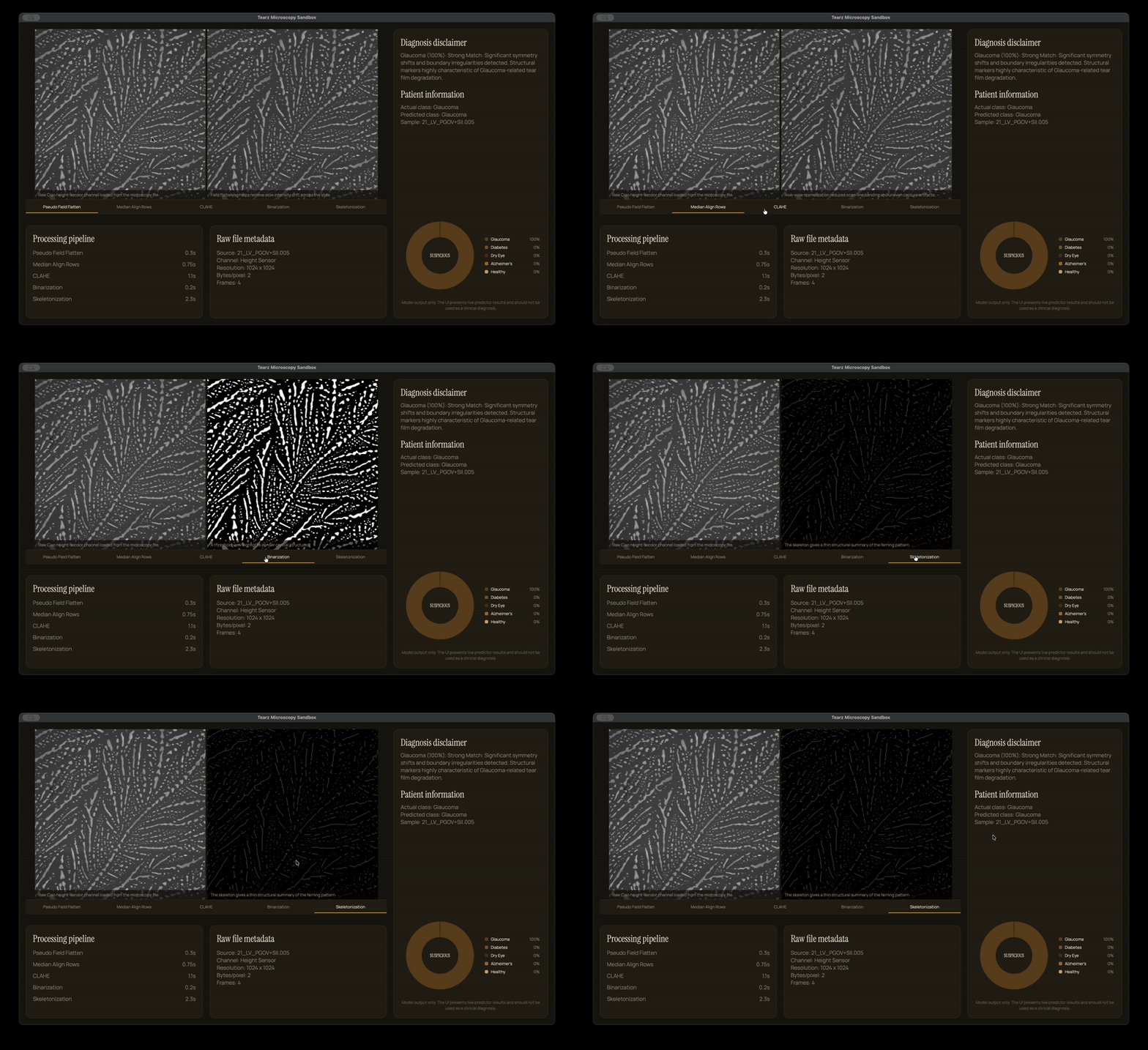
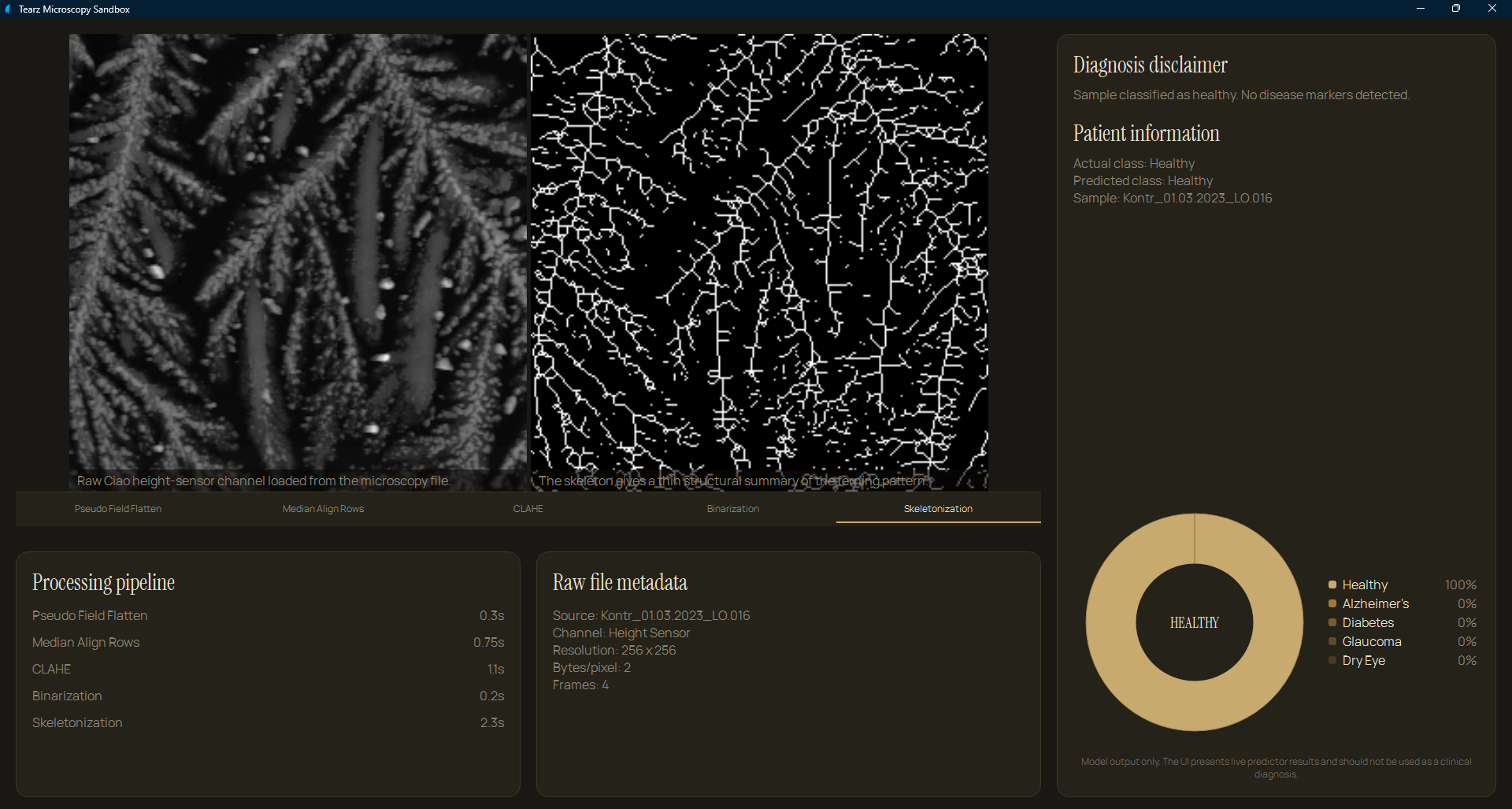
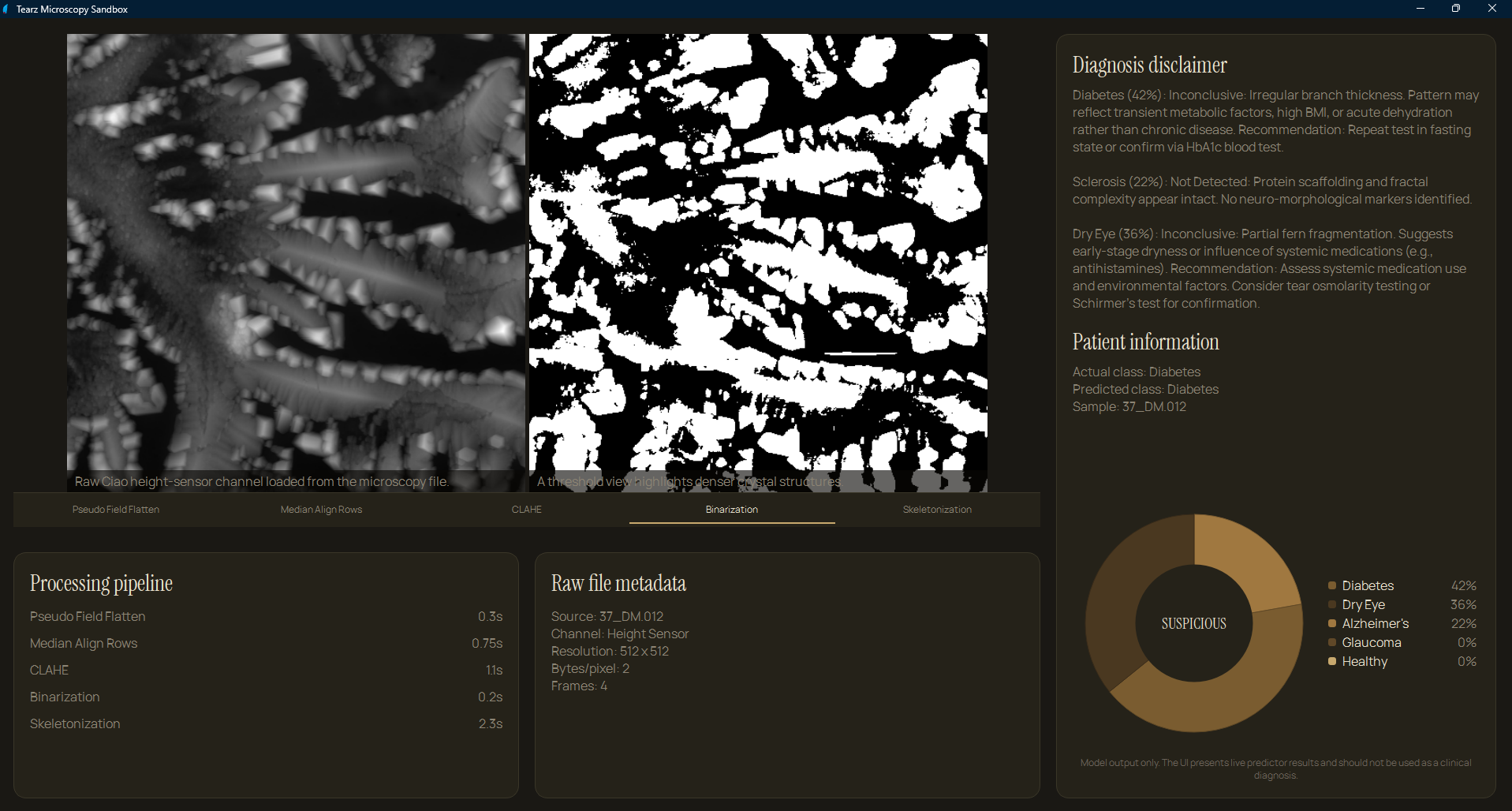
- Specialist: A deep-learning ensemble that identifies four specific pathologies: Glaucoma, Dry Eye (SucheOko), Sclerosis, and Diabetes. It features a drag-and-drop medical GUI that provides clinicians with predictions, confidence scores, and diagnostic recommendations.
How we built it
- Preprocessing: A Gwyddion-inspired pipeline (Pseudo-field flattening, Median row alignment, CLAHE, and Skeletonization) to isolate crystalline structures from sensor noise.
- Feature Engineering: Extracted 240 topological and texture features (Fractal Dimension, J/E Ratio, Haralick textures) for a robust Stage 1 Logistic Regression.
- Deep Learning: A 5-fold ResNet50 Ensemble using transfer learning, label smoothing, and Test-Time Augmentation (TTA) to maximize classification accuracy.
Challenges we ran into
- Sensor Noise: Surgical removal of 1-pixel wide scanner "scars" without blurring delicate fern branches.
- Data Scarcity: Preventing overfitting and data leakage on a small dataset (169 images) by enforcing strict subject-level splits.
- Computation Time: Training on raw 16-bit images was limited by available hardware, necessitating a strategic pivot to an optimized 8-bit pipeline.
Accomplishments that we're proud of
Achieving a perfect safety net for initial pathology screening.
- Resilient F1-Score: Reaching a 72.81% F1-score on a multi-class problem with limited subject diversity.
- Clinical Utility: Bridging the gap from a Jupyter notebook to a functional, user-friendly medical interface.
What we learned
- Data Quality > Model Complexity: Surgical preprocessing and row alignment were more impactful than switching to larger Transformer models.
- Small Data Strategy: Handcrafted topological features provide a stronger inductive bias than raw pixels in low-sample medical regimes.
- Medical Logic: The importance of designing for "Explainability" and acknowledging "Confounders" like age and hydration.
What's next for Tearz
- Dataset & Physiological Expansion: Scaling subject diversity and integrating patient metadata (age, BMI, hydration) to better "de-confound" metabolic shifts from specific disease signatures.
- 16-Bit High-Fidelity Training: Utilizing upgraded computational power to train on raw 16-bit data, capturing 65,536 intensity levels to reveal nearly invisible crystalline markers.
- Advanced Architecture Fine-Tuning: Leveraging high-performance computing to explore larger Vision Transformers and ensembles, pushing our F1-scores toward clinical-grade 90%+.
Built With
- keras
- python
- pytorch
- scikit
- scikit-learn


Log in or sign up for Devpost to join the conversation.