Inspiration
Everything on my desk went through a factory I have never seen. I make videos about how rockets and factories work, and the most common question I get is the simplest one: what is this thing actually made of? Search gives you a 20 minute video about someone else's headphones, or a wall of chatbot text. I wanted the answer drawn on my own photo, in two seconds.
What it does
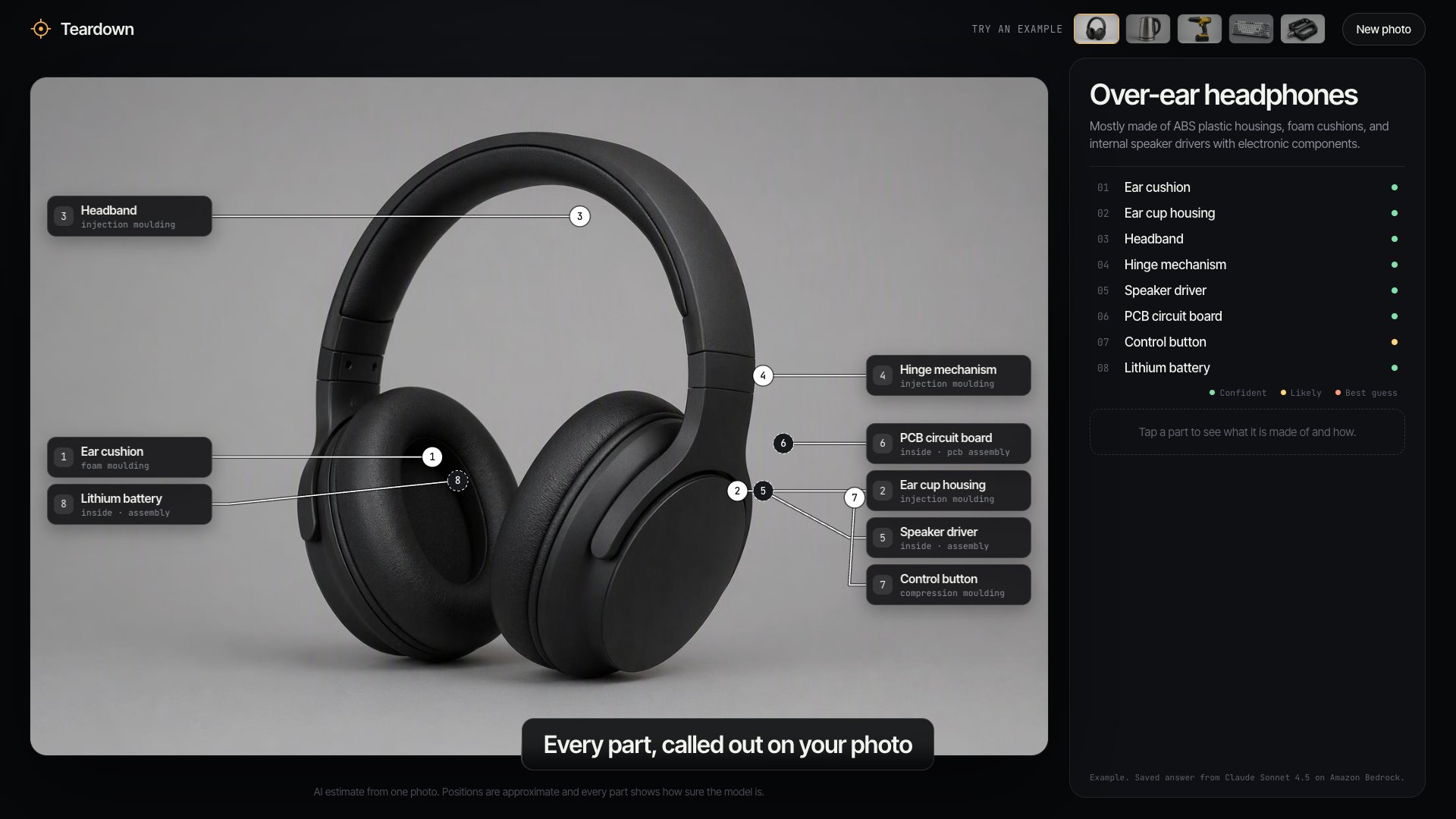
You drop in a photo of an object (or take one with your phone). Teardown:
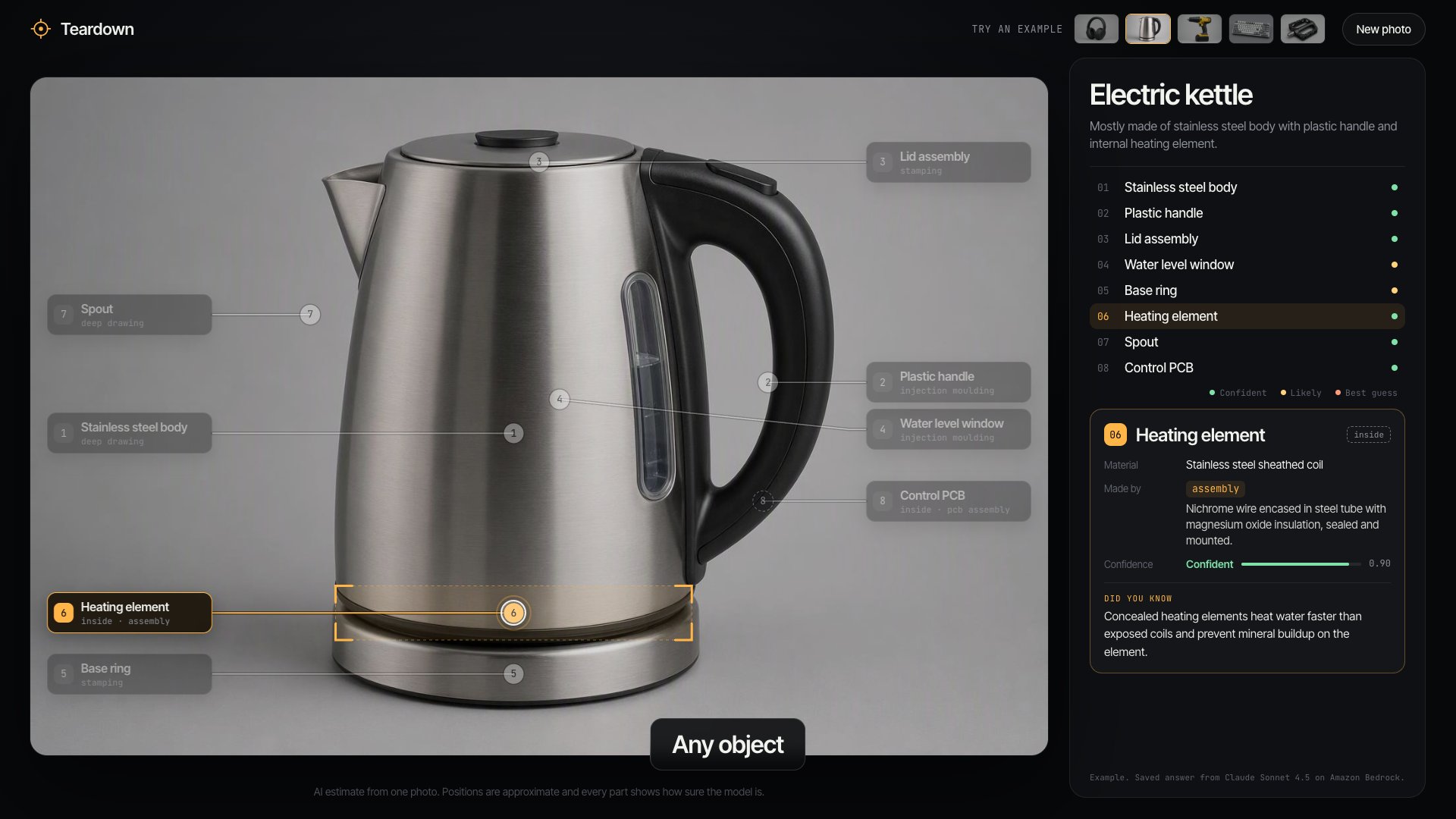
- draws numbered callouts onto your photo, one after another, for 4 to 10 main parts, including the hidden ones (drivers, circuit boards, batteries, heating elements) shown with dashed dots;
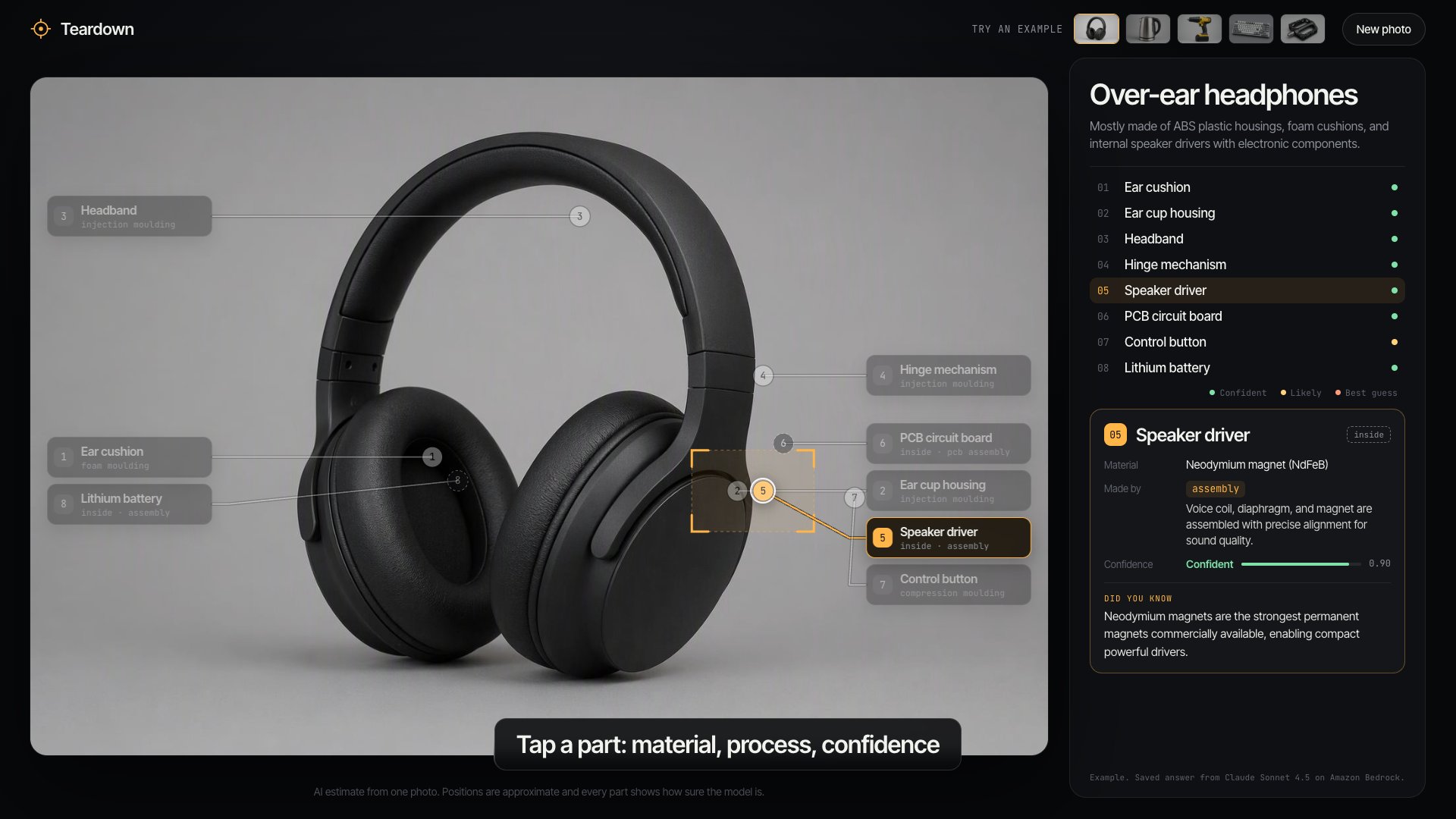
- lists the parts beside the photo; tap one and its card opens: material, manufacturing process (injection moulding, stamping, die casting, PCB assembly, winding and so on), one line on how it is made, a fun fact;
- says how sure it is on every part: Confident, Likely, or Best guess under 0.6;
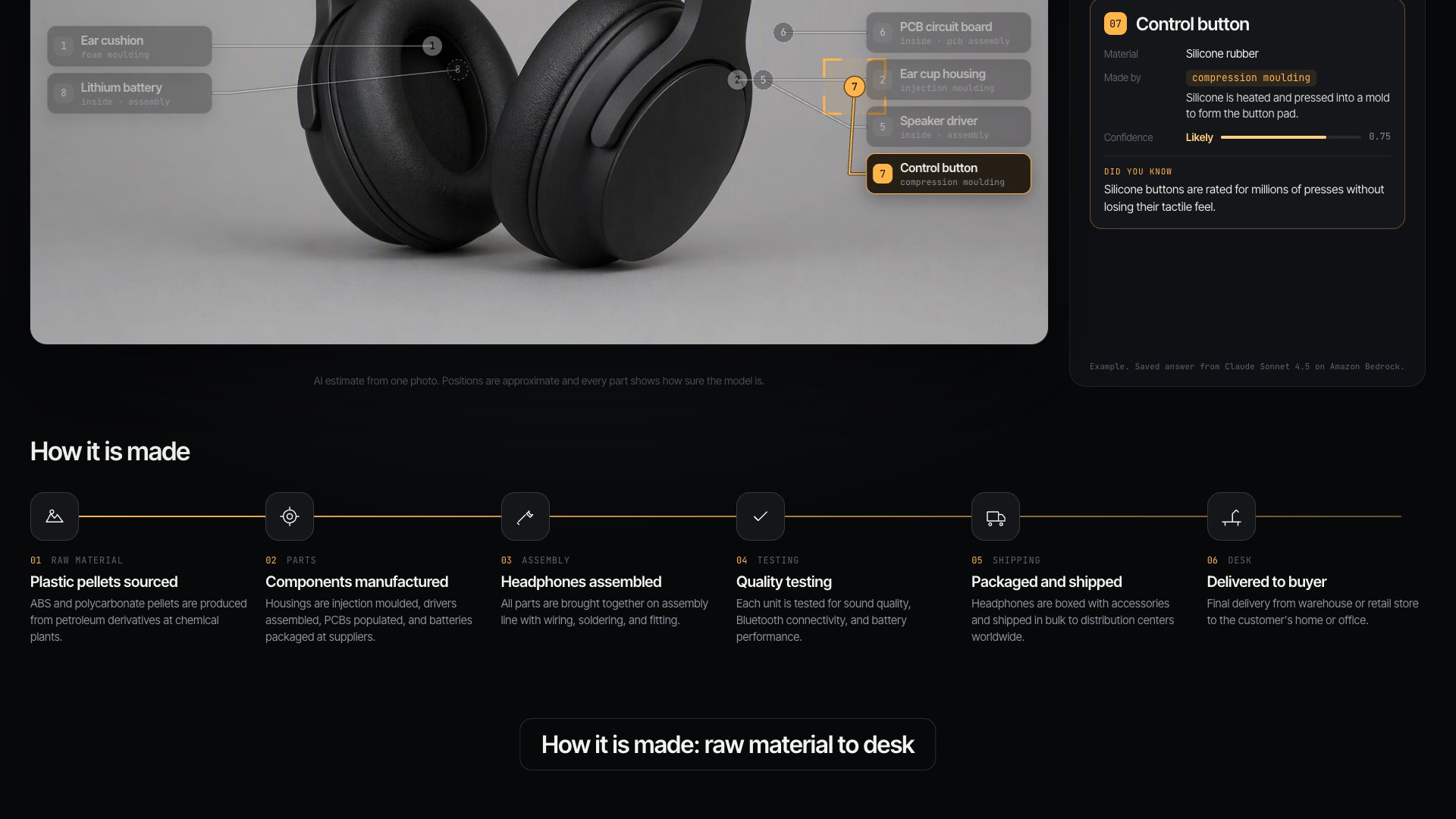
- shows "How it is made", 4 to 6 steps from raw material to your desk.
Five examples (headphones, kettle, cordless drill, mechanical keyboard, bicycle pedal) load instantly so anyone can try it without uploading.
How I built it
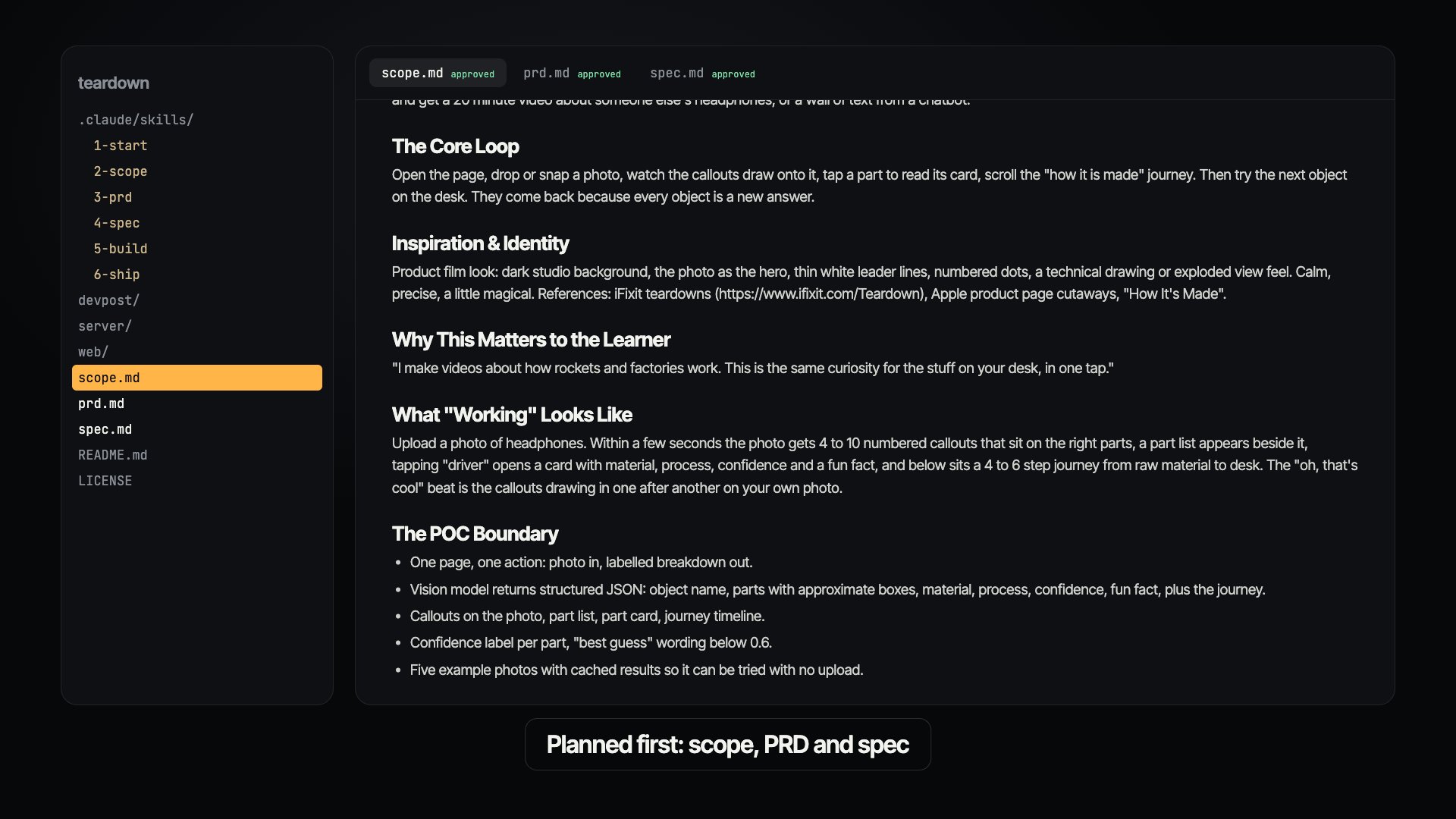
I started from an empty folder and installed the Devpost Learn skill pack (npx skills add challengepost/learn-ai-basics --all -y) in Claude Code. Then I ran the skills in order. 1-start asked about me and my idea. 2-scope pushed me to name the one distinctive thing (the answer is drawn on your own photo) and to cut accounts, history, chat and exact segmentation. 3-prd walked the journey screen by screen and asked what happens when the photo is bad. 4-spec chose the stack with me and made me write down what I was least sure about: whether an AI's bounding boxes are good enough to put dots on. Only then did 5-build split the work into five slices, each built, checked and committed.
The stack: a React + TypeScript + Vite page and a tiny Node server that holds the key. The server sends the photo to Claude Sonnet 4.5 on Amazon Bedrock through the Converse API with image input and a forced tool call, so the answer always comes back as JSON in a fixed schema. The server validates it (part counts, box ranges, allowed processes, confidence) and asks once more with the errors if it breaks a rule. The page lays out the labels so they never overlap and leader lines do not cross, then animates them in. The five sample photos are AI generated product shots, and their answers are real model outputs saved as JSON so the examples are instant and the demo film is repeatable.
Challenges I ran into
- Bounding boxes from a language model are rough. Big parts land well, small ones drift, hidden ones are a guess. Instead of hiding that, the product says it: confidence words on every part, dashed dots for inferred internal parts, and a note that positions are approximate.
- Label layout on a busy photo. The first version crossed leader lines across the whole image and hid a dot under its own label. Fixes: labels go to the side of their dot, neighbouring slots swap when lines would cross, and labels move out of the way of dots that sit in their column.
- My image generation key for the sample photos was rejected, so the samples were made with a different image model. The script keeps both paths.
- The dev server restarted itself in the middle of requests because of a file watcher. Turning the watcher off fixed the "socket hang up".
Accomplishments that I'm proud of
- The moment the callouts draw onto your own photo. It is one screen and one action, and it looks like a product film.
- Strict structured output: every answer in this project passed validation on the first try.
- It is honest by design. The uncertainty became a feature instead of a disclaimer.
What I learned
Planning before building changed what got built. The interview made me cut chat, accounts and history before I had written any code, and the spec's "what are you least sure about" question turned into the confidence labels, which ended up being one of the best parts of the design. Writing the risky assumption down first, then checking it on real outputs on day one, is something I will keep doing.
What's next
- Compare two products side by side (two kettles: which one is easier to recycle).
- A share card image and link for a teardown.
- A sustainability view per part: recyclable or not, and what it is made from.
- An exploded view animation that pulls the parts apart.
Limitations
- Part positions are approximate; hidden parts are inferred.
- Materials, processes and fun facts are not fact checked.
- None of the five examples has a part below 0.6 confidence, so "Best guess" does not appear in the film.
- Sample photos are AI generated studio shots.
- Not deployed; runs locally.
- The skill interviews were answered from my written project plan in one sitting.
Built With
- amazon-bedrock
- azure-ai-foundry
- claude
- claude-code
- claude-sonnet-4.5
- devpost-learn-skill-pack
- ffmpeg
- node.js
- playwright
- react
- typescript
- vite

Log in or sign up for Devpost to join the conversation.