-
-
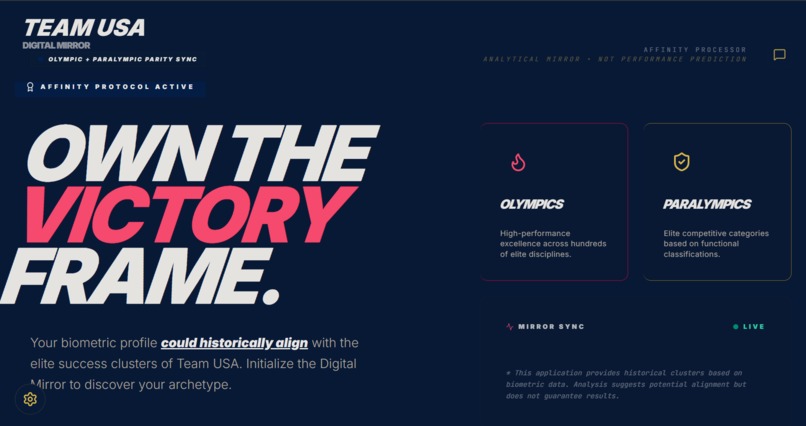
website
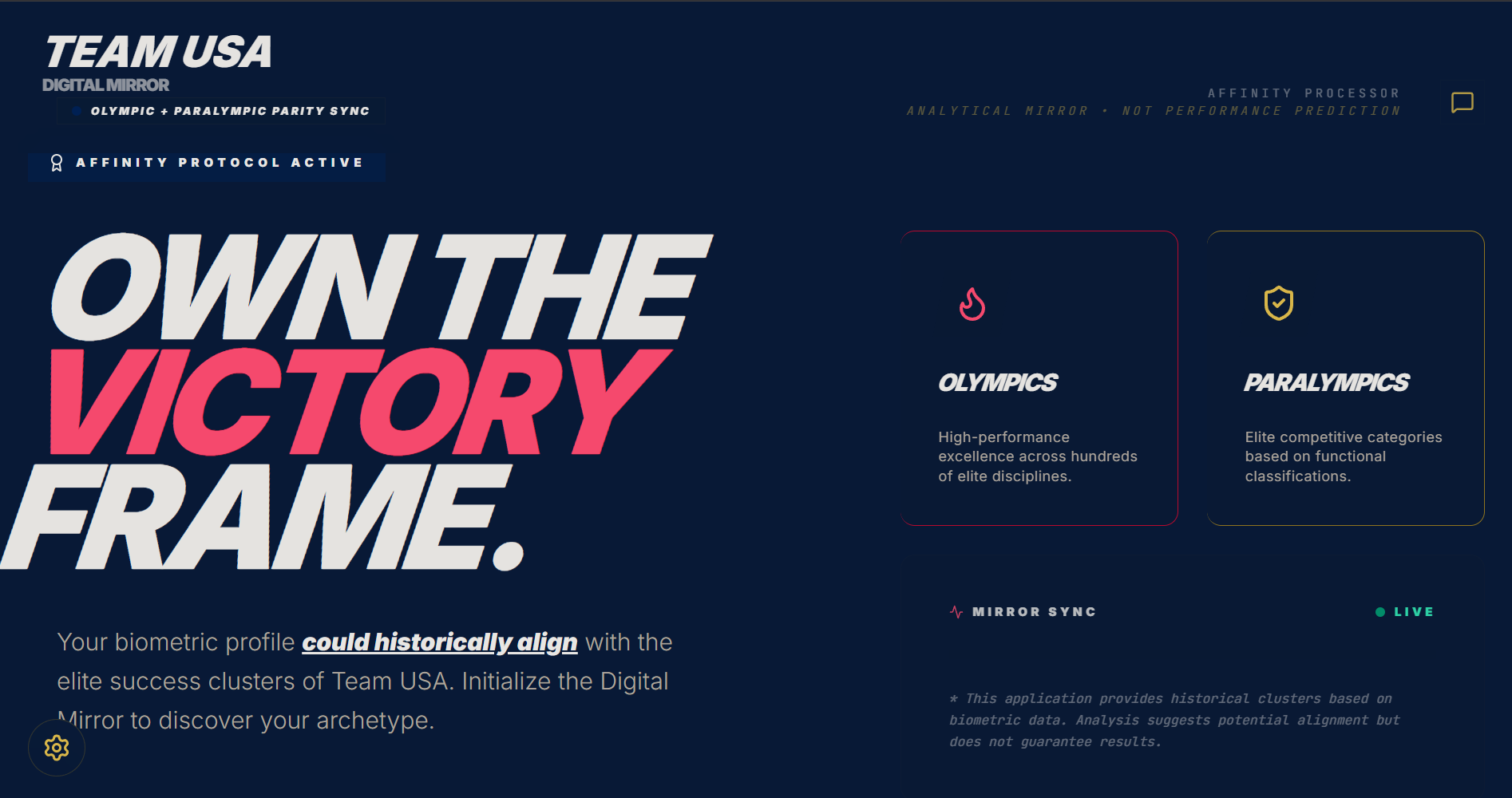
Inspiration
Most athlete-focused experiences today revolve around rankings, prediction systems, and performance metrics. While building this project, I wanted to explore a different idea:
What if AI could make sports exploration feel more personal, inclusive, and human?
That idea became Team USA Digital Mirror, a Gemini powered experience inspired by Olympic and Paralympic ecosystems that helps users explore their own “digital mirror” through historical athlete archetypes, regional sports culture, accessibility-aware storytelling, and Gemini-powered narratives.
What inspired me most was the realization that sports journeys are shaped by much more than statistics alone, including regional culture, accessibility, personal goals, historical eras, and community opportunities.
I wanted to create something that felt less like a rigid analytics tool and more like an immersive storytelling experience that encourages curiosity, reflection, and exploration.
What it does
Team USA Digital Mirror is an AI-powered interactive platform that uses Gemini and Google Cloud to explore historical athlete archetypes, Olympic and Paralympic pathways, regional sports culture, and accessibility-focused storytelling.
Users receive:
- Athlete archetype matches
- Regional sports reflections
- Historical era synchronization
- Gemini-powered narratives
- Interactive visualizations
The experience is designed to be immersive, explainable, and inclusive rather than predictive.
How I built it
I initially built the project using Google AI Studio with Gemini powered prototyping and interactive prompt experimentation. As the project evolved, I migrated the application to Vertex AI and deployed it on Google Cloud Run for scalable cloud-based deployment.
The project was built using:
- React + TypeScript
- Node.js + Express
- Google Cloud Run
- Vertex AI
- Gemini Models
- Tailwind CSS
- Recharts
- Framer Motion
The platform combines deterministic archetype matching with Gemini powered storytelling to create adaptive and explainable athlete reflections. I also designed accessibility-focused features including:
- High contrast mode
- Reduced motion mode
- Larger text support
- Responsive layouts
Challenges I ran into
One of the biggest challenges was balancing generative AI creativity with explainability and responsible design. I also wanted the platform to respectfully include both Olympic and Paralympic pathways without making predictive or diagnostic claims. Another challenge was migrating the application from Google AI Studio prototyping to a production-style Vertex AI deployment on Google Cloud while maintaining a smooth interactive experience.
Accomplishments that I'm proud of
- Building a Gemini-powered storytelling experience
- Successfully deploying the project on Google Cloud
- Migrating from AI Studio prototyping to Vertex AI deployment
- Designing accessibility first features
- Creating an inclusive Olympic + Paralympic exploration platform
- Combining explainable systems with generative AI
What we learned
This project taught me how powerful generative AI can be when combined with:
- Thoughtful UX
- Explainability
- Accessibility
- Storytelling
- Cloud native AI deployment
I also learned how to transition an AI Studio prototype into a deployed Vertex AI application running on Google Cloud infrastructure.
What's next for Team USA Digital Mirror
- Expanding sports datasets
- Adding more regional narratives
- Supporting more sports pathways
- Multilingual support
- Deeper explainability features
- More adaptive Gemini-powered interactions
- Enhanced mobile experience
Built With
- aistudio
- gcp
- vertexai

Log in or sign up for Devpost to join the conversation.