Prototype link:
**A video demo with a maximum of 3 minutes: Please prioritize walking through the app you designed, explaining key features – information about your research and design process should be included in the free response answers
Describe your project (Max 150 words)
Communication is key, but there’s no denying that it can be difficult, especially when it feels like you’re separated by so much. Within families, obstacles such as differing values, priorities, and opinions can lead to generational divides, making each member even more unlikely to share their true thoughts. FamJam fills the silence, and encourages authentic communication through a series of activities facilitated by a relaxed, living-room friendly mobile app.
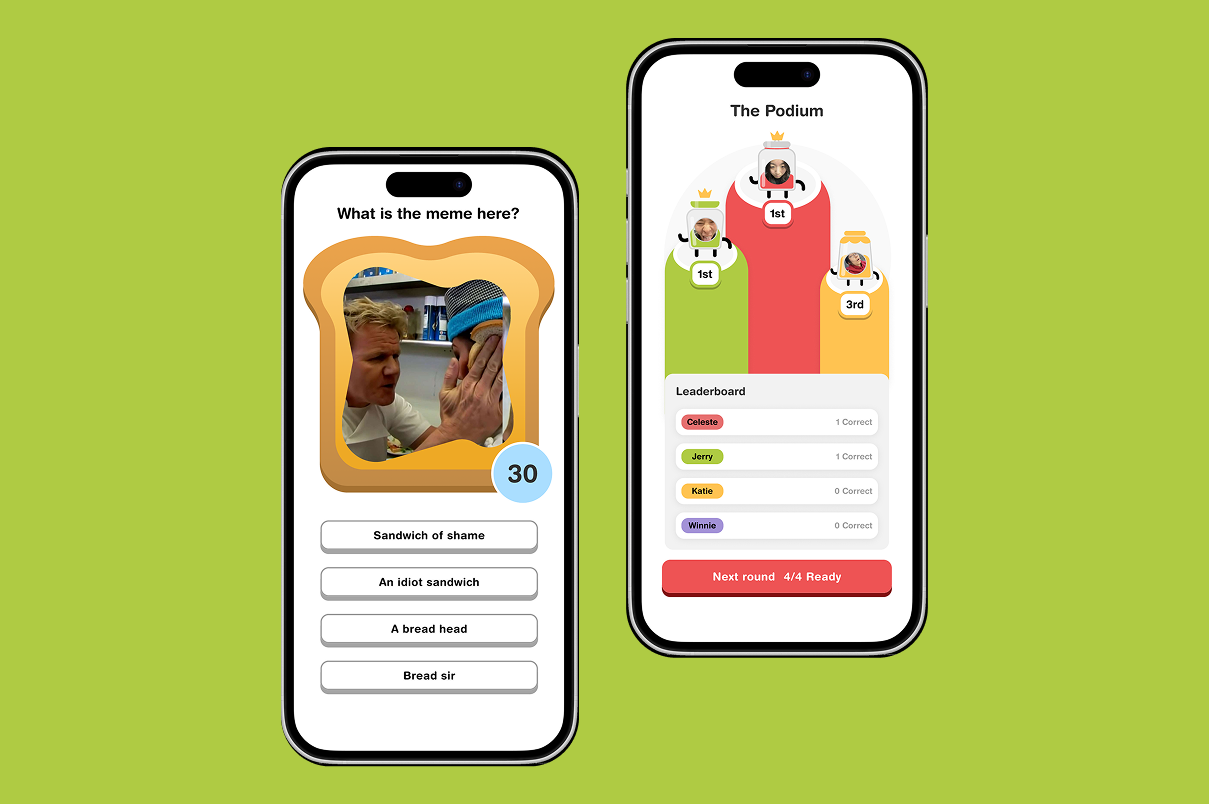
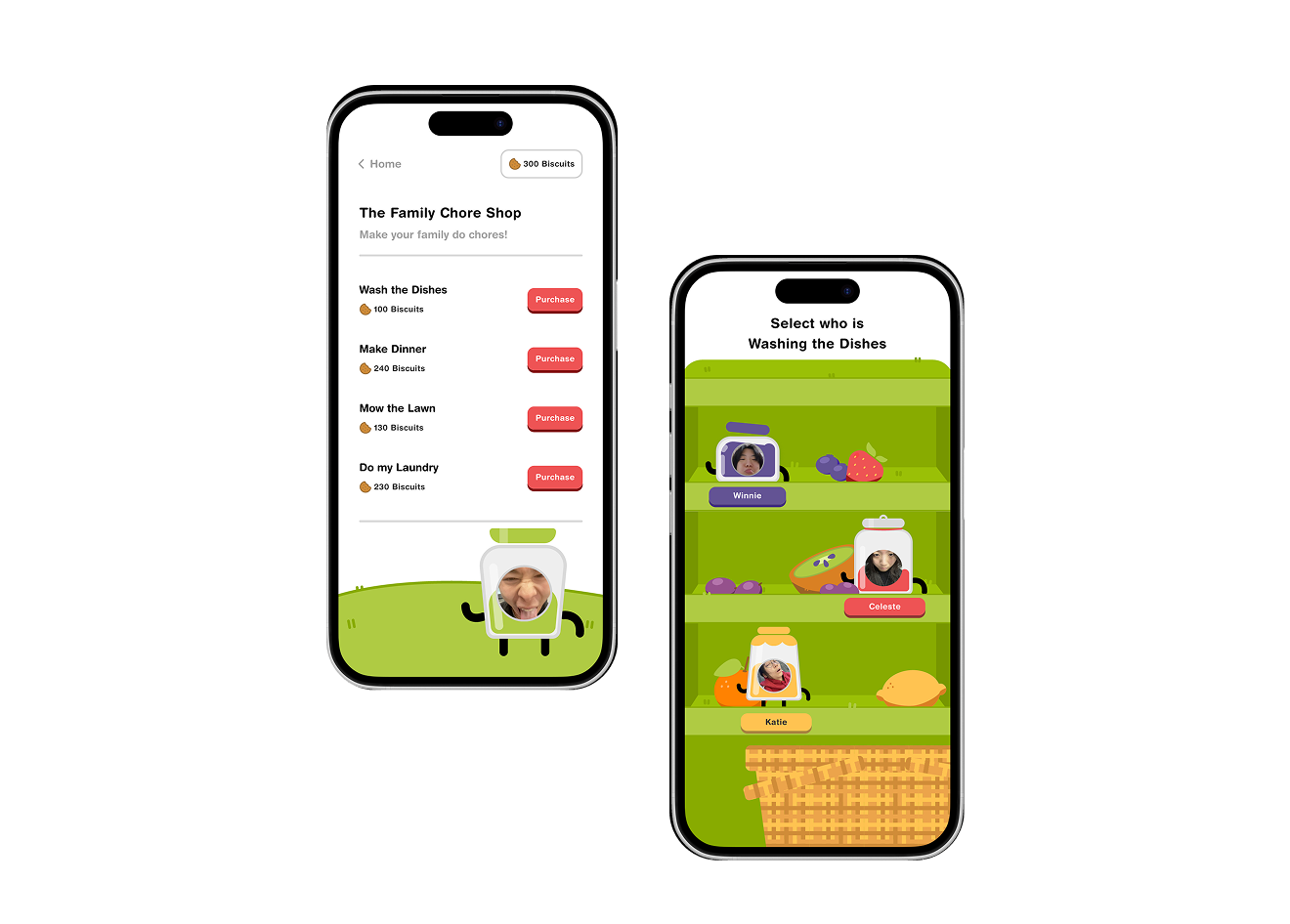
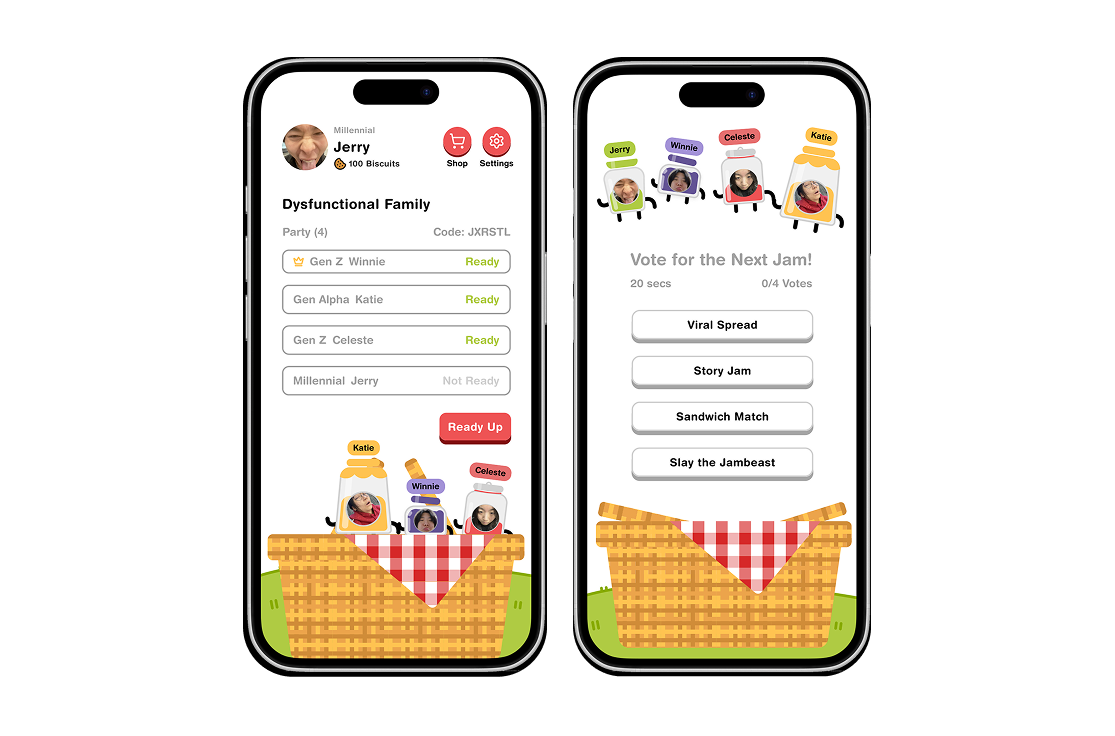
Players can create and join fams, vote on what to play next, and collect biscuits, which can be exchanged for personalized favors in the shop.
People are busy, so FamJam is ready to go whenever they are. Whether players have a quick ten minutes before dinner or an entire game night ahead, with customizable sprites and games suited for players both young and old, FamJam seeks to help families break bread and connect—with healthy doses of delicious fruit jams, of course.
Describe your research process and findings. If you conducted any surveys or interviews, please include the survey form and/or interview questions here. If you conducted secondary research by pulling from online sources, please include a link to your sources. (Max 500 words)
To get a better understanding of the needs of our users, we created a survey link with both short response and multiple-choice questions, and fielded responses from Discord, Reddit, and personal group chats. We aimed for a range of participants—posting in online spaces where we could access people in different age ranges—and collected data on respondents’ birth years, preferred communication styles, and family misunderstandings.
From 99 total survey respondents ranging from Gen X to Gen Alphas, we analyzed common patterns that emerged from our data: While people care for each other, how this is communicated can often lead to arguments.
- 97% of respondents believe that they have learned important lessons, values, or traditions from older generations in their family.
- 93% of respondents believe that technology helps cross-generational family connection.
The short response questions provided greater clarity into our problem space, and we kept several representative key quotes in mind as we progressed through the stages of our design process.
- “Their values are a lot more traditional than mine, so having to explain that I considered taking a gap year to explore career possibilities was a difficult conversation.”
- “My mother often doesn’t understand the importance I place on having a robust support network outside of family (friends, peers, etc.) and this leads to many disagreements about priorities.”
- “When I am expressing concern for their safety, my daughter will think I am nagging.”
We paired this primary research with secondary research to understand any existing methods serving to promote connection between individuals. From studies, we concluded that Playing games in general gives both children and parents an opportunity to see how the other reacts when challenges arise—therefore, a learning opportunity for both of them. link Playing together allows people to understand other points of view. link
From both these sources of data, we focused on parent-child relationships, noting that many of our Gen X parent respondents mentioned a difference in communication style as part of the reason why misunderstandings occurred. We found that play is significantly beneficial for both older and younger people, as participating in leisure activities improves communication and collaboration. Additionally, competitive games specifically were able to foster pro-social behaviors in children, allowing them to practice crucial skills such as cooperation and patience.
Overall, our research shows that games and other forms of play are valuable opportunities for parents and children to explore differing viewpoints. The low-stakes environment of a family game night could therefore encourage conversations that may not otherwise come about naturally.
Describe your most important design decisions. What research findings and/or user testing results led you to make these decisions? (Max 500 words)
User Interface and Design Given the results of our research findings, a lot of older generations mentioned they missed when there were buttons on mobile phones. We took that into consideration and added elevated buttons with strong shadows throughout our app, so that it is not only accessible for kids, but also gives the sense of a more intuitive physical experience. Additionally, we added a customization element so that family members could design an avatar that they feel reflects themselves. Our differences are what make us special, and we wanted FamJam to help people understand different backgrounds, not erase them.
Game Content This is also reflected in the games that we designed. We centered our game content around topics commonly believed to be sources of misunderstanding, based on the research we conducted, with the goal of having family members discuss these with one another. The “Story Jam” game was a direct response to what we gathered from our survey—67 respondents indicated experiencing misunderstandings that arose over values or beliefs. In “Story Jam,” players progress by voting for the answer that they agree with the most, and cannot vote for themselves; this enables players to think about why other members of their family answered in the way they did. We wanted to show that members of the same family can have differences, and yet still work together and uplift each other. On top of this, the decision to allow people to vote for games was intentionally structured so that all players can contribute equally. Our research also showed that certain respondents, often the younger members of a family, felt like they were not properly heard by their parents and elders. We wanted FamJam to be a platform where family members could stand and discuss as equals.
Biscuit System and Chore Shop Our chore shop also stems from our research findings, especially regarding the benefit of competition. Since we knew that competition could promote pro-social behavior, we chose to reward the winners while giving all players an incentive to continue learning about each other, so that they can eventually close the gaps between generations. Navigating a shop system as a family would allow both parents and children to get a better understanding of each other—children are able to see how their parents make rational decisions, and parents are able to see how their children think.
If applicable, describe how you utilized AI in your design process in detail. Please explain where AI fit into your workflow, which tools you used, and the specific purpose AI served at that stage. Include a concrete example of how AI influenced a design decision. (Max 500 words)
We used AI throughout the survey process to make sure our questions weren’t too leading, which helped make the questionnaire clearer and the responses more meaningful. After collecting responses, we also used AI to summarize the data and highlight key insights by identifying recurring keywords. These insights directly influenced the direction of our game content, as they revealed areas where families could improve communication. For example, “tech literacy” frequently appeared as a concern—Gen X often struggled with it, while Gen Z viewed it as a major barrier between generations. However, the issue wasn’t using technology itself, but keeping up with rapidly changing UI elements. Users preferred simple, intuitive buttons, which guided our decision to choose a design style that works for both generations. Overall, AI acted as a second pair of eyes in a data-heavy process, making it a uniquely valuable partner.
Built With
- figma


Log in or sign up for Devpost to join the conversation.