Inspiration & What It Does
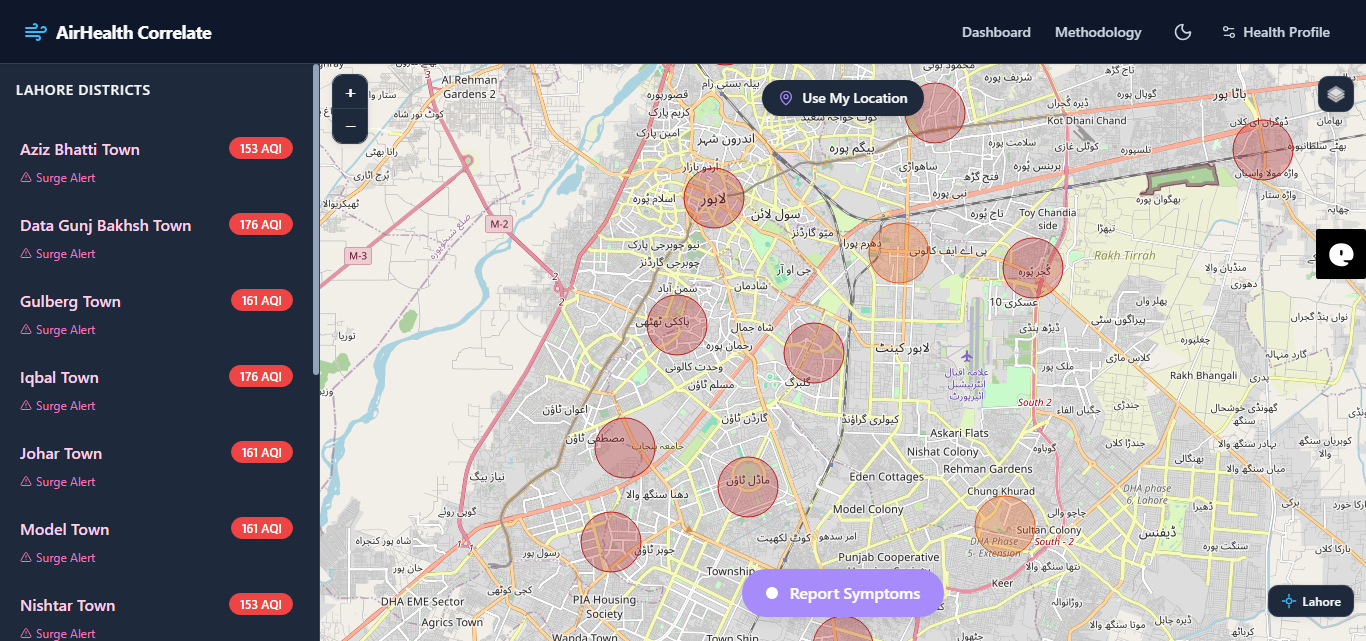
Lahore faces a severe air quality crisis, yet citizens only receive abstract numbers instead of actionable medical guidance. AirHealth Correlate bridges this gap by translating raw pollution telemetry into localized respiratory risk advisories and predictive clinical surge warnings.
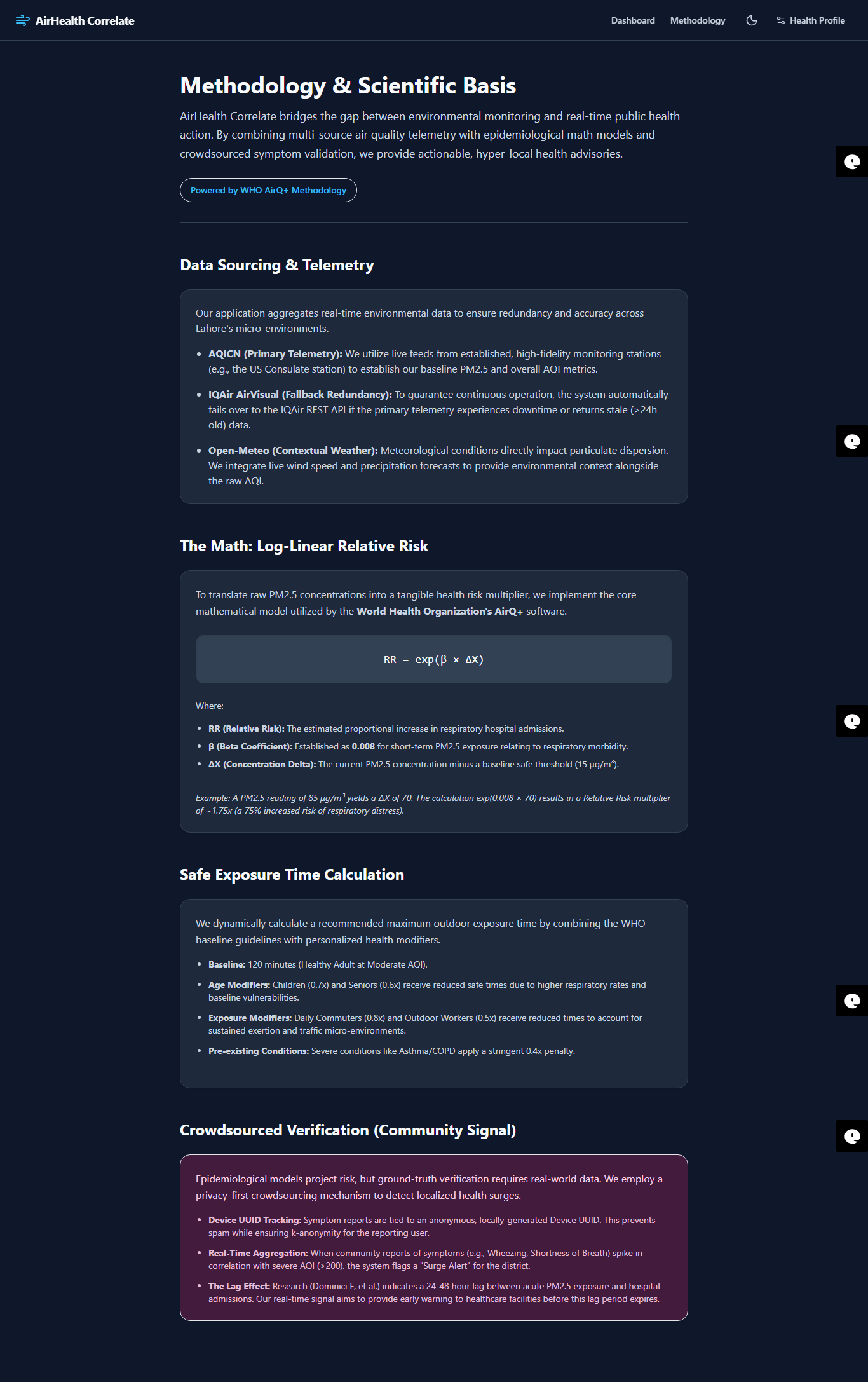
- Biostatistical Risk Modeling: We apply WHO AirQ+ coefficients and Gasparrini Distributed Lag Non-linear Models to calculate excess relative risk: $RR = \exp(\beta \times \Delta X)$.
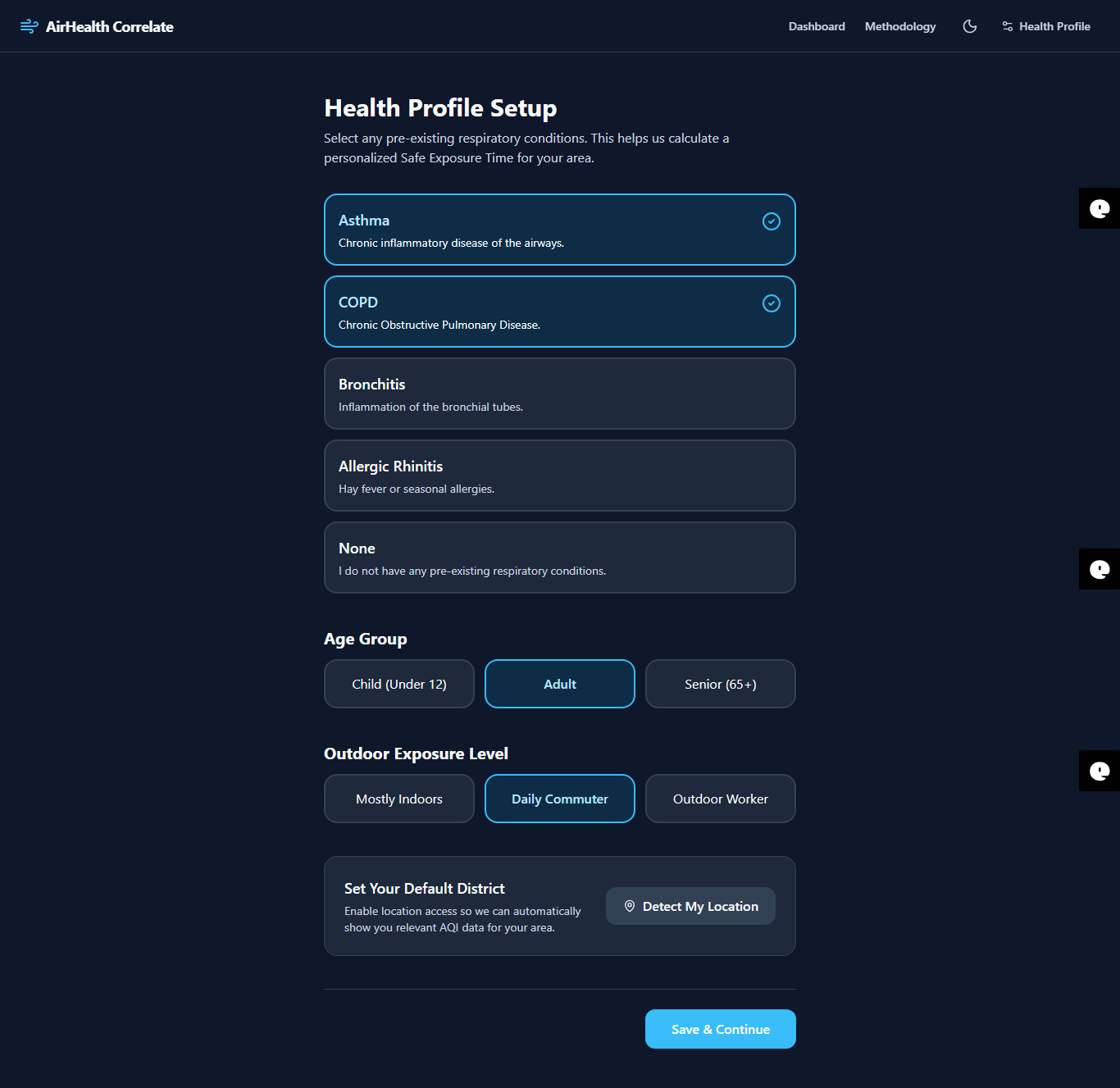
- Personalized "Pocket Doctor": Authenticated profiles dynamically adjust a Safe Outdoor Exposure Timer based on the user's age, outdoor exposure level, and conditions (e.g., Asthma, COPD).
- Predictive Surge Engine: Our system correlates 72-hour weather forecasts (thermal inversions, rain washout) with particulate data to predict emergency hospital respiratory influxes three days in advance.
- Admin Command Center: Provides municipal officials with a real-time demographic heatmap mapping crowdsourced syndromic surveillance to local districts.
Core Technology Stack
Operating with zero capital, we fused disparate open-source tools into a production-grade civic ecosystem.
- Frontend & AI: Next.js 14, Tailwind CSS, and the Vercel AI SDK powering a context-aware Google Gemini health advisor chatbot.
- Database & Auth: Supabase (PostgreSQL) handles secure user authentication, Role-Based Access Control (RBAC), and verified symptom telemetry.
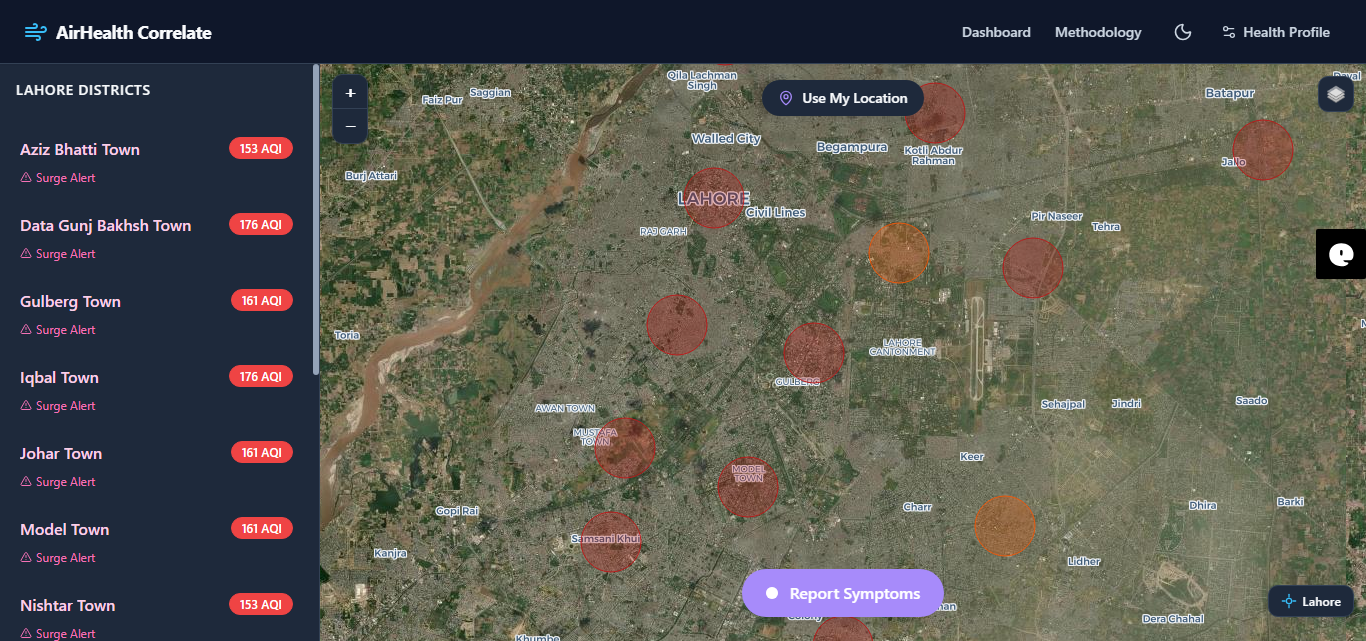
- Spatial & Ingestion: Leaflet multi-layer maps combine with Vercel Cron Jobs fetching 15-minute data from OpenAQ, AQICN, and Open-Meteo.
Challenges & Accomplishments
- Data Integrity & Math: We overcame the challenge of inaccurate pollutant estimates by implementing strict US EPA piecewise linear AQI formulas for six distinct criteria pollutants.
- Confounder Adjustments: We successfully engineered statistical controls for seasonal temperature and humidity to isolate the true pollution Attributable Fraction: $AF = \frac{RR_{adj} - 1}{RR_{adj}} \times 100\%$.
- Methodological Honesty: Instead of fabricating impossible integrations with closed hospital records, we created a scientifically defensible proxy using peer-reviewed epidemiology and anonymous crowdsourcing.
What We Learned & What's Next
We learned that cities can build intelligent, predictive digital twins without needing expensive proprietary infrastructure. By successfully fusing environmental telemetry with epidemiological models, we proved that open data saves lives. Next, we aim to deploy automated SMS delivery layers to push critical health advisories to vulnerable outdoor workers lacking smartphone access, ultimately paving the way for official integration with Punjab's public health records.
Built With
- leaflet.js
- next.js
- open-meteo
- openaq-api
- postgresql
- react
- supabase
- tailwind.css
- vercel

