Inspiration
Almost everyone has someone. A grandparent, a parent, a teacher, a best friend's mum. Cancer touches nearly every family at some point, and for a lot of kids, it arrives before anyone has explained what it actually is.
So kids fill the silence with whatever they hear. You can catch it. Chemo only attacks the bad cells, so why is Mum losing her hair? It came out of nowhere, so it could happen to anyone, anytime. These ideas spread through playgrounds and group chats, and they turn an already frightening time into something even scarier. Some kids stop hugging the people they love most, at the exact moment those people need it.
We kept thinking about that kid. The one sitting in a hospital waiting room, too scared to ask questions. The one who googles at night and finds things that make it worse. The one who just wants to understand what's happening to someone they love.
A leaflet won't reach them. A lecture won't either, because a belief that feels right doesn't disappear when someone says it's wrong. It disappears when you see it fail with your own eyes.
In biology, cancer begins as an anomaly: one cell that stops following the rules. So we called our project ANOMALY, a place where students can guess, get surprised, and finally understand what's really happening inside the body of someone they love.
What it does
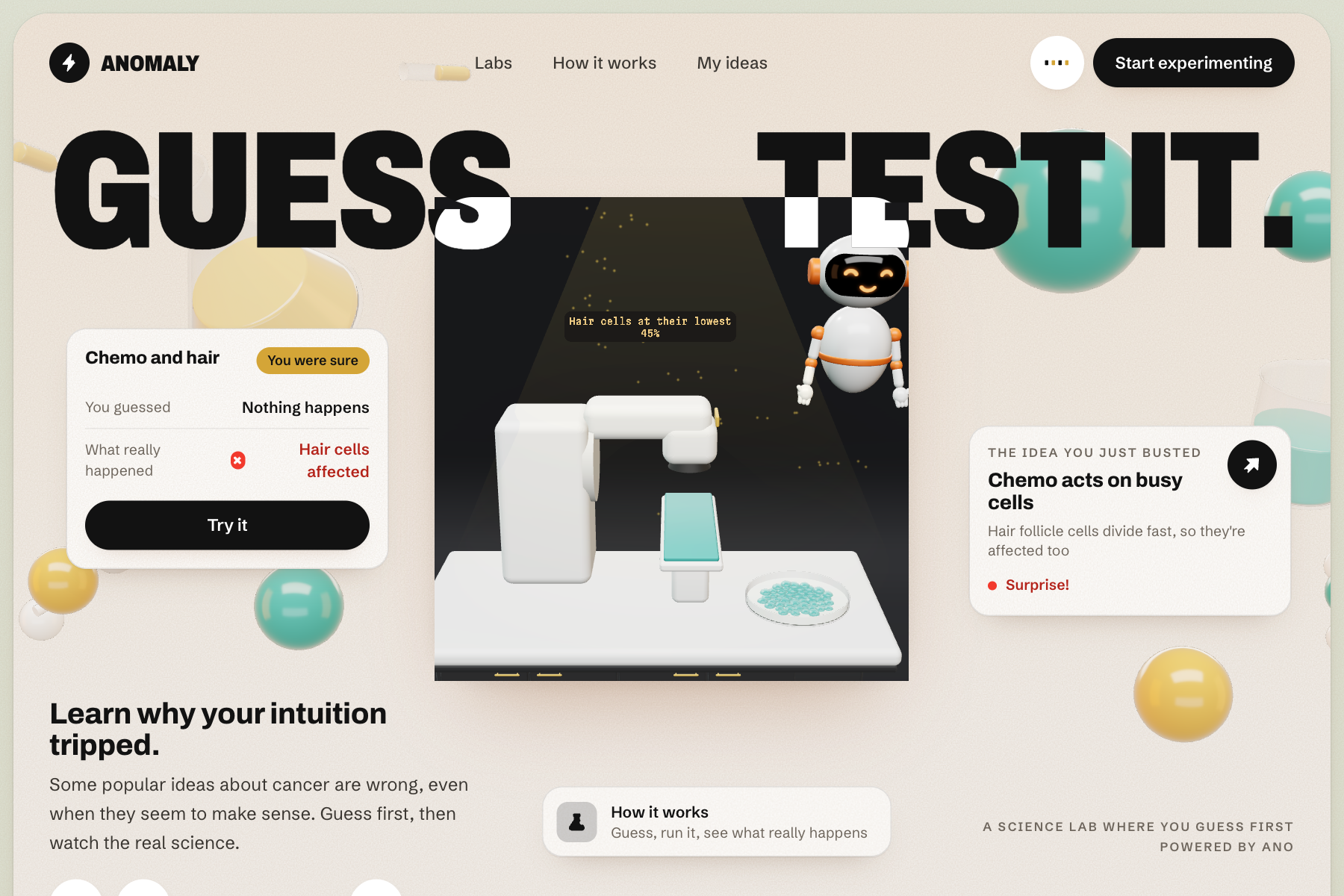
ANOMALY is a free 3D science lab in the browser that teaches students aged 11 to 18 the science of cancer by letting them discover the truth for themselves.
Every experiment follows the same loop:
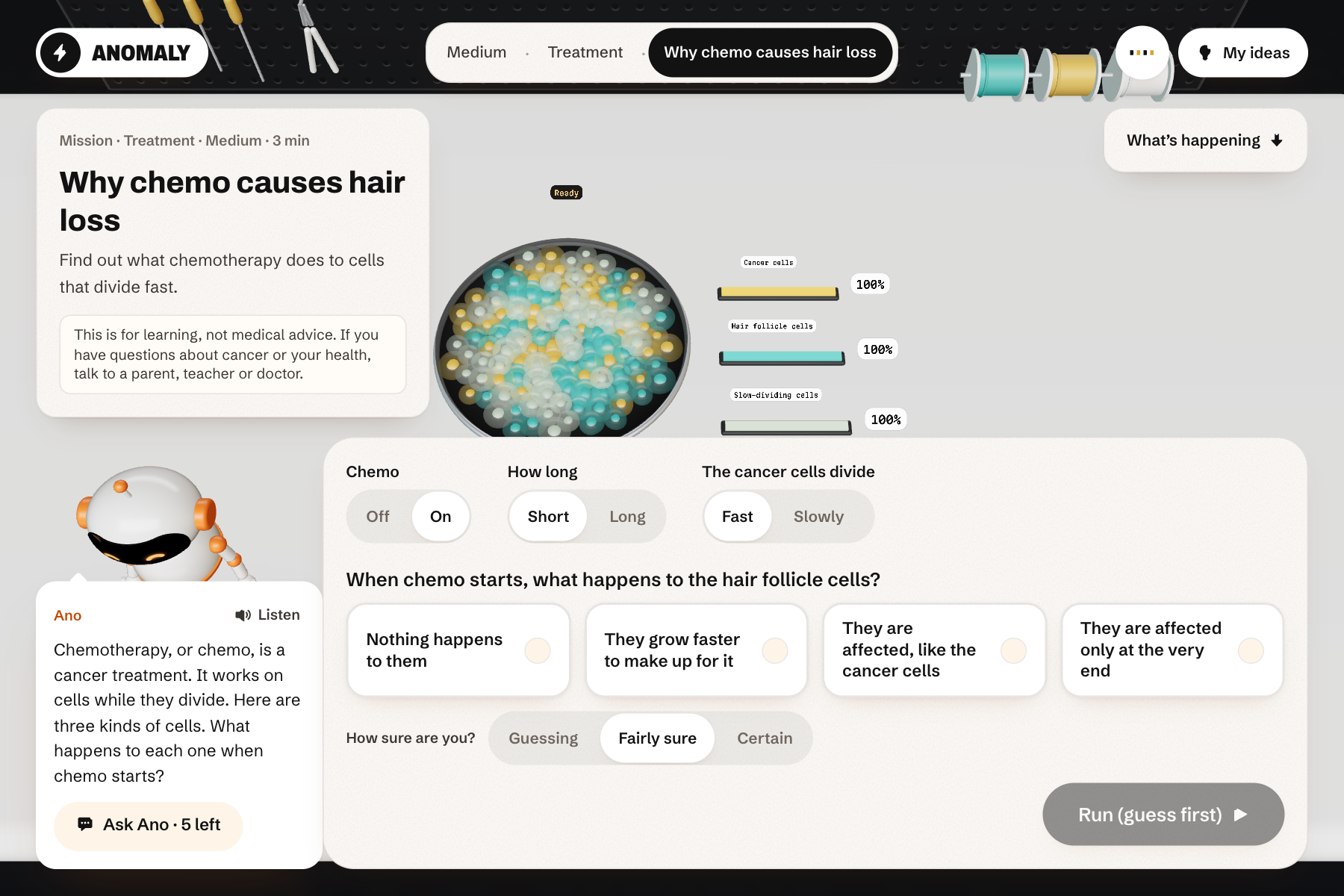
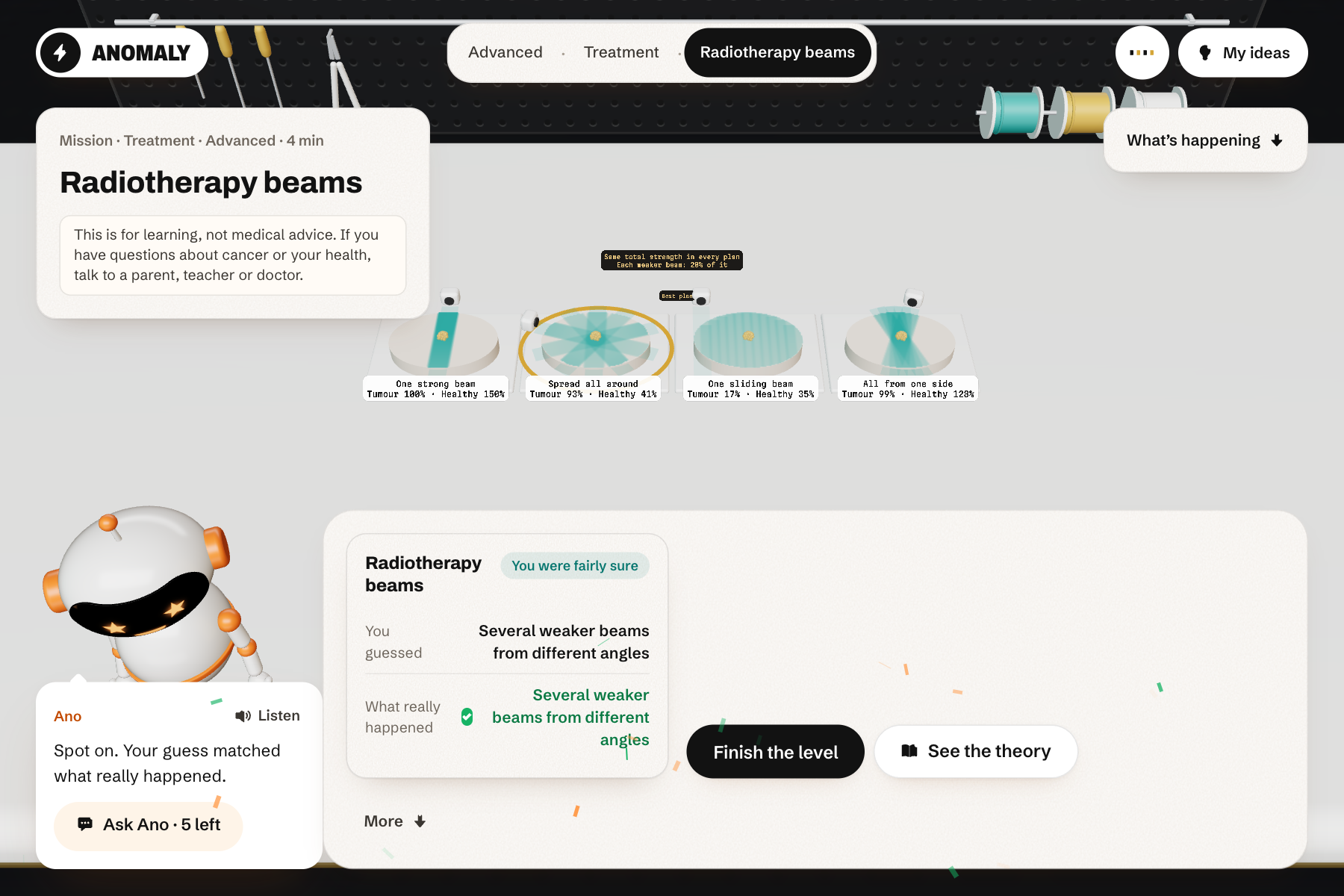
- Guess. Before anything runs, the student picks what they think will happen, and how sure they are.
- Run. The experiment plays out in 3D, with living cells shown through a microscope.
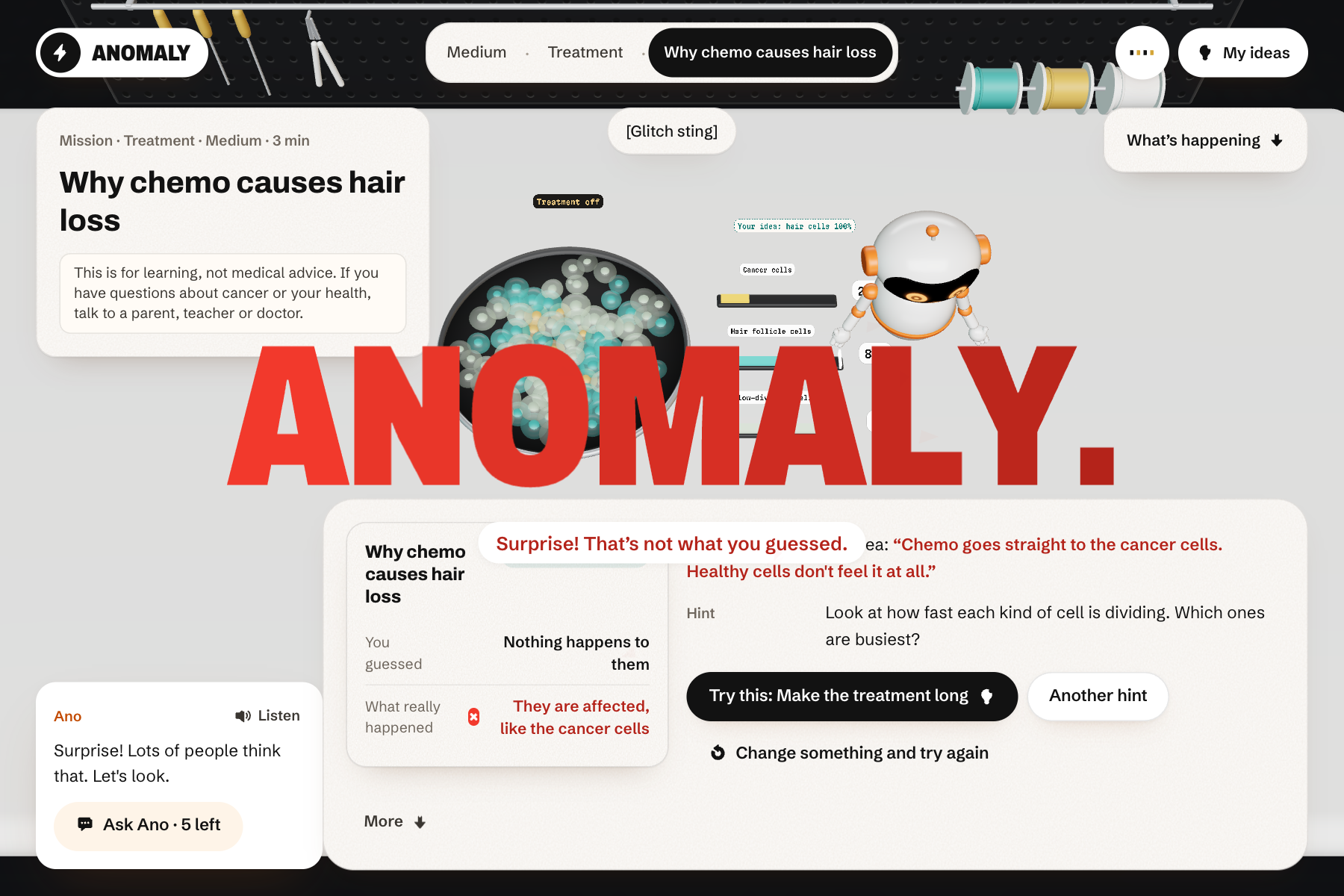
- Reveal. If they were right, Ano, our friendly robot guide, celebrates. If they were wrong, the ANOMALY moment plays: their guess appears as a ghost next to what really happened, and Ano helps them figure out why, one step at a time.
- Understand. A short explanation in kid-friendly words, with the sources it came from.
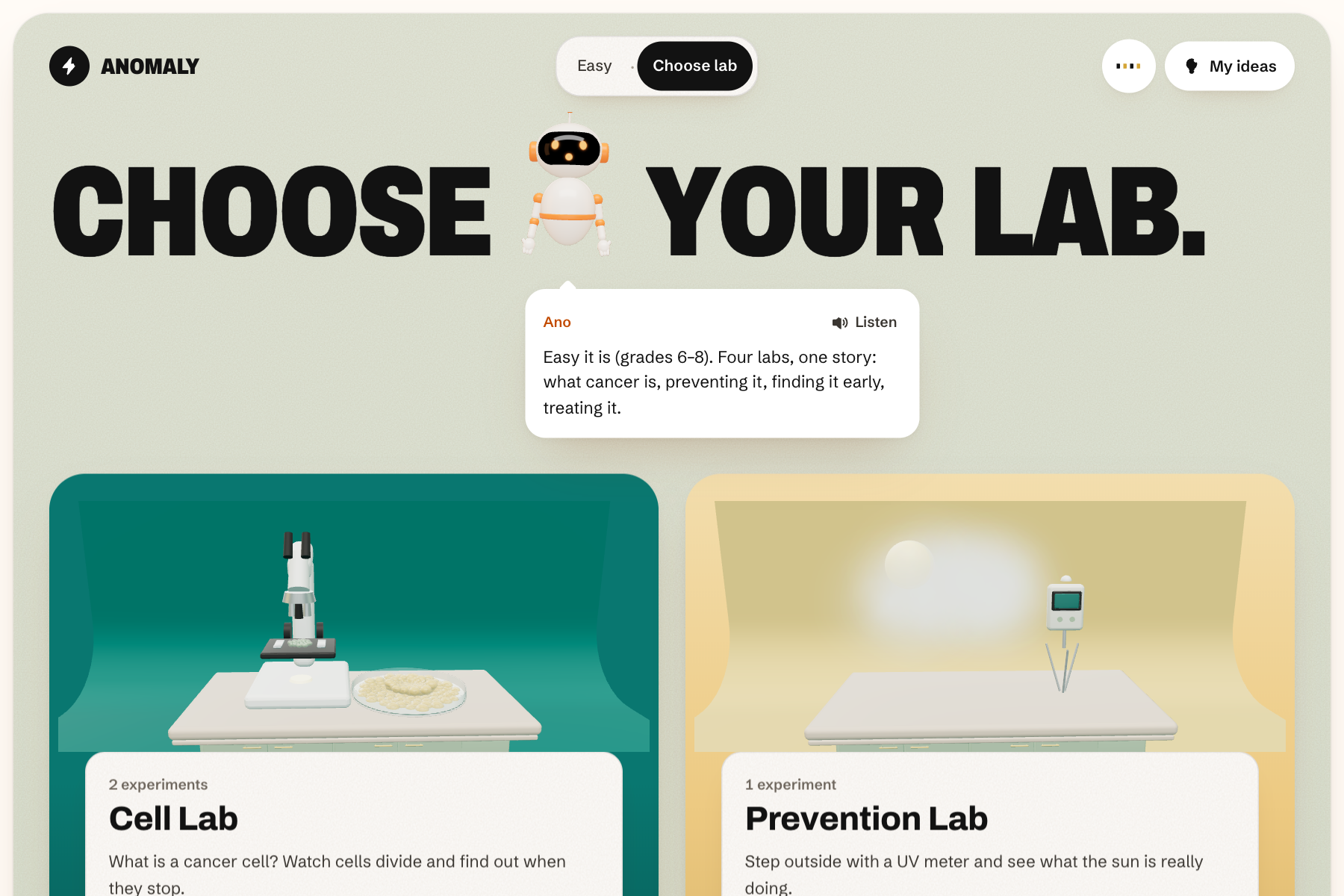
Seven experiments across four labs follow the cancer story:
- Cell Lab: what cancer actually is (Cells out of control), why you can't catch it from someone you love (Can you catch cancer?), and how much is really passed down in families (Born with it?).
- Prevention Lab: why sun protection still matters when it's cloudy (UV on a cloudy day).
- Detection Lab: how tumours grow by doubling, and why finding cancer early matters (How tumours grow).
- Treatment Lab: why chemotherapy causes hair loss (Why chemo causes hair loss), and why radiotherapy aims from many angles (Radiotherapy beams).
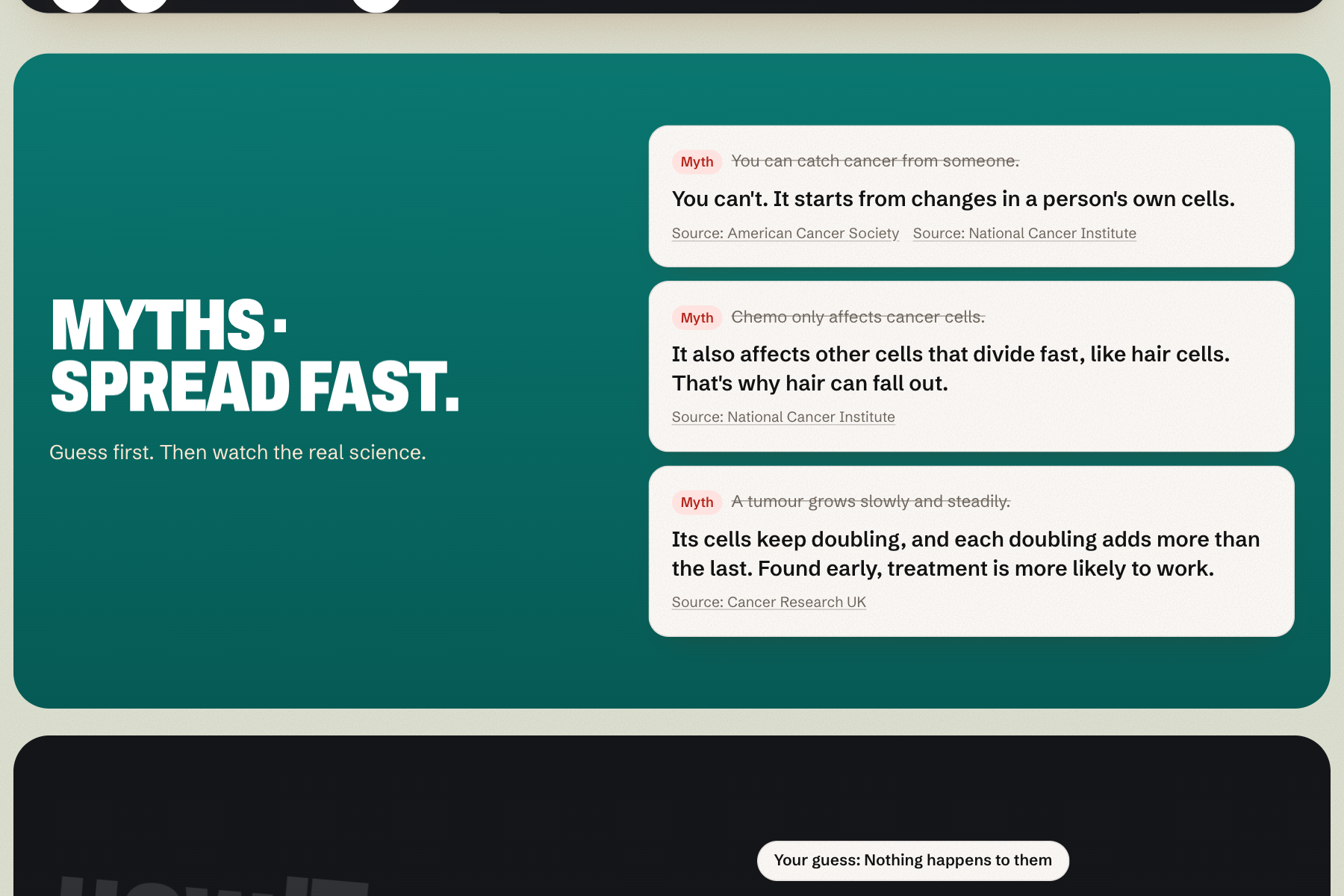
On the home page, myth-and-fact cards show common cancer myths side by side with what the science really says.
Every fact comes from the World Health Organization, the US National Cancer Institute, Cancer Research UK or the American Cancer Society, and every source is shown in the app. Everything is written gently, because some students using ANOMALY will have family members living with cancer right now. It's for learning, not medical advice, and when a student asks Ano something personal, like whether someone they love will be okay, Ano responds with warmth and gently encourages them to talk to a parent, teacher, doctor or nurse.
ANOMALY is built for Prevention & Education: by replacing myths with understanding, it helps young people protect themselves (like knowing UV still reaches you on cloudy days), see why early detection matters, and support the people they love through treatment instead of being afraid of them.
How we built it
- The simulator is the judge. Every result comes from real simulations, not AI, so it's instant and the same every time.
- Finding the wrong belief. Each common misconception is modelled as its own "wrong" version of the simulation. Comparing a student's guess with the real model and each wrong model shows which belief caused the mistake, and Ano can point out when several wrong guesses come from the same idea.
- Teaching models. For example, tumour growth uses simple doubling:
$$N(t) = N_0 \times 2^{t / T}$$
where \(T\) is the doubling time. Each doubling adds more cells than the one before, which is why finding cancer early matters.
- Every fact checked. 41 claims, each stored with the exact quote and link from a trusted cancer organisation. If any fact is missing its source, the app refuses to build, and validation checks run the teaching models against those facts live on our Science page.
- 3D everywhere. Next.js and React Three Fiber, with living, wobbling cells in a microscope view and each lab in its own colour world.
- Smooth on any device. The app detects how powerful a device is and picks a high, medium or low quality setting. The labs hold 60 frames per second in our tests, even with the computer's processor slowed down four times.
- Safe AI. "Ask Ano" answers questions in plain words, grounded in the simulation and the cited facts, rate-limited on the server, with written hints as a fallback. Personal health questions are gently redirected before any AI is ever called.
- Tested like a product. 655 unit tests and hundreds of automated browser tests check every experiment and every possible guess against the simulator, plus every line a student reads for scary words and long sentences.
Challenges we ran into
- Finding out what we were really building. We started out building a general science lab, and only discovered late that every category in this hackathon is judged on cancer. With hours to go, we rebuilt ANOMALY around the science of cancer, reusing our engine, our 3D lab and Ano. It turned out the idea fit better than anything we'd planned: cancer is full of beliefs that feel right and aren't.
- Writing for a child who's scared. The hardest part wasn't the code. It was choosing every word so it's honest, clear for a 12-year-old, and safe for a student whose parent is in treatment tonight. No scary images, no survival statistics, no blame.
- Accuracy without fear. Cancer science is complicated. We only used facts we could confirm on trusted sources, and cut anything we couldn't, even when it would have made a better story.
- Avoiding clutter. We kept adding features until the screens felt overwhelming, then stripped everything back to one clear step at a time.
- Making cells look alive. Our first cells looked like beads. We rebuilt them as soft, translucent cells with nuclei, seen through a microscope.
Accomplishments that we're proud of
- Seven cancer experiments where students discover the truth themselves instead of being told.
- Every fact backed by a trusted cancer organisation, with sources visible.
- Ano, a character who makes being wrong feel like part of learning, and makes a hard topic feel a little less lonely.
What we learned
- Seeing a wrong idea fail changes minds far more than being told the right answer.
- Health content for young people needs as much care as code: accuracy, tone and kindness matter as much as features.
- When to use AI and when not to: the simulation decides, the AI only explains.
- Great design comes from removing things, not adding them.
What's next for Project Anomaly
- Working with teachers, school counsellors and cancer charities so ANOMALY can reach kids when their family needs it most.
- Every experiment at every level, from age 11 to 18.
- Translations, so students everywhere can use it.
- Measuring whether students' understanding, and their fear, changes weeks later.
No kid should be afraid to hug someone they love because of something they heard at school. If ANOMALY helps even one of them understand, it was worth building.
Built With
- claude-code
- drei
- elevenlabs
- framer-motion
- gemini
- groq
- gsap
- indexeddb
- lenis
- next.js
- playwright
- rapier
- react
- react-three-fiber
- tailwindcss
- three.js
- typescript
- upstash
- vercel
- vitest
- zod
- zustand


