-
-
cover
-
intro-slide
Prototype link here
Describe your project
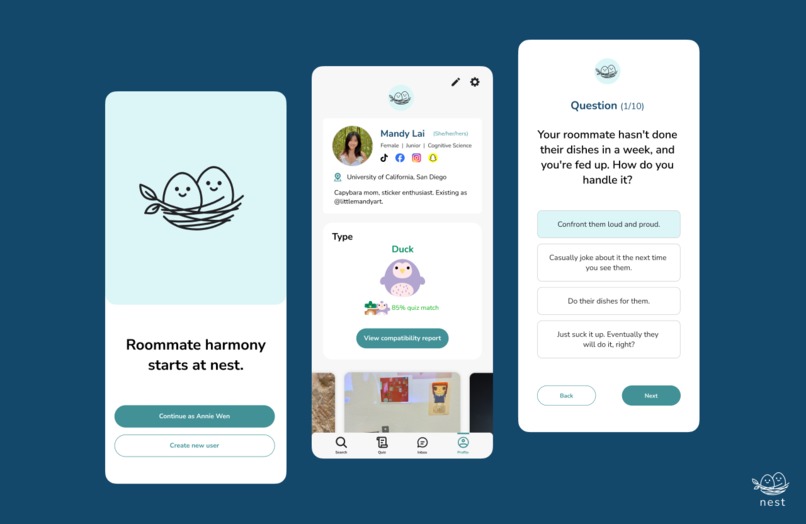
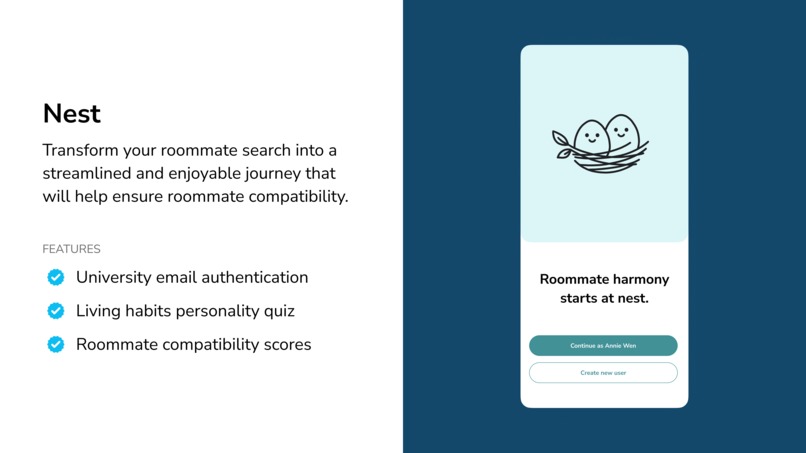
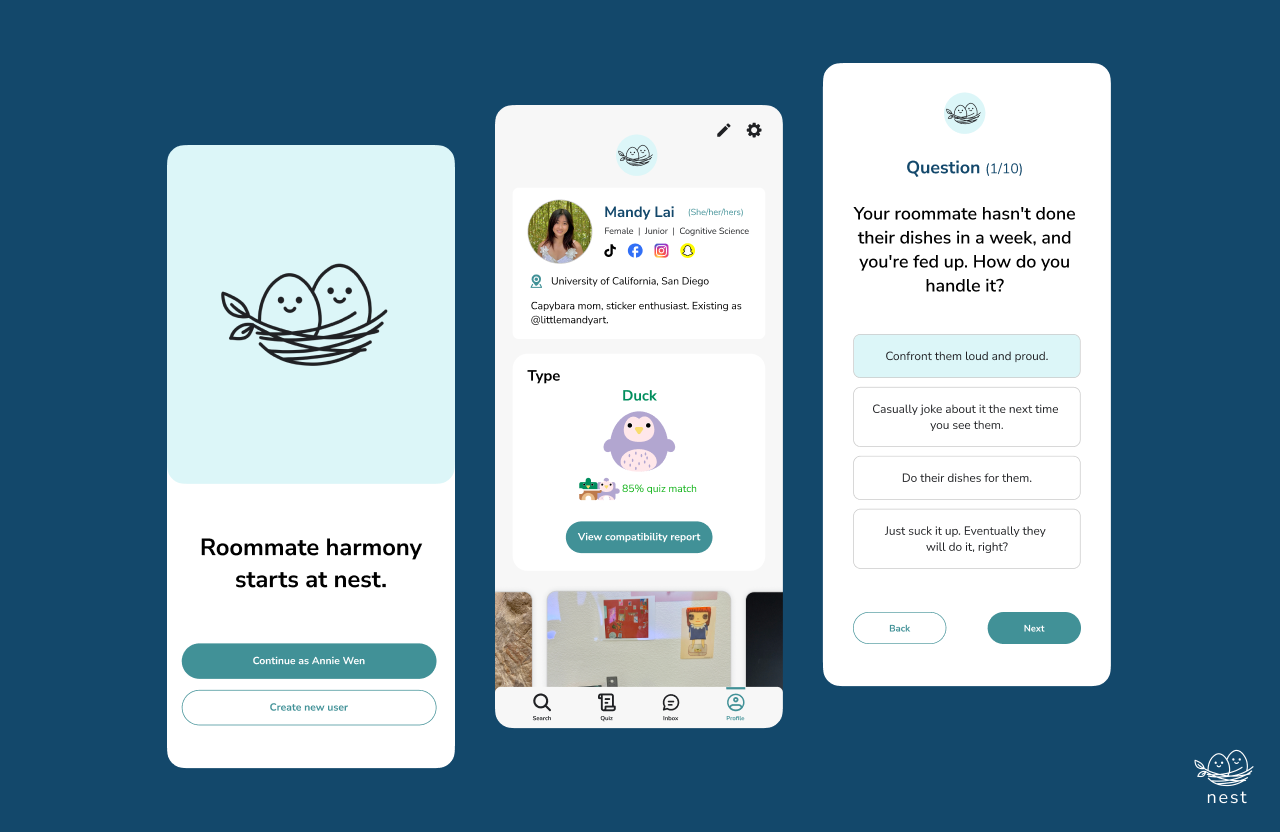
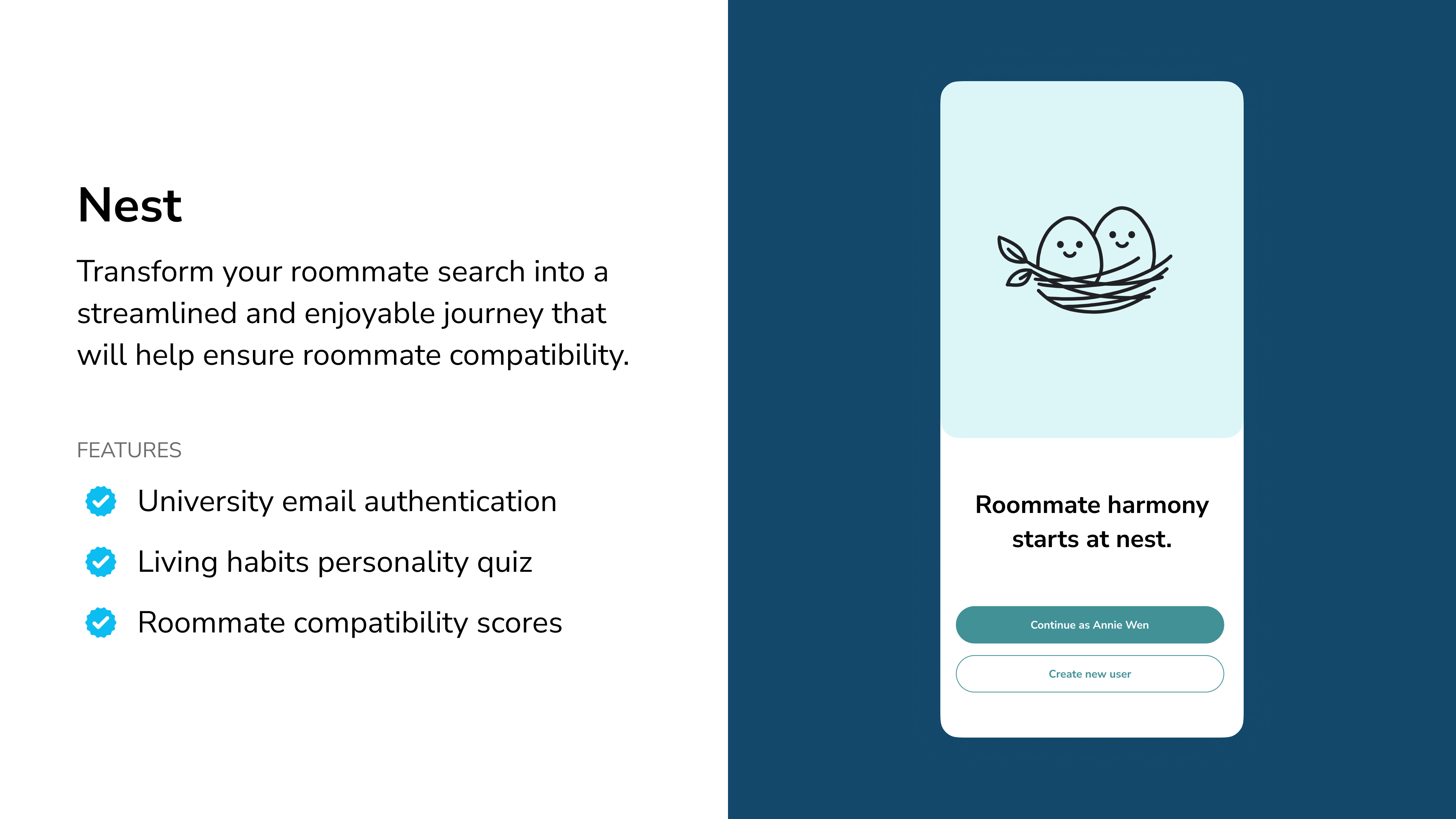
Finding the perfect roommate in college can be a scary experience, especially from hearing numerous horror stories of terrible roommate pairings. This led us to question, “How might we save undergraduate students time and effort on finding compatible roommates?” In this project, we introduce Nest—a revolutionary app designed to transform your roommate search into a streamlined and enjoyable journey that will help ensure roommate compatibility. By verifying your identity with your school email, Nest opens the door to a personalized experience. You begin by crafting a profile detailing your personality and then applying tags and filters to discover people. In particular, a Nest quiz adventure lets you discover your living type, which unlocks compatibility scores with potential roommates. Roommate hunting should not be terrifying. Through Nest, you will find your ideal match through an exciting journey of understanding yourself and your living needs. With Nest, roommate harmony starts today.
Describe your research process and findings.
Team Raccoon used primary and secondary research, specifically an online article, online forums, an ideation session insights regarding our personal experiences, a google form survey, and finally competitive analysis.
Following the double diamond design framework, the first step was to discover as many ideas as possible. First, my team and I conducted an ideation session on Figjam to list out personal struggles as a college student. Using a New York Post article quantifying the top 14 challenges of college students, we sorted and dot-voted on ideas that overlapped between the team and the top issues reported in the article. Following the session, my team decided to stick to addressing “Relationship issues with roommates – 27%” since it was one that we faced and understand the struggles of (SWNS, 2023).
After defining the scope, we next created a Google Form user survey to understand the experience of 20 current college students and their relationships with their housemates. For several users in particular, we interviewed them while filling out the survey based on their answers. After gathering the data in a Google sheet, we were able to gather insightful quantitative and qualitative data.
Through the data, we discovered that many students found incompatibilities with housemates that were due to characteristics inherent to their housemates.
Regarding what they want compatibility with in housemates, 90% of students surveyed look for cleanliness, 70% look for sleep schedule, and 60% look for frequency of guests. These are all habits regarding living styles. In addition, 85% of students cared about personality and 60% cared about interests, which factor into overall personality and hobbies.
In addition to common patterns, qualitative data revealed various niche complaints about housemates that students reported in the survey, such as relationship status, drug usage, and how often they are home. Thus, we wanted to be able to address as many of these potential deal breakers in our application. Lastly, one of our interviewees (survey response #15) noted that despite texting online briefly, he was still unable to discover that their personalities were incompatible until meeting them in person. By then, he felt bad about rejecting the housemate in person. 2 Team Raccoon members also expressed feeling bad about rejecting potential housemates after discussing plans for a while. Thus, we wanted to see if streamlining a personality matching early on, as well as providing context as to clear incompatibility, could help prevent rejection guilt.
Finally, we conducted a competitive analysis of our competition. Reddit 1 2 and from personal experiences recommend Facebook Marketplace and Craigslist as starting grounds, and for on-campus a short campus mandated survey is often used. However, both platforms ranked low in trustworthiness and customization of the roommate searching experience. With a clear problem of incompatible housemate pairings due to inherent traits, as well as issues with common housemate-finding platforms, Team Raccoon aims to make an application that creates compatible housemate pairings. Our goal is to mitigate high risks of severe conflicts by preventing them through successful matches.
Describe your most important design decisions.
Three of our most important design decisions were the overall project, our user flow and concept, and gamifying our application.
Our team initially spent a lot of time executing another idea–an application that tracks services on campus (ex. Water fountains, scooter paths). However, after conducting user interviews and also gathering insights from another survey, we realized that the app was too broad, as students had a variety of individual needs for navigating their campus life. In addition, we felt that this concept did not come from a place of deep empathy in comparison to other problems from our ideation session. Finally, this problem did not have a clear correlation with the top 14 issues that college students face. Thus, we decided to prioritize empathy, and we chose another overlapping issue that we faced: finding compatible housemates.
Next, figuring out the flow and unique concepts were important decisions, as it set the stage for the flow and functionality of the application. In early stages of designing, the team created many user flow drafts and screen ideations, which led to too many potential screens being designed. With the numerous cases of specific incompatibilities of roommates from our user survey, we decided to focus on exhausting as many characteristics and qualities regarding both our app user and a potential housemate as possible, so that we could ensure a proper pairing through filtering.
From our competitive analysis, one safety concern in general regarding competitors like Facebook and Craigslist is lack of verification of students. With this being a huge safety issue, we decided to make a school email address for account registration mandatory.
Based on the grouping of living habits, personality, and individual details, we included an abundance of filters for each category based off of survey results (ex: hobbies, relationship status, sleeping white noise). In addition, allowing the user to personalize their own profile with their personality and preferences allows other users to better understand a person in depth even from a quick glance.
Finally, we wanted to create an enjoyable user experience to ensure students not only can find potential good housemate matches, but also have fun while doing so. When looking at potential competitors such as Facebook and Craigslist, both can be tedious in writing up description and housemate needs. Therefore, we opted to game-ify our app. Inspired by popular personality quiz tests, such as Taiwan Expo and the Myers Briggs Personality Test, we created an engaging quiz that would generate a character that represented your lifestyle and living style. With several housemate concerns from the Google Form survey being hard to identify before they occur, we based potential quiz questions on data-driven scenarios. For example: 60% of survey responses complained about dirty housemates; thus, we created a survey question regarding a housemate not cleaning dishes and reaction-based answers the user can choose from.
Built With
- figjam
- figma
- google-docs
- procreate


Log in or sign up for Devpost to join the conversation.