Inspiration
Oilfield operations rely on complex systems of pumps, pipelines, and storage tanks to maintain continuous production. When equipment fails, operators must make quick decisions to prevent costly shutdowns. However, identifying a failure is only half the challenge. Determining the most cost-effective response while managing limited resources is equally important.
Inspired by the EOG Resources challenge at HackUTD 2026, we wanted to explore how artificial intelligence and optimization could help operators make faster, smarter, and more informed decisions.
What it does
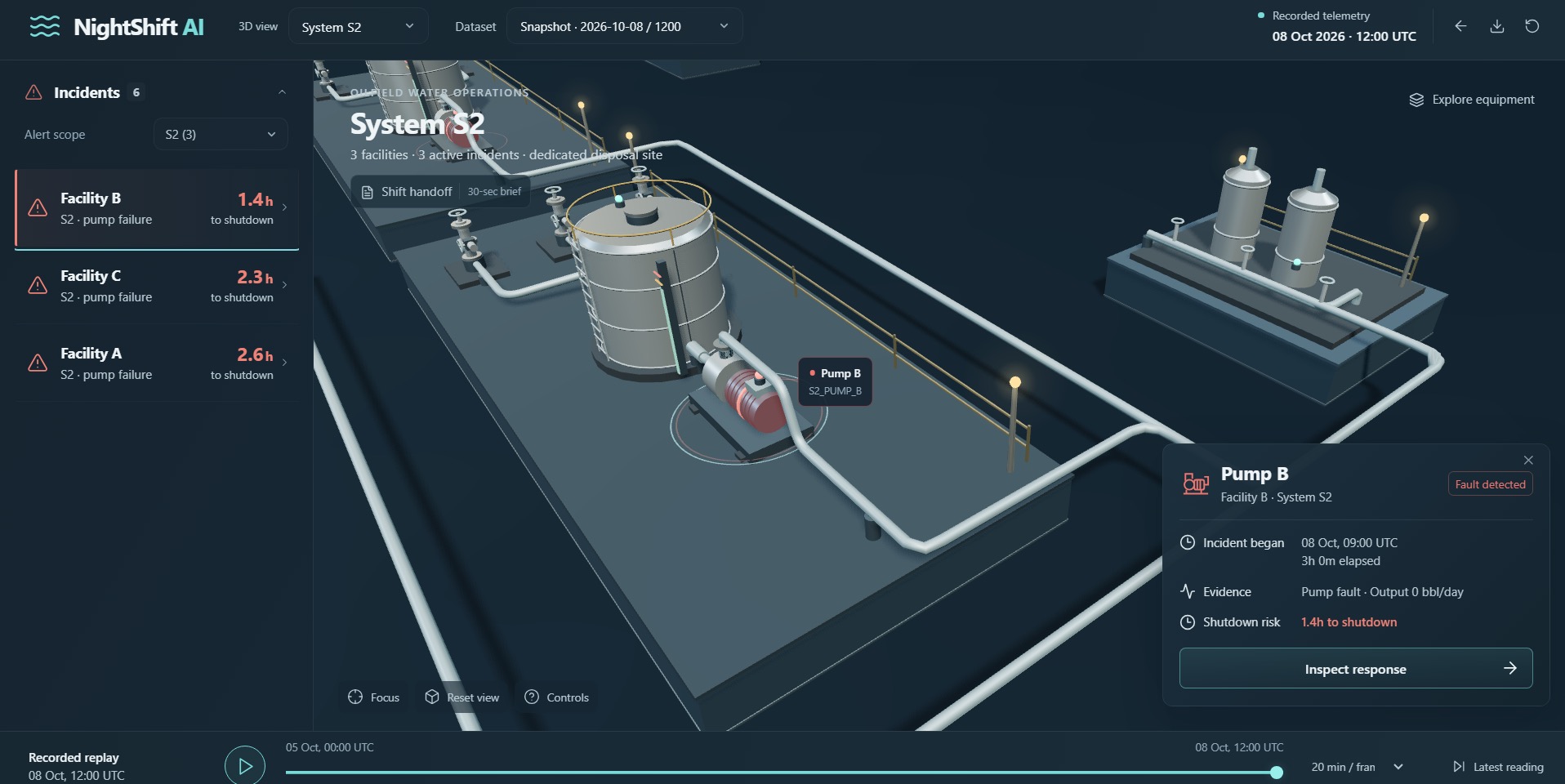
NightShift AI is an AI-powered oilfield operations command center that detects equipment failures, predicts potential shutdowns, and recommends cost-effective corrective actions.
The platform analyzes oilfield sensor data to identify pipeline leaks, pump degradation, and complete pump failures. It then evaluates possible responses, such as dispatching emergency trucks, temporarily shutting down selected wells, or combining multiple actions.
Using NVIDIA Nemotron and mathematical optimization, NightShift AI helps operators understand:
- What equipment has failed and why.
- How much time remains before a potential shutdown.
- Which corrective action minimizes operational costs.
- How limited emergency resources should be allocated.
- How alternative decisions affect production and expenses.
For example, one EOG reference scenario shows that dispatching an emergency truck costs approximately $905, compared with $5,016 in losses from allowing an automatic shutdown, representing a potential 82% reduction in costs.
How we built it
NightShift AI was designed using a combination of artificial intelligence, data analytics, mathematical optimization, and web development.
- Python and FastAPI: Backend architecture for processing oilfield data, detecting failures, and calculating operational responses.
- Next.js, React, and TypeScript: Responsive web dashboard for visualizing equipment conditions, alerts, recommendations, and estimated costs.
- NVIDIA Nemotron: AI orchestration for investigating incidents, coordinating analytical tools, and explaining operational recommendations.
- Mathematical optimization: Evaluating trucking expenses, production losses, equipment limitations, and shared resource availability.
- EOG Resources datasets: Synthetic equipment networks, operational constraints, and time-series sensor readings.
Our system follows a structured workflow: Data → Detection → AI Analysis → Optimization → Verification → Operator Recommendation.
Rather than relying on AI to generate numerical decisions independently, our approach combines AI reasoning with deterministic calculations and simulation to improve reliability.
Challenges we ran into
One of our biggest challenges was translating complex oilfield operations into a decision-making system that could accurately account for multiple variables.
A pump failure can affect tank capacity, production revenue, repair timelines, and emergency truck availability. Finding the lowest-cost response requires considering these factors simultaneously rather than evaluating each facility independently.
Another challenge was integrating AI with mathematical optimization. We needed an architecture where NVIDIA Nemotron could interpret operational problems and explain recommendations without inventing numerical results.
We also had to consider how the system could adapt to unfamiliar equipment networks and incidents without relying on hardcoded answers.
Accomplishments that we're proud of
We're proud of developing the concept and architecture for an AI-powered decision-support platform that addresses a real operational challenge in the energy industry.
Our key accomplishments include:
- Designing an integrated approach combining equipment monitoring, AI orchestration, and cost optimization.
- Establishing a framework for comparing operational responses based on financial impact.
- Incorporating verification and simulation into the decision-making process.
- Focusing on explainable recommendations rather than black-box AI outputs.
- Designing the system to accommodate different oilfield networks and operational conditions.
Most importantly, NightShift AI demonstrates how AI can support not just identifying operational problems, but determining what action should be taken and why.
What we learned
Throughout this project, we gained a deeper understanding of how data analytics, artificial intelligence, and optimization can work together to solve real-world business problems.
We learned that detecting a problem does not automatically identify the best solution. Effective operational decisions require balancing financial costs, resource limitations, and real-world constraints.
We also explored how AI agents can coordinate specialized analytical tools while deterministic models handle calculations requiring precision and reliability.
This experience strengthened our understanding of how technology can bridge the gap between complex operational data and actionable business decisions.
What's next for NightShift AI
Our next goal is to further develop NightShift AI into a more comprehensive industrial operations platform.
Future improvements include integrating live sensor streams, expanding predictive maintenance capabilities, improving optimization across larger equipment networks, and developing additional interactive simulations.
We also envision applying the same decision-support approach beyond oilfields to industries such as manufacturing, logistics, and energy infrastructure.
Ultimately, our vision is to make NightShift AI a platform that helps industrial operators detect failures earlier, respond more intelligently, and minimize the financial impact of unexpected disruptions.
Built With
- dataset
- eog
- fastapi
- mathematical
- nemotron
- next.js
- nvidia
- optimization
- python
- react
- typescript


