Inspiration
AI coding assistants now write a huge share of production code — and they reproduce the same injection flaws, hardcoded secrets, and broken auth checks security teams have fought for years. At the same time, customers are targeted by phishing and scam messages the moment a product ships clean code. We realized these are the same underlying problem: a scanner trained once and shipped goes stale the moment a new CVE or phishing campaign appears. So instead of building a static checklist, we built a pipeline that keeps reading the same public threat intelligence security researchers already read — continuously — and never enforces anything without a human saying yes first.
What it does
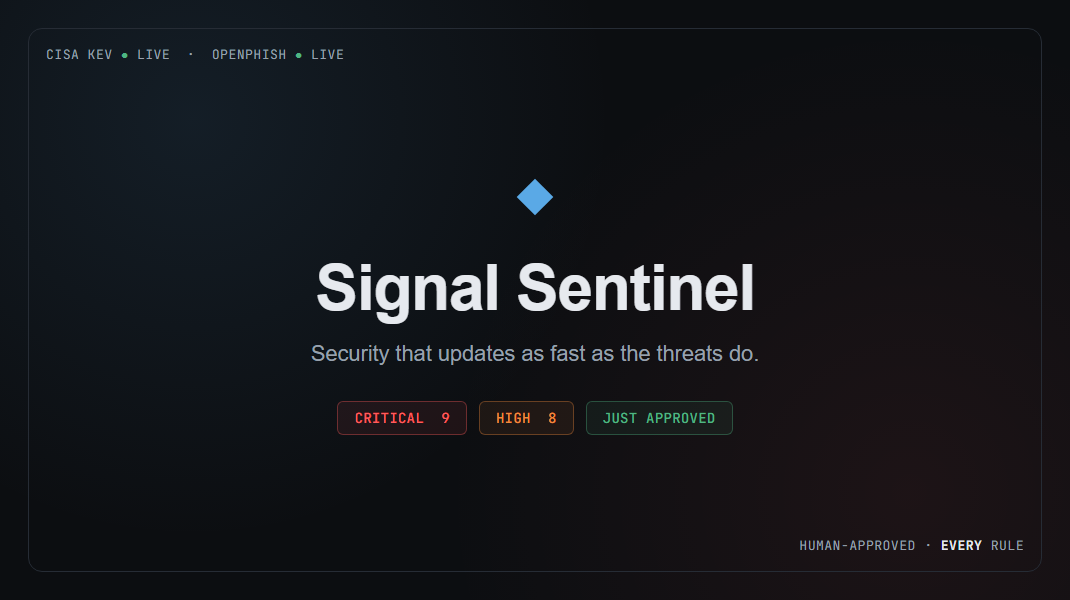
Signal Sentinel is a self-updating security pipeline with two enforcement layers sharing one brain. An agent continuously reads two live public feeds — the CISA Known Exploited Vulnerabilities catalog for code CVEs, and the OpenPhish community feed for active phishing domains — and drafts detection rules from them. Nothing is enforced automatically: a security analyst reviews and approves or rejects every drafted rule through a deliberate two-step confirm. Once approved, a rule is enforced in two places at once: the Dev/CI pipeline flags matching vulnerable code before it ships (file, line, severity, and a one-click verified fix), and Customer Shield — a link firewall — blocks malicious links in incoming customer messages. The link check reads only the destination domain, never the message content, so it works identically across SMS, email, or encrypted chat.
How we built it
Flask backend with JSON-file persistence (no database, by design, so every piece of state is inspectable). A regex-based static scanner flags known vulnerability patterns with severity levels across two intentionally vulnerable sample repos. Two live-sync agents — one polling CISA KEV, one polling OpenPhish — dedupe against existing rules and draft pending candidates, falling back to the last local cache if a feed is unreachable. The analyst console (New Vulnerabilities, Check Repository, Threat Intel, Customer Shield) and public landing page are vanilla HTML/CSS/JS on a small design-token system — a near-black instrument-panel look, one accent color, severity always paired with a text label — so every number on screen is real DOM state, not a mockup.
Challenges we ran into
The biggest challenge was philosophical, not technical: an early version of the customer-protection side needed to read message content to score it, which breaks down for encrypted or private channels and raises real privacy concerns on its own. We rebuilt it as a domain-only firewall — it never reads the message body, only a link’s destination — which turned out to be both more private and more broadly useful, since it works the same way regardless of channel. Making the live-feed sync behave politely (cache fallback, dedup, never auto-enforcing a draft) took a few iterations, and even producing our demo video hit a real FFmpeg crash mid-render that we had to diagnose and route around live.
Accomplishments that we’re proud of
Both halves of the system run on the same two real, live public feeds — not canned demo data. CISA KEV sync has read 1,769 real CVEs; OpenPhish has read hundreds of real reported phishing URLs, and together they’ve drafted 37 live threat-intel entries, 17 of which are currently enforced. Rules drafted from them produce real, verified one-click fixes that re-run cleanly against the scanner. Most of all, every single rule — code or domain — requires a human decision before it does anything, by design.
What we learned
Connecting to a live feed is the easy 20%; the hard 80% is designing what happens when the feed is unreachable, when an analyst rejects a draft, or when a message has no link at all — the empty and error states end up mattering more to trust than the happy path does. We also learned privacy constraints are a feature, not a limitation: restricting Customer Shield to domain-only checks made it simpler, faster to reason about, and more broadly applicable than a content-reading approach would ever have been.
