-
-
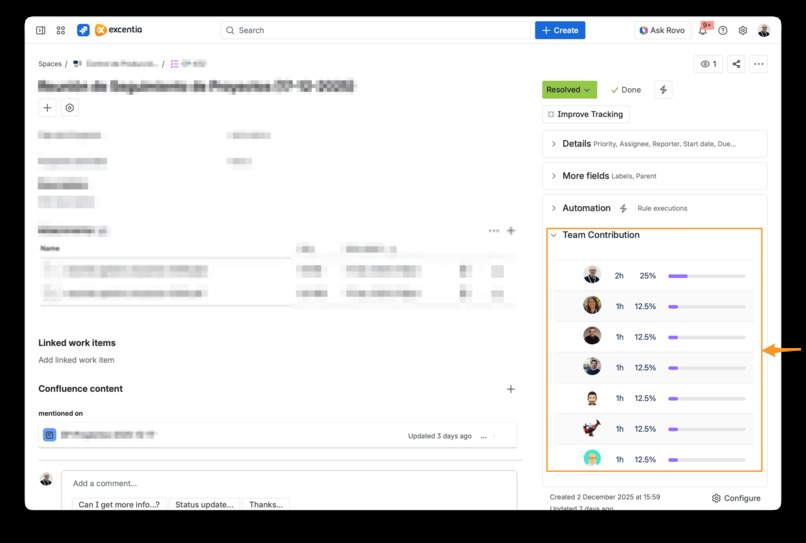
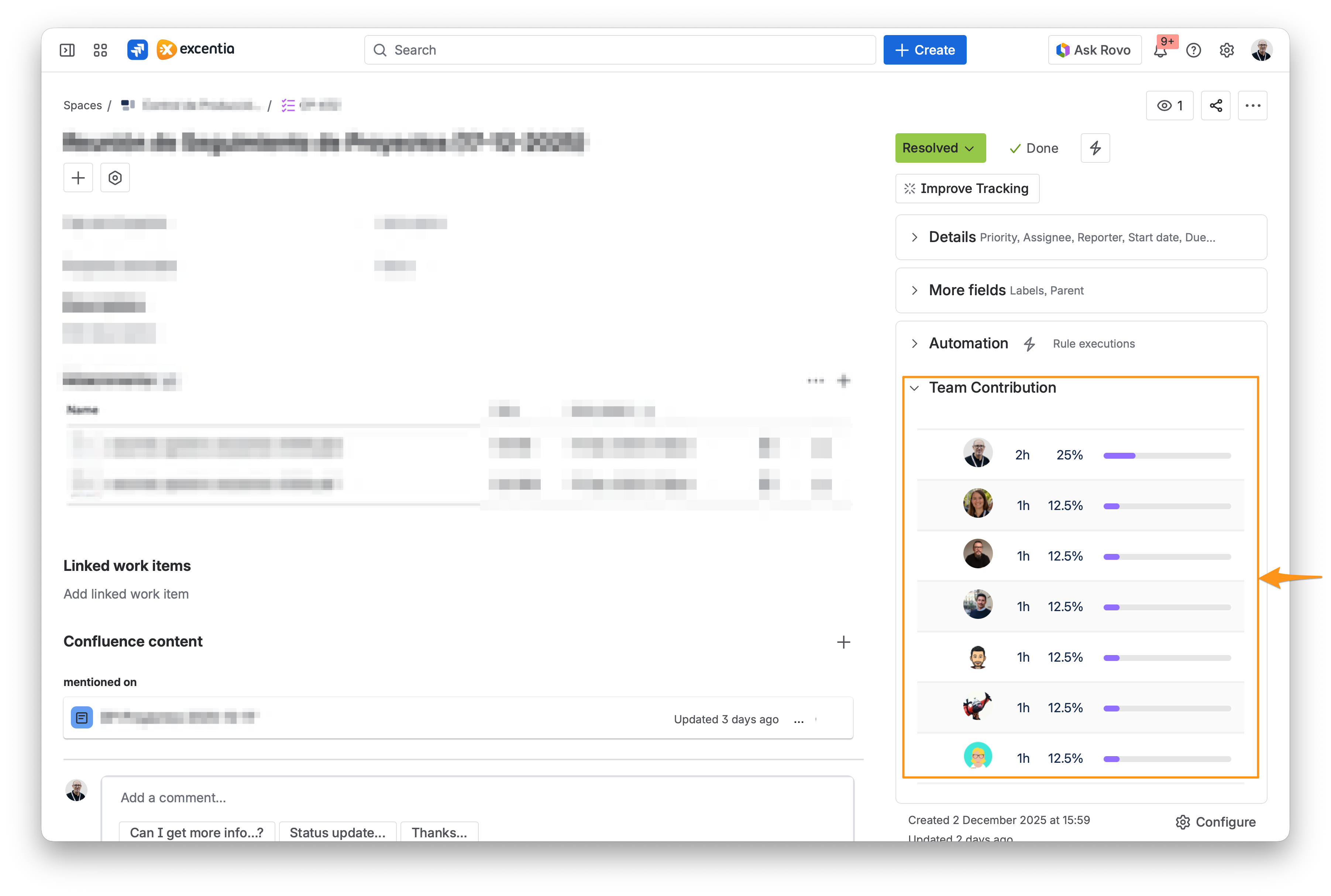
Easy to know the team contribution to an issue
-
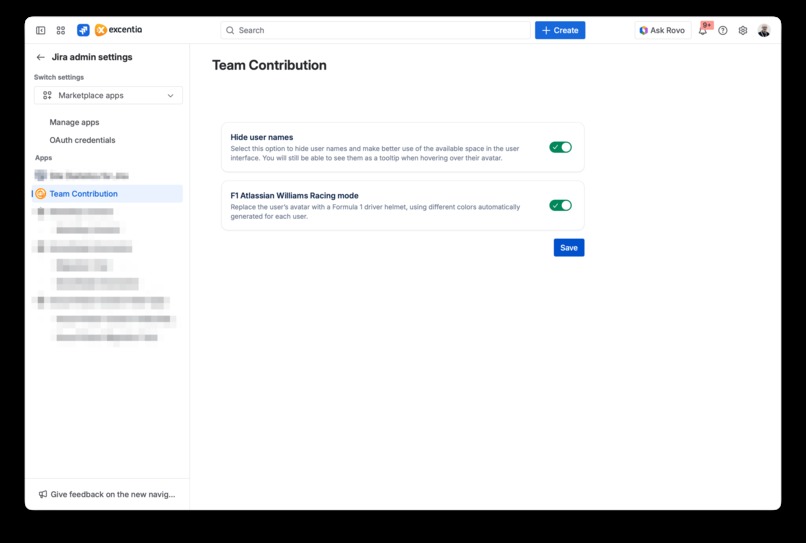
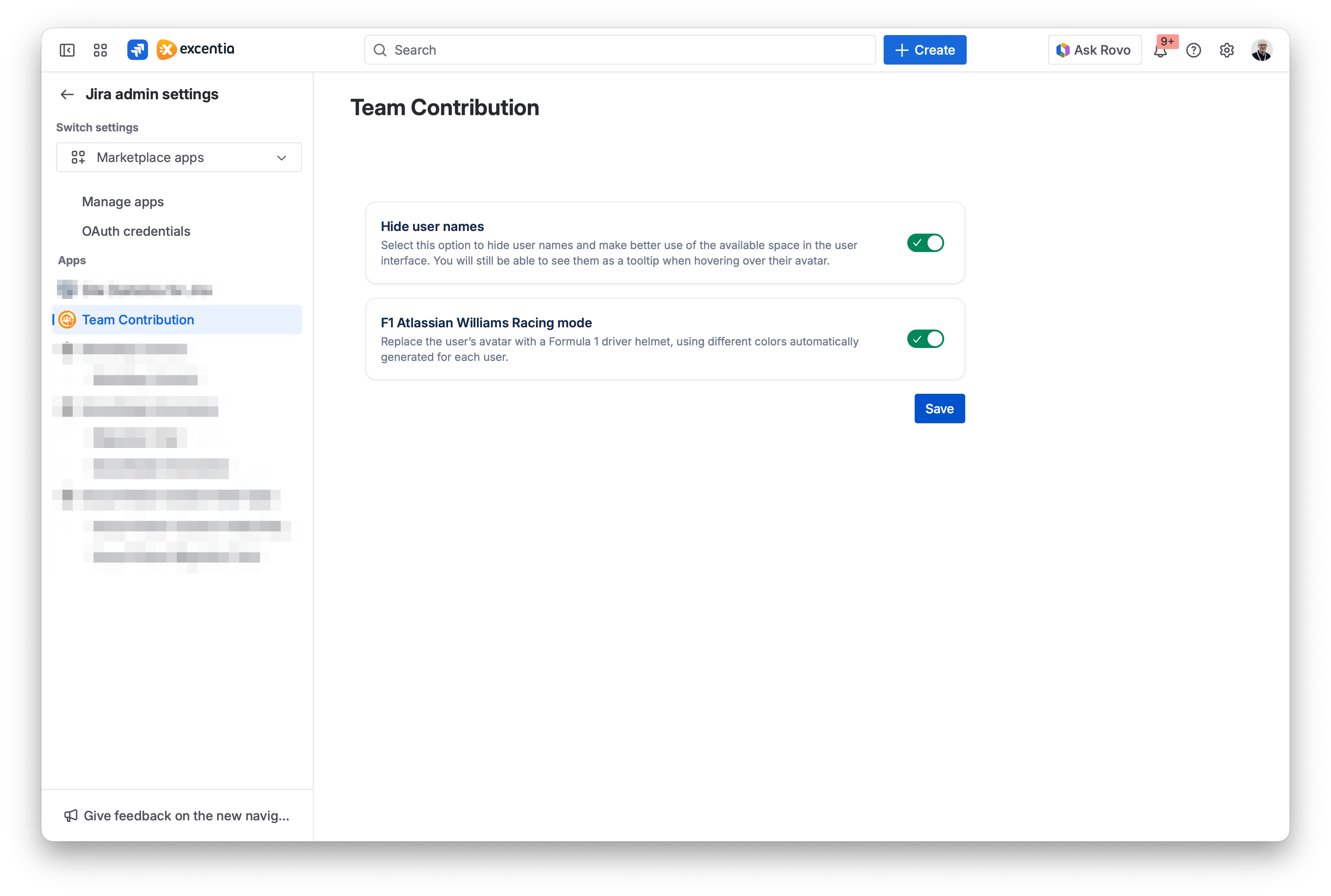
Global Settings
-
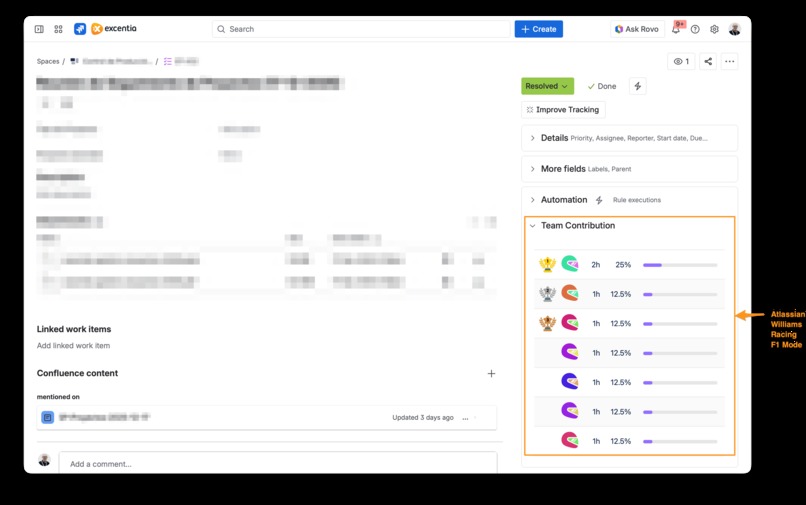
Atlassian Williams Racing Edition F1 mode
-
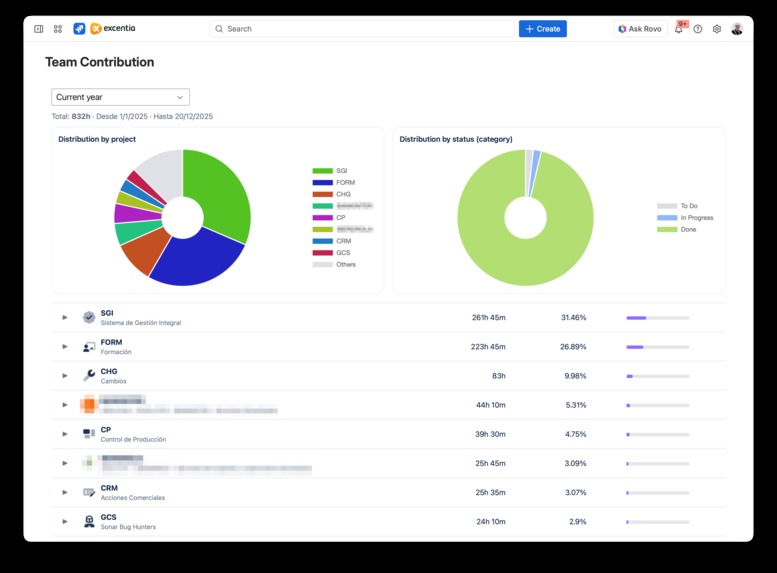
Global panel to know your personal contribution for projects
-
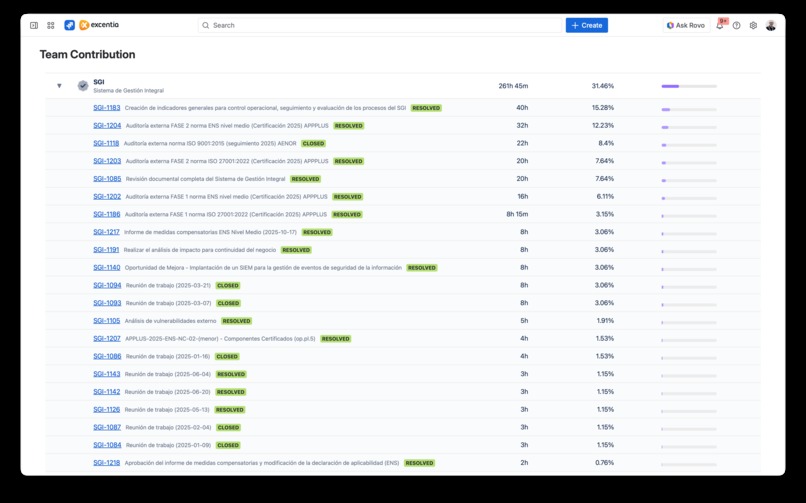
Browse your insights to project contribution
-
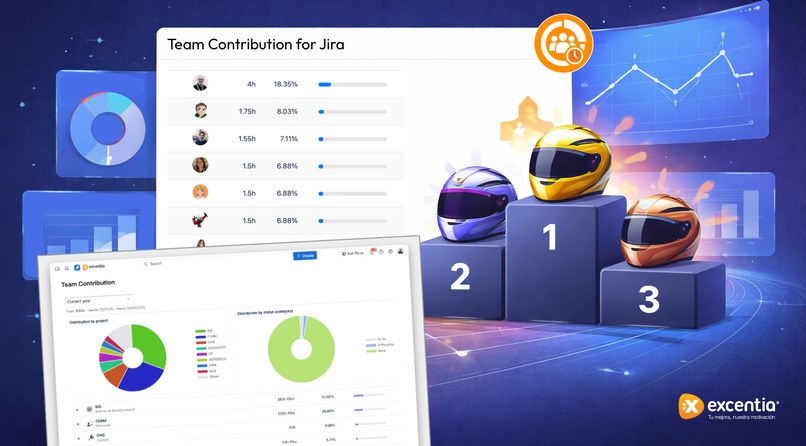
Product portrait
Inspiration
Modern software is built by teams, not individuals. Yet, many of the tools we use still tell a very individual story.
In Jira, work is often represented by a single assignee and a total amount of time. Behind that simplicity, collaboration disappears. Discussions, reviews, help from teammates, and shared ownership rarely leave a visible trace.
We believe that making teamwork visible matters.
Team Contribution for Jira was created to acknowledge the collective nature of work. To highlight participation, not just assignment. To recognize effort, not just outcomes. And to give teams a clearer, fairer picture of how work actually happens over time.
Because transparency builds trust. And trust builds better teams.
What it does
Team Contribution for Jira makes individual effort visible—both at the issue level and across projects.
Issue-level contribution
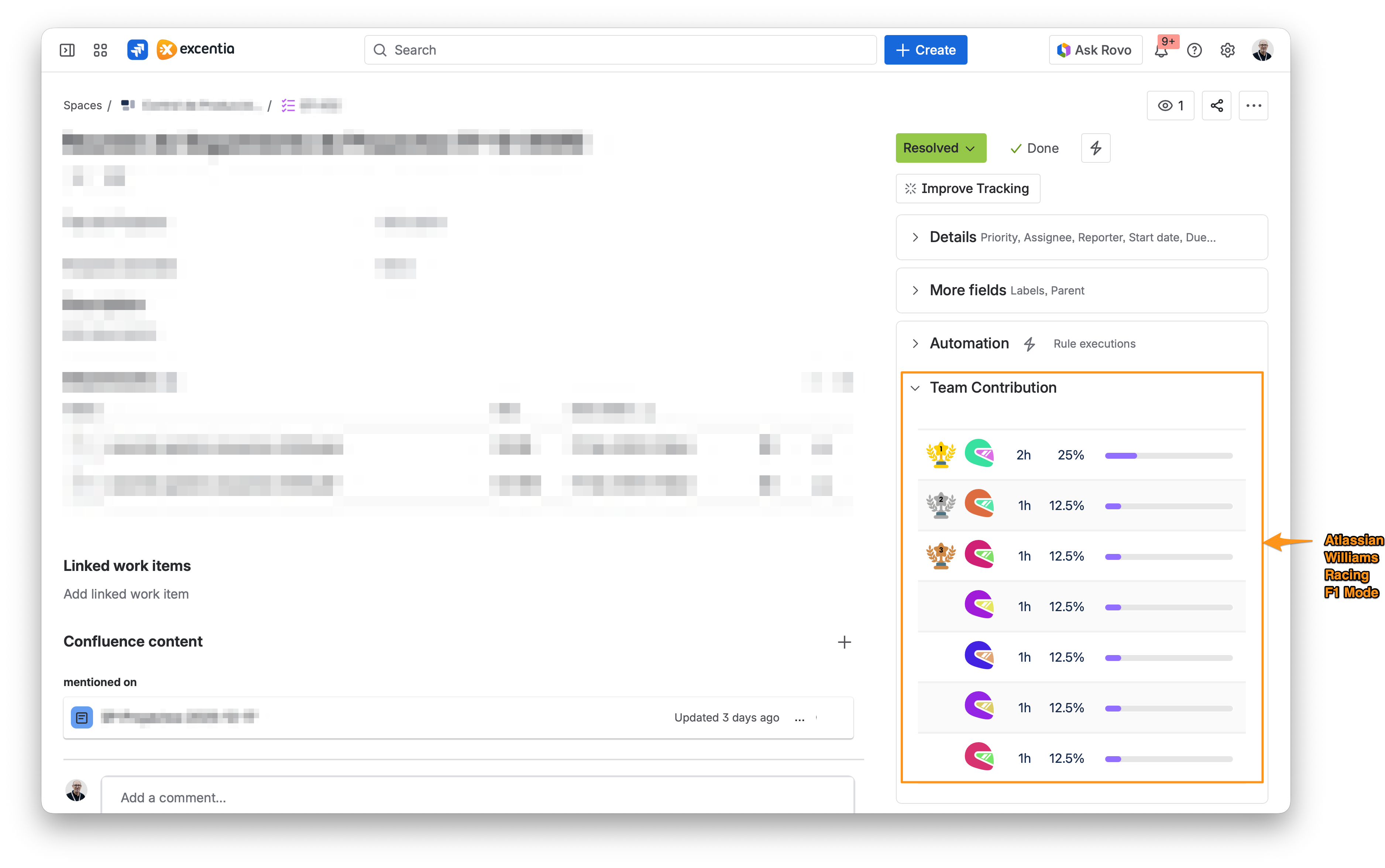
Inside the Jira issue view, the app shows how each contributor participated in the work:
- Time spent by every individual involved in the issue
- Percentage of the total effort, as an easy way to understand contribution
- Contributor avatars displayed next to their data for instant visibility
Atlassian Williams Racing Mode (optional)
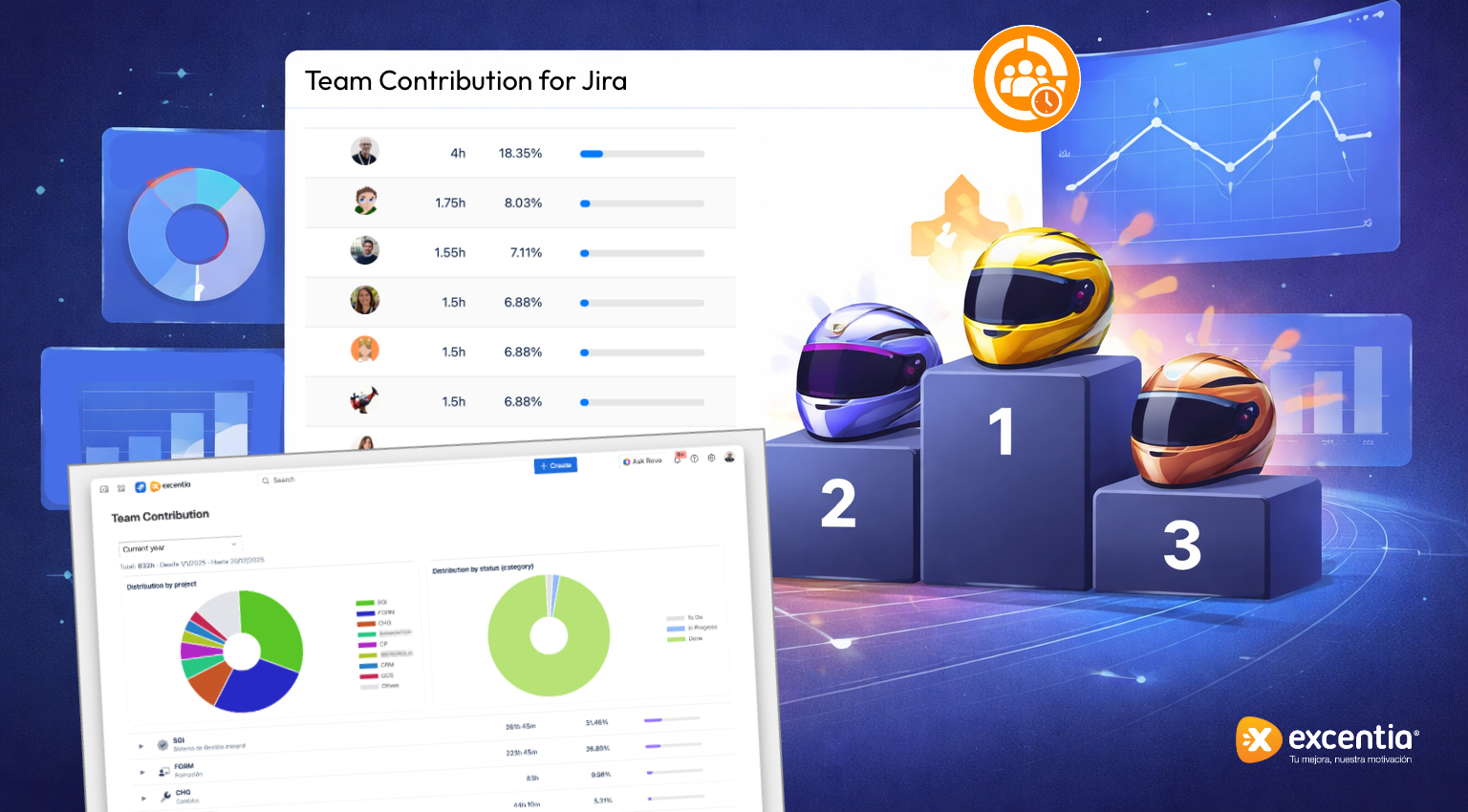
For teams that want a more playful touch, F1 Mode replaces user avatars with Formula 1 helmets:
- Contributors are ranked by effort
- The top three contributors are highlighted as a podium
Personal contribution overview
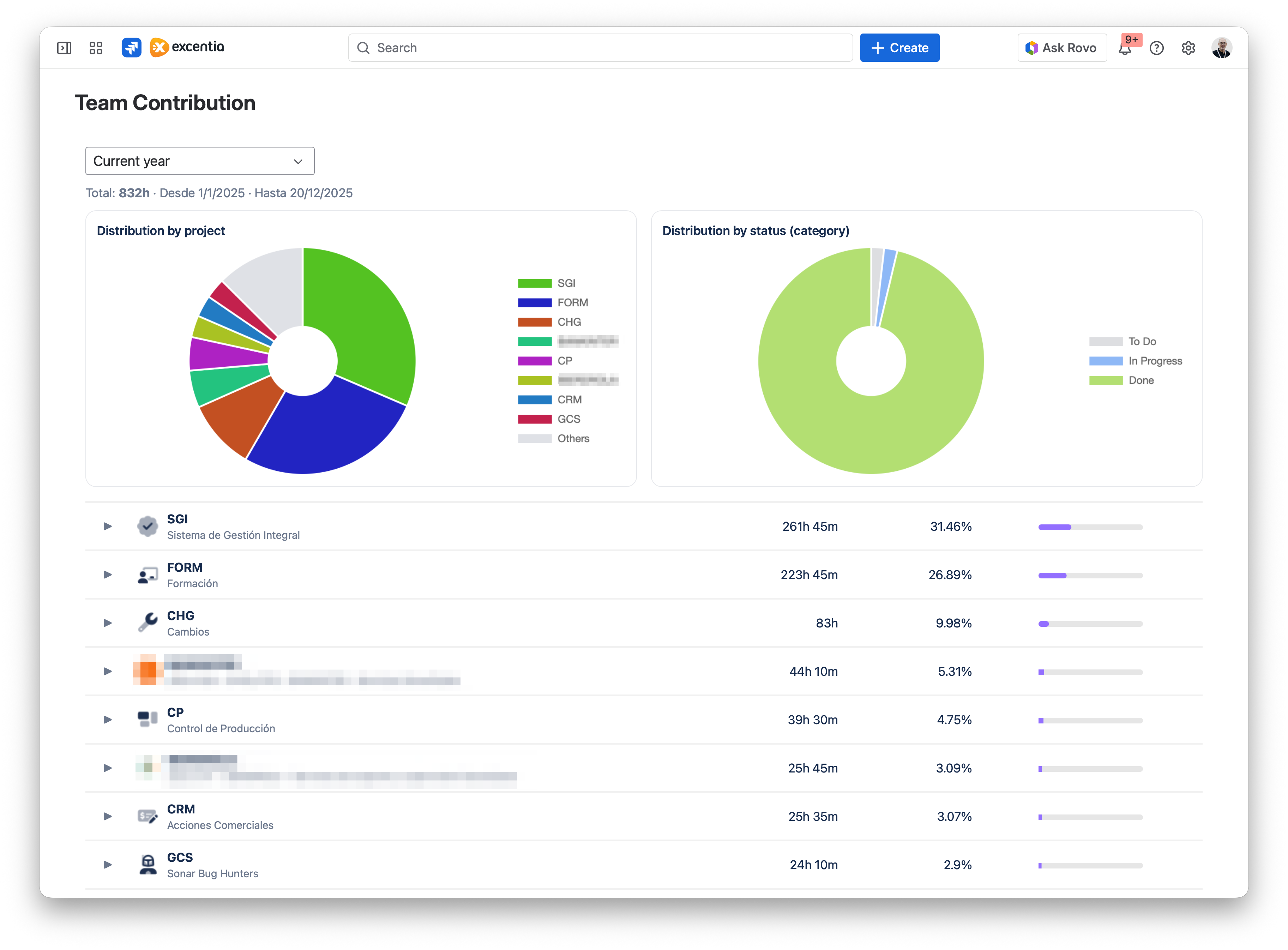
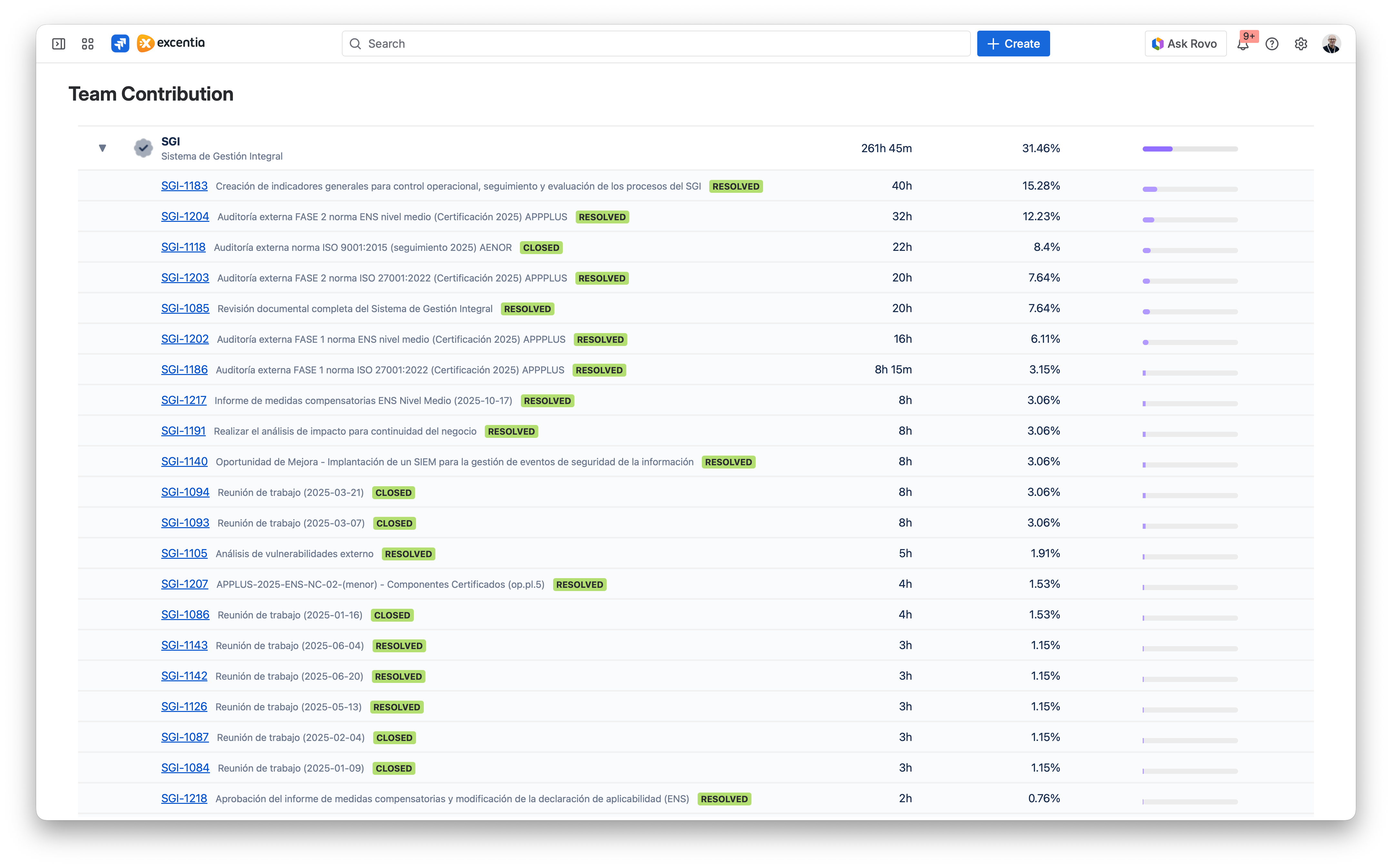
At a global level, the app gives each logged-in user a clear view of their own impact:
- Individual contribution across projects
- Time-based insights (last week, last month, last year, or custom periods)
- Projects where the user contributed the most
- Issue statuses where time was logged
This helps individuals and teams understand where effort is really going—over time and across the organization.
How we built it
Team Contribution for Jira is built as a native Forge app, designed to integrate seamlessly with Jira and feel like a natural extension of the platform.
We use Forge with Custom UI, combining Jira REST APIs to retrieve contribution data and present it in a clear, focused interface. No external systems. No unnecessary complexity. Just Jira data, used properly.
From the beginning, we followed a simple principle: KISS — Keep It Small and Simple.
Instead of adding layers of abstraction or overengineering the solution, we focused on doing one thing well: making contribution visible. The result is a lightweight app with a minimal codebase that delivers exceptional value.
Few features. Few screens. Little code. But meaningful insights, real transparency, and immediate usefulness.
Because sometimes, the most powerful tools are the simplest ones.
Challenges we ran into
One of the main challenges we faced was efficiently retrieving worklog data from Jira.
At the moment, contribution data is obtained by running JQL queries and then processing the related worklogs. This approach works well, but it becomes more demanding as the number of issues grows—especially in project-level views, where the volume of data is significantly higher.
Performance is a key concern when dealing with historical data and large projects.
Looking ahead, one of our next steps is to introduce caching mechanisms for closed issues. Since their data no longer changes, caching will allow us to dramatically improve response times while keeping the app lightweight and responsive.
This balance between accuracy, performance, and simplicity is an ongoing engineering effort—and one we’re continuously refining.
Accomplishments that we're proud of
We’re especially proud of how fast and intuitive the issue-level activity panel is.
Being able to instantly see who contributed to an issue—and how much—feels like something that should exist in Jira by default. With Team Contribution for Jira, that gap is finally covered, turning hidden collaboration into visible insight without slowing teams down.
We’re also proud of making contribution fun without losing meaning.
The Formula 1 mode, with racing helmets and a podium for the top three contributors, adds a playful layer that teams genuinely enjoy. It brings energy and recognition into everyday work, proving that transparency and engagement can go hand in hand.
Simple ideas, well executed—and used every day.
What we learned
Building Team Contribution for Jira has been a strong learning journey.
We learned how to design and deliver a fully native Forge app, embracing the platform’s constraints and strengths from day one. Along the way, we gained deep knowledge of Jira’s worklog APIs, issue data models, and JQL, understanding not just how to access the data, but how to make it meaningful.
We also learned how to build experiences at different levels:
- A focused panel embedded directly in the issue view
- A broader global app view that helps users understand their contribution across projects and time
Most importantly, we learned that simplicity is hard—but worth it.
There is still a lot of work ahead, and plenty to improve. But this foundation gives us confidence to keep iterating, learning, and building something better with every release.
What's next for Team Contribution for Jira
Our next step is to extend contribution insights from individuals and issues to the project level.
We’re working on a project contribution panel that shows how effort is distributed across the entire team within a project. This will complement Jira’s existing project summary by adding a missing dimension: who actually contributed time, where, and how much.
With this view, teams and project leads will be able to:
- Understand who dedicated the most effort to a project
- Identify the largest and most time-consuming issues
- See how work and collaboration evolved throughout the project
This will close the loop between issues, people, and projects—helping teams move from tracking work to truly understanding effort.
And as always, we’ll keep it simple, fast, and focused on real value.


Log in or sign up for Devpost to join the conversation.