-
Main Page
-
-
-

Operation Firewall: Building Trust in Real-Time Financial Systems
🚨 Inspiration
Modern financial systems move at incredible speed, but fraud detection often lags behind. Banks lose billions each year because suspicious behavior is identified too late, while overly aggressive filters block legitimate users.
We were inspired by a simple question:
What if fraud detection worked like a cybersecurity SOC — real-time, explainable, and collaborative with AI?
We wanted to build a system that not only flags suspicious activity instantly but also explains why it’s risky and how confident the decision is.
🎯 What We Built
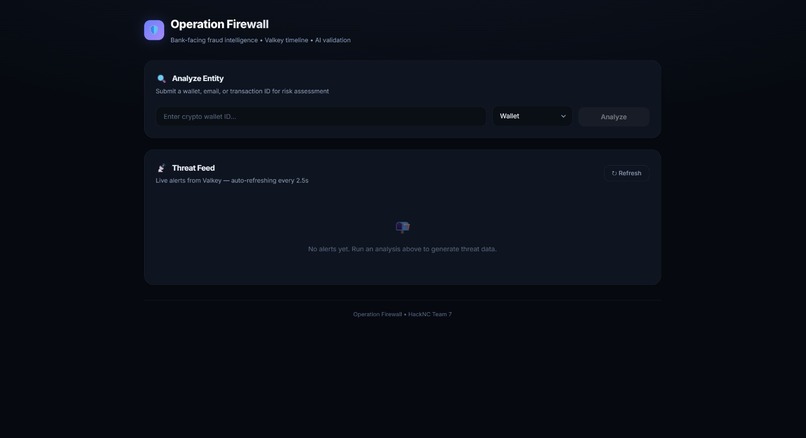
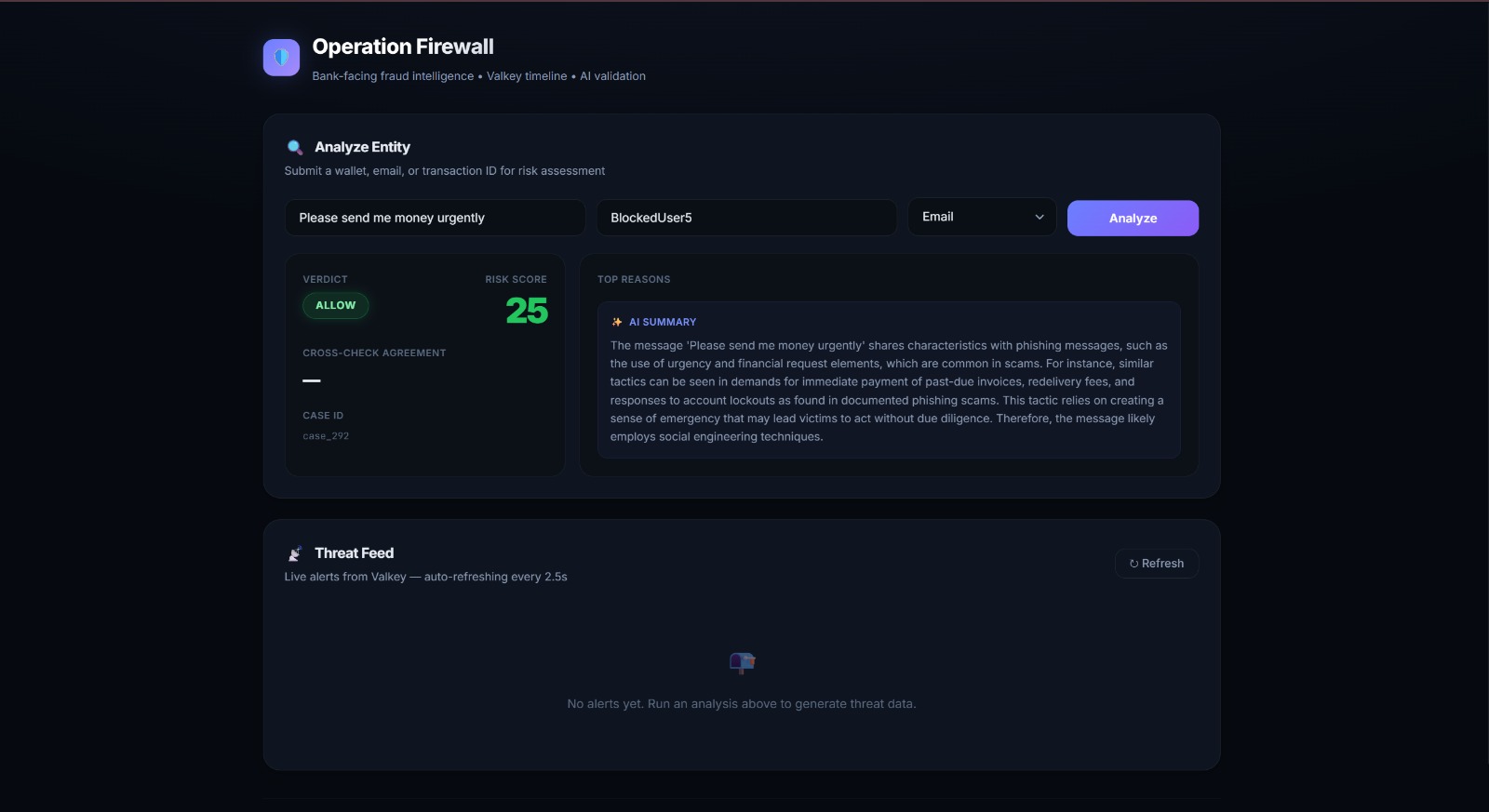
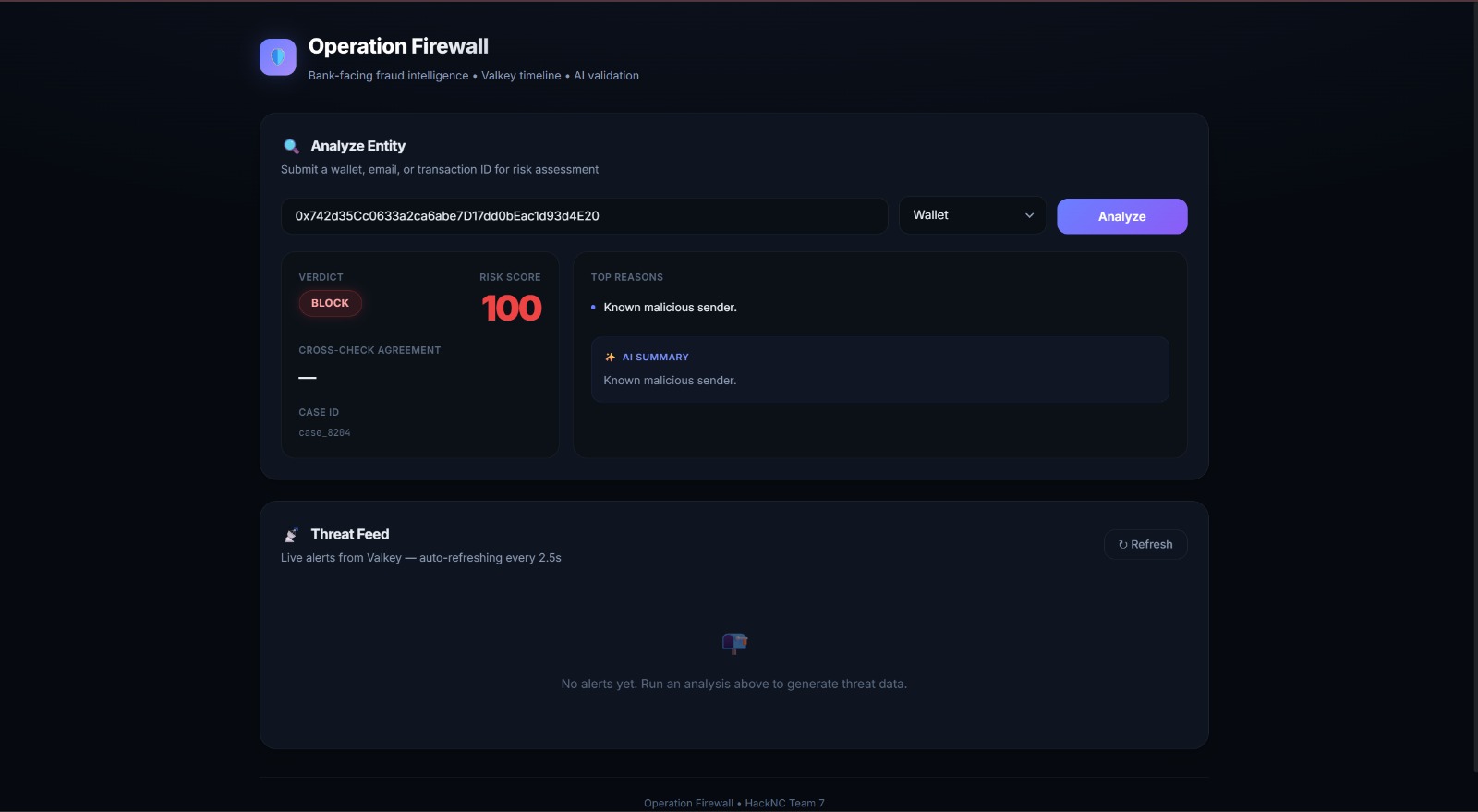
Operation Firewall is a real-time fraud intelligence platform designed for banks and fintechs.
It:
- Streams and evaluates transaction signals in real time
- Detects behavioral anomalies and risk patterns
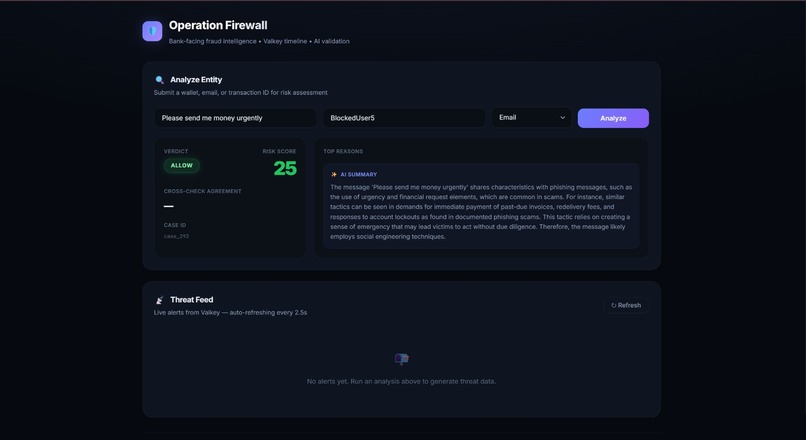
- Uses AI to generate explainable risk assessments
- Cross-validates decisions to reduce false positives
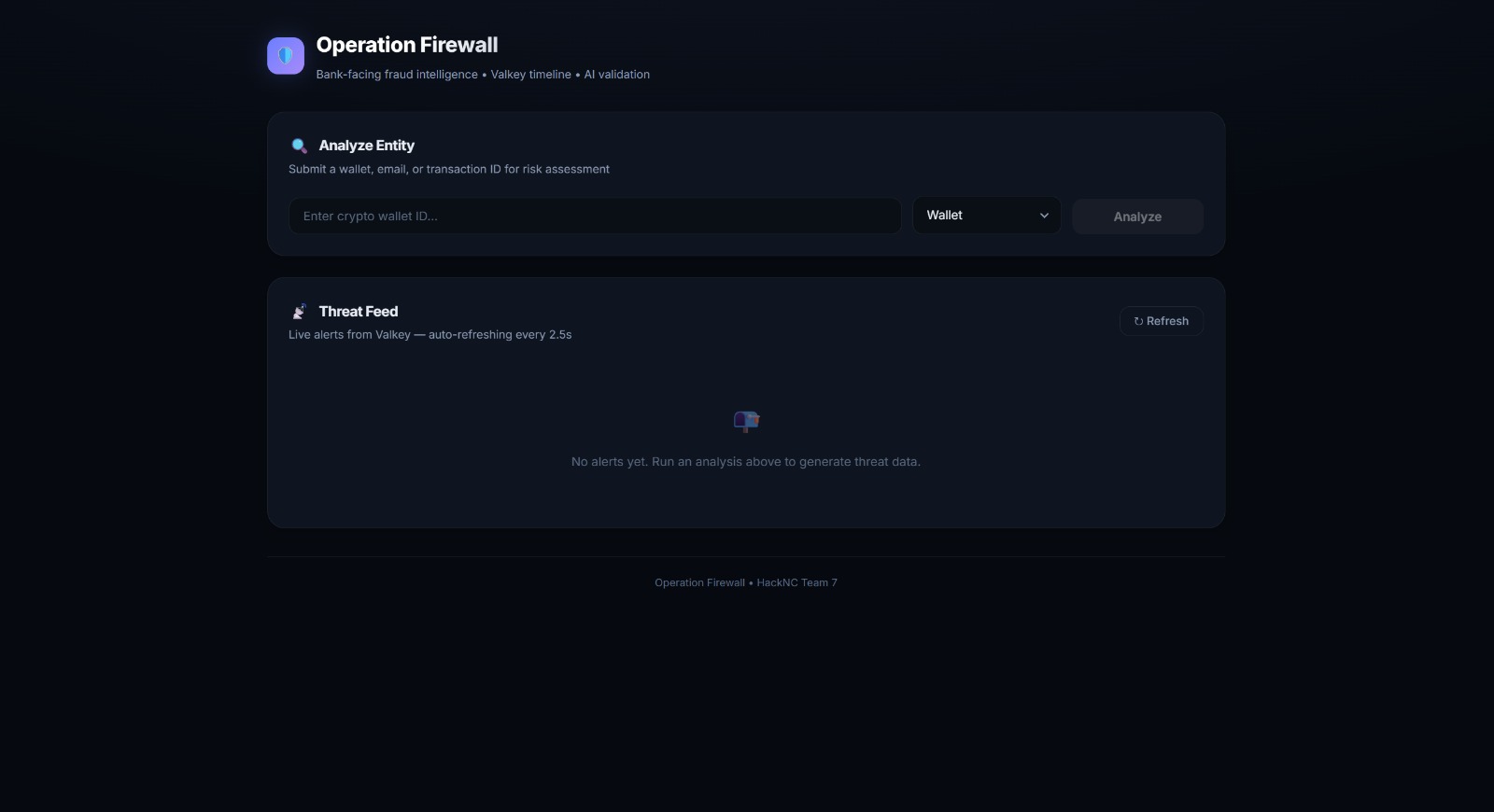
- Maintains a live threat feed for fraud analysts
Instead of a black-box model, analysts receive evidence-based insights they can trust.
🧠 How It Works
Our system combines real-time signal processing with AI reasoning:
Real-Time Signals (Valkey)
- Velocity spikes
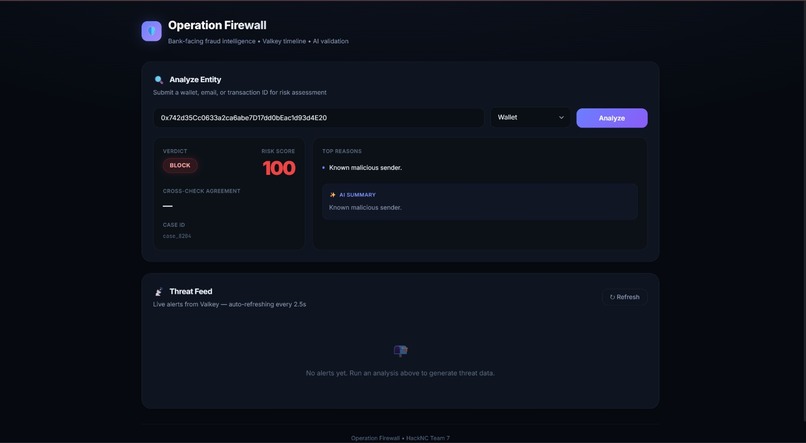
- Known bad actor detection
- Behavioral anomalies
AI Risk Analysis (Backboard RAG)
- Retrieves known fraud patterns
- References internal policy & past cases
- Generates explainable reports
Cross-Validation (Gemini)
- Verifies reasoning
- Provides confidence agreement
Fraud Dashboard
- Risk verdict & score
- AI reasoning
- Live threat timeline
🛠️ How We Built It
Backend
- FastAPI → API and orchestration
- Valkey → real-time caching & alert timeline
- RAG (Backboard) → threat intelligence retrieval
- Gemini → model cross-validation
Frontend
- React (Vite) → fraud analyst dashboard
- Live threat feed
- Explainable risk visualization
Infrastructure
- Dockerized services
- Real-time polling & event caching
- Proxy setup for seamless API communication
📚 What We Learned
1️⃣ Real-time systems require different thinking
Latency matters. In-memory stores and streaming signals are essential.
2️⃣ Explainability is critical in financial AI
Fraud analysts need evidence, not just scores.
3️⃣ Multi-model validation builds trust
Confidence scoring and agreement checks reduce AI risk.
4️⃣ UX matters in security tools
A clear threat feed and risk visualization drastically improve usability.
⚠️ Challenges We Faced
🔹 Designing for real-time detection
Balancing speed with meaningful signals required careful caching and rate detection logic.
🔹 Avoiding “black box AI”
We needed explainability, so we integrated retrieval-based reasoning instead of raw model output.
🔹 Handling noisy fraud signals
Not all anomalies equal fraud. We tuned thresholds to minimize false positives.
🔹 Frontend clarity vs complexity
Security dashboards can overwhelm users — we focused on simplicity and clarity.
🔹 Coordination between real-time data & AI reasoning
Ensuring signals, memory, and AI reports aligned required structured contracts between services.
🚀 Future Directions
- Cross-bank fraud intelligence sharing
- Customer-facing fraud prevention tools
- AI drift detection & governance dashboards
- Graph-based fraud network detection
🏁 Final Thoughts
Operation Firewall reimagines fraud detection as a real-time intelligence system, combining speed, explainability, and AI validation.
Because in financial systems, trust is the most valuable currency.

Log in or sign up for Devpost to join the conversation.