-
-
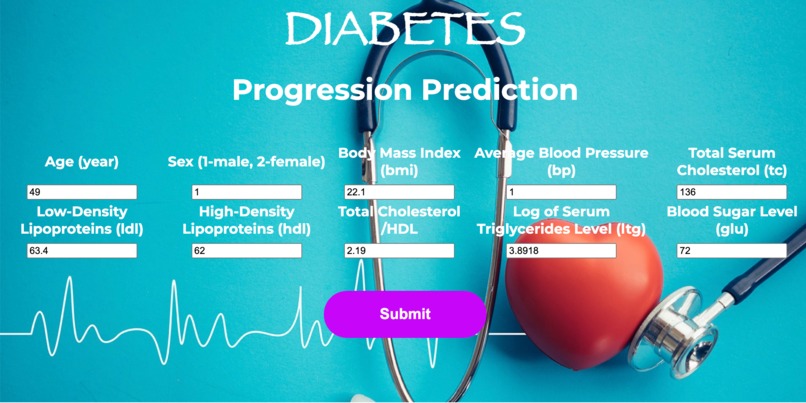
Diabetes Progression Prediction

Inspiration
There has long been the trust crisis in human-machine collaboration, where humans struggle with relying on machine decisions because the outputs are traditional a single point estimate. This problem is more severe in high-stake situations such as medical predictions. When human life is involved, decision-making needs to be ultra-careful. Therefore, some measurements of how confident the model is on each of its predictions are needed.
What it does
In this project, we worked with Diabetes Progression Prediction where we communicates with our users a measurement of how much their Diabetes will progress over the course of a year after they input 10 baseline indicators about themselves on our webpage. This project solves the trust-crisis in healthcare by providing two distinct measures of model's confidence in each of its predictions: aleatoric risk estimates and epistemic uncertainty estimates. They provide distinct interpretation. The former accounts for the inherent random chances in the nature, the latter refers to discrepancy between expectation and result due to simple limitation of knowledges. This additional information on uncertainty turns a point estimate into a distribution with variance, giving healthcare practitioners more information on how much one can trust a given prediction by the model.
How we built it
We used PyTorch and Scikit-learn to build the machine learning algorithms and program the uncertainty estimation methods. We used html, css, and flask to build the front-end and connect it to our algorithm.
Challenges we ran into
Grind through the machine learning part. There were all kinds of exotic bugs.
Accomplishments that we're proud of
We are proud that we run a systematic search over existing benchmark aleatoric, epistemic uncertainty estimation methods to locate the best combination for this Diabetes problem.
What we learned
We are experienced in Machine Learning and Algorithms but not in the front-end development. We learned basic html, css, and flask on spot, so we are really proud of that.
What's next for Team #5
We wish to continue expand this interface to general problems to provide general uncertainty estimation service so that we can make more model-solutions more explainable and trustworthy.


Log in or sign up for Devpost to join the conversation.